StatCounter

Wednesday, March 12, 2025

Bill Bonner, "Now Or Never"

Malcolm X
"Now Or Never"
by Bill Bonner

Baltimore, Maryland - "We’re talking about betrayals. Disappointment. Faithlessness. Markets Insider: "Another red day on Wall Street: Trump's latest tariff threats bring the market-cap wipeout to $5 trillion." How do investors feel? They expected a big boom. They thought they’d get rich. Disappointment seems to be spreading. Polls of CEOs and consumers show deepening pessimism. AP: "Inflation, looming trade war take a toll as confidence of the U.S. consumer tumbles." They were looking for a Golden Age…but the gold seems to be turning into base metal.

Yesterday brought more leaden news. CNN: "President Donald Trump backed down from an extraordinary trade war escalation Tuesday that had threatened a massive surge in tariffs on Canadian steel and aluminum and new tariffs on Canadian electricity. In turn, Ontario paused surcharges on electricity to US customers. After the back-and-forth tariff threats that sent markets sharply lower for a second day Tuesday, US Commerce Secretary Howard Lutnick, Canada’s Minister of Finance Dominic LeBlanc and Ontario Premier Doug Ford said they would meet Thursday to renegotiate the free trade treaty known as the USMCA."

What are Canadians supposed to think? Will this next round of talks settle the issue? Maybe. But once betrayed, they may be skeptical that they can trust the giant to their south. The Trump team is making a big mistake, says Charles C.W. Cooke at National Review. Trump spends his time and attention on distractions that don’t matter to the people who elected him. Greenland, Canada as 51st state, the Panama Canal, Trump Gaza, bad-mouthing reporters, opinion writers and opposing politicians - with so much fur flying, it is easy to lose sight of the real promise of Trump’s win. Mediate:

"President Donald Trump “is at risk of blowing his second term before it has hit the two-month mark,” wrote National Review senior editor Charles C. W. Cooke to kick off his latest column about the president’s hectic last few weeks, criticizing him for getting distracted by “stupid, irrelevant indulgences” instead of the core issues that led voters to re-elect him.

One of those ‘stupid, irrelevant indulgences’ is Trump’s attack on Thomas Massie. He believes Massie has betrayed the MAGA cause. Almost alone among the yes monkeys in Congress, Massie sticks to the core issues. He wonders how any Republican can vote to continue spending money on wasteful and unnecessary programs - including those revealed by Trump’s own DOGE task force. But that’s the charm of betrayal…it can work in both directions.

Massie believes it is he who has been betrayed. He thought the MAGA folks were going to drain the swamp. But there it was in front of him…a Continuing Resolution with more than 1,500 pages of boondoggles…bamboozles…and BS. USA Today: “Unless I get a lobotomy Monday that causes me to forget what I’ve witnessed the past 12 years,” Massie said in a post on X Sunday, “I’ll be a NO on the CR this week. Why would I vote to continue the waste, fraud and abuse DOGE has found,” the Kentucky representative wrote."

The big, beautiful bill also increases the debt level by $2 trillion per year over the next two years - bringing it over $40 trillion before the next mid-terms. It adds $3 trillion to deficits already programmed in the system. And it pulls the rug on Musk and his band of Jacobin cost cutters.

Why keep funding waste, they might ask? And Mr. Trump, why not just tell Congress to come up with a balanced budget…or he won’t sign? Imagine the approval he would get – at least from us! – if he were to announce: “Debt is out of control. I’m drawing the line right here, right now.” He might even recycle the momentous line of Malcolm X, “If not us, who…If not now, when?” As it is, the CR merely continues the spending pattern of the last 25 years. No wonder people feel let down. Stay tuned."

Tuesday, March 11, 2025

"Alert! WW3 Just Restarted! Moscow Is Burning! Kyiv Under Attack! Iran Tells Trump To F%&K Off!"

Full screen recommended.
Canadian Prepper, 3/11/25
"Alert! WW3 Just Restarted! Moscow Is Burning! 
Kyiv Under Attack! Iran Tells Trump To F%&K Off!"
Comments here:

"Depression 2.0 Will Change A Generation, Consumers Can No Longer Bail Out The Economy"

Jeremiah Babe, 3/11/25
"Depression 2.0 Will Change A Generation, 
Consumers Can No Longer Bail Out The Economy"
Comments here:

Musical Interlude: "Beautiful Relaxing Music - Calming Piano & Guitar Music"

Full screen recommended.
Soothing Relaxation,
"Beautiful Relaxing Music - Calming Piano & Guitar Music"
"Beautiful relaxing music by Soothing Relaxation. Enjoy calming piano and
 guitar music composed by Peder B. Helland, set to stunning nature videos."

"A Look to the Heavens"

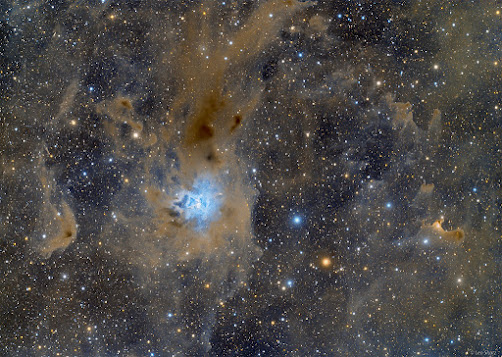
"Spooky shapes seem to haunt this dusty expanse, drifting through the night in the royal constellation Cepheus. Of course, the shapes are cosmic dust clouds visible in dimly reflected starlight. Far from your own neighborhood, they lurk above the plane of the Milky Way at the edge of the Cepheus Flare molecular cloud complex some 1,200 light-years away. 
Over 2 light-years across and brighter than most of the other ghostly apparitions, vdB 141 or Sh2-136 is also known as the Ghost Nebula, seen at the right of the starry field of view. Inside the nebula are the telltale signs of dense cores collapsing in the early stages of star formation. With the eerie hue of dust reflecting bluish light from hot young stars of NGC 7023, the Iris Nebula stands out against the dark just left of center. In the broad telescopic frame, these fertile interstellar dust fields stretch almost seven full moons across the sky."

Chet Raymo, “Yet…”

“Yet…”
by Chet Raymo

“My suspicion is that the universe is not only queerer than we suppose,
but queerer than we can suppose.”
- J. B. S. Haldane

“Legend has it that after reciting his official recantation, kneeling on the floor of the Holy Office in Rome before assembled officials of the Inquisition, Galileo whispered, “And yet it moves.” To save his life, or at least to avoid some dank dungeon and perhaps torture, the old man had publicly denied that he ever believed or taught that the Earth orbits the Sun, rather than the other way around. The public recantation was real enough. Whether Galileo whispered the private qualification we’ll never know. It makes a lovely story. In any case, he was allowed to go back to Florence under house arrest and in the final years of his life invented (I will dare to assert) mathematical physics.

And yet it moves. The Earth goes spinning around the Sun with its sister planets. The Sun whirls with its neighboring stars around the center of the Milky Way Galaxy. The Milky Way drifts with its attendant galaxies toward the Andromeda cluster. The Milky Way Galaxy, the Great Andromeda Galaxy, and their lesser galactic companions, the so-called Local Group, dance somewhere near the outer edge of the Local Supercluster of galaxies. Which are but the tiniest swarm of galaxies in the whole outward-racing shebang.

It moves. Oh, yes, it moves, and Galileo didn’t know the half of it. His inquisitors didn’t know any of it, but they thought they knew all of it. And their descendants still claim infallibility. But let me not beat up on the dogmatists. We should all whisper to ourselves now and then, “And yet, and yet.” Our descendants may be surprised at our own naivety. Wholly new paradigms may be required before we understand the origin of the universe or the mysteries of biological development and consciousness.

Such a little word, “yet.” Maybe the most significant word in our vocabulary.”

"When We Can No Longer Tell the Truth "

"When We Can No Longer Tell the Truth"
by Charles Hugh Smith

"When we can no longer tell the truth because the truth will bring the whole rotten, fragile status quo down in a heap of broken promises and lies, we've reached the perfection of dysfunction. You know the one essential guideline to leadership in a doomed dysfunctional system: when it gets serious, you have to lie. In other words, the status quo's secular goddess is TINA - there is no alternative to lying, because the truth will bring the whole corrupt structure tumbling down.

This core dynamic of dysfunction is scale-invariant, meaning that hiding the truth is the core dynamic in dysfunctional relationships, households, communities, enterprises, cities, corporations, states, alliances, nations and empires: when the truth cannot be told because it threatens the power structure of the status quo, that status quo is doomed.

Lies, half-truths and cover-ups are all manifestations of fatal weakness. What lies, half-truths and cover-ups communicate is: we can no longer fix our real problems, and rather than let this truth out, we must mask it behind lies and phony reassurances.

Truth is power, lies are weakness. All we get now are lies, statistics designed to mislead and phony reassurances that the status quo is stable and permanent. The truth is powerful because it is the core dynamic of solving problems. Lies, gamed statistics and false reassurances are fatal because they doom any sincere efforts to fix what's broken before the system reaches the point of no return. We are already past the point of no return. The expediency of lies has already doomed us.

Honest accounts of hugely successful corporations that implode share one key trait: in every case, managers were pressured to hide the truth from top management, which then hid the truth from investors and clients. is the key dynamic in failed oligarchies as well: if telling the truth gets you sent to Siberia (or worse), then nobody with any instinct for self-preservation will tell the truth. If obscuring the truth saves one's job, then that's what people do. That this dooms the organization is secondary to immediate self-preservation.

A distorted sense of loyalty to the family, community, company, institution, agency or nation furthers lying as the  solution to unsavory problems. Daddy a drunk? Hide the bottle. Church a hotbed of adultery and thieving? Maintain the facade of holiness at all costs. Company products are failing? Put some lipstick on the pig. The statistical truth doesn't support the party's happy story? Distort the stats until they do what's needed. The agency failed to fulfill its prime directive? Blame the managerial failure on a scapegoat.

Pathological liars and cheats rely on self-preservation and misplaced loyalty to mask their own failure and corruption. A hint here, a comment there, and voila, a culture of lying is created and incentivized.

Obscuring the truth is the ultimate short-term expediency. Now that it's serious, we have to lie. We'll start telling the truth later, we say, after everything's stabilized, we hope. But lying insures nothing can ever be truly stabilized, so there will never be a point at which the system is strong enough and stable enough to survive the truth.

We are now an empire of lies. The status quo,politically, socially and economically, depends on lies, half-truths, scapegoats and cover-ups for its very survival. Any truth that escapes the prison of lies endangers the entire rotten edifice.

In an empire of lies, leaders say what people want to hear. This wins the support of the masses, who would rather hear false reassurances that require no sacrifices, no difficult trade-offs, no hard choices, no discipline. The empire of lies is doomed. Lies are weakness, and they prohibit any real solutions. Truth is power, but we can no longer tolerate the truth because it frightens us. Our weakness is systemic and fatal."

The Poet: Theodore Roethke, “The Geranium”

“The Geranium”

“When I put her out, once, by the garbage pail,
She looked so limp and bedraggled,
So foolish and trusting, like a sick poodle,
Or a wizened aster in late September,
I brought her back in again
For a new routine -
Vitamins, water, and whatever
Sustenance seemed sensible
At the time: she’d lived
So long on gin, bobbie pins, half-smoked cigars, dead beer,
Her shriveled petals falling
On the faded carpet, the stale
Steak grease stuck to her fuzzy leaves.
(Dried-out, she creaked like a tulip.)
The things she endured!
The dumb dames shrieking half the night
Or the two of us, alone, both seedy,
Me breathing booze at her,
She leaning out of her pot toward the window.
Near the end, she seemed almost to hear me -
And that was scary -
So when that snuffling cretin of a maid
Threw her, pot and all, into the trash-can,
I said nothing.
But I sacked the presumptuous hag the next week,
I was that lonely.”

- Theodore Roethke

"For The Most Part..."

"Human beings never think for themselves, they find it too uncomfortable. For the most part, members of our species simply repeat what they are told - and become upset if they are exposed to any different view. The characteristic human trait is not awareness but conformity, and the characteristic result is religious warfare. Other animals fight for territory or food; but, uniquely in the animal kingdom, human beings fight for their 'beliefs.' The reason is that beliefs guide behavior, which has evolutionary importance among human beings. But at a time when our behavior may well lead us to extinction, I see no reason to assume we have any awareness at all. We are stubborn, self-destructive conformists. Any other view of our species is just a self-congratulatory delusion."
- Michael Crichton, "The Lost World"

The Daily "Near You?"

Tijeras, New Mexico, USA. Thanks for stopping by!

Adventures with Danno, "Groceries That Are Set To Soar In Price"

Adventures with Danno, PM 3/11/25
"Groceries That Are Set To Soar In Price"
Comments here:
o
Full screen recommended.
Travelling with Russell, 3/11/25
"Russian Typical Supermarket 
Selling Sanctioned Western Goods"
Can you buy Western goods that claim to have "Left" Russia? Join me on a tour of a Russian typical Supermarket selling predominantly western goods imported to Russia. Samra Retail is a supermarket based in Food City, Russia's largest food market."
Comments here:

"Sometimes..."

“Not knowing you can’t do something
is sometimes all it takes to do it.”
- Ally Carter

Gregory Mannarino, "The US Economy Is Rapidly Weakening, Expect A Wave Of Small Business Failures"

Gregory Mannarino, PM 3/11/25
"The US Economy Is Rapidly Weakening, 
Expect A Wave Of Small Business Failures"
Comments here:
o
Gregory Mannarino, AM 3/11/25
"The U.S. Dollar Is Flashing A Major Warning, 
Prepare For A Lock Up Of Credit/Debt"
Comments here:

"How It Really Is"


Dan, I Allegedly, "Are We in a Crisis? Depression Warning"

Full screen recommended.
Dan, I Allegedly 3/11/25
"Are We in a Crisis? Depression Warning"
"Mark Cuban has issued a powerful warning about the economy, and it’s time to pay attention. In this video, I break down why Cuban believes we’re on the brink of a recession and how massive layoffs, paycheck-to-paycheck living, and reduced consumer spending play into it. Whether you’re a Shark Tank fan or not, his insights are spot-on and worth discussing. I also share my thoughts on real estate, retail struggles, and what this economic downturn means for all of us. Are we headed to a Depression?"
Comments here:

As Dan said above, "When you lose your job..."
Full screen recommended.
Market Gains 3/11/25
"Citigroup Fires 20,000 Workers as Banks Collapse"
Comments here:

"Bad News Comes in Small Packages"

"Bad News Comes in Small Packages"
by Jeff Thomas

"There’s a change taking place in supermarkets – one that’s going largely unnoticed, in spite of the fact that it’s becoming a new norm. Packaging for products, particularly foodstuffs, is getting downsized. Folger’s coffee, Chobani Yoghurt, Fritos, etc. – all are being offered in smaller packages than before. The resizing is not dramatic; in fact, it’s so small – sometimes less than 10% - that it’s hard to imagine why they’re bothering to do it. This is particularly true of items that come in plastic packaging. Gatorade, for example, has been reduced in size from 32 to 28 ounces, but the price is the same.

To the consumer, a change in the size of a plastic Gatorade bottle doesn’t raise an eyebrow, but for food producers, it’s a significant event. Each time a new bottle is designed, even if the change is very slight, new moulds must be designed and machined. And every machine in every factory across the country that produces the bottles must be fitted with new moulds. Then, the injection-moulding machine must be re-calibrated to insert a smaller amount of polyethylene into the mould, and the molding time must be re-calibrated. Injection moulding machines are notoriously temperamental, and it can take weeks or months to fine-tune them to perform consistently in continual production. Very costly.

While this information is boring for most of us, it’s of great importance to the producer of the product. Resizing packaging is a last resort for any producer of goods. A simple downsizing is costly enough that he wouldn’t entertain the idea unless he’s backed into a corner and can’t do anything else. If an entire industry is downsizing products, it means something more concerning than just a few companies trying to remain competitive. And, in fact, a writer for Consumer World commented recently that price increases and smaller packaging "comes in waves," but that "We happen to be in a tidal wave at the moment."

But, again, all this is small potatoes to the consumer – it’s not his problem. So why should we bother to think about the minutiae of food production when we have bigger issues to concern us? Well, in actual fact, there’s no issue that’s of greater importance to us than the supply of food. Until recently, we’ve been able to be fairly complacent about food availability, as most of us have been accustomed to the shelves at the supermarket remaining full. But, recently, there have been a few scares. Some items have gone missing for several months. Certainly, the shortage of baby formula was important enough to have appeared on the evening news for several weeks. But what if all food products were, without warning, in short supply? What if a percentage of the supermarkets began shutting their doors across the country?

Let’s back up a bit here. In decades past, it was the norm for most major supermarkets to have their own warehouses, where backup stock could be stored. If, for any reason, shipments were delayed by, say, a snowstorm, the shelves could be restocked locally until the weather improved. In addition, payment terms of 30 days net were not uncommon in the industry.

Markups, too, were substantial enough that items that were marked up 10%, 20%, or more could cover for those items that could not be marked up as much but were necessary as a draw to get customers through the door. A store owner might decide, "Put 5% on the milk, and we’ll get the shortfall back on the Häagen-Dazs."

But, over the last decade or more, the food industry has taken repeated economic hits. In each case, the industry has attempted to give the impression that there were no problems – that it has been business as usual. But, truth be told, the viability of the industry as a whole has degraded considerably.

The food industry has, for years, gotten by on a retail markup as low as 2% on most items. Also, suppliers are demanding three-day payment turnarounds in order to get by. In addition, the local warehouses that most supermarkets once maintained are largely gone. Supermarkets now rely on semi-weekly deliveries from wholesalers to keep the shelves full. There’s minimal backup supply. What all this means is that the food industry, from the producers to the wholesalers, to the retailers, has no wiggle room left. At this point, the industry resembles a boxer who has given up and dropped his hands and is just waiting for the knockout punch.

It will come as no surprise to the reader that inflation is increasing due to dramatic government spending. In the last ten years, more currency has been created than in the previous 230 years put together. Dramatic inflation is unavoidable. If significant inflation were to occur in any given month, food industry profits would be eliminated for the month. This now happens periodically in the industry, but it’s recoverable the following month. (The next shipment is marked up enough to cover inflation, and while the profit for the month in question is never recovered, the industry survives.)

However, if a mere three consecutive months of significant inflation were to occur, we might expect to see the lights going off in supermarkets across the country. Those that are the most heavily in debt would go first. They’d be followed in the following months by others for as long as the inflation trend continued.

If any nation were to lose suppliers and retailers in, say, shoes or washing machines, shortages would occur, and we would simply adjust. Our old shoes would go to the cobbler rather than being thrown out. We’d call the washing machine repairman if we couldn’t go to the appliance store and buy a new one.

But food is different. It’s the one product that must be replaced immediately. We cannot simply postpone our need for food for a period of weeks or months. A decade ago, when I wrote that food shortages would take place in the coming economic crisis, unsurprisingly, few people took the notion seriously, as the warning had been made so early. But those shortages have now begun. They’re not yet serious, but we’re now seeing the warning signs.

Back then, I additionally projected that the shortages would become severe enough that food riots would take place and, worse, that famine would occur for the first time in living memory in the First World. If there’s a shortage of shoes or washing machines – let’s say 10% or even 20% - we’d simply adjust. But if there’s a 10% or 20% shortage of food, it means that some retailers have folded and that a given area no longer receives food.

If producers, wholesalers, and retailers shut their doors in greater numbers, there is famine. It will be selective – that is – it will be greater in some areas than others. And, of course, that’s a hard concept for us to wrap our heads around in an economy that until now allowed us to simply pop around to Burger King if we got a bit peckish.

So, the downsizing of a Gatorade bottle doesn’t mean that tomorrow, we’ll be without food. This is a mere symptom of a greater problem. But it’s a warning sign that we should be paying closer attention to an industry that has run out of wiggle room and may soon become unsustainable. If and when that happens, the outcome will be far more important than any of the other economic concerns that we presently focus on."

“Nine Meals from Anarchy”

Nine Meals from Anarchy
by Jeff Thomas

“In 1906, Alfred Henry Lewis stated, “There are only nine meals between mankind and anarchy.” Since then, his observation has been echoed by people as disparate as Robert Heinlein and Leon Trotsky. The key here is that, unlike all other commodities, food is the one essential that cannot be postponed. If there were a shortage of, say, shoes, we could make do for months or even years. A shortage of gasoline would be worse, but we could survive it, through mass transport, or even walking, if necessary.

But food is different. If there were an interruption in the supply of food, fear would set in immediately. And, if the resumption of the food supply were uncertain, the fear would become pronounced. After only nine missed meals, it’s not unlikely that we’d panic and be prepared to commit a crime to acquire food. If we were to see our neighbor with a loaf of bread, and we owned a gun, we might well say, “I’m sorry, you’re a good neighbor and we’ve been friends for years, but my children haven’t eaten today – I have to have that bread – even if I have to shoot you.”

So, let’s have a closer look at the actual food distribution industry, compare it to the present direction of the economy and see whether there might be reason for concern.

The food industry typically operates on very small margins – often below 2%. Traditionally wholesalers and retailers have relied on a two-week turnaround of supply and anywhere up to a 30-day payment plan. But an increasing tightening of the economic system for the last eight years has resulted in a turnaround time of just three days for both supply and payment for many in the industry. This is a system that’s already under sever pressure, and has no further wiggle room should it take significant further hits.

If there were a month where significant inflation took place (say, 3%), all profits would be lost for the month, for both suppliers and retailers, but goods could still be replaced and sold for a higher price next month. But, if there were three or more consecutive months of inflation, the industry would be unable to bridge the gap, even if better conditions were expected to develop in future months. A failure to pay in full for several months would mean smaller orders by those who could not pay. That would mean fewer goods on the shelves. The longer the inflationary trend continued, the more quickly prices would rise to hopefully offset the inflation. And ever-fewer items on the shelves.

From Germany in 1922, to Argentina in 2000, to Venezuela in 2016, this has been the pattern, whenever inflation has become systemic, rather than sporadic. Each month, some stores close, beginning with those that are the most poorly-capitalized. In good economic times, this would mean more business for those stores that were still solvent, but, in an inflationary situation, they would be in no position to take on more unprofitable business. The result is that the volume of food on offer at retailers would decrease at a pace with the severity of the inflation.

However, the demand for food would not decrease by a single loaf of bread. Store closings would be felt most immediately in inner cities, when one closing would send customers to the next neighborhood, seeking food. The real danger would come when that store had also closed and both neighborhoods descended on a third store in yet another neighborhood. That’s when one loaf of bread for every three potential purchasers would become worth killing over. Virtually no one would long tolerate seeing his children go without food because others had “invaded” his local supermarket.

In addition to retailers, the entire industry would be impacted and, as retailers disappeared, so would suppliers, and so on, up the food chain. This would not occur in an orderly fashion, or in one specific area. The problem would be a national one. Closures would be all over the map, seemingly at random, affecting all areas. Food riots would take place, first in the inner cities, then spread to other communities. Buyers, fearful of shortages, would clean out the shelves.

Importantly, it’s the very unpredictability of food delivery that increases fear, creating panic and violence. And, again, none of the above is speculation; it’s an historical pattern – a reaction based upon human nature whenever systemic inflation occurs.

Then… unfortunately… the cavalry arrives. At that point it would be very likely that the central government would step in and issue controls to the food industry that served political needs, rather than business needs, greatly exacerbating the problem. Suppliers would be ordered to deliver to those neighborhoods where the riots were the worst, even if those retailers were unable to pay. This would increase the number of closings of suppliers. Along the way, truckers would begin to refuse to enter troubled neighborhoods and the military might well be brought in to force deliveries to take place.

So what would it take for the above to occur? Well, historically, it has always begun with excessive debt. We know that the debt level is now the highest it has ever been in world history. In addition, the stock and bond markets are in bubbles of historic proportions. They are most certainly popping.

With a crash in the markets, deflation always follows, as people try to unload assets to cover for their losses. The Federal Reserve (and other central banks) has stated that it will unquestionably print as much money as it takes to counter deflation. Unfortunately, inflation has a far greater effect on the price of commodities than assets. Therefore, the prices of commodities will rise dramatically, further squeezing the purchasing power of the consumer, thereby decreasing the likelihood that he will buy assets, even if they’re bargain-priced. Therefore, asset-holders will drop their prices repeatedly, as they become more desperate. The Fed then prints more to counter the deeper deflation and we enter a period when deflation and inflation are increasing concurrently.

Historically, when this point has been reached, no government has ever done the right thing. They have, instead, done the very opposite – keep printing. Food still exists, but retailers shut down because they cannot pay for goods. Suppliers shut down because they’re not receiving payments from retailers. Producers cut production because sales are plummeting.

In every country that has passed through such a period, the government has eventually gotten out of the way, and the free market has prevailed, re-energizing the industry and creating a return to normal. The question is not whether civilization will come to an end. (It will not.) The question is the liveability of a society that is experiencing a food crisis, as even the best of people are likely to panic and become a potential threat to anyone who is known to store a case of soup in his cellar.

Fear of starvation is fundamentally different from other fears of shortages. Even good people panic. In such times, it’s advantageous to be living in a rural setting, as far from the centre of panic as possible. It’s also advantageous to store food in advance that will last for several months, if necessary. However, even these measures are no guarantee, as, today, modern highways and efficient cars make it easy for anyone to travel quickly to where the goods are. The ideal is to be prepared to sit out the crisis in a country that will be less likely to be impacted by dramatic inflation – where the likelihood of a food crisis is low and basic safety is more assured.”
If they act like this over a TV what happens when there's no food?

Greg Hunter, "Trump Will Face War & Depression"

"Trump Will Face War & Depression"
by Greg Hunter’s USAWatchdog.com

In October, renowned geopolitical and financial cycle expert Charles Nenner warned of a huge war cycle. Now, with the EU getting ready to fight a war with Russia, Nenner has a new warning in the economy, and President Trump will be forced to deal with both war and a big depression in the not-so-distant future. Let’s start with war. Nenner explains, “I think all the war cycles are pointing up, and we are getting into big trouble. You mention Ukraine, but I would say the situation in the Middle East is as bad and dangerous as it is in Ukraine. In Ukraine, there is a solution, and that is Ukraine is not going to be part of NATO and Russia is going to keep a little bit of the land. I am from Amsterdam, and we don’t have any army anymore, but now they want to make it official that everybody has to go back into the army. It’s like they are forcing a third world war. These people have no clue what they are doing. This will cost billions and billions of dollars. I talk to people who have their children in kindergarten, and now it is not subsidized anymore because the money is going to go to Ukraine.”

German bonds are now under stress and reportedly “melting down.” What is going on there? Nenner says, “German Bunds went down because the (EU) countries need money. This is also going to be an economic catastrophe as the economy is going to slow down. I hear they want to change into what they call a war-time economy. I don’t know exactly what this means. This is all for nothing. All this money has been destroyed. For the Americans, I am not sure, but we are talking about $500 billion now has been destroyed. What Zelensky does is say if we don’t stop them, Russia is going to take over Europe. I absolutely think that is totally ridiculous. My long-term cycles look the same as in 1928 and 1929. They all come together, and we are in for a very bad situation. So, it could be a depression. Yes, we are headed for a depression because the yearly income cycles are the same as just before the crash of 1929. In 1928 and 1927, there were already big down moves, and then they came back until the whole thing collapsed in 1929."

Recently, Nenner was shorting home builders and made 40% on the move down. Nenner is still long-term bullish on gold, and he likes silver too, but you have to be ready to be patient with silver. Nenner says the dollar is not going to crash anytime soon, although it has sold off in the last few weeks. The US dollar will stay strong for the foreseeable future. Nenner thinks a Strategic Bitcoin Reserve “is a crazy idea,” and people should concentrate on tangible investments like gold or paying off your house. On the interest rate front, Nenner predicted we hit bottom when the 10-Year Treasury was around 1%. He said interest rates would be going up. He was right, and now the 10-Year is above 4%. That is a big move. Eventually, Nenner says rates will, once again, be going back to double digits and says, “We will eventually get back to 16%.” Don’t worry, Nenner says that’s going to take a while. There is much more in the 42-minute interview."

Join Greg Hunter on Rumble as he goes One-on-One with 
renowned cycle analyst and financial expert Charles Nenner:

Bill Bonner, "Stocks Thumped"

"Stocks Thumped"
by Bill Bonner

Baltimore, Maryland - “I’ve never seen anything like it,” said a guest on a news show yesterday. “Canadians feel betrayed by their closest friends and allies. They’re not buying American-made goods… and they’re taking them off the shelves. They’re canceling their vacation plans to go to the US. They’re just really, really angry. It’s the thing they talk about most…” Today, we write about betrayal and befuddlement. They are all around us.

Yesterday, the media tried to keep up with the stock market. The Dow was down 1%… then 650 points…then…800…finally coming to rest down 890 points. But any sell-off is treated as a calamity by the media. And any calamity is someone else’s fault. Betrayal…rug pulls…and treachery. Investors, who thought they would make a fortune by buying into the Trump Bump…are now getting Trump Thumped as the entire gain since November has been wiped out.

Who stabbed whom? Did Powell fail to cut rates? Did Trump fail to settle the Ukraine war, get peace in the Mideast, stop inflation, balance the budget or any of the other things he pledged to do? Or did the Democrats sabotage us all?

Crypto investors have felt the sharp blade in their backs too. Decrypt: "Not even the president’s meme coin is weathering the crypto market downturn, with TRUMP now down more than 85% from its all-time high."

Did Trump pull the rug on his coin buyers? Or was it just bad luck? And last night, Trump went on the attack against Thomas Massie: "Congressman Thomas Massie…should be primaried, and I will lead the charge against him.” Massie’s sin? A lack of loyalty. He plans to vote ‘no’ on Trump’s big, beautiful bill – which keeps funding in place for trillions’ worth of boondoggles…including those just discovered by Elon Musk.

Trump’s every move seems to bring a new opportunity for accusations of perfidy. Over the weekend, this remarkable headline appeared. Bloomberg: "Donald Trump claims his $5M ‘gold card’ visa will ‘sell like crazy’ - and could pay off America’s staggering $36.2T debt load." US citizenship…for a price? Pay off the national debt? So, we can buy Treasuries again confident that they will hold their value, right?

Let’s see, how many of these rich foreigners would we have to take in? $36 trillion divided by $5 million = 7.2 million. Are there really that many people with a spare $5 million who want to become US citizens? If so, native-born Americans might be able to get jobs as their chauffeurs or golf caddies. Some could clean their swimming pools. Others could park their cars.

What? You say those jobs are already taken by the Mexicans and Guatemalans? No matter. There’s plenty of room under the Big Tent. And with Social Security in deficit, we need all the contributors we can get – especially if they’re rich. Elon Musk says Social Security is a ‘Ponzi scheme.’ He’s right. And it will go broke unless more people get enrolled. There’s a back-stab waiting right there, too. Millions of people depend on Social Security payments. But the feds will soon begin trimming benefits.

But new citizens at $5 million a pop may not be the answer. Even if the feds could process 100 of those rich peoples’ applications every single day…it still wouldn’t come close to keeping up with the additional US deficit…to say nothing of the principle.

Meanwhile, there are a number of other promises that probably won’t be kept. Trump’s ‘trade war,’ for example, the one that got Canadians so upset. He said it is all about stopping drugs, not trade. And while the yes monkeys were still applauding, he called it off. From an economic standpoint, this is the worst result possible - neither buyers nor sellers…importers or exporters…can make plans. And the blowback hits before the blow. AP:

"Ontario's premier, the leader of Canada’s most populous province, announced that effective Monday it is charging 25% more for electricity to 1.5 million Americans in response to U.S. President Donald Trump’s trade war. “I will not hesitate to increase this charge. If the United States escalates, I will not hesitate to shut the electricity off completely,” Ontario Premier Doug Ford said at a news conference in Toronto." More betrayals…tomorrow…"

Market Note, by Tom Dyson: The unstoppable march towards bankruptcy continues. At this rate, four months in, 2025’s budget deficit is going to be even bigger than 2024’s.

Monday, March 10, 2025

"We're Getting Close To Something Breaking, Wall St. Begins To Meltdown"

Jeremiah Babe, 3/10/25
"We're Getting Close To Something Breaking, 
Wall St. Begins To Meltdown"
Comments here:

Canadian Prepper, "Alert! OMFG! It's Really Crashing! Bloodbath In Markets!"

Canadian Prepper, 3/10/25
"Alert! OMFG! It's Really Crashing! 
Bloodbath In Markets!"
Comments here:

Musical Interlude: Richard Harris, "MacArthur Park"

Richard Harris, "MacArthur Park"

"A Look to the Heavens"

"Gorgeous spiral galaxy NGC 3521 is a mere 35 million light-years away, toward the constellation Leo. Relatively bright in planet Earth's sky, NGC 3521 is easily visible in small telescopes but often overlooked by amateur imagers in favor of other Leo spiral galaxies, like M66 and M65. It's hard to overlook in this colorful cosmic portrait, though. Spanning some 50,000 light-years the galaxy sports characteristic patchy, irregular spiral arms laced with dust, pink star forming regions, and clusters of young, blue stars.
Remarkably, this deep image also finds NGC 3521 embedded in gigantic bubble-like shells. The shells are likely tidal debris, streams of stars torn from satellite galaxies that have undergone mergers with NGC 3521 in the distant past."

"The Eternal Silence..."

"The eternal silence of infinite spaces frightens me. Why now rather than then? Who has put me here? By whose order and direction have this place and time have been ascribed to me? We travel in a vast sphere, always drifting in the uncertain, pulled from one side to another. Whenever we find a fixed point to attach and to fasten ourselves, it shifts and leaves us; and if we follow it, it eludes our grasp, slips past us, and vanishes for ever. Nothing stays for us. This is our natural condition, most contrary to our inclination; we burn with desires to find solid ground and an ultimate and solid foundation for building a tower reaching to the Infinite. But always these bases crack, and the earth obstinately opens up into abysses. We are infinitely removed from comprehending the extremes, since the end of things and their beginning are hopelessly hidden from us in an encapsulated secret; we are equally incapable of seeing the Nothing from which we were made, and the Infinite in which we are swallowed up."
- Blaise Pascal

"An Annoying Hum"

"An Annoying Hum"
by Alessandro13

"In 1965, two young radio astronomers at Bell Laboratories in Holmdel, New Jersey, Arno Penzias and Robert Wilson, were trying to use a large antenna for communications, but an incessant and annoying hum made any experiment impossible. This continuous background noise came from the receiver wherever the antenna was positioned and wherever the experiments were performed. The temperature of this anomalous signal was about 3 degrees above absolute zero. It was a very weak signal, but persistent and irritating, coming from all points of the sky, day and night, in all seasons.

For a whole year, Penzias and Wilson spared no effort in trying to track down the source of that noise and get rid of it (they were convinced that the noise was produced by their system, no cosmic source emitted at the wavelength to which they were tuned, 7.35 cm, and none could have emitted at such a uniform and constant wavelength).

They checked the entire electrical system, reassembled the instruments, shook the wires, analyzed the circuits, dusted the electrical outlets, covered the joints and rivets with electrical tape, chased away the pigeons and cleaned the satellite dish of their droppings, examined every solder joint. But there was nothing they could do.

Unbeknownst to them, and only 50 kilometers away, at Princeton University, the research group led by Robert Dicke was following a hypothesis suggested in the 1940s by the Russian-born astrophysicist George Gamow, according to which, if one peered deep enough into space, one could detect some of the cosmic microwave background radiation left over from the Big Bang. Gamow had calculated that, once it had crossed the vastness of the cosmos, the radiation would reach the Earth in the form of microwaves.

In fact, the hissing sound that tormented Penzias and Wilson was precisely what Gamow postulated: it was the cosmic microwave background. The two young scientists, without realizing it, had discovered the edge of the universe, they had "seen" the first photons - the oldest light in the universe - although time and distance had transformed them into microwaves.

It's nice to think of the cosmic background radiation as low-volume music broadcast by speakers placed in every corner of space, an ancient music, which tells us about our origins and which, until a few years ago, everyone could listen to. It was enough to tune the old analog television to any channel that it did not receive well: about 1% of the electrostatic disturbances were due to this ancient residue of the Big Bang. Those who could not see anything on the screen, instead of complaining, should have rejoiced: they were witnessing the birth of the universe."

"I Know..."

“I know that my plainness of speech makes them hate me, 
and what is their hatred but proof that I am speaking the truth?”
– Socrates, in "Plato’s Apology", before he ingested hemlock.

THe Daily "Near You?"

Ottawa, Illinois, USA. Thanks for stopping by!

"The Most Honest Three Minutes In Television History"

Strong language alert!
Full screen recommended.
"The Most Honest Three Minutes In Television History"
Comments here:

"Here And Now..."

"That we can never know," answered the wolf angrily. "That's for the future. But what we can know is the importance of what we owe to the present. Here and now, and nowhere else. For nothing else exists, except in our minds. What we owe to ourselves, and to those we're bound to. And we can at least hope to make a better future, for everything."
- David Clement Davies

"The Odds Of A U.S. Inflationary Depression Skyrocket, Stock Market Cratering"

Gregory Mannarino, 3/10/25
"The Odds Of A U.S. Inflationary Depression Skyrocket, 
Stock Market Cratering"
Comments here:
o
Market Data Center, Live Updates:

"How It Really Is"


Judge Napolitano, "Ray McGovern: Zelensky's Endgame"

Judge Napolitano - Judging Freedom, 3/10/25
"Ray McGovern: Zelensky's Endgame"
Comments here:
o
"A Weird End For A Weird War"
by The ZMan

"The war in Ukraine will go down as one of the stranger conflicts in American history, mostly because it has been a phony war. That is, the American government spent most of the war pretending to not be part of the war, while supplying the Ukrainians with hundreds of billions in war material. With a new administration bringing realism back to foreign policy, the end of the war promises to be strange as well. While the end is known, the path remains a mystery.

The story over the last few weeks has been the squeeze the administration has put on Zelensky to get him to agree to peace talks and agree to sign over the country’s natural resources as compensation for the hundreds of billions in aid. The process has revealed to the administration that Zelensky is an unreliable partner in a peace deal, so his future is now limited. You cannot make a deal with a guy that no one trusts, so whatever peace comes to Ukraine will not include Zelensky.

You see this with the peace talks coming this week between officials from the Trump administration and a Ukrainian delegation. Saudi Arabia is hosting the talks, and one man has been told not to attend. That man is Zelensky. Not only was he excluded from the meeting, but he was also barred from traveling with the delegation. Zelensky had planned to just hang around Saudi Arabia during the talks. Clearly, these meetings are about life after Zelensky.

The main point of the meeting is to find out if there is any support in Ukrainian politics for a peace deal. Getting rid of Zelensky is not a great challenge. Finding a replacement is not a great challenge. The issue is finding a new leader who can sign a peace deal without the country collapsing into turmoil. The Trump administration needs to find someone that can act as an interim leader, get the political factions to accept a peace deal and then hold elections.

If elections were held today, the most likely winner would be the former commander of the Ukrainian army, Valery Zaluzhny. While he has the respect of the army and the respect of the public, he is tightly tied with the ultranationalists. There are a lot of pictures of Zaluzhny posing next to iconography reminiscent of a certain period in German history, because he is extremely fond of that time. That means he is probably not a reliable option as a peaceful leader of Ukraine.

Another option is Petro Poroshenko, an oligarch who got rich in the aftermath of the collapse of the Soviet Union. He first got rich in the candy business, which earned him the nickname of the “Chocolate King.” He also owned media companies, natural resources firms and manufacturing concerns. He has lost a lot of his power over the last five years as Zelensky consolidated his own power in Kiev. Poroshenko is also an outlandishly corrupt figure with ties to the ultranationalists.

Another option is Yulia Tymoshenko, who made some headlines in the West when she briefly became the face of the “Orange Revolution.” She is the leader of the Batkivshchyna (Fatherland) political party and strongly anti-Russian, but she has been a critic of the war and Zelensky’s handling of it. She is an oligarch as well, having got rich in the energy business. This earned her the nickname “The Gas Princess”, which may be one of the better nicknamed in politics.

Within Ukrainian media, the betting favorite at the moment is Tymoshenko for the simple reason that she does not have the ultranationalist baggage. She has her own party outside the Zelensky machine, and she seems willing to strike a deal. It may also be easier for a woman to sell peace to the public. There are millions of wives and mothers of men who have been killed or maimed in the war. That might be enough to overcome opposition from the ultranationalists.

A major challenge to finding a replacement for Zelensky is Europe. The scheming ladies of Brussels view Zelensky as an essential part of their scheme to turn the EU into a replacement for NATO. This is why they are offering him unconditional support for his efforts to scuttle any peace deal with Russia. Then you have individual leaders like Keir Starmer and Emmanuel Macron, who are trying hard to make Zelensky seem like the most honest man in Europe.

Further complicating matters is the condition of the Ukraine army. They are now being routed in the Kursk region. Thousands of their best soldiers are now trapped in a cauldron with no chance of escape. Thousands of others have surrendered and thousands more have died fleeing toward the border. An army low on morale, hearing that its main benefactor wants a peace deal, is not going to respond well to news that its best units have been routed.

Since everything about this proxy war has been strange, it is fitting that its last acts will be strange as well. Normally in a long war of attrition, the side with the upper hand is willing to press on with the war, while the other side wants peace. In this case, the winning side wants a deal, while the losing side demands to fight on, even as its main benefactor demands peace. It will be another reminder that this part of the world produces nothing but misery for everyone around it."

Dan, I Allegedly, "Evictions Are Banned Again!"

Full screen recommended.
Dan, I Allegedly, 3/10/25
"Evictions Are Banned Again!"
"Evictions are banned again, and landlords are absolutely furious! In this video, I break down what’s happening with the return of eviction moratoriums, how cities like Los Angeles are making it harder than ever for landlords, and why this could spread across the country. From major structural repairs to tenant relocation costs, landlords are left holding the bag. Plus, we dive into the skyrocketing rents, housing market chaos, and what this means for property owners everywhere. Trust me, it’s wild! What’s your take on all this? Is California leading the charge in tenant protections, or is this a crushing blow to landlords? Let me know in the comments!"
Comments here: