"The Retail Apocalypse is here, and 2025 is shaping up to be the most devastating year yet for brick-and-mortar stores. With 15,000 retail locations expected to close across industries like clothing, auto parts, fast food, and even hardware, we're seeing a massive shift in how people shop. Online shopping is booming, with platforms like Teemu and Shein crushing traditional stores. Meanwhile, iconic brands like Macy's are shutting down locations at record rates. What does this mean for consumers, businesses, and local economies?
In this video, I break down the staggering numbers, why this is happening, and how companies like Amazon are making drastic decisions like closing fulfillment centers. I also touch on the rise of online therapy, the struggles of government employees heading back to offices, and even how the diamond industry has taken a massive hit. From layoffs to declining retail sales to the closure of unique businesses like a 174-year-old bookstore, there's a lot to unpack."
Empires, for example, rise and fall. There are no exceptions.
They get ‘good’ leaders and ‘bad’ leaders. But mostly they get leaders
who do what they have to do to take the Empire where it needs to go.
by Bill Bonner
Baltimore, Maryland - "Can you really get ‘there’ from ‘here?’ Here we are... a late, degenerate empire sitting on a debt bubble that is ready to blow sky high... run by people who benefit from inflation and deficits. ‘There’ is a peaceful, ‘soft landing’... bringing debt under control without a depression... avoiding a meltdown and controlling inflation.
Javier Milei, in Argentina, seems to be headed ‘there.’ Inflation has been reduced by 90%. Government payrolls have been trimmed by 30,000 employees. And the nation ran its first budget surplus in 123 years. But Milei did not start from ‘here’...he started from a much different place, with 250% inflation and half the population living in poverty. It would be nice to think that earnest leaders could follow him. But things do not happen just because you want them to.
Empires, for example, rise and fall. There are no exceptions. They get ‘good’ leaders...and ‘bad’ leaders...but mostly they get leaders who do what they have to do to take the Empire where it needs to go. The Roman Empire was the most successful political organization since humans left Olduvai Gorge. It lasted 450 years. Emperors generally expanded the reach of their power until Trajan died in 117. Thereafter, the best they could do was to hold it together...which...finally, they couldn’t. The big loss was obvious. The Visigoths sacked Rome in 410... 66 years later Rome was finished.
Where was the Big Gain? Broadly, the center of gravity for Western Civilization shifted to Northern cities - first to those of north Italy - Florence and Venice... and then over the Alps to Paris...London...Amsterdam...and New York. A tiny patch of ground in Manhattan, not worth anything in the 15th century, today sells for millions...
But we don’t have a millennium for our investment guesses to play out. Our look-ahead period is only ten years. And to make a guess about where you’re going...according to our cosmology...you have to know where you are now. And here in the USA, 2025, things are getting weirder and weirder... but not yet desperate.
We saw on Friday how non-weirdness works. Asset prices go up. Then they go down. The Primary Trend gave us only three major highs in the 20th century – ’29, ’66, and ’99. Each one was followed by a predictable sell-off. Up, down, up again; that’s the way it works.
But after a short collapse in 2000-2003, stocks went into a weird and unnatural phase. They dyed their hair green and said they were neither bull nor bear...but something preposterous and strange. They were ‘market fluid,’ they said, asserting a right to use whichever bathroom they wanted.
After the huge run-up of the stock market – 1982-1999 – the logical, historically determined, Primary Trend should have been down...and should have taken the Dow all the way to five ounces of Dow/gold.
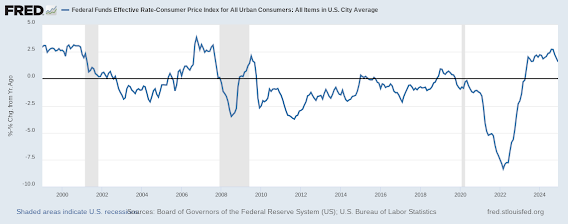
Instead, the Fed manipulated interest rates - cutting 500 bps to try to reverse the sell-off - and managed to get stocks moving up again. Thence, the trajectory was up...up...up... with only a brief pause in 2008...followed by another 500-basis point cut...and more than ten years of negative real interest rates (below the rate of inflation).
Real interest rates - the Effective Federal Funds Rate minus the official year-over-year change in Consumer prices, have been negative for most of the 21st century.
During that period, too (2000 to today), the feds added over $30 trillion to US debt - the biggest stimulus ever. Even those extreme interventions could not stop the Primary Trend...which, in terms of gold, cut the value of the Dow stocks in half. But in trying to stop ‘normal’...the feds made things very weird.
As Tom says, it was as if they had suspended gravity. Asset prices floated freely, untethered to the real world of the main street economy, goods and services, earnings, or costs. Without maps or compass, investors got lost. They didn’t know if they were coming or going...climbing up or tumbling down. Cryptos, NFTs, fractionalized assets...and then came MicroStrategy (whose only real value is the bitcoin it owns... but whose stock price suggests its BTC is worth twice its real market value)...Fartcoin... and even a new coin from a dead man, John McAfee.
And who would have imagined that a man preparing to take on the gravest responsibility known to humans would launch a new crypto currency named after himself, just hours before taking office? You’d think he’d have other things on his mind.
The Fed inflated asset prices. Then, the inflated assets created distortions of their own. At current prices, stock owners feel they have gained nearly $50 trillion worth of stock market capital so far this century (US stocks had a total market value of $15 trillion at the end of 1999...and close to $63 trillion today). And out of the blue, crypto holders have a claim on another $3.3 trillion.
There is little connection between this new wealth and any real earnings in the real economy. But having made so much, they are eager for more, awaiting the next Fartcoin like children watching the chimney on Christmas Eve."
“Once Trump runs out of easy ways to unf*ck the federal government,
his administration will hit a crossroads moment, probably sooner rather than later.”
- Matt Taibbi
"That’s the sound of a swamp being drained. And much fetid water is still backed up over the 68.3 square miles that comprise the District of Columbia. You might be just realizing that the “Joe Biden” regime was not a government at all, but rather, a colossal racketeering operation. And let’s be clear and precise: racketeering is making money dishonestly. Thus: the grubby Biden Family itself at the top of that putrid food-chain, and their smalltime harvesting of mere table-scraps. Where trillions got creamed off by the big gators, the Bidens risked all for a measly few million, like newts gorging on gnats in a drainage ditch.
Are you so cynical - as the Marxians are in their so-called “critique” of capitalism - that you think all human transactions of making-and-doing are dishonest? That is yet another misreading of reality, which the recent years of nonstop official propaganda and gaslight have catastrophically aggravated to the degree that half of America can no longer think at all.
Capitalism is not a political ideology despite the “ism” incorrectly attached to it, like the tail pinned on a donkey. Capitalism is simply the management of surplus wealth. The catch is, in a hyper-complex society, the management itself becomes complex to an extreme. And that can easily lead to mismanagement, which will deform and pervert the very mechanisms that superintend wealth, sometimes so badly that the wealth disappears altogether.
These are the dynamics faced by the newborn Trump command. Both political parties, per se, have fallen into a dismal habit of racketeering in this sclerotic state-of-empire. But now Mr. Trump has seized control of the Republican apparatus, at least, and the Party’s entrenched ol’ crocs and pythons descry that under DJT the regular feeding frenzy is over. Hence: the hand-wringing over Pete Hegseth setting foot in the Pentagon, as he will sometime this dawning day. The dollars pounded down that rat-hole in this century could have funded start-ups of several empires, but instead the swag just landed in the index funds of countless board members parasitically lodged in a dark cosmos of G.I. procurement circle-jerks. A lot of that can and will be stopped. And the ones who just won’t quit are liable to be found out.
Now, the Democratic Party faces more perplexing quandaries. It, too, is constructed as a gigantic grift machine. But if you subtract the employees of the multitudinous NGOs and non-profit orgs set up in recent years to receive government largess - which have spawned like smelts in the San Joaquin delta - you would eliminate much of the party’s rank-and-file. (The rest are apparently embedded in government itself and the teachers’ union.) A whole lot of activists would lose their platforms for activism in the process.
These crypto-bureaucracies have become the places where the Democratic Party stashes the “elite over-production” of Woked-up Marxian semi-morons from America’s diploma mills - in which orgs they are lavishly paid to conduct the aforementioned propaganda and gaslighting operations that wrecked so many American minds. The funding spigot to many of those is getting shut down. It will result in an employment crunch for a large cohort of professional crybabies. They could possibly adapt to their new circumstances by ceasing to be crybabies, and finding other, more useful things to do. That would portend some very significant cultural shiftings, which might include the death of the Democratic Party as we’ve known it. Or, they could all just join Antifa (if they’re not already in it) and go make trouble in the streets.
The first seven days of Mr. Trump have been sheer razzle-dazzle. He and the people around him have torn through the zeitgeist like front-end-loaders through a homeless encampment. He has yet to meet a crisis. Some of the obvious traps are avoidable. For instance: seeking further injury to Russia as a way of ending the stupid Ukraine war - started by us in 2014, thanks a lot Victoria Nuland & Company - since both the US and Russia are just about unconditionally desirous of stopping the damn thing as soon as possible. It’s had no benefit for anybody but the Raytheon war lobby and the Zelensky regime’s legion of grifters. Mr. Trump’s recent tough talk has been entirely for show, just a mass of rhetorical lube to un-stick the lingering “Joe Biden” stasis in that sad-sack corner of the world.
If crisis awaits, it’s probably lurking in the financial realm, where the operations of debt have put nearly every country on Gawd’s Green Earth behind the eight-ball. There is just too much of it that everybody knows can’t possibly be paid back - or soon even serviced - and the grand managers of these matters are finally out of tricks for pretending things can go on. Nor, here in America, can Mr. Trump cut spending fast enough to rebalance accounts. And if he somehow could, government employment has become such a big piece of the total economy that we would land post-haste in a new great depression That predicament is yet-to-be faced, but hold your breath because it is hard upon us.
Meanwhile, this is the week when the most hardcore of Mr. Trump’s cabinet warriors go ‘splainin’ before committees in the US Senate: Bobby Kennedy, Jr., Tulsi Gabbard, and Kash Patel. Prepare for some heat and light. And then, the deluge."
"The OFR Financial Stress Index (OFR FSI)is a daily market-based snapshot of stress in global financial markets. It is constructed from 33 financial market variables, such as yield spreads, valuation measures, and interest rates. The OFR FSI is positive when stress levels are above average, and negative when stress levels are below average. The OFR FSI incorporates five categories of indicators: credit, equity valuation, funding,safe assets and volatility. The FSI shows stress contributions by three regions: United States, other advanced economies, and emerging markets."
"Legendary financial and geopolitical cycle analyst Martin Armstrong is back with a warning to President Trump, who is on record wanting a weaker dollar. Trump might try to force a lower value for the US dollar to help offset the trade deficit. Just this past week, Trump is demanding lower interest rates. Experts say this might also lower the value of the US dollar. Armstrong predicts, “Everything has an international value. If you lower the value of the dollar, then oil in terms of dollars will rise. Look at gold. It’s not making new highs right now because the dollar is going up, but chart it in Canadian dollars or Euros and it’s making new highs. You dramatically lower the dollar and you are going to cause a crash–again. It could be 40% to 50%.”
Armstrong has deep experience in the currency markets. In 1985, Armstrong was called in by the Reagan Administration about cutting the value of the dollar to spark trade. Armstrong warned if you cut the dollar, you will have a big crash within two years. What happened? Two years later, the stock market crashed more than 22% in one day in the infamous 1987 stock market crash. It is still the record for a one-day crash in percentage terms. Armstrong says, “In the end, they said we think foreign exchange had something to do with the crash. That was the best I could get out of them. They are not going to stand up and say, oh gee, we caused it (the crash) by lowering the dollar by 40%.” Armstrong is going to write President Trump a letter warning him NOT to force the US dollar lower.
How is the war picture shaping up now that Trump, who wants to be a “peacemaker,” is in office? Armstrong says, “You have French President Macron saying he wants to send troops into Ukraine. Britian has just now sent 20,000 or 30,000 troops into Romania. They want war. They are basically on the verge of a sovereign debt crisis. So, they have a choice. They default and say, oh sorry, we screwed up. Or, it’s not us, it’s Putin. We have to go get him. The German government fell the very next day after Trump was elected. You see this going on all over Europe.”
In closing, Armstrong sees gold (and silver) going up from here. The US is still the strongest economy by far, but Armstrong’s computer program “Socrates” sees a global recession no later than 2028. Socrates also sees the possibility of “war as early as April or May of 2025.” Armstrong tells President Trump, “Get out of NATO–ASAP.” There is much more in the 66-minute interview.
“A now famous picture from the Hubble Space Telescope featured Pillars of Creation, star forming columns of cold gas and dust light-years long inside M16, the Eagle Nebula. This false-color composite image views the nearby stellar nursery using data from the Herschel Space Observatory's panoramic exploration of interstellar clouds along the plane of our Milky Way galaxy. Herschel's far infrared detectors record the emission from the region's cold dust directly.
The famous pillars are included near the center of the scene. While the central group of hot young stars is not apparent at these infrared wavelengths, the stars' radiation and winds carve the shapes within the interstellar clouds. Scattered white spots are denser knots of gas and dust, clumps of material collapsing to form new stars. The Eagle Nebula is some 6,500 light-years distant, an easy target for binoculars or small telescopes in a nebula rich part of the sky toward the split constellation Serpens Cauda (the tail of the snake).”
"Never perceive anything as being inevitable or predestined.
The only absolute is uncertainty."
- Lionel Suggs
○
"Humans may crave absolute certainty; they may aspire to it; they may pretend, as partisans of certain religions do, to have attained it. But the history of science - by far the most successful claim to knowledge accessible to humans - teaches that the most we can hope for is successive improvement in our understanding, learning from our mistakes, an asymptotic approach to the Universe, but with the proviso that absolute certainty will always elude us."
"You may wonder about long-term solutions. I assure you, there are none. All wounds are mortal. Take what's given. You sometimes get a little slack in the rope but the rope always has an end. So what? Bless the slack and don't waste your breath cursing the drop. A grateful heart knows that in the end we all swing."
“I cling like a miser to the freedom that disappears
as soon as there is an excess of things.”
- Albert Camus, "Lyrical and Critical Essays"
"Let me tell you a story about a haunted house and all the thoughts it evoked in me. Do we believe we can save ourselves by saving things? Or do our saved possessions come to possess their saviors? Do those who save many things or hoard believe that there are pockets in shrouds? Or do they collect things as a magical protection against the shroud?
These are questions that have preoccupied me for weeks as my wife and I have spent long and exhausting days cleaning out a friend’s house. Many huge truckloads of possessions have been carted off to the dump. Thousands of documents have been shredded and thousands more taken to our house for further sorting. Other things have been donated to charity. This is what happens to people’s things; they disappear, never to be seen again, just as we do, eventually.
Tolstoy wrote a story – “How Much Land Does A Man Need’’ – that ends with the answer: a piece six feet long, enough for your grave. As in this story, the devil always has the last laugh when your covetousness gets the best of you. Yet so many people continue to collect in the vain hope that they are exceptions. Ask almost anyone and they will reluctantly admit that they hoard to some degree.
In capitalist consumer societies, getting and spending and hoarding not only lays waste our powers, but it is done on the backs of the poor and destitute around the world. It is a system built to inflame the worst human tendencies of acquisitiveness and indifference since it teaches that one never has enough of everything.
It denies the primal sympathy of human care for all humans as it teaches that if you surround yourself with enough things – have ten pair of shoes, twenty shirts, an attic filled with things in reserve – you will be safe from the fate of the majority of the world’s poor who have next to nothing. It is an insidious form of soul murder wherein one pulls the shades on the prison-house, counts one’s possessions, and shakes hands with the Devil. And it is sadly common.
From attic to cellar to garage, every little cubbyhole, closet, and drawer in this relative’s house was filled with “saved” items. Nothing was ever thrown away. If you walked in the front door, you would never know that the occupants were compulsive keepers. While there were plenty of knick-knacks in evidence like so many houses where the fear of emptiness rules (the emptiness that is the source of freedom and creativity), once you opened a drawer or closet, a secreted lunacy spilled out seriatim like circus clowns from a small car.
Like all clown shows, it was funny but far more frightening, as though all the saved objects were tinged with the fear of death and dissolution, were futile efforts to stop the flow of time and life by sticking a finger in a dike.
Let me begin with the bags. Hidden in every corner and closet, there were bags stuffed in bags. Big bags and little bags, hundreds if not thousands, used and unused, plastic, paper, cloth bags with price tags still on them. The same was true for boxes, especially empty jewelry boxes. Cardboard boxes that once held a little something, wooden boxes, cigar boxes, large cartons, boxes from every device ever purchased – all seemingly being saved for some future use that would never come.
But the bags and boxes filled each other so that no emptiness could survive, although desolation seemed to cry out from within: “You can’t suffocate me.”
Tens of thousands of photographs and slides were squirreled into cabinets, closets, and their own file cabinets, each neatly marked with the date and place of their taking. Time in a “bottle” from which one would never drink again – possessing the past in a vain attempt to stop time. These photos were kept in places where their taker would never see them again but could find a weird comfort that they were saved somewhere in this vast collection. Cold comfort by embalming time.
It so happens that while emptying the house, I was rereading the wonderful novel, Zorba The Greek, by Nikos Kazantzakis. There is a passage in it where a woman has died, and while her corpse lies in her house, the villagers descend on her possessions like shrieking vultures on a carcass.
Old women, men, children went rushing through the doors, jumped through the open windows, over the fences and off the balcony, each carrying whatever he had been able to snatch – sauce pans, frying pans, mattresses, rabbits... Some of them had taken doors or windows off their hinges and had put them on their backs. Mimiko had seized the two court shoes, tied on a piece of string and hung them round his neck – it looked as though Dame Hortense were going off astraddle on his shoulders and only her shoes were visible….
The avidity for things drives many people mad, to get and to keep stuff, to build walls around life so as to protect themselves from death. To consume so as not to be consumed. Kazantzakis brilliantly makes this clear in the book. "Zorba, the Greek" physical laborer and wild man, is different, for he knows that salvation lies in dispossession.
"One day he encounters five little children begging in a village. Their father has just been murdered. “I don’t know why, divine inspiration I suppose, but I went up to them.” He gives the children his basket of food and all his money. He tells his interlocutor, a writer whom he calls “Boss,” a man whom Zorba accuses of not being able to cut the string that ties him to a life of living-death, that that was how he was rescued.
Rescued from my country, from priests, and from money. I began sifting things, sifting more and more things out. I lighten my burden that way. I – how shall I put it? – I find my own deliverance, I become a man."
In the jam-packed attic where there is little room to move with boxes and objects piled on top of each other, I found a large metal four-drawer file cabinet packed with files. In one file folder there was a small purse filled with the following: four very old unmarked keys, six paper clips, two old unworkable watches, a bobby pin, a circular case that contained what looked like a piece of a human bone, a few old medallions, tweezers, four buttons, an eye screw, a safety pin, a nail, a screw, two ancient tiny photos, and a lock of human hair.
Similar objects were stored throughout the house in various containers, bags, boxes, the pockets of clothes, in old ancient furniture in the basement, on shelves, in cigar boxes, in desks, etc.
Old receipts for purchases made forty years ago, airline baggage tags, ticket stubs, school papers, jewelry hidden everywhere, old foreign and domestic coins, perhaps twenty-five old unworkable watches, clocks, radios, clothes and more clothes, more than anyone could ever have worn, scores of old pens and pencils, hand-written notes with no dates or any semblance of order or meaning, chaos and obsessive account-keeping hiding everywhere in contradictory forms shared by two people: one the neat freak and the other disorganized.
One dead and the other forced by fate to let her stuff go, to stand naked in the wind.
How does it help a person to record that they bought a toaster for $6.98 in 1957 or a bracelet for $20 in 1970 or that they called so-and-so some undated time in the past? What good does it do to save vast correspondences documenting your complaints, bitterness, and quarrels? Or boxes upon boxes of Christmas cards received thirty years ago? Or brochures and receipts from a trip taken long ago? Old sports medals? Scrapbooks?
Photos of long dead relatives no one wants? Fashion designer shoes and coats and handbags hidden in a dusty attic where you don’t even know they are there. An immigrant mother’s ancient sewing machine weighing seventy-five pounds and gathering dust in the cellar?
Nothing I could tell you can come close to picturing what we saw in this house. It was overwhelming, horrifying, and weirdly fascinating. And aside from the useful things that were donated to charity and some that were taken to the woman’s next dwelling, ninety percent was dumped in a landfill, soon to be buried.
In his brilliant novel "Underworld", Don DeLillo writes about a guy named Brian who goes to visit a collector of old baseball paraphernalia – bats, balls, an old scoreboard, tapes of games, etc. – in a house where “a mood of mausoleum gloom” fills the air. The man tells Brian: "There’s men in the coming years they’ll pay fortunes for these objects. Because this is desperation speaking. Men come here to see my collection. They come and they don’t want to leave. The phone rings, it’s the family – where is he? This is the fraternity of missing men."
Men and women hoarders, collectors, and keepers are lost children, trying desperately to secure themselves from death while losing themselves in the process. In my friend’s house I found huge amounts of string and rope waiting to tie something up neatly someday. That day never came.
Zorba tells the Boss, who insists he’s free, the following: "No, you’re not free. The string you’re tied to is perhaps no longer than other people’s. That’s all. You’re on a long piece of string, boss; you come and go and think you’re free, but you never cut the string in two. And when people don’t cut that string...
It’s difficult, boss, very difficult. You need a touch of folly to do that; folly, d’you see? You have to risk everything! But you’ve got such a strong head, it’ll always get the better of you. A man’s head is like a grocer; it keeps accounts. I’ve paid so much and earned so much and that means a profit of this much or a loss of that much!
The head’s a careful little shopkeeper; it never risks all it has, always keeps something in reserve. It never breaks the string. Ah, no! It hangs on tight to it, the bastard! If the string slips out of its grasp, the head, poor devil, is lost, finished! But if a man doesn’t break the string, tell me what flavor is left in life? The flavor of camomile, weak camomile tea! Nothing like rum – that makes you see life inside out."
On the way out the door on our final day cleaning the house, I found a beautiful boxed fountain pen on a windowsill. I love pens since I am a writer. This one shone brightly and seemed to speak to me: think of what you could write with me, it said so seductively. I was sorely tempted, but knowing that I didn’t need another pen, I left it there, thinking that perhaps the next occupants of this house would write a different story and embrace Camus’ advice about an excess of things. Perhaps."
Look around you, see all the fine possessions you have, how proud you are of it all! Then ask yourself how many of them you will take back into eternity when your time comes. None. No, you will take out exactly what you brought in... nothing, "and all your money won't another minute buy." Fill a bowl with water, and place your hand in it, then take it out. The hole left in the water is how long you'll be remembered. You are, as we all are, "dust in the wind..."
"Richard Wolff's Last Warning: US Decline, BRICS &
China’s Rise, Trump’s Denial Ends the Empire"
"Economist Richard Wolff offers a final warning and explains why its crash is coming fast and hard as the rise of BRICS and Trump's second presidential administration bring the entire economic foundations of US empire to its knees. Richard Wolff is Professor Emeritus of Economics at the University of Massachusetts Amherst."
"Did I find Russia's cheapest supermarket? Discover with me what a Russian typical supermarket looks like inside. B1 - Perviy Vybor supermarket is a hard discount supermarket chain owned by Magnit, which has more than 30,000 locations in Russia."
"The shocking truth about safety deposit boxes might just change how you protect your valuables! In today’s video, I discuss some major concerns surrounding safety deposit boxes, from limited access during emergencies to lack of insurance for your stored items. Plus, we’ll dive into the current state of gold and silver sales, how businesses are handling cash shortages, and the growing desperation among sellers in today’s economy. If you’re thinking about selling your precious metals or renting a safety deposit box, there are some critical things you need to know right now.
The economy is shifting rapidly, and I’m sharing firsthand insights from retailers and buyers about what’s happening with gold, silver, and even junk silver. Whether it’s postdated checks, under-spot offers, or limited business hours, these are challenging times for many. I’ll also touch on the importance of having a trust and why naming beneficiaries could save your loved ones from legal headaches down the road. If you’re looking for opportunities to buy, this might be your chance to get great deals on gold, silver, and other valuable items. But don’t let desperation drive your decisions—stay informed and be prepared! Let’s navigate these turbulent times together."
“A person who has not been completely alienated, who has remained sensitive and able to feel, who has not lost the sense of dignity, who is not yet ‘for sale’, who can still suffer over the suffering of others, who has not acquired fully the having mode of existence – briefly, a person who has remained a person and not become a thing – cannot help feeling lonely, powerless, isolated in present-day society. He cannot help doubting himself and his own convictions, if not his sanity.”
"Cosmic dust clouds cross a rich field of stars in this telescopic vista near the northern boundary of Corona Australis, the Southern Crown. Less than 500 light-years away the dust clouds effectively block light from more distant background stars in the Milky Way. Top to bottom the frame spans about 2 degrees or over 15 light-years at the clouds' estimated distance. At top right is a group of lovely reflection nebulae cataloged as NGC 6726, 6727, 6729, and IC 4812.
A characteristic blue color is produced as light from hot stars is reflected by the cosmic dust. The dust also obscures from view stars in the region still in the process of formation. Just above the bluish reflection nebulae a smaller NGC 6729 surrounds young variable star R Coronae Australis. To its right are telltale reddish arcs and loops identified as Herbig Haro objects associated with energetic newborn stars. Magnificent globular star cluster NGC 6723 is at bottom left in the frame. Though NGC 6723 appears to be part of the group, its ancient stars actually lie nearly 30,000 light-years away, far beyond the young stars of the Corona Australis dust clouds."
"It doesn't take a genius to recognize that human males have a propensity for intergroup violence, and that the killing is often accompanied by rape. One need only read the newspapers. The only question is to what extent these tendencies are innate or culturally inculcated. Nature or nurture? Or both? A new book, "Sex and War: How Biology Explains Warfare and Terrorism and Offers a Path to a Safer World," by population biologist Malcolm Potts and science writer Thomas Hayden, dishes up a bit of both. The violence is in our (male) genes, they maintain, but it is susceptible to cultural control.
What the authors calls "behavioral propensity to engage in male coalitional violence" evolved as far back as the common ancestor of humans and chimps, they claim, although our other close relations, bonobos and gorillas, seem to have found more peaceful ways of living. Genes predispose, say Potts and Hayden, but cultural forces can alleviate the worst of male nastiness. By empowering women to be leaders in cultural, social and political spheres, the violent propensities of men can be restrained. Further, empowerment will give women control of their reproductive destinies, and will therefore result in fewer offspring. Less population pressure will reduce other factors fueling violence and conflict, the authors claim.
Anthropologist Hillard Kaplan reviews the book in the October 9, 2009, issue of "Science." He agrees that the available evidence suggests that male intergroup violence has a long evolutionary history. He believes this tendency was exacerbated into large scale warfare with the development of agriculture and the associated larger population groups and competition for fertile land. Kaplan believes that male group violence is stoked by poor economic prospect for young males. To the empowerment of women he would add education and jobs as a way to reduce antisocial behavior.
There is nothing particularly new or revolutionary about any of this. Progress? Yes, I suppose so, but we clearly have a long way to go before women exercise equal power in society, or before young men in the developing world, especially, have an economic stake in social stability. Meanwhile, as the painting above by Jacques-Louis David, "The Sabine Women," suggests, women and children will continue to be caught in the middle.”




.jpeg)


