StatCounter

Saturday, December 7, 2024

“The Science of Stress and How Our Emotions Affect Our Susceptibility to Burnout and Disease”

“The Science of Stress and How Our Emotions
Affect Our Susceptibility to Burnout and Disease
by Maria Popova

"I had lived thirty good years before enduring my first food poisoning - odds quite fortunate in the grand scheme of things, but miserably unfortunate in the immediate experience of it. I found myself completely incapacitated to erect the pillars of my daily life - too cognitively foggy to read and write, too physically weak to work out or even meditate. The temporary disability soon elevated the assault on my mind and body to a new height of anguish: an intense experience of stress. Even as I consoled myself with Nabokov’s exceptionally florid account of food poisoning, I couldn’t shake the overwhelming malaise that had engulfed me - somehow, a physical illness had completely colored my psychoemotional reality.

This experience, of course, is far from uncommon. Long before scientists began shedding light on how our minds and bodies actually affect one another, an intuitive understanding of this dialogue between the body and the emotions, or feelings, emerged and permeated our very language: We use “feeling sick” as a grab-bag term for both the sensory symptoms - fever, fatigue, nausea - and the psychological malaise, woven of emotions like sadness and apathy.

Pre-modern medicine, in fact, has recognized this link between disease and emotion for millennia. Ancient Greek, Roman, and Indian Ayurvedic physicians all enlisted the theory of the four humors - blood, yellow bile, black bile, and phlegm - in their healing practices, believing that imbalances in these four visible secretions of the body caused disease and were themselves often caused by the emotions. These beliefs are fossilized in our present language - melancholy comes from the Latin words for “black” (melan) and “bitter bile” (choler), and we think of a melancholic person as gloomy or embittered; a phlegmatic person is languid and impassive, for phlegm makes one lethargic.

And then French philosopher and mathematician René Descartes came along in the seventeenth century, taking it upon himself to eradicate the superstitions that fueled the religious wars of the era by planting the seed of rationalism. But the very tenets that laid the foundation of modern science - the idea that truth comes only from what can be visibly ascertained and proven beyond doubt - severed this link between the physical body and the emotions; those mysterious and fleeting forces, the biological basis of which the tools of modern neuroscience are only just beginning to understand, seemed to exist entirely outside the realm of what could be examined with the tools of rationalism.

For nearly three centuries, the idea that our emotions could impact our physical health remained scientific taboo - setting out to fight one type of dogma, Descartes had inadvertently created another, which we’re only just beginning to shake off. It was only in the 1950s that Austrian-Canadian physician and physiologist Hans Selye pioneered the notion of stress as we now know it today, drawing the scientific community’s attention to the effects of stress on physical health and popularizing the concept around the world. (In addition to his scientific dedication, Selye also understood the branding component of any successful movement and worked tirelessly to include the word itself in dictionaries around the world; today, “stress” is perhaps the word pronounced most similarly in the greatest number of major languages.)

But no researcher has done more to illuminate the invisible threads that weave mind and body together than Dr. Esther Sternberg. Her groundbreaking work on the link between the central nervous system and the immune system, exploring how immune molecules made in the blood can trigger brain function that profoundly affects our emotions, has revolutionized our understanding of the integrated being we call a human self. In the immeasurably revelatory "The Balance Within: The Science Connecting Health and Emotions" (public library), Sternberg examines the interplay of our emotions and our physical health, mediated by that seemingly nebulous yet, it turns out, remarkably concrete experience called stress.

With an eye to modern medicine’s advances in cellular and molecular biology, which have made it possible to measure how our nervous system and our hormones affect our susceptibility to diseases as varied as depression, arthritis, AIDS, and chronic fatigue syndrome, Sternberg writes: "By parsing these chemical intermediaries, we can begin to understand the biological underpinnings of how emotions affect diseases… The same parts of the brain that control the stress response play an important role in susceptibility and resistance to inflammatory diseases such as arthritis. And since it is these parts of the brain that also play a role in depression, we can begin to understand why it is that many patients with inflammatory diseases may also experience depression at different times in their lives.

Rather than seeing the psyche as the source of such illnesses, we are discovering that while feelings don’t directly cause or cure disease, the biological mechanisms underlying them may cause or contribute to disease. Thus, many of the nerve pathways and molecules underlying both psychological responses and inflammatory disease are the same, making predisposition to one set of illnesses likely to go along with predisposition to the other. The questions need to be rephrased, therefore, to ask which of the many components that work together to create emotions also affect that other constellation of biological events, immune responses, which come together to fight or to cause disease. Rather than asking if depressing thoughts can cause an illness of the body, we need to ask what the molecules and nerve pathways are that cause depressing thoughts. And then we need to ask whether these affect the cells and molecules that cause disease.

We are even beginning to sort out how emotional memories reach the parts of the brain that control the hormonal stress response, and how such emotions can ultimately affect the workings of the immune system and thus affect illnesses as disparate as arthritis and cancer. We are also beginning to piece together how signals from the immune system can affect the brain and the emotional and physical responses it controls: the molecular basis of feeling sick. In all this, the boundaries between mind and body are beginning to blur."

Indeed, the relationship between memory, emotion, and stress is perhaps the most fascinating aspect of Sternberg’s work. She considers how we deal with the constant swirl of inputs and outputs as we move through the world, barraged by a stream of stimuli and sensations: "Every minute of the day and night we feel thousands of sensations that might trigger a positive emotion such as happiness, or a negative emotion such as sadness, or no emotion at all: a trace of perfume, a light touch, a fleeting shadow, a strain of music. And there are thousands of physiological responses, such as palpitations or sweating, that can equally accompany positive emotions such as love, or negative emotions such as fear, or can happen without any emotional tinge at all. What makes these sensory inputs and physiological outputs emotions is the charge that gets added to them somehow, somewhere in our brains. Emotions in their fullest sense comprise all of these components. Each can lead into the black box and produce an emotional experience, or something in the black box can lead out to an emotional response that seems to come from nowhere."

Memory, it turns out, is one of the major factors mediating the dialogue between sensation and emotional experience. Our memories of past experience become encoded into triggers that act as switchers on the rail of psychoemotional response, directing the incoming train of present experience in the direction of one emotional destination or another.

Sternberg writes: "Mood is not homogeneous like cream soup. It is more like Swiss cheese, filled with holes. The triggers are highly specific, tripped by sudden trails of memory: a faint fragrance, a few bars of a tune, a vague silhouette that tapped into a sad memory buried deep, but not completely erased. These sensory inputs from the moment float through layers of time in the parts of the brain that control memory, and they pull out with them not only reminders of sense but also trails of the emotions that were first connected to the memory. These memories become connected to emotions, which are processed in other parts of the brain: the amygdala for fear, the nucleus accumbens for pleasure - those same parts that the anatomists had named for their shapes. And these emotional brain centers are linked by nerve pathways to the sensory parts of the brain and to the frontal lobe and hippocampus - the coordinating centers of thought and memory."

The same sensory input can trigger a negative emotion or a positive one, depending on the memories associated with it. This is where stress comes in - much like memory mediates how we interpret and respond to various experiences, a complex set of biological and psychological factors determine how we respond to stress. Some types of stress can be stimulating and invigorating, mobilizing us into action and creative potency; others can be draining and incapacitating, leaving us frustrated and hopeless. This dichotomy of good vs. bad stress, Sternberg notes, is determined by the biology undergirding our feelings - by the dose and duration of the stress hormones secreted by the body in response to the stressful stimulus. She explains the neurobiological machinery behind this response:

"As soon as the stressful event occurs, it triggers the release of the cascade of hypothalamic, pituitary, and adrenal hormones - the brain’s stress response. It also triggers the adrenal glands to release epinephrine, or adrenaline, and the sympathetic nerves to squirt out the adrenaline-like chemical norepinephrine all over the body: nerves that wire the heart, and gut, and skin. So, the heart is driven to beat faster, the fine hairs of your skin stand up, you sweat, you may feel nausea or the urge to defecate. But your attention is focused, your vision becomes crystal clear, a surge of power helps you run - these same chemicals released from nerves make blood flow to your muscles, preparing you to sprint.

All this occurs quickly. If you were to measure the stress hormones in your blood or saliva, they would already be increased within three minutes of the event. In experimental psychology tests, playing a fast-paced video game will make salivary cortisol increase and norepinephrine spill over into venous blood almost as soon as the virtual battle begins. But if you prolong the stress, by being unable to control it or by making it too potent or long-lived, and these hormones and chemicals still continue to pump out from nerves and glands, then the same molecules that mobilized you for the short haul now debilitate you."

These effects of stress exist on a bell curve - that is, some is good, but too much becomes bad: As the nervous system secretes more and more stress hormones, performance increases, but up to a point; after that tipping point, performance begins to suffer as the hormones continue to flow. What makes stress “bad” - that is, what makes it render us more pervious to disease - is the disparity between the nervous system and immune system’s respective pace. 

Sternberg explains: "The nervous system and the hormonal stress response react to a stimulus in milliseconds, seconds, or minutes. The immune system takes parts of hours or days. It takes much longer than two minutes for immune cells to mobilize and respond to an invader, so it is unlikely that a single, even powerful, short-lived stress on the order of moments could have much of an effect on immune responses. However, when the stress turns chronic, immune defenses begin to be impaired. As the stressful stimulus hammers on, stress hormones and chemicals continue to pump out. Immune cells floating in this milieu in blood, or passing through the spleen, or growing up in thymic nurseries never have a chance to recover from the unabated rush of cortisol. Since cortisol shuts down immune cells’ responses, shifting them to a muted form, less able to react to foreign triggers, in the context of continued stress we are less able to defend and fight when faced with new invaders. And so, if you are exposed to, say, a flu or common cold virus when you are chronically stressed out, your immune system is less able to react and you become more susceptible to that infection."

Extended exposure to stress, especially to a variety of stressors at the same time - any combination from the vast existential menu of life-events like moving, divorce, a demanding job, the loss of a loved one, and even ongoing childcare - adds up a state of extreme exhaustion that leads to what we call burnout.

Sternberg writes: "Members of certain professions are more prone to burnout than others - nurses and teachers, for example, are among those at highest risk. These professionals are faced daily with caregiving situations in their work lives, often with inadequate pay, inadequate help in their jobs, and with too many patients or students in their charge. Some studies are beginning to show that burnt-out patients may have not only psychological burnout, but also physiological burnout: a flattened cortisol response and inability to respond to any stress with even a slight burst of cortisol. In other words, chronic unrelenting stress can change the stress response itself. And it can change other hormone systems in the body as well."

One of the most profound such changes affects the reproductive system - extended periods of stress can shut down the secretion of reproductive hormones in both men and women, resulting in lower fertility. But the effects are especially perilous for women - recurring and extended episodes of depression result in permanent changes in bone structure, increasing the risk of osteoporosis. In other words, we register stress literally in our bones.

But stress isn’t a direct causal function of the circumstances we’re in - what either amplifies or ameliorates our experience of stress is, once again, memory. Sternberg writes: Our perception of stress, and therefore our response to it, is an ever-changing thing that depends a great deal on the circumstances and settings in which we find ourselves. It depends on previous experience and knowledge, as well as on the actual event that has occurred. And it depends on memory, too.

The most acute manifestation of how memory modulates stress is post-traumatic stress disorder, or PTSD. For striking evidence of how memory encodes past experience into triggers, which then catalyze present experience, Sternberg points to research by psychologist Rachel Yehuda, who found both Holocaust survivors and their first-degree relatives - that is, children and siblings - exhibited a similar hormonal stress response.

This, Sternberg points out, could be a combination of nature and nurture - the survivors, as young parents for whom the trauma was still fresh, may well have subconsciously taught their children a common style of stress-responsiveness; but it’s also possible that these automatic hormonal stress responses permanently changed the parents’ biology and were transmitted via DNA to their children. Once again, memory encodes stress into our very bodies. Sternberg considers the broader implications: "Stress need not be on the order of war, rape, or the Holocaust to trigger at least some elements of PTSD. Common stresses that we all experience can trigger the emotional memory of a stressful circumstance - and all its accompanying physiological responses. Prolonged stress - such as divorce, a hostile workplace, the end of a relationship, or the death of a loved one - can all trigger elements of PTSD."

Among the major stressors - which include life-events expected to be on the list, such as divorce and the death of a loved one - is also one somewhat unexpected situation, at least to those who haven’t undergone it: moving. Sternberg considers the commonalities between something as devastating as death and something as mundane as moving: One is certainly loss - the loss of someone or something familiar. Another is novelty - finding oneself in a new and unfamiliar place because of the loss. Together these amount to change: moving away from something one knows and toward something one doesn’t. An unfamiliar environment is a universal stressor to nearly all species, no matter how developed or undeveloped.

In the remainder of the thoroughly illuminating "The Balance Within", Sternberg goes on to explore the role of interpersonal relationships in both contributing to stress and shielding us from it, how the immune system changes our moods, and what we can do to harness these neurobiological insights in alleviating our experience of the stressors with which every human life is strewn.”
Related:
"Neuroscience Says Listening to This Song 
Reduces Anxiety by Up to 65 Percent"
By Melanie Curtin
Full screen recommended.
"Everyone knows they need to manage their stress. When things get difficult at work, school, or in your personal life, you can use as many tips, tricks, and techniques as you can get to calm your nerves. So here's a science-backed one: make a playlist of the 10 songs found to be the most relaxing on earth. Sound therapies have long been popular as a way of relaxing and restoring one's health. For centuries, indigenous cultures have used music to enhance well-being and improve health conditions.

Now, neuroscientists out of the UK have specified which tunes give you the most bang for your musical buck. The study was conducted on participants who attempted to solve difficult puzzles as quickly as possible while connected to sensors. The puzzles induced a certain level of stress, and participants listened to different songs while researchers measured brain activity as well as physiological states that included heart rate, blood pressure, and rate of breathing.

According to Dr. David Lewis-Hodgson of Mindlab International, which conducted the research, the top song produced a greater state of relaxation than any other music tested to date. In fact, listening to that one song- "Weightless"- resulted in a striking 65 percent reduction in participants' overall anxiety, and a 35 percent reduction in their usual physiological resting rates. That is remarkable.

Equally remarkable is the fact the song was actually constructed to do so. The group that created "Weightless", Marconi Union, did so in collaboration with sound therapists. Its carefully arranged harmonies, rhythms, and bass lines help slow a listener's heart rate, reduce blood pressure and lower levels of the stress hormone cortisol.

When it comes to lowering anxiety, the stakes couldn't be higher. Stress either exacerbates or increases the risk of health issues like heart disease, obesity, depression, gastrointestinal problems, asthma, and more. More troubling still, a recent paper out of Harvard and Stanford found health issues from job stress alone cause more deaths than diabetes, Alzheimer's, or influenza.

In this age of constant bombardment, the science is clear: if you want your mind and body to last, you've got to prioritize giving them a rest. Music is an easy way to take some of the pressure off of all the pings, dings, apps, tags, texts, emails, appointments, meetings, and deadlines that can easily spike your stress level and leave you feeling drained and anxious.

Of the top track, Dr. David Lewis-Hodgson said, "'Weightless' was so effective, many women became drowsy and I would advise against driving while listening to the song because it could be dangerous." So don't drive while listening to these, but do take advantage of them:

10. "We Can Fly," by Rue du Soleil (Café Del Mar)
8. "Someone Like You," by Adele
7. "Pure Shores," by All Saints
6. "Please Don't Go," by Barcelona
5. "Strawberry Swing," by Coldplay
4. "Watermark," by Enya
2. "Electra," by Airstream
1. "Weightless," by Marconi Union

I made a public playlist of all of them on Spotify that runs about 50 minutes (it's also downloadable)."

The Daily "Near You?"

Lawton, Oklahoma, USA. Thanks for stopping by!

The Poet: Czeslaw Milosz, "A Song On The End Of The World"

"A Song On The End Of The World"

“On the day the world ends
A bee circles a clover,
A fisherman mends a glimmering net.
Happy porpoises jump in the sea,
By the rainspout young sparrows are playing
And the snake is gold-skinned as it should always be.

On the day the world ends
Women walk through the fields under their umbrellas,
A drunkard grows sleepy at the edge of a lawn,
Vegetable peddlers shout in the street
And a yellow-sailed boat comes nearer the island,
The voice of a violin lasts in the air
And leads into a starry night.

And those who expected lightning and thunder
Are disappointed.
And those who expected signs and archangels’ trumps
Do not believe it is happening now.
As long as the sun and the moon are above,
As long as the bumblebee visits a rose,
As long as rosy infants are born
No one believes it is happening now.

Only a white-haired old man, who would be a prophet
Yet is not a prophet, for he’s much too busy,
Repeats while he binds his tomatoes:
There will be no other end of the world,
There will be no other end of the world.”

~ Czeslaw Milosz

"I Have Hope..."


"At Last..."

“At last, the answer why. The lesson that had been so hard to find, so difficult to learn, came quick and clear and simple. The reason for problems is to overcome them. Why, that’s the very nature of man, I thought, to press past limits, to prove his freedom. It isn’t the challenge that faces us, that determines who we are and what we are becoming, but the way we meet the challenge, whether we toss a match at the wreck or work our way through it, step by step, to freedom.”
- Richard Bach, “Nothing by Chance”

"America’s ‘Greatest Ally’ Cost US Taxpayers $310 Billion"

"America’s ‘Greatest Ally’ Cost US Taxpayers $310 Billion"
by Joziah Thayer

"The Qualitative Military Edge agreement between the United States and Israel has cost U.S. taxpayers $310 billion since Israel was founded. Many people in the United States and around the world are upset with how the United States continues to support Israel as they besiege and bombard Gaza, resulting in what some estimates say are 200,000 deaths. What people may not be aware of is that it is U.S. law to defend and sustain Israel’s hegemony. The QME agreement between the United States and Israel has its roots in the 1960s during the peak of Cold War tensions. The U.S. saw Israel as an invaluable geopolitical ally to combat the expansion of Soviet influence into the Middle East. Lydon B. Johnson was the first president to speak publicly about arms deals with Israel.

The Six-Day War in 1967 proved Israel’s military capabilities, and the U.S. felt that Israel could be a valuable partner in combating Soviet influence in the Middle East. Following the Six-Day War, there was a spike in military and financial transfers to Israel using the Foreign Assistance Act of 1961. The QME was further solidified during the Yom Kippur War in 1973 when a U.S. airlift of military supplies to Israel was critical in turning the tide of the conflict.

In 2008, in the last months of the Bush administration, the QME agreement between the U.S. and Israel became an official U.S. law by amending the Foreign Assistance Act of 1961 and the Arms Export Control Act of 1976 to become the Naval Vessel Transfer Act of 2008. This law made it a legal requirement for the U.S. to ensure that any arms sales to Middle Eastern countries do not compromise Israel’s military superiority.

Legacy media will tell us that this legislation enjoyed bipartisan support, driven by a recognition of Israel’s strategic role in the region when, in truth, it was driven by AIPAC and Senator Joe Liberman, while one of the biggest opponents of the bill was Senator Rand Paul who railed against the budget of this bill especially as domestic debt soared and argued he for a more balanced approach that would not alienate Arab allies, in a time when the U.S. sought to stabilize Iraq and Afghanistan.

In response to what the U.S. government called a failed state in Syria and a rise in ISIS and Al-Qaeda, the U.S. gave Israel F-35 fighter jets America’s most advanced stealth fighters, making Israel the only country at the time outside of the U.S. to operate the F-35. These jets made Israel a regional superpower because no other nation in the region had this capability. The decision to equip Israel with F-35s is not a secret; we were told this move was to counter Iran’s regional influence, while the real reason at the time was to put Israel on an even playing field with Russia in Syria.

The Naval Transfer Act of 2008 legally required the United States to ensure that Israel maintains a qualitative military edge over its adversaries. Specifically, it mandates that any sale of arms to Middle Eastern countries must undergo a rigorous review to confirm that it does not compromise Israel’s QME. The law defines QME as the capability to “counter and defeat any credible conventional military threat” with minimal damage to Israel’s forces and resources. The QME is a legal commitment from the U.S. to ensure that Israel is not only victorious in battle but will be able to win decisively. This law is reaffirmed by congressional vote year after year, with Congress passing various recent provisions that mandate the Department of Defense to report on Israel’s QME status periodically.

Israel is often called America’s greatest ally when, in truth, Israel is really America’s greatest overseas asset. Since 1958, the United States has been funneling hundreds of billions of dollars to Israel. American tax dollars built the democratic state of Israel, and while this issue is often seen as a policy decision, since 2008, it has been official U.S. law. Before 2008, it was just an unwritten rule that republican and democratic administrations signed off on for decades. Politicians and talking heads can repeatedly claim that Israel is an ally, which they are, but at what cost?

Security in the Middle East or Peace in the Middle East are just catchphrases used to perpetuate this false notion that only through Israel can we attain peace in the Middle East. Iraq, Syria, and Yemen were all conflicts that Israel vehemently pushed the international community to pursue. Netanyahu lied to Congress about WMDs in Iraq, moved mountains to destabilize Syria, and then cried to the UN about the Houthis in 2014.

The original basis of the Israeli QME was to use Israel to combat Soviet expansion into the Middle East, and this policy has not changed over the last 70-plus years. The Iranian Revolution in 1979 shifted the focus of the QME a bit to containing a new threat from Iran. Operation Cyclone in Afghanistan was in part to maintain Israel’s qualitative military edge in the region, and we know how that ended. The United States cannot allow Russia or China to build relationships with Middle Eastern countries because the U.S. will not be able to guarantee Israel’s qualitative military edge if they allow Russia and China to advance the militaries and economies of nations in the Middle East.

The current status quo policy on Russian or Chinese influence in the Middle East is not to prevent Russia or China from threatening America’s interests in the region; It’s about protecting Israel’s security under the guise of perpetuating Western ideology and control. Allowing this law to remain on the books codifies into public law that U.S. lawmakers in both Democratic and Republican administrations are beholden to Israel, no matter what. The international stage is far too dynamic to have policy decisions adhere to such a static law.

The price of war is always paid by the people of those nations, not the governments that orchestrate conflicts. American taxpayers have shouldered the burden of the war machine for far too long without reaping any rewards from so-called assets overseas the military-industrial complex claims to protect. We have built infrastructure in other nations as ours crumbles and assure the security of foreign lands as ours dwindles, but it seems as soon as someone mentions Russia or Muslim extremists, people forget all of this, standing in line with a war drum strapped to their chest, pounding away robotically."
And here it is, whether you like it or not...

"How It Really Is"


"How It Really Was"

"Universal Truth, Facts & Life"
Past happenings, History, facts about life and long living.
By Shiv Tandon

"In the Middle Ages, there were no toothbrushes, perfumes, deodorants, and much less toilet paper. Human excrements were thrown out of palace windows. On a holiday, the palace kitchen was able to prepare a feast for 1500 people, without the minimum hygiene. The explanation is not in the heat, but in the foul odor emitted under the skirts. It was also not customary to shower due to the cold and the almost non-existence of running water. Only the nobles had lackeys to fan them, to dispel the bad odor that exhalated the body and mouth, as well as to scare away the insects.

Those who have been to Versailles have admired the huge and beautiful gardens that, at that time, were not only contemplated, but used as a toilet in the famous ballads promoted by the monarchy, because there were no bathrooms. 

In the Middle Ages, most weddings took place in June. The reason is simple: the first bath of the year was taken in May; so, in June, the smell of people was still tolerable. However, as some odors were already beginning to bother, the brides carried bouquets of flowers near their bodies to cover the odor. Hence the explanation of the origin of the bridal bouquet. The baths were taken in a single massive tub filled with hot water. The head of the family had the privilege of the first swim in clean water. Then, without changing the water, the others arrived in the house, in order of age, women, also by age and finally, children. The babies were the last ones to bathe.

During the 1600s and 1700s, the Palace of Versailles, like many other European royal residences, did not have modern bathrooms or sanitation facilities.

1. No bathrooms: The Palace of Versailles, built during the reign of Louis XIV (1638-1715), did not have dedicated bathrooms. Instead, chamber pots and commodes were used in private quarters.

2. Medieval hygiene: During the Middle Ages, personal hygiene was not a priority. Toothbrushes, perfumes, deodorants, and toilet paper were not widely used or available.

3. Waste disposal: Human waste was often disposed of by throwing it out of windows or into streets, a practice known as "chamber pot emptying." This was common in many European cities, including Paris.

4. Palace specifics: Versailles had some primitive sanitation facilities, like latrines and cesspits, but they were not connected to a modern sewage system. Waste was often collected in cesspits and emptied manually.

5. Royal exceptions: Royalty and nobility used decorative commodes and chamber pots, sometimes with aromatic herbs or perfumes to mask odors. However, these were not connected to drainage systems.

6. Modernization: It wasn't until the late 18th and early 19th centuries that modern plumbing and sanitation systems were gradually introduced in European royal palaces, including Versailles.

These practices were common during that time period and not unique to Versailles. The palace has since undergone significant modernization and now features modern bathrooms and sanitation facilities."

"Man's Nature..."

"Man has one name, and many more than two natures. 
But the essential two are these:
that he shall strive to impose order on chaos, 
and that he shall strive to take advantage of chaos…
A third element of man's nature is this: 
that he shall not understand what he is doing."
- John Brunner

"The War-Whores Of The Military-Industrial Complex Are Lighting The World On Fire"

"The War-Whores Of The Military-Industrial Complex 
Are Lighting The World On Fire"
Syria is just the latest case of U.S. meddling and 
the timing could not be more suspicious...
by Leo Hohmann

"The Biden administration has triggered another proxy war for Donald Trump to deal with when he becomes president next month. The U.S. deep state is fighting a proxy war in Syria, which appears to be waged with the intention of further destabilizing the Middle East and stirring up another front in World War III.

Syria is collapsing under the weight of another U.S.-sponsored proxy Civil War, with the US, Israel and Sunni jihadists on one side and Russia, Iran, Assad, and Shiite jihadists on the other. Al Nusra (which is comprised of Al-Qaida and ISIS affiliates) is taking over the country with the help of Turkey, a U.S. ally and key member of the NATO military alliance. These rebels have seized the city of Aleppo and many smaller towns and villages.

M. Dowling at The Independent Sentinel notes that “Jake Sullivan has said Al-Qaida is on our side in Syria.” Jake Sullivan is Biden’s national security adviser and a key enabler, along with Secretary of State Antony Blinken, of the anti-Russia obsessed deep-state club that shares one thing in common. They all belong to the Trilateral Commission and the Council on Foreign Relations.

Dowling notes that Syria’s civil war started in 2011 after an uprising against President Bashar Assad’s rule. The U.S., Russia, Israel and Iran all have a military presence in Syria. Forces opposed to Assad, along with U.S.-backed rebels, control more than a third of the country and now Russia and Iran have launched a counter-offensive. Russia is very upset with Turkey for instigating the coup against Assad, likely with the direct assistance of the CIA.

The false narrative being proffered by the US mockingbird media is that a rag-tag coalition of so-called “noble rebels” has somehow organically emerged to save Syria from the dictator Assad. No, what we have here are Sunni jihadists backed by the U.S. and NATO fighting Shia jihadists backed by Russia.

As Dowling points out, “All jihadists are bad guys.” They are bad because as soon as they get in power one of the first things they do is start raping the Christian women and executing the Christian men. It happened in Iraq after Saddam Hussein was overthrown and it’s happening now in Syria.

Congress funded jihadist rebels in Syria for years. The chief war whores of the military-industrial complex, Senators Lindsey Graham and John McCain, led the way. Graham is now turning on Trump’s pick for Defense Secretary, Pete Hegseth, because he’s afraid the Fox News host might not be fully on board with the U.S. forever wars.

Dowling quotes Joe Kent, a former chief warrant officer in the U.S. Army special forces, saying that the U.S. is “in an endless cycle of violence” and a “regime-change war” in Syria that the US has pushed. The world is aflame and the regime in Washington appears to be dowsing it with gasoline in anticipation of handing the chaos over to Donald Trump to deal with as the 47th president. Dowling ends her article with this truth bomb: “We need to be out of Syria. We’re helping no one, certainly not Americans. This is another spear in World War III.”

The U.S. is also stirring the pot in the Eastern European country of Georgia, where protesters continue to be out in the streets. The U.S. is complicit in the deaths of more than half a million Ukrainians.

I would say we need to be out of every country in the world where there is no direct compelling national interest for America’s national security. Rein in the CIA and limit its actions strictly to intelligence gathering (no more fomenting of revolutions and coups) bring our boys home and return the concept of “defense” to our U.S. Department of Defense."

"Larry C. Johnson & Scott Ritter, Syria In Turmoil - Shocking Escalation You Won’t Believe!"

Dialogue Works, 12/7/24
"Larry C. Johnson & Scott Ritter, 
Syria In Turmoil - Shocking Escalation You Won’t Believe!"
Comments here:

Friday, December 6, 2024

Jeremiah Babe, "I Was the Only Person At The RV Sale, Buyers Are Gone"

Full screen recommended.
Jeremiah Babe, 12/6/24
"I Was the Only Person At The RV Sale, 
Buyers Are Gone"
Comments here:

"Costco Insider Exposes Products Disappearing From Shelves!"

Full screen recommended.
Epic Economist, 12/6/24
"Costco Insider Exposes 
Products Disappearing From Shelves!"

"Costco customers are familiar with the frustration of wanting to stock up on their favorite Costco products only to find out that they have been discontinued or are out-of-stock. Unfortunately, this happens pretty regularly at the chain's warehouses, and in the coming weeks shelves will look even emptier, according to a new announcement made by the company last week.

Typically, when the warehouse retailer faces shortages it may be because there were disruptions in manufacturing, delivery delays, or prices have risen way too high to keep in line with the company’s low-cost brand. When products are discontinued it is often because they were limited edition or weren't selling well. Then again, it could just be that the retailer wants to create a sense of urgency and encourage shoppers to embark on its infamous Costco grocery treasure hunts.

Down the supply chain, manufacturers and food processors are coping with declining agricultural and livestock production as well as labor shortages and rampant operational costs. As we were warned by experts and economists several times in the past, grocery inflation and shortages will be stickier than government officials have predicted. Sadly, this means Americans will have to get used to spending more on food and seeing their favorite essentials vanishing from sight."
Comments here:

Adventures With Danno, "Grocery Prices Are Going Up, More Shrinkflation"

Adventures With Danno, PM 12/6/24
"Grocery Prices Are Going Up, More Shrinkflation"
Comments here:

Musical Interlude: 2002, “Cycle Of Time”

Full screen mode recommended.
2002, “Cycle Of Time”

"A Look to the Heavens"

"These three bright nebulae are often featured in telescopic tours of the constellation Sagittarius and the crowded starfields of the central Milky Way. In fact, 18th century cosmic tourist Charles Messier cataloged two of them; M8, the large nebula left of center, and colorful M20 on the right. The third, NGC 6559, is above M8, separated from the larger nebula by a dark dust lane. All three are stellar nurseries about five thousand light-years or so distant.
The expansive M8, over a hundred light-years across, is also known as the Lagoon Nebula. M20's popular moniker is the Trifid. Glowing hydrogen gas creates the dominant red color of the emission nebulae, with contrasting blue hues, most striking in the Trifid, due to dust reflected starlight. The colorful skyscape recorded with telescope and digital camera also includes one of Messier's open star clusters, M21, just above the Trifid."

Chet Raymo, "Seeing"

"Seeing"
by Chet Raymo

"There was a moment yesterday evening when the elements conspired to evoke these few lines, spoken by Macbeth:
"Light thickens,
And the crow makes wing to the rooky woods,
Good things of day begin to droop and drowse.
The fading light. The crows gliding down the fields to the trees in Ballybeg:
Light thickens,
And the crow makes wing to the rooky woods,
Good things of day begin to droop and drowse."

It's all there, in those few lines - the mysterious power of poetry to infuse the world with meaning, to anoint the world with a transforming grace. One could spend an hour picking those lines apart, syntax and sound, sense and alliteration. The t's of light thickening, tongue against the teeth. The alar w's making wing. The owl eyes of the double o's. The d's nodding into slumber - day, droop, drowse.

The poet Howard Nemerov says of poetry that it "works on the very surface of the eye, that thin, unyielding wall of liquid between mind and world, where somehow, mysteriously, the patterns formed by electrical storms assaulting the retina become things and the thought of things and the names of things and the relations supposed between thing." It works too in the mouth, in the physical act of speech - tongue, teeth, those d's gliding deeper into the darkness of the throat.

I stand in the gloaming garden and the black birds glide, down, down to Ballybeg, and I marvel that with so few syllables Shakespeare can - across the centuries - teach me how to see."

"As Far As We Can Discern..."

"As far as we can discern, the sole purpose of human
existence is to kindle a light in the darkness of mere being."
- Carl Jung

"Oliver Sacks on Gratitude, the Measure of Living, and the Dignity of Dying"

"Oliver Sacks on Gratitude, 
the Measure of Living, and the Dignity of Dying"
by Maria Popova

“Living has yet to be generally recognized as one of the arts,” proclaimed a 1924 guide to the art of living. That one of the greatest scientists of our time should be one of our greatest teacher in that art is nothing short of a blessing for which we can only be grateful - and that’s precisely what Oliver Sacks (July 9, 1933–August 30, 2015), a Copernicus of the mind and a Dante of medicine who turned the case study into a poetic form, became over the course of his long and fully lived life.

In his final months, Dr. Sacks reflected on his unusual existential adventure and his courageous dance with death in a series of lyrical New York Times essays, posthumously published in the slim yet enormously enchanting book Gratitude (public library), edited by his friend and assistant of thirty years, Kate Edgar, and his partner, the writer and photographer Bill Hayes.

In the first essay, titled “Mercury,” he follows in the footsteps of Henry Miller, who considered the measure of a life well lived upon turning eighty three decades earlier. Dr. Sacks writes: "Last night I dreamed about mercury - huge, shining globules of quicksilver rising and falling. Mercury is element number 80, and my dream is a reminder that on Tuesday, I will be 80 myself. Elements and birthdays have been intertwined for me since boyhood, when I learned about atomic numbers. At 11, I could say “I am sodium” (Element 11), and now at 79, I am gold. Eighty! I can hardly believe it. I often feel that life is about to begin, only to realize it is almost over."

Having almost died at forty-one while being chased by a white bull in a Norwegian fjord, Dr. Sacks considers the peculiar grace of having lived to old age: "At nearly 80, with a scattering of medical and surgical problems, none disabling, I feel glad to be alive - “I’m glad I’m not dead!” sometimes bursts out of me when the weather is perfect… I am grateful that I have experienced many things - some wonderful, some horrible - and that I have been able to write a dozen books, to receive innumerable letters from friends, colleagues and readers, and to enjoy what Nathaniel Hawthorne called “an intercourse with the world.”

I am sorry I have wasted (and still waste) so much time; I am sorry to be as agonizingly shy at 80 as I was at 20; I am sorry that I speak no languages but my mother tongue and that I have not traveled or experienced other cultures as widely as I should have done."

But pushing up from beneath the wistful self-awareness is Dr. Sacks’s fundamental buoyancy of spirit. Echoing George Eliot on the life-cycle of happiness and Thoreau on the greatest gift of growing older, he writes: "My father, who lived to 94, often said that the 80s had been one of the most enjoyable decades of his life. He felt, as I begin to feel, not a shrinking but an enlargement of mental life and perspective. One has had a long experience of life, not only one’s own life, but others’, too. One has seen triumphs and tragedies, booms and busts, revolutions and wars, great achievements and deep ambiguities, too. One has seen grand theories rise, only to be toppled by stubborn facts. One is more conscious of transience and, perhaps, of beauty. At 80, one can take a long view and have a vivid, lived sense of history not possible at an earlier age. I can imagine, feel in my bones, what a century is like, which I could not do when I was 40 or 60. I do not think of old age as an ever grimmer time that one must somehow endure and make the best of, but as a time of leisure and freedom, freed from the factitious urgencies of earlier days, free to explore whatever I wish, and to bind the thoughts and feelings of a lifetime together."

In another essay, titled “My Own Life” and penned shortly after learning of his terminal cancer diagnosis at the age of eighty-one, Dr. Sacks reckons with the potentiality of living that inhabits the space between him and his death: "It is up to me now to choose how to live out the months that remain to me. I have to live in the richest, deepest, most productive way I can. In this I am encouraged by the words of one of my favorite philosophers, David Hume, who, upon learning that he was mortally ill at age 65, wrote a short autobiography in a single day in April of 1776. He titled it “My Own Life.”

“I now reckon upon a speedy dissolution,” he wrote. “I have suffered very little pain from my disorder; and what is more strange, have, notwithstanding the great decline of my person, never suffered a moment’s abatement of my spirits. I possess the same ardour as ever in study, and the same gaiety in company.”

Gliding his mind’s eye over one of Hume’s most poignant lines - “It is difficult to be more detached from life than I am at present.” - Dr. Sacks considers the paradoxical way in which detachment becomes an instrument of presence: "Over the last few days, I have been able to see my life as from a great altitude, as a sort of landscape, and with a deepening sense of the connection of all its parts. This does not mean I am finished with life.

On the contrary, I feel intensely alive, and I want and hope in the time that remains to deepen my friendships, to say farewell to those I love, to write more, to travel if I have the strength, to achieve new levels of understanding and insight."

"Gratitude" is a bittersweet and absolutely beautiful read in its entirety. Complement it with Dr. Sacks on the life-saving power of music, the strange psychology of writing, and his story of love, lunacy, and a life fully lived, then revisit my remembrance of Dr. Sacks’s singular spirit.

Canadian Prepper, "WTF Alert! WW3 Has Hit Home; Total Gun Ban; Martial Law"

Canadian Prepper, 12/6/24
"WTF Alert! WW3 Has Hit Home; 
Total Gun Ban; Martial Law"
Comments here:

The Daily "Near You?"

Clarkston, Michigan, USA. Thanks for stopping by!

"Wars And Rumors Of War: The Middle East"

Dialogue Works, 12/6/24
"Larry C. Johnson: Hama Falls, Syria in Chaos,
 Turkey Backing HTS against Iran & Russia"
Comments here:
o
Judge Napolitano - Judging Freedom, 12/6/24
"Scott Ritter: 
Hezbollah-Syria-Iranian Axis Backed By Russia"
Comments here:
o
Danny Haiphong, 12/6/24
"Pepe Escobar: Russia Braces for War as Turkey's 
Secret Meeting Shocks Putin, Exposes Israel in Syria"
"In this video, renowned geopolitical analyst Pepe Escobar provides a deep dive into Russia’s next moves in Syria as Turkey and Israel escalate their proxy war in Aleppo and beyond. We examine the secret meetings held by Turkey in preparation for this operation, shedding light on the broader implications for the region. From the shifting dynamics between Ankara, Tel Aviv, and Moscow to the potential fallout of this covert strategy, Pepe Escobar unpacks the latest developments and what they mean for Syria’s future."
Comments here:

Dan, I Allegedly, "Insurance Companies' Deadly Secret - What They Don't Tell You"

Full screen recommended.
Dan, I Allegedly, 12/6/24
"Insurance Companies' Deadly Secret - 
What They Don't Tell You"

"Breaking down the shocking murder of United Healthcare CEO Brian Thompson and the chilling message left on shell casings: "defend, deny, depose." As someone with extensive experience dealing with insurance companies, I share my personal insights into the healthcare system and why this tragic event has sparked widespread discussion about insurance practices.

I break down the disturbing details of this high-profile case, including the mysterious shell casing message that appears to reference the book "Delay, Deny, Defend." Drawing from my firsthand experience helping a loved one battle cancer while navigating insurance claims, I explain why healthcare coverage challenges have become such a heated issue in America.

This video explores United Healthcare's history of claim denials, the ongoing DOJ investigation that was underway before Thompson's death, and what this means for policyholders. I also share crucial advice about choosing the right insurance coverage and protecting yourself in today's complex healthcare system. Join me for this in-depth look at a story that has sent shockwaves through the insurance industry and raised serious questions about our healthcare system. Filmed on location in St. Kitts, I provide unique perspective on this developing story that impacts all Americans."
Comments here:

Bill Bonner, "Saving Grace"

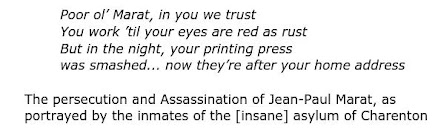
"The Death of Marat," in pen and ink.
"Saving Grace"
It is a costly extravagance for most Americans, roughly equal to the 
entire US debt added in this century. But it pays huge dividends
 for powerful participants; suppliers, lobbyists, and politicians.
by Bill Bonner

Baltimore, Maryland - "There is something so sweetly innocent... so endearingly naïve... about a revolution - even a fake one. Trying to Make America Great Again, for example. The thrill of a new start... a new direction... another chance to build a better world. The exhilaration of calling each other ‘citoyen’... or comrade... of holding mass rallies, giving the prescribed salute or waving copies of Mao’s Little Red Book. It’s like losing your virginity or discovering online sports betting; it opens up a world of pleasant possibilities.

We recall the Grace Commission, in which Ronald Reagan asked businessman Peter Grace to “drain the swamp... be bold. We want your team to work like tireless bloodhounds. Don’t leave any stone unturned in your search to root out inefficiency.”

The results of the study came out in 47 volumes, in 1984, concluding: "With two thirds of everyone's personal income taxes wasted or not collected, 100 percent of what is collected is absorbed solely by interest on the federal debt and by federal government contributions to transfer payments. In other words, all individual income tax revenues are gone before one nickel is spent on the services that taxpayers expect from their government."

But hope springs up from time to time... and now, even our friend David Stockman is staying up late... working out the details. Well after midnight... his candle flickering... he labors over the obese body of US spending. He’s already found $400 billion in ‘fat’ that could be readily lipo-sucked from the US budget. Now, he’s got his scalpel into the muscle of the Empire - the military, industrial, surveillance, full spectrum dominance complex.

There, he finds another $500 billion - a half-trillion per year that could be Ozempic-ed by simply returning to an America First strategy. There are no enemies on earth that could possibly mount a conventional attack on the US. Their war fleets (which they don’t have)... built and sustained by their large economies (that they don’t have)... sent out by conquest-lusting megalomaniacs (which they don’t have)... from huge military-grade ports in Siberia or on the Black Sea (which don’t exist)... equipped with the millions of troops, supplies and sophisticated weapons needed to overcome US resistance (which they don’t have) would be spotted from the air by tourists... and obliterated by US bombers, missiles and submarines... long before they got anywhere near California or New Jersey.

The only real vulnerability of the US is nuclear. And the answer to that is America’s nuclear Triad... submarines, bombers, and missiles - all carrying things that go ‘boom’ in a major way. The cost of this protection, however, is less than one-tenth of the present all-in Empire budget.

But power is the ultimate aphrodisiac, as Mr. Kissinger pointed out. And once you can get away with it, throwing your weight around becomes irresistible. You become the ‘indispensable nation’ (Madeleine Albright), without whom ‘nothing good happens.’ So, instead of spending, say, $100 billion per year on a reasonable ‘defense’ strategy, the US spends $1 trillion-plus... and gets to meddle in places most Americans have never heard of.

This is a costly extravagance for most Americans... roughly equal to the entire US debt added in this century. But it pays huge dividends for a few powerful participants, suppliers, cheerleaders, lobbyists, and politicians.

The budget cutters - including, notably, Musk and Ramaswamy - may have charm and logic on their side. Mr. Stockman has the numbers. And who wants to waste $500 billion every year? But on the other side are those who get the $500 billion... and have a keen incentive to keep it.

They use the money to buy complex, probably useless, weapons systems... with enough ‘fat’ in the contracts to support politicians, lobbyists and think-tanks who will argue for more of them. They will explain how it is vital to US security to bomb even the poorest people on earth... people who could not possibly do the US any significant harm. They will see the benefit in even larger outlays... to counter even less likely threats... in even more implausible ways.

They do not want revolution; they want things to remain as they are. And by the way, these people are now very well armed... very well- funded... very well-schooled at bending America’s politics in their direction…and they’ll soon be looking for Mr. Ramaswamy’s home address! The Grace Commission handed in its report in 1986. A few of its recommendations were actually implemented, resulting in trivial savings. US deficits and debt continued to rise. We’ll see what happens this time."

"How It Really Is"


"The Question On Everyone’s Mind: Is This the End or the Beginning?"

"The Question On Everyone’s Mind: 
Is This the End or the Beginning?"
by Philbutler

"The desperate Western hegemony has been halted in its tracks by a stark warning from the Russians. Further escalation, especially making Ukraine into a nuclear-armed threat, has forced Vladimir Putin to admonish the waning liberal order with assured nuclear destruction. The comedian dictator in Kyiv is now begging to work the best deal for Washington and the rest; only Zelensky has nothing to bargain with. Other signs assure us that the Ukraine debacle is drawing to a close and that a new and brighter world may be on the horizon.

Turning the page from this foregone conclusion, we see Mr. Putin is placing new puzzle pieces for the coming solidarity of nations seeking a multipolar world. Putin has announced that Russia is ready for new large-scale projects with Kazakhstan, the world’s ninth-largest nation. Russia’s southern neighbour has been under constant assault from Washington to swing Central Asia’s most prosperous nation into the liberal order’s orbit. Astana is now magnetized toward Moscow and the economic horizon the BRICS promise.

The “So Big” World: Looking past geography and Kazakhstan’s strategic position, Western hegemons will lose one country brimming with valuable natural resources when the Ukraine conflict is ended. In the bigger picture, Vladimir Putin’s strategies combined with the best interests of China, India, Iran, and a laundry list of nations have started the domino effect of Cold War lunatics once feared. It should be noted that Kazakhstan has the world’s second-largest uranium, chromium, lead, and zinc reserves. The landlocked nation in a critical strategic location bordering the Caspian Sea to the West and China to the East also possesses the third-largest manganese reserves; the fifth-largest copper reserves; and ranks in the top ten for coal, iron, and gold. I won’t bore the reader with a cumulative list of world resources this multipolar community possesses. The world is only so big, you know?

Even here in Greece, the newspapers (Greek language) are eager to report that Zelensky is ready to surrender if Ukraine becomes a NATO nation. As ludicrous as this proposal is, it signals the end of a senseless conflict that could have been avoided a decade ago. It’s also emblematic of the same way many in my circle are behaving. Everyone I talk to asks me, “What are the chances of a nuclear war?” Others ask an even more chilling question, they query me, “Would the Russians launch a first strike with their new weapons?” I ask myself, “Well, do they want my real opinion or a comforting pat on the back?”

To Get “It” Over With? If you were a nation that had been assaulted on every side by powers that seem to be led by a Satanic cult, would you take advantage of a new first-strike option that could not be stopped? Furthermore, as Mr. Putin readily admitted in a press conference, the much feared and talked about Oreshnik that was “tested” in Dnipo did not even have explosive warheads, conventional or nuclear. The Russian president pointed out that the kinetic and heat energy of the empty warheads was sufficient to eliminate targets. I’ll let the reader forecast a conventional weapon capable of the same destruction as a nuclear warhead.

Ballistic missiles carrying multiple nuclear warheads that can be independently targeted and plummet toward their targets anywhere on the globe at 11 times the speed of sound affords strategists interesting potentialities. That’s my honest answer. It’s a good thing the Russians, Chinese, Iranians, and the other nations that have been pushed about by Britain, the EU, and especially my own country don’t need to obliterate anybody. Only the people behind inept imbeciles like Joe Biden need an emergency measure. Ukraine is lost, the people cannot freeze for one more Winter, and there are no more young men and women to sacrifice on the altar of dominion.

I hope that the Londoners, the New Yorkers, Parisians, and the Berliners in charge are now at the drawing board unveiling PLAN B. One can only reason that these geniuses of power have a contingency in place other than killing us all off alongside them. The Western elites may have some pseudo-capitalist scheme to fit in rather than control the world completely. As a geographer, I cannot help but notice how small the Western empire is becoming now. Take a look at a map sometime soon. Let’s see if there is a “next” move by my country and her now shaky allies."

Adventures With Danno, "Saver Deals At Aldi You Should Be Buying Right Now!"

Full screen recommended.
Adventures With Danno, AM 12/6/24
"Saver Deals At Aldi You Should Be Buying Right Now!"
Comments here: