StatCounter

Sunday, January 30, 2022

"Yes to Life, in Spite of Everything"

"Yes to Life, in Spite of Everything: Viktor Frankl’s
Lost Lectures on Moving Beyond Optimism and
Pessimism to Find the Deepest Source of Meaning"
by Maria Popova

“To decide whether life is worth living is to answer the fundamental question of philosophy,” Albert Camus wrote in his classic 119-page essay "The Myth of Sisyphus" in 1942. “Everything else… is child’s play; we must first of all answer the question.” Sometimes, life asks this question not as a thought experiment but as a gauntlet hurled with the raw brutality of living.

That selfsame year, the young Viennese neurologist and psychiatrist Viktor Frankl (March 26, 1905–September 2, 1997) was taken to Auschwitz along with more than a million human beings robbed of the basic right to answer this question for themselves, instead deemed unworthy of living. Some survived by readingSome through humor. Some by pure chance. Most did not. Frankl lost his mother, his father, and his brother to the mass murder in the concentration camps. His own life was spared by the tightly braided lifeline of chance, choice, and character.

A mere eleven months after surviving the unsurvivable, Frankl took up the elemental question at the heart of Camus’s philosophical parable in a set of lectures, which he himself edited into a slim, potent book published in Germany in 1946, just as he was completing "Man’s Search for Meaning."

As our collective memory always tends toward amnesia and erasure - especially of periods scarred by civilizational shame - these existential infusions of sanity and lucid buoyancy fell out of print and were soon forgotten. Eventually rediscovered - as is also the tendency of our collective memory when the present fails us and we must lean for succor on the life-tested wisdom of the past - they are now published in English for the first time as "Yes to Life: In Spite of Everything" (public library).

Frankl begins by considering the question of whether life is worth living through the central fact of human dignity. Noting how gravely the Holocaust disillusioned humanity with itself, he cautions against the defeatist “end-of-the-world” mindset with which many responded to this disillusionment, but cautions equally against the “blithe optimism” of previous, more naïve eras that had not yet faced this gruesome civilizational mirror reflecting what human beings are capable of doing to one another. Both dispositions, he argues, stem from nihilism. In consonance with his colleague and contemporary Erich Fromm’s insistence that we can only transcend the shared laziness of optimism and pessimism through rational faith in the human spirit, Frankl writes: "We cannot move toward any spiritual reconstruction with a sense of fatalism such as this."

Generations and myriad cultural upheavals before Zadie Smith observed that “progress is never permanent, will always be threatened, must be redoubled, restated and reimagined if it is to survive,” Frankl considers what “progress” even means, emphasizing the centrality of our individual choices in its constant revision: "Today every impulse for action is generated by the knowledge that there is no form of progress on which we can trustingly rely. If today we cannot sit idly by, it is precisely because each and every one of us determines what and how far something “progresses.” In this, we are aware that inner progress is only actually possible for each individual, while mass progress at most consists of technical progress, which only impresses us because we live in a technical age."

Insisting that it takes a measure of moral strength not to succumb to nihilism, be it that of the pessimist or of the optimist, he exclaims: "Give me a sober activism anytime, rather than that rose-tinted fatalism! How steadfast would a person’s belief in the meaningfulness of life have to be, so as not to be shattered by such skepticism. How unconditionally do we have to believe in the meaning and value of human existence, if this belief is able to take up and bear this skepticism and pessimism?
[…]
Through this nihilism, through the pessimism and skepticism, through the soberness of a “new objectivity” that is no longer that “new” but has grown old, we must strive toward a new humanity."

Sophie Scholl, upon whom chance did not smile as favorably as it did upon Frankl, affirmed this notion with her insistence that living with integrity and belief in human goodness is the wellspring of courage as she courageously faced her own untimely death in the hands of the Nazis. But while the Holocaust indisputably disenchanted humanity, Frankl argues, it also indisputably demonstrated “that what is human is still valid… that it is all a question of the individual human being.” Looking back on the brutality of the camps, he reflects:

"What remained was the individual person, the human being - and nothing else. Everything had fallen away from him during those years: money, power, fame; nothing was certain for him anymore: not life, not health, not happiness; all had been called into question for him: vanity, ambition, relationships. Everything was reduced to bare existence. Burnt through with pain, everything that was not essential was melted down - the human being reduced to what he was in the last analysis: either a member of the masses, therefore no one real, so really no one - the anonymous one, a nameless thing (!), that “he” had now become, just a prisoner number; or else he melted right down to his essential self."

In a sentiment that bellows from the hallways of history into the great vaulted temple of timeless truth, he adds: "Everything depends on the individual human being, regardless of how small a number of like-minded people there is, and everything depends on each person, through action and not mere words, creatively making the meaning of life a reality in his or her own being."

Frankl then turns to the question of finding a sense of meaning when the world gives us ample reasons to view life as meaningless - the question of “continuing to live despite persistent world-weariness.” Writing in the post-war pre-dawn of the golden age of consumerism, which has built a global economy by continually robbing us of the sense of meaning and selling it back to us at the price of the product, Frankl first dismantles the notion that meaning is to be found in the pursuit and acquisition of various pleasures:

"Let us imagine a man who has been sentenced to death and, a few hours before his execution, has been told he is free to decide on the menu for his last meal. The guard comes into his cell and asks him what he wants to eat, offers him all kinds of delicacies; but the man rejects all his suggestions. He thinks to himself that it is quite irrelevant whether he stuffs good food into the stomach of his organism or not, as in a few hours it will be a corpse. And even the feelings of pleasure that could still be felt in the organism’s cerebral ganglia seem pointless in view of the fact that in two hours they will be destroyed forever. But the whole of life stands in the face of death, and if this man had been right, then our whole lives would also be meaningless, were we only to strive for pleasure and nothing else — preferably the most pleasure and the highest degree of pleasure possible. Pleasure in itself cannot give our existence meaning; thus the lack of pleasure cannot take away meaning from life, which now seems obvious to us."

He quotes a short verse by the great Indian poet and philosopher Rabindranath Tagore - the first non-European to win the Nobel Prize, Einstein’s onetime conversation partner in contemplating science and spirituality, and a man who thought deeply about human nature:

"I slept and dreamt
that life was joy.
I awoke and saw
that life was duty.
I worked - and behold,
duty was joy."

In consonance with Camus’s view of happiness as a moral obligation - an outcome to be attained not through direct pursuit but as a byproduct of living with authenticity and integrity - Frankl reflects on Tagore’s poetic point: "So, life is somehow duty, a single, huge obligation. And there is certainly joy in life too, but it cannot be pursued, cannot be “willed into being” as joy; rather, it must arise spontaneously, and in fact, it does arise spontaneously, just as an outcome may arise: Happiness should not, must not, and can never be a goal, but only an outcome; the outcome of the fulfillment of that which in Tagore’s poem is called duty… All human striving for happiness, in this sense, is doomed to failure as luck can only fall into one’s lap but can never be hunted down."

In a sentiment James Baldwin would echo two decades later in his superb forgotten essay on the antidote to the hour of despair and life as a moral obligation to the universe, Frankl turns the question unto itself: "At this point it would be helpful [to perform] a conceptual turn through 180 degrees, after which the question can no longer be “What can I expect from life?” but can now only be “What does life expect of me?” What task in life is waiting for me?"

Now we also understand how, in the final analysis, the question of the meaning of life is not asked in the right way, if asked in the way it is generally asked: it is not we who are permitted to ask about the meaning of life - it is life that asks the questions, directs questions at us… We are the ones who must answer, must give answers to the constant, hourly question of life, to the essential “life questions.” Living itself means nothing other than being questioned; our whole act of being is nothing more than responding to - of being responsible toward - life. With this mental standpoint nothing can scare us anymore, no future, no apparent lack of a future. Because now the present is everything as it holds the eternally new question of life for us.

Frankl adds a caveat of tremendous importance - triply so in our present culture of self-appointed gurus, self-help demagogues, and endless podcast feeds of interviews with accomplished individuals attempting to distill a universal recipe for self-actualization: "The question life asks us, and in answering which we can realize the meaning of the present moment, does not only change from hour to hour but also changes from person to person: the question is entirely different in each moment for every individual.

We can, therefore, see how the question as to the meaning of life is posed too simply, unless it is posed with complete specificity, in the concreteness of the here and now. To ask about “the meaning of life” in this way seems just as naive to us as the question of a reporter interviewing a world chess champion and asking, “And now, Master, please tell me: which chess move do you think is the best?” Is there a move, a particular move, that could be good, or even the best, beyond a very specific, concrete game situation, a specific configuration of the pieces?"

What emerges from Frankl’s inversion of the question is the sense that, just as learning to die is learning to meet the universe on its own terms, learning to live is learning to meet the universe on its own terms - terms that change daily, hourly, by the moment:

"One way or another, there can only be one alternative at a time to give meaning to life, meaning to the moment — so at any time we only need to make one decision about how we must answer, but, each time, a very specific question is being asked of us by life. From all this follows that life always offers us a possibility for the fulfillment of meaning, therefore there is always the option that it has a meaning. One could also say that our human existence can be made meaningful “to the very last breath”; as long as we have breath, as long as we are still conscious, we are each responsible for answering life’s questions."

With this symphonic prelude, Frankl arrives at the essence of what he discovered about the meaning of life in his confrontation with death - a central fact of being at which a great many of humanity’s deepest seers have arrived via one path or another: from Rilke, who so passionately insisted that “death is our friend precisely because it brings us into absolute and passionate presence with all that is here, that is natural, that is love,” to physicist Brian Greene, who so poetically nested our search for meaning into our mortality into the most elemental fact of the universe. Frankl writes:

"The fact, and only the fact, that we are mortal, that our lives are finite, that our time is restricted and our possibilities are limited, this fact is what makes it meaningful to do something, to exploit a possibility and make it become a reality, to fulfill it, to use our time and occupy it. Death gives us a compulsion to do so. Therefore, death forms the background against which our act of being becomes a responsibility.
[…]
Death is a meaningful part of life, just like human suffering. Both do not rob the existence of human beings of meaning but make it meaningful in the first place. Thus, it is precisely the uniqueness of our existence in the world, the irretrievability of our lifetime, the irrevocability of everything with which we fill it - or leave unfulfilled - that gives our existence significance. But it is not only the uniqueness of an individual life as a whole that gives it importance, it is also the uniqueness of every day, every hour, every moment that represents something that loads our existence with the weight of a terrible and yet so beautiful responsibility! Any hour whose demands we do not fulfill, or fulfill halfheartedly, this hour is forfeited, forfeited “for all eternity.” Conversely, what we achieve by seizing the moment is, once and for all, rescued into reality, into a reality in which it is only apparently “canceled out” by becoming the past. In truth, it has actually been preserved, in the sense of being kept safe. Having been is in this sense perhaps even the safest form of being. The “being,” the reality that we have rescued into the past in this way, can no longer be harmed by transitoriness."

In the remainder of the slender and splendid "Yes to Life", Frankl goes on to explore how the imperfections of human nature add to, rather than subtract from, the meaningfulness of our lives and what it means for us to be responsible for our own existence. Complement it with Mary Shelley, writing two centuries ago about a pandemic-savaged world, on what makes life worth living, Walt Whitman contemplating this question after surviving a paralytic stroke, and a vitalizing cosmic antidote to the fear of death from astrophysicist and poet Rebecca Elson, then revisit Frankl on humor as lifeline to sanity and survival."

Gregory Mannarino, "Markets, A Look Ahead: A Massive Opportunity Is Developing"

Gregory Mannarino, PM 1/30/22:
"Markets, A Look Ahead: 
A Massive Opportunity Is Developing"

"The Economic Pain Continues - Living through the Global Insanity"

Full screen recommended.
Dan, iAllegedly PM 1/30/22:
"The Economic Pain Continues - Living through the Global Insanity"
"We need to learn to live with the economy we have. The economic Insanity Continues. Everything is chaotic and we can still get ahead knowing this. I am at Seal Cove in La Jolla."

"How It Really Is"


"America’s Social Order Is Unraveling"

"America’s Social Order Is Unraveling"
by Charles Hugh Smith

"What kind of nation boasts a record-high stock market and an unraveling social order? Answer: a failed nation, a nation that has substituted artifice for realism for far too long, a nation that now depends on illusory phantoms of capital, prosperity and democracy to prop up a crumbling facade of “wealth” that the populace now understands is largely in the hands of a few families and corporations, most of which pay little to support the citizenry they dominate politically and financially.

The social order sounds abstract, but it is all too real. The social order has two primary components: social cohesion, the glue of common purpose and shared sacrifice binding the social order, and the social contract, the implicit contract between the ruling elite, the state (government) and commoners (the middle class, the working poor and state dependents) that their labor, taxes and sacrifices will nourish a society with a level playing field, broad-based opportunity and security.

America’s social cohesion has been lost, ground under the heel of soaring inequality, a two-tiered economic/political order, systemic unfairness and the elite’s divide-and-conquer manipulation of the political and cultural orders.
Historian Peter Turchin characterized this social unraveling as disintegrative: people no longer find reasons to cooperate and share sacrifices to work towards a common national purpose. Rather, they find a multitude of reasons to offload sacrifices onto others, hoard their own wealth and seek to expand their power by accelerating the disintegrative forces.

There is no debate about the collapse of America’s social contract, there are only varying levels of self-serving denial. Commoners have awakened to the emptiness of the conventional promise to get a college degree, work hard and you’ll be rewarded with security and prosperity. Huge swaths of America are a ransacked, decaying shell of a society reminiscent of developing nations suffering under the jackboot of kleptocrats.

America’s fast-expanding class of billionaires are doing their best to mimic the clueless French nobility just before France’s convulsive revolution in 1789: America’s billionaires bleat that they should pay more taxes while their lobbying bulldozes gigantic loopholes in the tax code, enabling Apple and other global giants to escape U.S. taxes.

America’s billionaires are busy building $500 million private yachts and private spaceships while proclaiming their globally distributed sweatshops are raising all boats in a tide of money conjured out of thin air by the billionaires’ central bankers.

America’s ruling elite has rewritten the social contract to benefit itself at the expense of the bottom 99.9%. Studies have confirmed that the bottom 99.9% hold virtually no political power, and the bottom 90% collect a pitiful 3% of all income generated by capital and hold an inconsequentially thin slice of the nation’s wealth.


"Trends in Income From 1975 to 2018:" $50 trillion in earnings has been transferred to the Financial Aristocracy from the bottom 90% of American households over the past 45 years.

"Monopoly Versus Democracy: How to End a Gilded Age:": Ten percent of Americans now control 97 percent of all capital income in the country. Nearly half of the new income generated since the global financial crisis of 2008 has gone to the wealthiest one percent of U.S. citizens. The richest three Americans collectively have more wealth than the poorest 160 million Americans.

As I pointed out in "Is a Cultural Revolution Brewing in America?" (4/9/21), actions have consequences and cultural revolutions result from the suppression of legitimate political expression and the failure of the regime to meet its lofty idealistic goals.

When there is no relief valve in a collapsing social order, the explosive pressure is eventually released in a Cultural Revolution that unleashes all the bottled-up frustrations on elites. These frustrations have no outlet politically because they’re threatening to the status quo and therefore suppressed at every turn. Put another way, if the pendulum is pushed to an extreme of exploitation, suppression and inequality, when it’s released, it will reach an equivalent extreme (minus a bit of friction) at the opposite end. That could be an unexpected but entirely foreseeable Cultural Revolution.

Those who claim that can’t happen in America are safely outside the pressure cooker, protected by a delusional confidence that since I’m doing great, everyone is doing great. Since real political agency is no longer allowed, the pressure will find release outside the political system. The lobbyists will still be haunting the hallways of governance, but no one will care, for The falcon will no longer hear the falconer. The unraveling of America’s social order is accelerating, and denial will not save us from the consequences of the plundering of the social contract."

"Roll The Dice"

"Life's a gamble. Courage is to roll the dice and go
for the gusto when all odds and bets are against you!"
- Bobby Compton
Charles Bukowski, "Roll The Dice"

Greg Hunter, "Covid War Ending – Gerald Celente"

"Covid War Ending – Gerald Celente"
By Greg Hunter’s USAWatchdog.com 

"Renowned trends researcher and publisher of “The Trends Journal,” Gerald Celente, boldly predicted back in April 2021, “We are going to start seeing a big anti-vax movement.” He was spot on. Now, Celente has another bold prediction: “The Covid War is coming to an end.” Celente explains, “On the virus, my forecast is the Covid war is going to end. Wind down, I should say significantly, by the end of March to mid-April. The new fear they are going to be selling after that is climate change.”

The wind down of Covid is really financial necessity. Celente says, “It’s killing businesses. New York City is a dead town. One after another you look at the places going out of business, and they are getting push back now. They can’t go on with this anymore. They are killing the hospitality business, the restaurant business, they are all going down. They can’t go on like this, and they need the tax money. Politicians never work a day in their lives, so they need the money coming in.”

On the economic front, Celente predicted months ago that the Fed would be forced to raise rates. Now, the official inflation rate is 7%. The Fed is going to raise rates to fight inflation. Celente says, “Here is our forecast. This is a Paul Volker 2.0. You go back to 1982 and inflation was skyrocketing. They dramatically raised interest rates to stop it. (The Fed Funds Rate hit 20% under Volker’s plan.) So, they stopped inflation. They also dragged down the economy. The markets are going to go down. I don’t see a crash, at this point, in real estate.”

Celente also says oil could keep rising and inflation too. Celente says, “They are going to have to keep raising interest rates more and more to fight inflation, and if that keeps going, that’s when it will collapse. If inflation keeps going up and they have to raise rates much beyond the 2% mark, it’s over.”

Celente also gives his take on what is going on in Ukraine, and it’s not flattering to the Biden Administration. Celente talks about many other top trends as well."

Join Greg Hunter on Rumble as he goes One-on-One with the top trends researcher on the planet, Gerald Celente, publisher of "The Trends Journal". (There is much more in the 57 min. interview.)

Saturday, January 29, 2022

Musical Interlude: Foy Vance, Ed Sheeran, "Make it Rain"

Foy Vance, "Make it Rain"
The original, Ed Sheeran's version is the cover.
Ed Sheeran, "Make it Rain"

"A Look to the Heavens"

“Why is the sky near Antares and Rho Ophiuchi so colorful? The colors result from a mixture of objects and processes. Fine dust illuminated from the front by starlight produces blue reflection nebulae. Gaseous clouds whose atoms are excited by ultraviolet starlight produce reddish emission nebulae. Backlit dust clouds block starlight and so appear dark.
Antares, a red supergiant and one of the brighter stars in the night sky, lights up the yellow-red clouds on the lower center. Rho Ophiuchi lies at the center of the blue nebula near the top. The distant globular cluster M4 is visible just to the right of Antares, and to the lower left of the red cloud engulfing Sigma Scorpii. These star clouds are even more colorful than humans can see, emitting light across the electromagnetic spectrum.”

"The Story Of Man"

“The sands of time blew into a storm of images... images in sequence to tell the truth! Glorious legends of revolutionaries, bound only by a desire to be true to themselves, and to hope! Parables of colliding worlds, of forbidden love, of enemies healing the wounds of circumstance! Projected myth of persecution through greed and selfishness... and the will to survive! The Will to survive! And to survive in the face of those who claim credit for your very existence! We survive not as pawns, but as agents of hope. Sometimes misunderstood, but always true to our story. The story of Man."
- Scott Morse
Vangelis, "Alpha"
This song always suggested the image of our relentless, idealized, noble, glorious March of Mankind through the ages. Despite it all, despite ourselves, we survive and march onward towards our unknown destiny.

Still, some wonder about our true nature as a species, as the Apex Predator of this planet, as Sir Arthur Conan Doyle did when he asked,“What can we know? What are we all? Poor silly half-brained things peering out at the infinite, with the aspirations of angels and the instincts of beasts.” Indeed, Angelic aspirations regardless, the historical record suggests a less benevolent but far more accurate and truthful view of the instincts of beasts within Humanity...
Steve Cutts, "MAN"
“What a chimera then is man, what a novelty, what a monster, what chaos, what a subject of contradiction, what a prodigy! Judge of all things, yet an imbecile earthworm; depository of truth, yet a sewer of uncertainty and error; pride and refuse of the universe. Who shall resolve this tangle?”
- Blaise Pascal

"Pride and refuse," indeed...

The Poet: W.H. Auden, "September 1, 1939"


"September 1, 1939"

"Defenseless
under the night
Our world in stupor lies;
Yet, dotted everywhere,
Ironic points of light
Flash out
wherever the Just
Exchange their messages:
May I, composed like them
Of Eros and of dust,
Beleaguered by the same
Negation and despair,
Show an affirming flame."

- W.H. Auden
"On September 1, 1939, the German army under Adolf Hitler launched an invasion of Poland that triggered the start of World War II (though by 1939 Japan and China were already at war). The battle for Poland only lasted about a month before a Nazi victory. But the invasion plunged the world into a war that would continue for almost six years and claim the lives of tens of millions of people."

"The War Against Will"

"The War Against Will"
by Paul Rosenberg

"The modern world will allow you to join any of a thousand collectives, but it will punish you for standing on your own, as a self-willed entity. People who commit this crime understand that they are outlaws in the present world. And if at first they don’t understand that, the world makes sure they know.

The world as it is, then, is the enemy of will. This is nothing new, of course, governments have been at war against will since they began: How else can you get people to blindly obey you, to hand over half their income, and to thank you for it? People who possess a full and active will must be convinced to do things, and governments couldn’t function if they had to do that.

The present world is built around the restraint of will, and not just on the government level. Advertising, for example, is more or less devoted to implanting subconscious desires and subverting the will with them. In dysfunctional families, manipulating one another – whether by guilt, ridicule, being left out of Papa’s will or whatever – is the currency of the realm.

And so obedience, consumption and acquiescence have become cardinal virtues, and the avoidance of immediate pain the prime directive. As we might paraphrase an old apostle, this world’s God is the belly.

The Willful, For Whom Heaven And Earth Were Created: All human creativity functions on individual will. Everyone interested in creativity knows this, and here are just a couple of passages to make the point:

"Everything that is really great and inspiring is
created by the individual who can labor in freedom."
- Albert Einstein

"This I believe: that the free, exploring mind of the
individual human is the most valuable thing in the world."
- John Steinbeck

It is the active will of individuals that has created everything good in this world. Really, life comes down to a choice between creativity and entropy:

• The world (the realm of officialdom, acquiescence and so on) is an incarnation of entropy, winding down and collapsing once the fuel left to it by creative men and women of the past is burned out.
• The creatives, who are willing to take blows in defense of their willfulness, and who bless the world in myriad ways

The willful, then, are creativity incarnate; the universe is and ought to be dedicated to beings of their type. It should also be populated by beings of their type, and I think someday shall be. This is not to say that entropic people can’t make their way out of entropy and join the creatives; in fact they can, and do, on a daily basis. Still, it is a gulf that must be crossed, and the only way across is to act on one’s own will, alone, and for purely self-generated reasons. That is the price.

The Automated War On Will: The great threat of the modern world is a system I call Descartes’ Demon, the Big Data/AI personalized manipulation system that is already in daily use. I held back talking about this for years, seeing that it was too much for people to bear, but the beast has progressed so far that I can’t see holding back any further.

The Matrix, as it turns out, was all too true, and its world is now the world of Facebook, Twitter and especially Google. The real-life version of The Matrix is functional, right now. (See here for explanation, or here for illustration.) What personalized manipulation is really all about is the subversion of individual will. And if you don’t think it’s happening, pull up YouTube on your smart phone, then ask your friend to pull it up on his or hers: You’re already receiving personalized pages. The world is deeply committed to passing this off as trivial and ridiculing those that don’t. But it isn’t trivial; it’s a present and actual war against free will.

We Are Inherently Creative: Humans are inherently creative beings. We cannot create matter out of nothing, but we can mold it to an infinite number and variety of uses. We are the fountains of new and beneficial action in the universe. And we ought to function that way.

I’ll leave you with a few words from Albert Schweitzer: "Civilization can only revive when there shall come into being in a number of individuals a new tone of mind independent of the one prevalent among the crowd and in opposition to it… It is only an ethical movement which can rescue us from the slough of barbarism, and the ethical comes into existence only in individuals." This is what we need… and we need it now."
Full screen recommended.

"The New Normal is Empty Shelves and Runaway Inflation"

Full screen recommended.
Dan, iAllegedly, PM 1/29/22:
"The New Normal is Empty Shelves and Runaway Inflation"
"People are selling their cars back to their dealerships and getting out of high lease payments and car payments. We are seeing store shelves empty again and Inflation is out of control."

The Daily "Near You?"

Oaxaca, Mexico. Thanks for stopping by!

Rumi, "The Guest House"

"The Guest House"

"This being human is a guest house.
Every morning a new arrival.
A joy, a depression, a meanness,
some momentary awareness comes
as an unexpected visitor.
Welcome and entertain them all!
Even if they're a crowd of sorrows,
who violently sweep your house
empty of its furniture,
still, treat each guest honorably.
He may be clearing you out
for some new delight.
The dark thought, the shame, the malice,
meet them at the door laughing,
and invite them in.
Be grateful for whoever comes,
because each has been sent
as a guide from beyond."

~ Rumi
"Jalal al-Din Muhammad Rumi was a 13th century Afghan poet and philosopher who heavily influenced both eastern and western poetry. His poetry is divided into categories: the quatrains and odes of the "Divan," the six books the "Masnavi," the discourses, the letters and the "Six Sermons." Rumi's major poetic work is "Matnawiye Ma'nawi," a six-volume poem, considered by many literary critics to be one of the greatest works of mystical poetry ever written. Rumi's prose works included "Fihi Ma Fihi," "Majalese Sab'a" and "Maktubat." His prose work largely contains sermons and lectures given by Rumi to his disciples and family members. Following Rumi's death, his followers founded the Mevlevi Order, also known as the "Whirling Dervishes."
Free downloads:
Freely download "The Divan" and "The Masnavi" here:

"We Must Ask Ourselves..."

''As Americans, we must ask ourselves: Are we really so different? Must we stereotype those who disagree with us? Do we truly believe that ALL red-state residents are ignorant racist fascist knuckle-dragging NASCAR-obsessed cousin-marrying roadkill-eating tobacco juice-dribbling gun-fondling religious fanatic rednecks; or that ALL blue-state residents are godless unpatriotic pierced-nose Volvo-driving France-loving left-wing communist latte-sucking tofu-chomping holistic-wacko neurotic vegan weenie perverts?''
- Dave Barry

"In The Time Of Your Life..."

"In the time of your life, live - so that in good time there shall be no ugliness or death for yourself or for any life your life touches. Seek goodness everywhere, and when it is found, bring it out of its hiding-place and let it be free and unashamed. Place in matter and in flesh the least of the values, for these are things that hold death and must pass away. Discover in all things that which shines and is beyond corruption. Encourage virtue in whatever heart it may have been driven into secrecy and sorrow by the shame and terror of the world. Ignore the obvious, for it is unworthy of the clear eye and the kindly heart. Be the inferior of no man, nor of any man be the superior. Remember that every man is a variation of yourself. No man's guilt is not yours, nor is any man's innocence a thing apart. Despise evil and ungodliness, but not men of ungodliness or evil. These, understand. Have no shame in being kindly and gentle, but if the time comes in the time of your life to kill, kill and have no regret. In the time of your life, live - so that in that wondrous time you shall not add to the misery and sorrow of the world, but shall smile to the infinite delight and mystery of it."
- William Saroyan

"The Bewildered Herd..."

“The bewildered herd is a problem. We've got to prevent their roar and trampling. We've got to distract them. They should be watching the Superbowl or sitcoms or violent movies. Every once in a while you call on them to chant meaningless slogans like "Support our troops!" You've got to keep them pretty scared, because unless they're properly scared and frightened of all kinds of devils that are going to destroy them from outside or inside or somewhere, they may start to think, which is very dangerous, because they're not competent to think. Therefore it's important to distract them and marginalize them.”
- Noam Chomsky
"Those who can make you believe absurdities
can make you commit atrocities."
- Voltaire

“In The Long Run… We Are All Alive”

“In The Long Run… We Are All Alive”
by MN Gordon

“In 1976, economist Herbert Stein, father of Ben Stein, the economics professor in Ferris Bueller’s Day Off, observed that U.S. government debt was on an unsustainable trajectory. He, thus, established Stein’s Law: “If something cannot go on forever, it will stop.” Stein may have been right in theory. Yet the unsustainable trend of U.S. government debt outlasted his life. Herbert Stein died in 1999, several decades before the crackup. Those reading this may not be so lucky.

Sometimes the end of the world comes and goes, while some of us are still here. We believe our present episode of debt, deficits, and state sponsored economic destruction, is one of these times.. We’ll have more on this in just a moment. But first, let’s peer back several hundred years. There we find context, edification, and instruction.

In 1696, William Whiston, a protégé of Isaac Newton, wrote a book. It had the grandiose title, “A New Theory of the Earth from its Original to the Consummation of All Things.” In it he proclaimed, among other things, that the global flood of Noah had been caused by a comet. Mr. Whiston took his book very serious. The good people of London took it very serious too. Perhaps it was Whiston’s conviction. Or his great fear of comets. But, for whatever reason, it never occurred to Londoners that he was a Category 5 quack.

Like Neil Ferguson, and his mathematical biology cohorts at Imperial College, London, Whiston’s research filled a void. Much like today’s epidemiological models, the science was bunk. Nonetheless, the results supplied prophecies of the apocalypse to meet a growing demand. It was just a matter of time before Whiston’s research would cause trouble…

Judgement Day: In 1736, William Whiston crunched some data and made some calculations. He projected these calculations out and saw the future. And what he witnessed scared him mad. He barked. He ranted. He foamed at the mouth to anyone who would listen. Pretty soon he’d stirred up his neighbors with a prophecy that the world would be destroyed on October 13th of that year when a comet would collide with the earth.

Jonathan Swift, in his work, “A True and Faithful Narrative of What Passed in London on a Rumour of the Day of Judgment,” quoted Whiston: “Friends and fellow-citizens, all speculative science is at an end: the period of all things is at hand; on Friday next this world shall be no more. Put not your confidence in me, brethren; for tomorrow morning, five minutes after five, the truth will be evident; in that instant the comet shall appear, of which I have heretofore warned you. As ye have heard, believe. Go hence, and prepare your wives, your families, and friends, for the universal change.”

Clergymen assembled to offer prayers. Churches filled to capacity. Rich and paupers alike feared their judgement. Lawyers worried about their fate. Judges were relieved they were no longer lawyers. Teetotalers got smashed. Drunks got sober. Bankers forgave their debtors. Criminals, to be executed, expressed joy.

The wealthy gave their money to beggars. Beggars gave it back to the wealthy. Several rich and powerful gave large donations to the church; no doubt, reserving first class tickets to heaven. Many ladies confessed to their husbands that one or more of their children were bastards. Husbands married their mistresses. And on and on…

The Archbishop of Canterbury, William Wake, had to officially deny this prediction to ease the public consternation. But it did little good. Crowds gathered at Islington, Hampstead, and the surrounding fields, to witness the destruction of London, which was deemed the “beginning of the end.” Then, just like Whiston said, a comet appeared. Prayers were made. Deathbed confessions were shared. And at the moment of maximum fear, something remarkable happened: the world didn’t end. The comet did not collide with earth. It was merely a near miss.

The experience of Whiston, and his pseudoscience prophecy, shows that predictions of the end of the world come and go while people still remain. Sometimes the fallout of these predictions, and the foolishness they provoke, is limited. Other times the foolishness they provoke leads to catastrophe. Here’s what we mean…

“In the long run we are all dead,” said 20th Century economist and Fabian socialist, John Maynard Keynes. This was Keynes rationale for why governments should borrow from the future to fund economic growth today. Of course, politicians love an academic theory that gives them cover to intervene in the economy. This is especially so when it justifies spending other people’s money to buy votes. Keynesian economics, and in particular, counter-cyclical stimulus, does just that.

U.S. politicians have attempted to borrow and spend the nation to prosperity for the last 80 years. Over the past decade, the Federal Reserve has aggressively printed money to fund Washington’s epic borrowing binge. The world as it was once known – where a dollar was as good as gold – has come and gone. Today, in life after the end of that world, we are witnessing the illusion of wealth, erected by four generations of borrowing and spending, crumble before our eyes. Moreover, contrary to Keynes, in the long run we are not all dead. In fact, in the long run we are all very much alive. And we are all living with the compounding consequences of shortsighted economic policies.”

"How It Really Is"


"Massive Shortages At Dollar General; Empty Shelves Everywhere!"

Full screen recommended.
Adventures with Danno, 1/29/22:
"Massive Shortages At Dollar General; Empty Shelves Everywhere!"
"In today's vlog we visit Dollar General, and witness massive food shortages! With stores struggling to get in products we are also dealing with another issue of skyrocketing prices. We will also check out the shelves as stores all across the country are having trouble."

Friday, January 28, 2022

Musical Interlude: Neil H, "Spellbound"; "Letting Go"

Neil H, "Spellbound"
Neil H, "Letting Go"

"Against All Odds..."

"There's a little animal in all of us and maybe that's something to celebrate. Our animal instinct is what makes us seek comfort, warmth, a pack to run with. We may feel caged, we may feel trapped, but still as humans we can find ways to feel free. We are each other's keepers, we are the guardians of our own humanity and even though there's a beast inside all of us, what sets us apart from the animals is that we can think, feel, dream and love. And against all odds, against all instinct, we evolve."
- "Grey's Anatomy"

"Our Time’s 1989 Moment, Maybe?"

"Our Time’s 1989 Moment, Maybe?"
by Eric Peters

"The good news is the wheels are finally coming off. It was the only way the runaway truck of Sickness Psychosis could ever be stopped. The Biden Thing’s heavy-handed attempt to force-medicate the entire country has been stymied by the courts – again! – which should make it much harder for the corporations to force-medicate employees. They now have both firmer ground to stand on as regards refusing to go along with it as well as the far more important pressure-relief valve of an alternative to it.

Without a government mandate, applicable everywhere, there will always be employers who don’t insist that employment is contingent upon being medicated. This makes it much more difficult for employers who do insist on it to continue so insisting. People can just quit – and go to work someplace sane. Leaving the insane other place without workers. It’s hard to get things done without them.

It’s kind of like having fifty different states,with some states having low (or even no) state income taxes and a more live-and-let-live culture. When there is a freedom option, most people will take it. And even if they don’t, the fact that they could applies a salutary pressure upon those who would take it away. Which is why the underlying theme of the Cult of Sickness Abiding was always and above all to take it away, everywhere. From “masks” to Jabs, the same for all – and everywhere.

Luckily for us, we do have fifty different states – including states like Florida, which provided not only an alternative but also an example. People there were not only free to show their faces, the fact that they did showed that not showing them wasn’t the magical talisman against sickness and death asserted by the Cult. It is certain that Florida’s example undermined the bogeyman assertions made by the Faucists, that failing to abide by the “guidelines” urged by them would guarantee death and doom.

When it didn’t, the Faucists began to look not merely like ridiculous hysterics but something more sinister. The apoplectic fury directed at Florida and especially at Florida’s governor, Ron DeSantis, makes no sense unless it is prompted by something other than “concern” for what is styled “public health” – an odd turn of phrase given there’s no such thing, except as a vague rhetorical abstraction. People are healthy or not. There is no such thing as collective (i.e., “public”) health.

By letting people breathe – and live – DeSantis established it was not necessary to force them to breathe through a “mask” – nor turn their lives upside down in order to continue living. Florida proved that normalcy is healthy. You’d think – if “concern” over people’s “health” were the driving motive – that the Faucists would have thanked DeSantis for proving them wrong. Perhaps even apologized for getting it wrong. Assuming they were well-intended. But admitting that DeSantis was right makes it harder to continue selling – imposing – what is wrong. What is evil.

People began to see the emperor’s new clothes. Rather, they began to see that the emperor was prancing around naked, his gray-haired man boobs flopping around in the breeze. The sight wasn’t – isn’t – pretty.

Now it looks like a whole country, Great Britain is going to follow Florida’s example. It will soon be legal for people in Great Britain to practice normalcy again, too. The whole show – all the Sickness Kabuki “practices” – is about to be shelved as far as being mandatory. No more “masking” – unless you want to. No more having to present paperwork documenting you’ve had your rabies shots to get a cup of coffee or shop, either.

This is going to make it harder for other European countries to continue practicing abnormalcy – for the same reason that Florida’s example is making it hard for other states in America to continue practicing it. Even in states where it is still technically expected – such as California – it is becoming harder to insist on it. This writer has family in Oceanside, CA – which is part of California, one of the states most firmly in thrall to the Cult of Sickness Abiding. And yet, even there, the rituals are losing their puissance because the mechanisms of the state aren’t insisting upon them. The city government says it is not going to enforce the state government’s decree that people “mask” in order to shop. And so, many don’t.

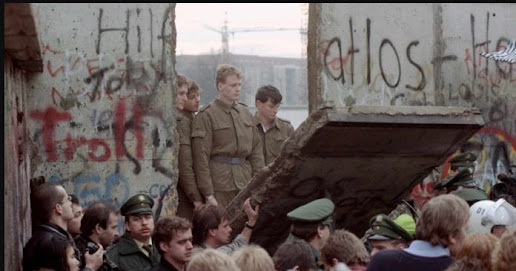
The more who don’t, the more who won’t. Sanity re-asserts itself. People see it’s ok to show their faces. More faces show. Color and life returns. This could be our time’s 1989 Moment – the reference being to the fall of the old Soviet Union and the coming down of the wall between East and West Berlin. As long as there was a West Berlin as a counterpoint to East Berlin, people wanted to get out of East Berlin. As long as there is something other than the Soviet Union, people will know that living in a Soviet Union isn’t the only way to live. With Florida leading the way, here – we may be on our way back to America, too."

"Apple Saves Stock Market Today; Economic Depression On Deck; FED Still Buying Assets"

Full screen recommended.
Jeremiah Babe, PM 1/28/22:
"Apple Saves Stock Market Today; Economic Depression On Deck;
FED Still Buying Assets"

"Chaos At Ports: Cargo Theft Soars 356% As Container Crisis Worsens In California"

Full screen recommended.
"Chaos At Ports: Cargo Theft Soars 356% 
As Container Crisis Worsens In California"
by Epic Economist

"Thieves have been raiding cargo containers every day and taking thousands of products that belong to consumers from all over the country. Shocking new images and footage published by CBS LA this week show debris ‘as far as the eye can see’ laying outside ports and across rail yards as massive package theft accelerates due to a record backlog of containers at the ports of Los Angeles and Long Beach.

Cargo is being stolen at ports way before dockworkers have a chance to unload the containers. And in rail yards, when trains stop in the downtown section of Union Pacific tracks to unload their wares, often staying overnight, thieves target them and take away all valuable merchandise they can find in the hauls. Giant piles of opened packages and torn cardboard boxes can be seen tossed along the train tracks and right off the twin California ports. And it’s more than just a pain – it’s costing a lot of money for everyone in the supply chain, including end consumers.

Many companies have reportedly lost millions of packages, in particular retail giants who ship high volumes of cargo on a daily basis. “Doesn’t matter what time it is. It could be broad daylight and they just don’t care,” Union Pacific subcontractor Louis Barosas said of the thieves while crews were working at the site of the derailment. CargoNet, a company that tracks cargo theft across the country for retailers and insurance companies, explains that this is happening partly because of the historic shift to e-commerce and the extraordinary uptick in consumer demand over the past few years. Ports have never handled such a high volume of cargo, and with a shortage of labor plaguing the supply chain sector, it’s never been harder to move all of those goods around the nation until they get to the stores.

Union Pacific data suggests that cargo theft has soared 160% in Los Angeles since December 2020, and that on average, more than 90 containers are compromised every day. In several months of 2021, the increase from the previous year surpassed 200%, according to the company. For the month of January 2022, the increase is estimated to surpass 356% compared to the year before. In a recent letter sent by companies to L.A. County District Attorney George Gascón, retailers urged action to deal with “the spiraling crisis of organized and opportunistic rail theft.”

“Organized retail theft is one of the fastest-growing criminal enterprises in the world due to the dramatic growth of business-to-consumer online sales, which rose from $4.2 trillion in 2019 to $5.3 trillion in 2020 due to [the health crisis],” explained Matt Albence, a spokesperson for United to Safeguard America from Illegal Trade, also known as USA-IT. Albence’s organization is a private-public partnership created to fight against the sale of stolen and counterfeit goods. “The looting of packages from trains like those seen in Los Angeles County are tied to the same networks connected to the ‘smash and grabs’ happening across the country – and for good reason: it is a low-risk, high-reward offense,” he highlighted.

The biggest issue is the lack of space to process all of the incoming cargo. Crowded container yards prevent ships from unloading efficiently, which gives the offenders numerous targets to choose from. On the other hand, the rising level of cargo theft means that it is consumers who will ultimately feel the impact, with theft now being added to a myriad of other supply chain problems and weighting as an inflationary factor. "Any time you have a theft you're going to have a shortage of certain items," Cornell said. "There will be even fewer things on the shelves when you go out to shop.”

At least 150 container ships are loitering within 40 miles from the ports, plus another 95 slow speed steaming outside the Safety and Air Quality Area. Port congestion is actually worse now than during the holiday season, given that many foreign shippers have sent their goods too late last year. At this point, Americans’ expectations of rising prices are becoming a self-fulfilling prophecy. And slower production, slower shipping, and massive cargo theft are only going to make shortages worse. That’s to say, a lot more turbulence is coming for us, and we should definitely start getting ready for the worst because this crisis is far from over."

"The Backlash Is Here"

"The Backlash Is Here"
by Jeffrey Tucker

"The national press barely covered the anti-mandate, anti-lockdown rally in D.C. last Sunday, and when they did, they mostly described it as an “anti-vaccine rally.” That’s a ridiculous thing to say about an event involving some 10K-plus people who have had enough of the coercive impositions of the last nearly two years. To be there, they braved the cold, the cruelties of today’s plane travel, the D.C. vaccination and mask mandates, the prospect of being doxxed from facial recognition technology, plus the financial strains that have hit so many families due to business closures and inflation.

All differences of opinion aside, the main message was that everyone has a right to freedom. Let’s get back to the progress we were experiencing in our lives before this great disruption. Why did it take so long for Americans finally to hit the streets in protest? For one thing, it was mostly illegal to do so from March 13, 2020, onward. States imposed stay-at-home orders and limited gatherings to 10 people. People couldn’t meet for civic clubs, church, family reunions, much less anything vaguely political. They forcibly separated people for many months. When the George Floyd protests began, they got the green light but that light later turned red again.

The Backlash Is Here: Today there is massive pent-up frustration out there, alongside depression, ill health, financial hardship and generalized shock to discover that we live in a country where freedom can no longer be taken for granted. We know now that at any moment, they can close our businesses and our churches and take away our right to travel or even to show a smile. On any pretext. Absolutely astonishing.

Is a backlash coming? It is here. It is a bit quiet for now but it will not stay that way. The ruling class absolutely overplayed its hand this time. In the coming few years, they will rediscover that rulers in every society must acquiesce to the consent of the governed over the long term. When that consent is withdrawn, the results can be wildly unpredictable, but they generally mitigate against the rulers and in favor of a new way of doing things. How can I be confident about this? It comes down to three different ways to view the course of history.

Is There a Direction to History? One, history is on one long trajectory headed toward one great culminating moment. Every moment in history points toward that end state. That is Hegel and Marx and a slew of crazy ideologues who think in that millenarian tradition. Also, some apocalyptic religions’ traditions hold that view. This worldview – the perception of inevitability somehow baked into the stream of events – has made a great deal of mischief over time.

Two, history is just one thing after another with no particular rhyme or reason. Anyone who tries to make sense of it is inventing mirages of meaning that do not exist in reality. That view was generally held by English philosopher David Hume (but it’s a crude summary). There is something to this idea, but it doesn’t quite take account of certain observable ebbs and flows.

Three, history is cyclical, with overlapping rounds of error and truth, good and evil, liberty and power, progress and reaction, bull and bear markets, recession and recovery, centralization and decentralization, and these cycles are powered by the ebb and flow of forces within the population that shape them.

From my description, you can probably tell that this is the view I hold. It strikes me as realistic and fits most known facts about the shape of history. In light of this idea, please permit me some wild speculations about the bigger picture here.

Reality Check: The last two years have been defined by a theme: centralization of power. It’s happened in technology. It’s affected politics. It’s taken place within financial markets. To some extent it is even true in media culture, despite the rise of the internet. This centralization has overwhelmed all of us: We previously believed that there was some integral relationship between private life and political life, such that the aspirations of the ruled (due to democracy and so on) were somehow impactful on the rulers, until suddenly we were shown that this is not the case

We previously believed that our social-media and digital spaces were our own, until we were taught that they are not

We previously believed that the Bill of Rights protected us, that our court systems more or less worked, that there were certain things that simply could not happen to us due to law and tradition, and then suddenly there were no limits to power.

Why did all of this happen when it did? Precisely because all these old-world institutions have been on the ropes for the previous 10–20 years. The internet has been a massive force for decentralization in every area of life: technology, media, government and even money.

Goodbye to the Old Order: We’ve seen over the last decade or perhaps two a gradual melting away of the old order and the emergence of a new one with a great deal of promise for empowering individuals and all social classes in new ways we had not previously seen. Think what this means for the old order. It means a massive loss of power and profit. It means the transformation of the relationship between the individual and the state, plus what media we consume, what money we use, what rules we obey, how our children are educated, what businesses with which we trade and so on.

In other words, the ruling class - a big term but it describes something very real - faced the biggest and most disruptive threat in generations or perhaps in many centuries. This was the state of the world in 2019. It wasn’t just about Trump but he symbolized the possibility of dramatic change even at the highest levels. The main point is that he was never one of “them”; in fact, he hated “them.” Of all people, he was not supposed to be president and yet there he was, tweeting and disregarding protocol and generally behaving like a loose cannon. And his presidency coincided with a growing restlessness in the population.

“Shut up and Obey!” Something had to be done. Something big. Something had to happen to remind the unruly masses who precisely is in charge. Therefore, the most powerful interest groups set to lose in the newly decentralized order of the future decided to act. They would reassert their power in ways that would inspire shock and awe. They had to convince the president to go along and they finally did.

The result was what we’ve lived through for 22 months. It has been nothing less than a display of power and control. We have all been traumatized in ways we’ve never imagined possible. Our workplaces have been disrupted or shut. They managed to end religious freedom for a time. The freedoms we all believe we had and which were growing by the day came to a dramatic and stunning halt. We “went medieval” exactly as The New York Times called for on Feb. 28, 2020.

Who is in charge? In the spring of 2020, the entire ruling class shouted in unison, not just here, but all over the world: “We are!” I do not mean that there was a “plot” in some crude sense. I do not believe there was one. There was a coming together of interests, and this was born of fear and frustration that the world was changing too quickly and the wrong people were going to land on top.

The Reactionary Impulse: In retrospect, it seems obvious that the great decentralization would not be a soft landing from the old order. There would be, shall we say, bumps along the road. That is precisely what they created and what happened to us. Lockdowns and mandates ultimately stemmed from reactionary impulses, the same ones we saw in history when royals and religious establishments set out unsuccessfully to crush the rise of liberalism. But there’s just one major problem with the whole thing: It did not actually achieve its aims.

Let me explain that. If you think of the aim as “take back our power,” it did accomplish that, however temporarily. But that’s not how they pitched it. They said they would stop and crush a virus and that all your sacrifice would be worth it because otherwise you would die or have your life wrecked. That agenda, that propaganda, has been a tremendous flop. In other words, the whole thing is being exposed as a massive error at best, and a complete lie at worst.

Elites Have Earned Our Distrust: Lying has consequences. When you are discovered, people do not believe you in the future. This is the situation currently faced by Big Tech, Big Media, Big Government, Big Pharma and big everything. They display their power but they do not display their intelligence and they have not earned our trust. Quite the opposite.

This is why the seeds of revolt have been so deeply planted and why they are growing so mightily now. The driving goal here will be to restart the engine of progress back to what it was only two years ago, back to the push for the decentralist paradigm. The technology that was pushing that paradigm is not only still with us but it has been tested and dramatically advanced during lockdowns and mandates. We have more tools than ever before to confront and finally defeat the ruling class that seized so much power over two years.

So yes, we’ve lived through an enormous setback, pushed by reactionary elements among the ruling class, but it is likely a prequel to what comes next: a backlash against reaction and toward a new stage of progress. Cycles within cycles. Forces of centralization have had a field day, and a good run of it, but the forces of decentralization are fighting back again with good odds of regaining the narrative again. It’s real progress. But the battle is far from over."

The Traveling Wilburys, "End Of The Line"

Full screen recommended.
The Traveling Wilburys, "End Of The Line"

"A Look to the Heavens"

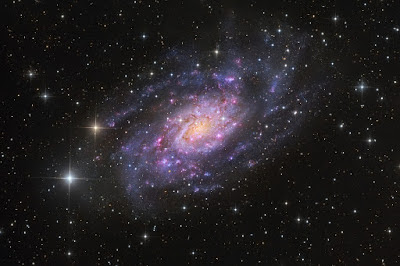
“Magnificent island universe NGC 2403 stands within the boundaries of the long-necked constellation Camelopardalis. Some 10 million light-years distant and about 50,000 light-years across, the spiral galaxy also seems to have more than its fair share of giant star forming HII regions, marked by the telltale reddish glow of atomic hydrogen gas. The giant HII regions are energized by clusters of hot, massive stars that explode as bright supernovae at the end of their short and furious lives.
A member of the M81 group of galaxies, NGC 2403 closely resembles another galaxy with an abundance of star forming regions that lies within our own local galaxy group, M33 the Triangulum Galaxy. Spiky in appearance, bright stars in this colorful galaxy portrait of NGC 2403 lie in the foreground, within our own Milky Way.”