StatCounter

Saturday, March 21, 2026

"How It Really Is"

“We'll know our disinformation program is complete 
when everything the American public believes is false.”
- William Casey, former director of the CIA

"Just Look At Us..."

"Just look at us. Everything is backwards; everything is upside down. Doctors destroy health, lawyers destroy justice, universities destroy knowledge, governments destroy freedom, the major media destroy information and religions destroy spirituality"
- Michael Ellner

"As Robert Oppenheimer said a short while before he died, 'It is perfectly obvious that the whole world is going to hell. The only possible chance that it might not is that we do not attempt to prevent it from doing so.' You see, many of the troubles going on in the world right now are being supervised by people with very good intentions whose attempts are to keep things in order, to clean things up, to forbid this, and to prevent that. The more we try to put everything to rights, the more we make fantastic messes. Maybe that is the way it has got to be. Maybe I should not say anything at all about the folly of trying to put things to right but simply, on the principle of Blake, let the fool persist in his folly so that he will become wise."
- Alan Watts

"Warning: America’s Housing Market Is Changing Fast"

Full screen recommended.
Snyder Reports, 3/21/26
"Warning: America’s Housing Market Is Changing Fast"
Comments here:

"Something Is Happening in America… The Cost of Living Is Pushing People to the Edge"

Full screen recommended.
The Unfolded States, 3/21/26
"Something Is Happening in America… 
The Cost of Living Is Pushing People to the Edge"
"Across the United States, many people are working harder than ever, yet it still doesn’t feel like enough. Rising costs for housing, food, insurance, and everyday essentials are putting steady pressure on households, even as inflation appears to slow in official reports. This video breaks down what’s actually happening behind the numbers. From wage growth that can’t keep up, to fixed expenses that continue to rise, to the growing sense of financial burnout, we look at the real reasons why daily life feels more expensive than ever. If you’ve noticed these changes in your own life, you’re not alone. This is a closer look at the cost of living crisis in America and why Americans are struggling financially, using real data and real patterns that are shaping how people live today."
Comments here:

“Fertilizer Shock”: The Closure Of The Strait Of Hormuz Could Cause Widespread Global Food Shortages"

by Michael Snyder

"If commercial traffic through the Strait of Hormuz remains paralyzed for months, we will witness a global food crisis on a scale that many experts would have once considered to be unthinkable. Over the past couple of weeks, there has been much written about how the closure of the Strait of Hormuz has caused the price of oil to rise, has caused the price of natural gas to soar to insane levels and has caused the average price of diesel in the United States to jump above five dollars a gallon. But I think that the bigger story is what the closure of the Strait of Hormuz could mean for global food supplies.

Normally, approximately one-third of all globally-traded nitrogen fertilizer and approximately one-half of all globally-traded sulfur passes through the Strait of Hormuz… "Another world crisis sparked by the war in Iran may also be in the offing. That’s because the region’s oil and gas production has made it one of the world’s leading exporters of nitrogen fertilizers, which are indispensable to the global food system. To produce the chemicals used to grow much of the planet’s crops, natural gas is broken down to extract hydrogen, which is combined with nitrogen to make ammonia, and then mixed with carbon dioxide to make urea. All told, nearly a third of the global trade for nitrogen fertilizer passes through the Strait of Hormuz, while almost half of the world’s sulfur, essential in producing phosphate fertilizers, also travels through the corridor."

Reading that should chill you to the core. But that is just part of the story. Fertilizer producers in other countries will also be forced to shut down if they are not able to get the liquified natural gas that normally comes to them through the Strait of Hormuz…Already, fertilizer plants in India and Pakistan are facing production declines given the disruption to natural gas supplies from the Middle East. Gulf countries targeted in the war supply nearly all of Pakistan’s LNG imports, 72% of Bangladesh’s and 53% of India’s.

Even if deescalation occurs, the conflict has likely locked in a food price hike in the coming months. The longer the war continues, the greater the shock to food security as energy and fertiliser prices remain elevated. What we are facing is truly a global problem.

A farmer in Virginia named John Boyd recently admitted to NBC News that local dealers are telling him that “we can’t get the fertilizer” that he needs…"John Boyd Jr., a fourth-generation farmer in Virginia who grows soybeans, corn and wheat, said his fertilizer supplier recently warned him that shipments may not arrive as expected. “The dealers are telling me we can’t get the fertilizer,” Boyd told NBC News in an interview this week. “Due to the war and the bombing through that area, the fertilizer isn’t moving.” Fertilizer is essential to food production, he said, and it must be applied before crops are planted. “If I don’t apply fertilizer, that means I won’t have the yields to make my crop,” Boyd explained."

If one U.S. farmer can’t grow enough, that isn’t a big deal. But if hundreds of thousands of U.S. farmers can’t grow enough, that will be a full-blown national crisis. Stacy Simunek, the president of the Oklahoma Farm Bureau, is warning that we really are facing a worst-case scenario… The war in Iran has led to the closure of the Strait of Hormuz, a critical shipping route not only for oil and gas, but also for fertilizers needed to produce the world’s food. “We cannot grow without it. There is absolutely no way you get around it,” said Stacy Simunek, president, Oklahoma Farm Bureau."

If farmers do not grow our food, we do not eat. The U.S. is actually in better shape than much of the rest of the world, because we produce much of the fertilizer that we use. But as Simunek has very aptly observed, if this crisis in the Middle East results in a major global fertilizer shortage, there is no way that we are going to be able to feed the entire world… “Who’s going to feed us? Where are we going to get the food to eat? Where are we going to feed the world? This is critical,” said Simunek. Already, hundreds of millions of people around the world go to bed hungry every night. So a very large disruption to global food production would push us very deep into nightmare territory.

Today, approximately half of the population of the world eats food that is grown using nitrogen fertilizer…"About 4 billion people on the planet eat food grown with synthetic nitrogen fertilizers. Roughly half of the global population, in other words, is alive because of these chemicals converted into nutrients for plants, said Lorenzo Rosa, who researches sustainable energy, water, and food systems at the Carnegie Institution for Science at Stanford University."

Spring planting season in the northern hemisphere is rapidly approaching. The fertilizer that would normally be traveling through the Strait of Hormuz now would get into the hands of farmers around the middle of April. But that isn’t going to happen, and that means that a lot of farmers around the world are simply not going to have the fertilizer that they need in 2026.

China produces more fertilizer than anyone else, and there was hope that they could help ease the potential global supply shock that we are facing, but instead they have chosen to implement very strict restrictions on fertilizer exports…"China is tightening controls on fertilizer exports as disruptions linked to the conflict in Iran ripple through global crop-nutrient markets and push prices higher. Authorities have asked exporters to halt outbound shipments of nitrogen-potassium fertilizer blends while reiterating existing restrictions on urea exports, according to people familiar with the matter. The steps appear aimed at protecting domestic supply and stabilizing prices as farmers prepare for the spring planting season, a period when demand typically peaks in the country’s vast agricultural sector.

People familiar with the situation said the latest directives have effectively paused overseas shipments of most fertilizer types, including compound varieties that had still been moving abroad after China loosened some urea limits last year. One key exception is ammonium sulfate, which accounted for about half of the country’s fertilizer shipments last year and remains unaffected for now."

The Chinese want to make sure that they have enough fertilizer for themselves. A global scramble for what is available has begun, and nobody can blame the Chinese for putting themselves first. But what is the rest of the world supposed to do? White House National Economic Council Director Kevin Hassett is telling us that the Trump administration is “all over the fertilizer problem”…"The Trump administration is seeking alternative fertilizer supplies for U.S. farmers as the war in Iran disrupts a key global trade route just weeks before the spring planting season. “We’ve been all over the fertilizer problem,” White House National Economic Council Director Kevin Hassett said on CNBC Tuesday. “I’m not saying that we can eliminate what disruption there is so far, but we can minimize it for sure.”

Hopefully he is right. But words alone can’t magically get fertilizer into the hands of the farmers that need it. What we really need is for traffic through the Strait of Hormuz to return to normal. Unfortunately, the Iranians are telling us that traffic through the Strait of Hormuz “cannot be the same as before and return to its previous conditions”… "In a televised interview Tuesday, Iranian parliamentary speaker Mohammad Baqer Qalibaf said the Strait of Hormuz remained under threat because of the American and Israeli presence in the Gulf region. “The Strait of Hormuz cannot be the same as before and return to its previous conditions,” Qalibaf said, adding that “there is no longer any security.” He also cautioned that US bombs and jets could not destroy Iran’s weapons facilities."

Since the Iranians are not willing to allow commercial traffic to flow through the Strait, it will be up to the United States and Israel to reopen it, because everyone else has decided that they do not want to be involved. This is something that President Trump just posted about on his Truth Social account

"The United States has been informed by most of our NATO “Allies” that they don’t want to get involved with our Military Operation against the Terrorist Regime of Iran, in the Middle East, this, despite the fact that almost every Country strongly agreed with what we are doing, and that Iran cannot, in any way, shape, or form, be allowed to have a Nuclear Weapon. I am not surprised by their action, however, because I always considered NATO, where we spend Hundreds of Billions of Dollars per year protecting these same Countries, to be a one way street - We will protect them, but they will do nothing for us, in particular, in a time of need. Fortunately, we have decimated Iran’s Military - Their Navy is gone, their Air Force is gone, their Anti-Aircraft and Radar is gone and perhaps, most importantly, their Leaders, at virtually every level, are gone, never to threaten us, our Middle Eastern Allies, or the World, again! Because of the fact that we have had such Military Success, we no longer “need,” or desire, the NATO Countries’ assistance - WE NEVER DID! Likewise, Japan, Australia, or South Korea. In fact, speaking as President of the United States of America, by far the Most Powerful Country Anywhere in the World, WE DO NOT NEED THE HELP OF ANYONE! Thank you for your attention to this matter. President DONALD J. TRUMP

The Europeans are being hurt by the closure of the Strait of Hormuz, but they have announced that they are simply not willing “to put their people in harm’s way”… “Nobody is ready to put their people in harm’s way in the Strait of Hormuz,” EU foreign policy chief Kaja Kallas told the Reuters news agency on Tuesday. “We have to find diplomatic ways to keep this open so that we don’t have a food crisis, fertilizers crisis, energy crisis as well.”

I see three ways that the Strait of Hormuz could potentially be reopened soon. The first option would be for the U.S. and Israel to give the Iranians everything that they are demanding and the war would end. But that is certainly not going to happen. The second option would be for the U.S. and Israel to put boots on the ground and secure the Iranian side of the Strait of Hormuz. But that is not going to happen any time soon. The third option would be for the U.S. and Israel to completely destroy the Iranian regime using nuclear weapons, but that would be absolutely unthinkable. The use of nuclear weapons is completely off the table, and I don’t know anyone that would argue with that.

So it appears that the Strait of Hormuz will be closed for an extended period of time. In the western world, that will mean that food prices will likely be going up quite substantially. But in impoverished nations all over the globe, the consequences will be much more serious. We are potentially facing widespread global food shortages, and most of us don’t even want to think about what that could look like."

Dan, I Allegedly, "Millions of Bank Accounts Could Be Shut Down Overnight"

Full screen recommended.
Dan, I Allegedly, 3/21/26
"Millions of Bank Accounts 
Could Be Shut Down Overnight"
"Millions of bank accounts in the United States could soon face new verification requirements as regulators and financial institutions crack down on fraud, identity abuse, and незакон banking activity. In this video, I break down the growing push for stricter “Know Your Customer” (KYC) rules, new restrictions tied to SBA loans, and how these changes could impact everyday Americans, business owners, and even legal account holders. With billions lost to fraud in recent years, banks and the federal government are under pressure to act - but at what cost? We also dive into the real-world consequences of these policies, including account closures, frozen funds, and increased scrutiny of financial transactions. Could this be the beginning of broader financial surveillance or even a shift toward a digital currency system? Whether you’re concerned about your bank account, small business funding, or financial privacy, this is a story you need to understand right now."
Comments here:

Michael Bordenaro, "26 'Normal' Things That Used To Be Affordable, Now Outrageously Expensive"

Full screen recommended.
Michael Bordenaro, 3/21/26
"26 'Normal' Things That Used To Be Affordable,
 Now Outrageously Expensive"
Comments here:

Adventures With Danno, "Outrageous Prices At Publix!"

Full screen recommended.
Adventures With Danno, 3/21/26
"Outrageous Prices At Publix!"
Comments here:

Friday, March 20, 2026

"Alert! Now Pentagon Plans Iran Invasion! China WW3 Prediction"

Canadian Prepper, 3/20/26
"Alert! Now Pentagon Plans Iran Invasion!
 China WW3 Prediction"
Comments here:

"Bond Markets Scream; Hybrid Economic Depression Has Begun; Small Businesses Getting Destroyed"

Jeremiah Babe, 3/20/26
"Bond Markets Scream; Hybrid Economic Depression Has Begun; 
Small Businesses Getting Destroyed"
Comments here:

"People Aren't Prepared For What's Coming To America: A Once In A Lifetime Crash Is Already Unfolding"

"People Aren't Prepared For What's Coming To America:
 A Once In A Lifetime Crash Is Already Unfolding"

"Something is shifting in America, and more people are starting to feel it every single day. The cost of living keeps climbing, good-paying jobs are disappearing, and the financial foundation that generations built their lives on is starting to look a lot less stable than it used to. In this video, we react to some of the most eye-opening clips circulating right now about where the U.S. economy is truly headed, and what it might mean for everyday Americans. People across the country are waking up to the fact that the economy is not going through more than just a rough patch. The signals coming in from financial markets, from global investors, from historians, and from regular Americans living paycheck to paycheck all seem to be pointing in the same direction. And that direction is not reassuring.

From the weakening of the U.S. dollar to the growing threat of nations pulling out of dollar-based systems, the cracks in the foundation are becoming harder to ignore. The national debt is approaching numbers that would have seemed unthinkable not long ago. Fifty billion dollars borrowed every single week. Interest payments alone threatening to consume entire future budgets. Wall Street lenders sitting on shaky loans tied to an AI expansion that has yet to prove it can deliver on its promises. These abstract problems have real consequences for real people trying to build a life in this country. And then there are the layoffs. Over a hundred thousand jobs lost in January 2026 alone. Major tech companies cutting tens of thousands of workers while funneling billions into data centers and AI infrastructure. Entry-level jobs down 35 percent since 2023. More people out of work for six months or longer than at almost any point in recent memory.

 The job market is not just slow right now. For a lot of people, it feels completely broken. What makes all of this so heavy is that the people being hit hardest are doing everything right. They are applying, networking, interviewing, and still coming up empty. And on top of that, they are watching the purchasing power of every dollar they earn quietly erode year after year. The retirement math for younger generations has become almost impossible. The homeownership dream keeps drifting further out of reach. And for the first time since the Great Depression, more people are leaving the United States than are moving into it. We hope this gives you something to think about, something to talk about with the people around you, and maybe some motivation to rethink what stability and security actually look like for you and your family right now."
Comments here:

Judge Napolitano, "INTEL Roundtable w/Johnson & McGovern - Week of 20 March"

Judge Napolitano - Judging Freedom, 3/20/26
"INTEL Roundtable w/Johnson & McGovern - Week of 20 March"
Comments here:
o
Full screen recommended.
War Current, 3/20/26
"Iran Just Hit 3 Gulf States in One Night - 
$80 Billion Gas Infrastructure Destroyed"
"Last night changed everything. Iran launched coordinated strikes hitting Qatar's massive Ras Laffan LNG facility, UAE's critical Habshan gas hub, and Saudi Arabia's SAMREF refinery in Yanbu - three Gulf states, one night, $80 billion in energy infrastructure targeted. Europe's gas supply just entered survival mode as the world's largest LNG exporter goes offline and global markets panic. This isn't regional conflict anymore - this is the opening move of an energy war that will hit every economy on Earth."
Comments here:
o
Danny Haiphong, 3/20/26
"Larry Johnson & Col. Lawrence Wilkerson:
Iran Takes Down F-35, Rains Missile Hell on Israel"
Comments here:

Musical Interlude: Ludovico Einaudi, "Lady Labyrinth & Nightbook"; "Una Mattina"

Full screen recommended.
Ludovico Einaudi,
"Lady Labyrinth & Nightbook"
o
Full screen recommended.
Ludovico Einaudi, "Una Mattina"

"A Look to the Heavens"

“The Flame Nebula is a stand out in optical images of the dusty, crowded star forming regions toward Orion's belt and the easternmost belt star Alnitak, a mere 1,400 light-years away. Alnitak is the bright star at the right edge of this infrared image from the Spitzer Space Telescope. About 15 light-years across, the infrared view takes you inside the nebula's glowing gas and obscuring dust clouds though. It reveals many stars of the recently formed, embedded cluster NGC 2024 concentrated near the center. 
The stars of NGC 2024 range in age from 200,000 years to 1.5 million years young. In fact, data indicate that the youngest stars are concentrated near the middle of the Flame Nebula cluster. That's the opposite of the simplest models of star formation for a stellar nursery that predict star formation begins in the denser center of a molecular cloud core. The result requires a more complex model for star formation inside the Flame Nebula.”

"Life is A Journey - Don't Be Afraid"

"Life is A Journey - Don't Be Afraid"
Author Unknown

"Life is a journey filled with lessons, hardships, heartaches, joys, celebrations and special moments that will ultimately lead us to our destination, our purpose in life. The road will not always be smooth; in fact, throughout our travels, we will encounter many challenges. Some of these challenges will test our courage, strengths, weaknesses, and faith. Along the way, we may stumble upon obstacles that will come between the paths that we are destined to take. In order to follow the right path, we must overcome these obstacles. Sometimes these obstacles are really blessings in disguise, only we don't realize that at the time.

Along our journey we will be confronted with many situations, some will be filled with joy, and some will be filled with heartache. How we react to what we are faced will determine what kind of outcome the rest of our journey through life will be like. When things don't always go our way, we have two choices in dealing with the situations. We can focus on the fact that things didn't go how we had hoped they would and let life pass us by, or two, we can make the best out of the situation and know that these are only temporary setbacks and find the lessons that are to be learned.

Time stops for no one, and if we allow ourselves to focus on the negative we might miss out on some really amazing things that life has to offer. We can't go back to the past, we can only take the lessons that we have learned and the experiences that we have gained from it and move on. It is because of the heartaches, as well as the hardships, that in the end help to make us a stronger person.

The people that we meet on our journey, are people that we are destined to meet. Everybody comes into our lives for some reason or another and we don't always know their purpose until it is too late. They all play some kind of role. Some may stay for a lifetime; others may only stay for a short while. It is often the people who stay for only a short time that end up making a lasting impression not only in our lives, but in our hearts as well. Although we may not realize it at the time, they will make a difference and change our lives in a way we never could imagine. To think that one person can have such a profound effect on your life forever is truly a blessing. It is because of these encounters that we learn some of life's best lessons and sometimes we even learn a little bit about ourselves.

People will come and go into our lives quickly, but sometimes we are lucky to meet that one special person that will stay in our hearts forever no matter what. Even though we may not always end up being with that person and they may not always stay in our life for as long as we like, the lessons that we have learned from them and the experiences that we have gained from meeting that person, will stay with us forever.

It's these things that will give us strength to continue with our journey. We know that we can always look back on those times of our past and know that because of that one individual, we are who we are and we can remember the wonderful moments that we have shared with that person. Memories are priceless treasures that we can cherish forever in our hearts. They also enable us to go on with our journey for whatever life has in store for us. Sometimes all it takes is one special person to help us look inside ourselves and find a whole different person that we never knew existed. Our eyes are suddenly opened to a world we never knew existed- a world where time is so precious and moments never seem to last long enough.

Throughout this adventure, people will give you advice and insights on how to live your life but when it all comes down to it, you must always do what you feel is right. Always follow your heart, and most importantly never have any regrets. Don't hold anything back. Say what you want to say, and do what you want to do, because sometimes we don't get a second chance to say or do what we should have the first time around.

It is often said that what doesn't kill you will make you stronger. It all depends on how one defines the word "strong". It can have different meanings to different people. In this sense, "stronger" means looking back at the person you were and comparing it to the person you have become today. It also means looking deep into your soul and realizing that the person you are today couldn't exist if it weren't for the things that have happened in the past or for the people that you have met. Everything that happens in our life happens for a reason and sometimes that means we must face heartaches in order to experience joy."
- Author Unknown, 

Free Download: Charles Mackay, "Extraordinary Popular Delusions and the Madness of Crowds"

"Extraordinary Popular Delusions 
and the Madness of Crowds"

"Every age has its peculiar folly: Some scheme, project, or fantasy into which it plunges, spurred on by the love of gain, the necessity of excitement, or the force of imitation. Men, it has been well said, think in herds; it will be seen that they go mad in herds, while they only recover their senses slowly, and one by one."
- Charles Mackay

"'Extraordinary Popular Delusions and the Madness of Crowds" is an early study of crowd psychology by Scottish journalist Charles Mackay, first published in 1841. The book chronicles its subjects in three parts: "National Delusions", "Peculiar Follies", and "Philosophical Delusions". MacKay was an accomplished teller of stories, though he wrote in a journalistic and somewhat sensational style.

The subjects of Mackay's debunking include alchemy, crusades, duels, economic bubbles, fortune-telling, haunted houses, the Drummer of Tedworth, the influence of politics and religion on the shapes of beards and hair, magnetizers (influence of imagination in curing disease), murder through poisoning, prophecies, popular admiration of great thieves, popular follies of great cities, and relics. Present-day writers on economics, such as Michael Lewis and Andrew Tobias, laud the three chapters on economic bubbles. Scientist and astronomer Carl Sagan mentioned the book in his own discussion about pseudoscience, popular delusions, and hoaxes.

In later editions, Mackay added a footnote referencing the Railway Mania of the 1840s as another "popular delusion" which was at least as important as the South Sea Bubble. Mathematician Andrew Odlyzko has pointed out, in a published lecture, that Mackay himself played a role in this economic bubble; as leader writer in the Glasgow Argus, Mackay wrote on 2 October 1845: "There is no reason whatever to fear a crash."
Freely download "Extraordinary Popular Delusions and the Madness of Crowds"
by Charles Mackay, here:

"Knowing..."

“Knowing can be a curse on a person’s life. I’d traded in a pack of lies for a pack of truth, and I didn’t know which one was heavier. Which one took the most strength to carry around? It was a ridiculous question, though, because once you know the truth, you can’t ever go back and pick up your suitcase of lies. Heavier or not, the truth is yours now.”
- Sue Monk Kidd

"It Took Me 50+ Years To Realize What I'll Tell You In 10 Minutes..."

Full screen recommended.
The 11th Hour,
"It Took Me 50+ Years To Realize 
What I'll Tell You In 10 Minutes..."
"After years of living and learning the hard way, I'm sharing the life lessons I wish I knew when I was younger. In this video, I talk about time, relationships, regrets, success, and what truly matters in life. If you're in your 20s, 30s, 40s, or beyond, this wisdom could save you decades of mistakes. This is raw, honest advice from someone who's lived long enough to know what actually matters. Don't waste years figuring it out like I did. Learn from my mistakes and make better choices while you still have time."
Comments here:

The Poet: Mary Oliver, “Some Questions You Might Ask”

“Some Questions You Might Ask”

“Is the soul solid, like iron?
Or is it tender and breakable, like
the wings of a moth in the beak of the owl?
Who has it, and who doesn’t?
I keep looking around me.
The face of the moose is as sad
as the face of Jesus.
The swan opens her white wings slowly.
In the fall, the black bear carries leaves into the darkness.
One question leads to another.
Does it have a shape? Like an iceberg?
Like the eye of a hummingbird?
Does it have one lung, like the snake and the scallop?
Why should I have it, and not the anteater
who loves her children?
Why should I have it, and not the camel?
Come to think of it, what about the maple trees?
What about the blue iris?
What about all the little stones, sitting alone in the moonlight?
What about roses, and lemons, and their shining leaves?’
What about the grass?”

- Mary Oliver

The Daily "Near You?"

Montgomery, Alabama, USA. Thanks for stopping by!

'The Cruelest Joke Of All..."

“The smallest decisions made had such profound repercussions. One ten-minute wait could save a life… or end it. One wrong turn down the right street or one seemingly unimportant conversation, and everything was changed. It wasn’t right that each lifetime was defined, ruined, ended, and made by such seemingly innocuous details. A major life-threatening event should come with a flashing warning sign that either said ABANDON ALL HOPE or SAFETY AHEAD. It was the cruelest joke of all that no one could see the most vicious curves until they were over the edge, falling into the abyss below.”
- Sherrilyn Kenyon

"Fate. Luck. Chance."

“That is life, isn’t it? Fate. Luck. Chance. A long series of what-if’s that lead from one moment to the next, time never pausing for you to catch your breath, to make sense of the cards that have been handed to you. And all you can do is play your cards and hope for the best, because in the end, it all comes back to those three basics. Fate. Luck. Chance.”
- Kelseyleigh Reber

“Unless, of course, there’s no such thing as chance… in which case, we should either - optimistically - get up and cheer, because if everything is planned in advance, then we all have a meaning and are spared the terror of knowing ourselves to be random, without a why; or else, of course, we might - as pessimists - give up right here and now, understanding the futility of thought-decision-action, since nothing we think makes any difference anyway, things will be as they will. Where, then, is optimism? In fate or in chaos?”
- Salman Rushdie

"No Plan! No Answers! Powell Just Exposed the Truth About the Economy"

Full screen recommended.
Dan, I Allegedly, 3/20/26
"No Plan! No Answers! 
Powell Just Exposed the Truth About the Economy"
"The economy is sending mixed signals, and now even Federal Reserve Chairman Jerome Powell is admitting uncertainty about where things are headed. In this breaking news update, I Allegedly dives into Powell’s latest comments on interest rates, inflation, job growth, and the growing risk of stagflation. If the person in charge of monetary policy doesn’t have clear answers, what does that mean for your money, your job, and your future? We also cover rising costs, failing restaurants, consumer debt, and why everyday Americans are feeling the pressure despite what the headlines say. From mortgage stress to business closures and economic slowdown, this is the real story behind today’s financial system. Stay informed with I Allegedly as we break down the latest economic news, financial trends, and what you need to do right now to protect yourself."
Comments here:

"We Really Are Facing An “Economic Armageddon” Scenario In The Middle East"

by Michael Snyder

"When this war with Iran erupted, everyone knew that it would have an impact on the global economy. But very few anticipated that it would be this bad. We are facing the worst oil disruption in history, the worst natural gas disruption in history, the worst helium disruption in history and the worst fertilizer disruption in history simultaneously. The Iranians have control over which ships are allowed through the Strait of Hormuz, and they are determined to keep it that way for as long as possible. But even if the war ended and traffic through the Strait of Hormuz was fully restored tomorrow, it would take years for the global economy to return to normal because of all the energy infrastructure that has been destroyed on both sides.

With no end in sight for the war, oil prices in the western world just continue to move higher. But if you want to see where oil prices are eventually headed if this crisis persists, just check out what has been happening in Dubai. At one point on Thursday, the price of oil in Dubai briefly hit an all-time record of $166 a barrel…"The extreme spike in oil prices seen in local markets in the Middle East could give investors a glimpse into to where U.S. and Europe prices are headed if the Strait of Hormuz isn’t opened soon. Dubai crude oil prices surpassed $166 a barrel to a new record high on Thursday, according to market data provider Platts. Dated Brent and West Texas intermediate Cushing’s are trading around the $100 mark after historic runs higher."

Normally, the price of oil in Dubai falls somewhere between West Texas oil and Brent oil. But once the war began, it started selling at an unprecedented premium. In Saudi Arabia, officials are projecting that the price of oil could eventually surpass $180 a barrel if this war persists until the end of next month…"Saudi Arabia’s oil officials are working frantically to project how high oil prices might go if the Iran war and its disruption of energy supplies doesn’t end soon-and they don’t like what they are seeing. The base case, several oil officials in the Gulf’s biggest producer said, is that prices could soar past $180 a barrel if the disruptions persist until late April."

While that would sound like a bonanza for a kingdom still heavily leveraged to oil revenue, it is deeply concerning. Prices that high could push consumers into habits that slash their oil use-potentially for the long term-or trigger a recession that also hurts demand. They also would risk casting Saudi Arabia in the role of profiteer in a war it didn’t start.

If the price of oil reaches that level and stays there for an extended period of time, it will crash everything. Our system is simply not designed to be able to handle a shock like that. Of course we are also facing a historic natural gas crisis as well. Normally, approximately one-fifth of the world’s supply of liquified natural gas is produced by Qatar’s Ras Laffan complex. That complex is nearly three times the size of Paris, and it cost hundreds of billions of dollars to build. So it was a really, really big deal when Iranian missiles started raining down.

The CEO of QatarEnergy is telling us that output at the complex has been reduced by 17 percent, and it will take three to five years to rebuild the capacity that has been lost…"Qatar could face years of reduced natural gas exports after Iranian strikes damaged key energy infrastructure, wiping out a significant share of its liquefied natural gas (LNG) production capacity, QatarEnergy’s chief executive told Reuters. Saad al-Kaabi said the attacks disabled two LNG production units out of 14 and one gas-to-liquids facility out of two, reducing output by about 17% at a time when Qatar sits at the heart of global gas supply. He said the affected facilities alone account for roughly 12.8 million tons of annual LNG production, and warned repairs could keep them offline for three to five years depending on security conditions and technical recovery timelines."

This is a catastrophic blow for the global economy. As Jack Prandelli has accurately observed, there is no spare capacity elsewhere on the planet that can replace what has been destroyed…So what do we do now? It is going to take years to repair the damage that has already been done. And what is going to happen if Iran attacks Qatar’s Ras Laffan complex again?

Meanwhile, the world is also facing a looming helium shortage. Prior to the war, Qatar’s Ras Laffan complex produced over one-third of the world’s entire supply of helium. "The war in the Middle East could pose a threat to the semiconductor industry and other sectors dependent on a resource produced in the Gulf - helium. Helium is a little-known but key input in many industries, most notably technology. In semiconductor manufacturing, its cooling properties are used to transfer heat. Helium is also indispensable in photolithography, a technique used to print each chip’s intricate circuitry.

The U.S. Geological Survey estimates that before the war Qatar produced more than one-third of the world’s helium supply. Lately, however, operations at QatarEnergy’s Ras Laffan Industrial City - the world’s largest liquefied natural gas export facility, which produces helium as a byproduct - were halted after it was struck by an Iranian drone early in the war. On Wednesday, Iranian missiles crippled the plant." Without that helium, tech companies all over the planet are going to be thrown into a state of chaos. So that is a huge problem. But personally I am even more concerned about what this war is going to mean for global food production.

Farmers all over the northern hemisphere are preparing to plant their crops, and so if we can’t get the fertilizer that they need through the Strait of Hormuz we are going to be in for a world of hurt…"The Strait of Hormuz is a critical channel for fertilizer, including about 50% of global nitrogen-rich urea fertilizers, according to the Fertilizer Institute, the industry’s trade association. The strait has been effectively impassable since President Donald Trump launched the assault, which is now in its third week with no end in sight.

The closure has spiked fertilizer prices just before planting season, potentially scrambling decision-making for farmers across the U.S. And it comes on top of already low commodity prices that have lingered for years and eaten into farmers’ margins. There will be a wild scramble for whatever is available, and those with the most money will be victorious. But since western farmers will be paying much, much more for fertilizer this year, they will be forced to pass those costs along…

“We’re in uncharted territory,” Matt Frostic, a Michigan farmer who sits on the board of the National Corn Growers Association, said in an interview with CNBC. “It’s like a code red.” Frostic said he purchased nitrogen fertilizer, critical for corn crops, in January for around $350 per ton. That same product, he said, is now closing in on $600 per ton." Of course large numbers of farmers in poorer nations won’t have access to nitrogen fertilizer at all. As a result, global food production will be way down and there simply won’t be enough food for everyone.

So we really need traffic to start flowing through the Strait of Hormuz like it normally does. But that is not going to happen any time soon. I think that we are about to see a lot of chaos erupt in global financial markets. Already, we are witnessing a confluence of developments that we haven’t seen since 2008…"Thursday’s bond-market selloff caused the Treasury yield curve to exhibit what traders describe as a “bear-flattening” pattern. This actually began back in early February. Typically, the pattern emerges when bond traders are bracing for a difficult economic environment ahead."

The confluence of these three developments - oil above $100 a barrel, a 2-year yield above the fed funds rate, and a bear-steepening dynamic in the bond market - is making some investors nervous. The last time all three things unfolded simultaneously was in the late spring of 2008, according to Bloomberg data. About four or five months later, Lehman Brothers collapsed, ushering in the most acute phase of the 2008 financial crisis. The S&P 500 declined 38.5% that year. Widespread mortgage defaults also resulted in many Americans losing their homes.
Hold on tight, because if this war doesn’t come to a conclusion soon this is only just the beginning. The Iranians are trying to inflict so much pain on the rest of the world that the U.S. and Israel will be forced to agree to never attack Iran again. On the other side, the U.S. and Israel are absolutely determined to win this war, and they would love to bring the regime in Iran to an end. So I think that this war is going to go on for a while. If it lasts into the summer, we really will be facing an economic “Armageddon scenario”, and that is not good news for any of us."

"How It Really Is"


"Running on Empty"

"Running on Empty"
by Joel Bowman

“War is the realm of uncertainty; three-quarters of the factors on which action in
 war is based are wrapped in a fog of greater or lesser uncertainty. A sensitive and 
discriminating judgment is called for; a skilled intelligence to scent out the truth.”
– Carl von Clausewitz, "On War" (1832)

Ormond Beach, Florida - "First, the headlines...From the Associated Press: "Brent crude briefly tops $119 per barrel before pulling back, and stocks sink worldwide." From the BBC: "Gas price soars over 20% after strikes on Qatar hub." And from Oilprice.com: "$200 Oil No Longer Crazy Idea as Middle East Supply Collapses."

Your editor is no geophysicist, dear reader, but we know enough about the matter to understand that, reduced to its most basic equation, all life depends on energy. That goes for the fat and the skinny... the old and the young... Republicans, Democrats and unreconstructed anarcho-capitalists alike.

The Age of Abundance: When energy is cheap, reliable and abundant, life on planet earth flourishes, as it has done, more or less unabated, since Colonel Edwin Drake sank the first commercial oil well in Titusville, Pennsylvania, back in 1859. The ensuing Age of Energy Abundance has seen the world population grow by more than 7 fold, from about ~1.2 billion people when first Drake got to drilling to over ~8 billion today.... even as the percentage of the global population living in poverty has declined precipitously during that same period. In 1820, somewhere between 80-90% of all people on earth lived in what is today categorized as “extreme poverty.” That percentage in 2026: < 8%.

The global economy is able to sustain such plenitude because it, too, has grown exponentially thanks to an abundance of cheap, reliable energy. Back in 1850, the world’s entire economic output was equal to roughly $1.2 trillion (measured in today’s dollars). Today, global economic output is orders of magnitude greater, with estimates in the range of ~$170 trillion in 2024. In other words, while the population has grown by ~7x... the size of the economy in which they live, love and loathe has mushroomed over ~145x, meaning per capita GDP has increased about ~22x during the same time.

Human life expectancy has doubled during that time... from about ~30-40 years in 1850, to roughly ~75 years today. Child mortality has fallen by 90%, from four in ten children dying before reaching adulthood (mostly during birth), to four in 100 today. All this while per capita electricity consumption has increased between 10x and 20x since 1900. That’s no coincidence.

When energy is cheap, reliable and abundant, life flourishes. When energy is expensive, unreliable and in short supply... things get difficult, quickly... MN Gordon explains in today’s article (below)...

A Trend Reversal: Of course, not all countries will be impacted in the same way and at the same time during the energy crunch. Indeed, some who were last are suddenly finding themselves, if not quite first, rapidly advancing along the line.

Here’s Argentina’s energy trade balance over the last few years, as compiled by Econométrica, based on official INDEC figures. The figures shown are in billions of dollars. (Note that the shaded areas, 2026-227, are projected figures.)
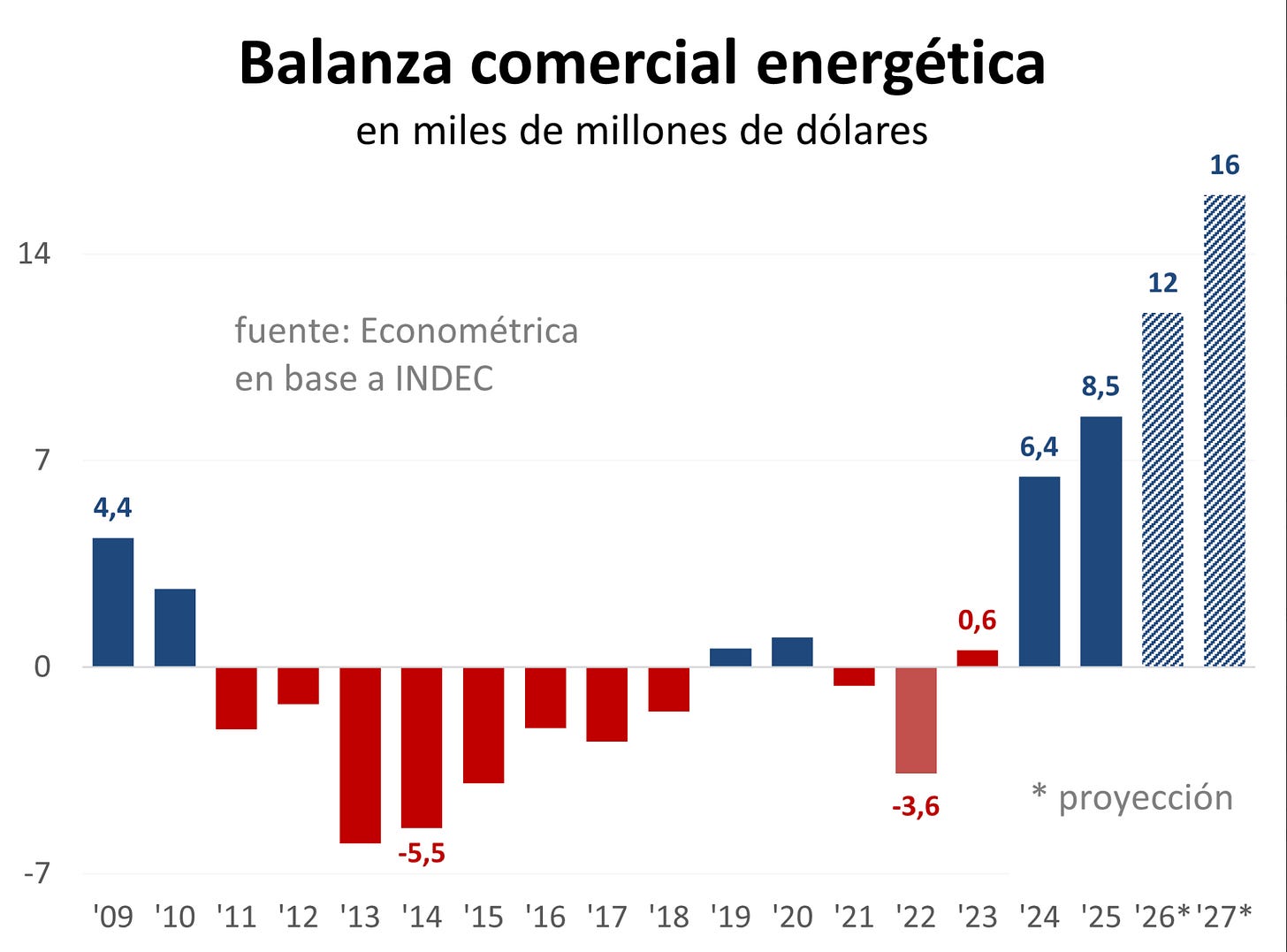
And here’s the latest from Infobae (translated): "Driven by rising oil prices, Argentine exports could exceed USD 100 billion for the first time in 2026. With a barrel of crude hovering around $100 - and the expectation that it will remain at elevated levels for several months - foreign oil sales are poised for a substantial increase, rising from a projected $12.5 billion to a staggering $17 billion. An additional jump in agricultural exports is also anticipated, as commodity prices have likewise been on a sustained upward trend. It is estimated that, in this sector, the increase would amount to approximately $1 billion. The consequence of this surge in energy and agricultural sales is that Argentina’s total exports could, for the first time in history, surpass the $100 billion mark."

The more the end of the world looms, the more the End of the World looks like the place to be... Meanwhile, read on for Mr. Gordon’s column below, and don’t forget to check out his excellent site, Economic Prism, for more of his fine work."
o
"Running On Empty"
by MN Gordon

"The opening bombardment of Operation Epic Fury on February 28 succeeded in taking out the heart of the Iranian regime. But it also triggered extreme geopolitical instability in the Middle East and severed the aorta of the global economy. The massive barrage of missile strikes, the chaotic swarm of counter-drone attacks, and the succession of Mojtaba Khamenei offer sensational headline material. Yet the real destruction, the kind that reshapes civilizations, isn’t happening in the smoky ruins of Tehran. It’s happening in the empty shipping lanes of the Strait of Hormuz.

Skyrocketing oil prices are a noted precursor to declining economic activity. Higher gas prices are not just an inconvenient market fluctuation. They act as a regressive tax on every single human being who eats, moves, or buys things. When the price of gas spikes and the pumps run dry, the very foundation of the global economy crumbles.

As of March 19, Californians are already paying $5.60 per gallon to fill up their cars. That may seem like a lot if you’re living elsewhere. In the south, for example, we’re paying $3.22 per gallon. But according to the math of human survival, $5.60 per gallon is still the bargain of a lifetime. It’s a clearance sale on the very substance that built the modern world.

As the supply of oil is disrupted across the globe, we’re about to learn a painful lesson. That the modern economy has been living off an unearned inheritance of energy productivity. Without this liquid gold, the cost of everyday convenience, from overnight shipping to fresh fruits and vegetables in February and central air conditioning, would be utterly impossible.

When the math of energy’s boiled down to its crystalline essence, a great disparity is discovered. Cheap, abundant petroleum has detached people from the physical reality of work. The actual costs to move a mountain or even a minivan have been obscured. Splitting wood with an axe, for example, is much harder than using a gas-powered log splitter. Assuming a $20-an-hour labor wage, let’s look at the engineering reality.

A single gallon of gasoline contains roughly 33.7 kilowatt-hours (kWh) of energy. To put that in perspective, a healthy human being, working a grueling 8-hour shift of manual labor, produces about 0.6 kWh. Do the math (33.7 divided by 0.6). One gallon of gas does the work of 56 days of back-breaking human labor. If you pay a worker $20 an hour to do what that gallon of gas does, you aren’t paying $5.60. You are paying for 448 hours of labor. Thus, at $20 per hour of labor, the real value of a gallon of gas, in terms of human effort, is $8,960.

Even when accounting for the inefficiency of small internal combustion engines (at roughly 25 percent), that gallon is still doing the work of 112 hours of manual labor. That puts the fair price of gasoline, the price where human sweat is finally competitive with a piston, at $2,240 per gallon. When you drive to Starbucks for your morning cup of coffee, you aren’t just burning fuel. You are burning the equivalent of a man working for two weeks straight to push your 4,000-pound SUV to the drive-thru window.

Over many decades, the precious utility of gasoline has been taken for granted. But the Strait of Hormuz is now closed. Soon enough, it will become very apparent how little can be accomplished without the aid of refined petroleum.

Approaching the Caloric Cliff: Yet the closure of the Strait doesn’t just mean you can’t afford to fill up your gas tank. It means the world can’t afford to eat. Energy and food are often thought of as two different cornerstones of civilization. But, in reality, they’re the same thing.

Impacts to the supply of oil and gas lead directly to impacts to the supply of fertilizer and food production. You can’t have an abundance of food brought to market when the tractor has no diesel and the soil has no nutrients. About 30 percent of global nitrogen and phosphate fertilizer transits the Strait. What’s more, in the Northern Hemisphere, it’s currently the spring planting season. The most vulnerable moment in the calendar.

Natural gas doesn’t just heat homes. Rather, it’s the primary feedstock for urea. Without it, crop yields dramatically decline – often by half or more. By this, we are looking at a significant reduction in global grain carry-over (storage inventory) if this blockade lasts through April.

In addition, as the petrochemical industry halts, the miracle of the Green Revolution, which allowed 8 billion people to exist on a planet that naturally supports far fewer, disappears. The world population for most of human history was capped by the amount of nutrient rich soil, water, and sunlight that were available. That cap was busted through in the mid-20th century thanks to fossil fuels.

Without synthetic fertilizers, energy powered water conveyance pump stations, and diesel-powered tractors, the carrying capacity of planet earth drops by billions. The caloric math simply becomes too small a number to provide the sustenance everyone needs to live. In short, the entire agricultural infrastructure is a mechanism for turning fossil fuels into calories. When the fuel stops, grocery store shelves go empty. What’s the backup plan?

Running On Empty: Markets reacted favorably last week to the G7 and the International Energy Agency (IEA) proposals for a coordinated release from the Strategic Petroleum Reserve (SPR). Something on the order of 300 to 400 million barrels has been mentioned. This is massive. Nearly double the emergency release of 2022. It makes good headlines. And helped ease the price of a barrel of WTI crude from $115 to below $90... for a day or two.

But, once again, the math reveals a great disparity. The Strait of Hormuz isn’t just a small spider vein. It’s the aorta main line artery. With it closed, the world is staring down a shortfall of roughly 20 million barrels per day (mbd). If the G7 and IEA actually manages to dump 400 million barrels into the market, that historic intervention covers the gap for exactly 20 days. That’s it. Less than three weeks of breathing room.

And that’s assuming the logistics even work. You can’t just press a magic button and have 400 million barrels appear where it’s needed. The maximum drawdown rate for the U.S. SPR is only about 4.4 mbd, and the rest of the G7 nations have even tighter bottlenecks. It’s physically impossible to pump the oil out of the reserves fast enough to replace what used to flow through the strait.

The SPR was designed for basic supply disruptions. A hurricane in the Gulf. Or a pipeline strike. It wasn’t built to subsidize a global blockade of the world’s energy aorta. If Operation Epic Fury isn’t over in three weeks, the G7 will be running on empty. At that time, it will become lucidly clear what happens when over a century of energy abundance vanishes. The impacts are both countless and extreme. For starters, the futile chickens of building cities in deserts, developing sprawling suburbs, and just in time delivery of food to market will come home to roost."

"Israel- US-Iran War, 3/20/26"

Full screen recommended.
Money Matters, 3/20/26
"Iran Sank US Supply Ship in Red Sea -
 30,000 Interceptors Lost in 20 Minutes"
"Iran just sank the USNS Robert E. Peary with five missiles costing $5.2 million total. The cargo lost: 30,000 interceptor missiles worth $58 billion. That's 47 years of US production capacity at the bottom of the Red Sea in 20 minutes. The replacement timeline makes continued naval operations mathematically impossible. The Navy is now rerouting supply ships around Africa, adding 14 days to transit times, tacitly admitting they cannot defend the Red Sea. This isn't tactical defeat. This is logistics collapse."
Comments here:
o
Full screen recommended.
WW3 Global Watch, 3/20/26
"Israel Just Admitted It Cannot Protect the City Anymore - 
 Iran Hit Tel Aviv Four Times"
"Iranian ballistic missiles have now struck Tel Aviv four times. And after the fourth strike something happened that has not happened at any point in this conflict. An Israeli government official admitted on camera that Tel Aviv cannot be fully protected right now. Not that the system is being restored. Not that coverage is improving. Cannot be fully protected right now. That admission changes everything about how this war is being understood by the millions of Israeli civilians who have been following shelter guidance and trusting official statements since the first missile came through. Iran has now achieved something no adversary has achieved before. A public admission from the Israeli government that its largest city is currently undefended. The question is what Iran does with that admission next."
Comments here:
o
Full screen recommended.
War Current, 3/20/26
"Iran's 6th Midnight Missile Wave Destroyed 
Israel's $10 Billion Defense - Qadr & Haj Qasem Strike"
"Iran just launched its 6th ballistic missile wave in 19 hours against Israel, deploying Qadr multi-warhead missiles, Haj Qasem hypersonic systems, and precision-guided Emad strikes that are systematically overwhelming Israel's $10 billion air defense network. At 10:52 AM local time, sirens screamed across Tel Aviv and Haifa as interception rates dropped from 90% to 65-80%, burning through interceptor stockpiles that cost $2.5 million per shot against $500,000 Iranian missiles. The mathematics are catastrophic: Iran manufactures 100 missiles per month while the US produces only 6-7 interceptors, creating an attrition war Israel cannot sustain. This is not another missile attack - this is the moment defensive doctrine collapsed against operational reality, and the next wave is already being calculated in Tehran."
Comments here:
o
A must watch! Cold, hard, brutal truth...
Full screen recommended.
"From South Pars to Global Chaos - 
The Domino Effect Begins!"
Comments here:

Stipendium peccati mors est, Israel...

"Americans Warned: Grocery Prices Will Spike Soon!"

Full screen recommended.
Snyder Reports, 2/20/26
"Americans Warned: 
Grocery Prices Will Spike Soon!"
Comments here:

"$150–$200 Oil Could Hit This Year, What You Need to Know"

Full screen recommended.
Partisan Pulse, 2/20/26
"$150–$200 Oil Could Hit This Year,
 What You Need to Know"
"Iran oil crisis, $200 oil, gas prices rising, Strait of Hormuz blockade, global oil supply shock, inflation, Trump Iran policy, energy crisis - this is already hitting your wallet. Iran has now closed the the Strait of Hormuz - a choke point for nearly 20% of the world’s oil supply. Experts are warning oil could hit $150… even $200 per barrel. That’s not just a headline. That’s your gas bill, your groceries, your cost of living - all rising fast. In this video, we break down what’s really happening behind the headlines - and why the economic impact could be far worse than what you’re being told."
Comments here:
o
Full screen recommended.
Michael Bordenaro, 3/20/26
"The Perfect Storm - 
Oil Prices Exploding While Private Credit Implode"
Comments here: