StatCounter

Tuesday, December 16, 2025

The Poet: Mary Oliver, "Mysteries, Yes"

"Mysteries, Yes"

"Truly, we live with mysteries too marvelous
to be understood.
How grass can be nourishing in the
mouths of the lambs.
How rivers and stones are forever
in allegiance with gravity
while we ourselves dream of rising.
How two hands touch and the bonds
will never be broken.
How people come, from delight or the
scars of damage,
to the comfort of a poem.
Let me keep my distance, always, from those
who think they have the answers.
Let me keep company always with those who say
"Look!" and laugh in astonishment,
and bow their heads."

~ Mary Oliver

"All Of Us..."

"So long as the deceit ran along quiet and monotonous, all of us let 
ourselves be deceived, abetting it unawares or maybe through cowardice..." 
- William Faulkner

The Universe

“Believe me, I know all about it. I know the stress. I know the frustration. I know the temptations of time and space. We worked this out ahead of time. They're part of the plan. We knew this stuff might happen. Actually, you insisted they be triggered whenever you were ready to begin thinking thoughts you've never thought before. New thinking is always the answer.”
“Good on you,”
The Universe

“Thoughts become things... choose the good ones!”

"Alone..."

“We are all alone, born alone, die alone, and – in spite of True Romance magazines – we shall all someday look back on our lives and see that, in spite of our company, we were alone the whole way. I do not say lonely – at least, not all the time – but essentially, and finally, alone. This is what makes your self-respect so important, and I don’t see how you can respect yourself if you must look in the hearts and minds of others for your happiness.”
- Hunter S. Thompson,
“The Proud Highway: Saga of a Desperate Southern Gentleman”

"Knowing..."

“Knowing can be a curse on a person’s life. I’d traded in a pack of lies for a pack of truth, and I didn’t know which one was heavier. Which one took the most strength to carry around? It was a ridiculous question, though, because once you know the truth, you can’t ever go back and pick up your suitcase of lies. Heavier or not, the truth is yours now.”
- Sue Monk Kidd

“To love. To be loved. To never forget your own insignificance. To never get used to the unspeakable violence and the vulgar disparity of life around you. To seek joy in the saddest places. To pursue beauty to its lair. To never simplify what is complicated or complicate what is simple. To respect strength, never power. Above all, to watch. To try and understand. To never look away. And never, never to forget.”
- Arundhati Roy, "The Cost of Living"

Gerald Celente, "The Clock Is Ticking on the U.S. Economy"

Gerald Celente, 12/16/25
"The Clock Is Ticking on the U.S. Economy"
Comments here:

"McDonalds is Crashing Right in Front of Us"

Full screen recommended.
EconoSilicon, 12/16/25
"McDonalds is Crashing Right in Front of Us"

"McDonald’s is Crashing right in front of us - and most people still don’t understand why. This isn’t just about burgers, prices, or a few slow locations. This is a warning signal for the entire U.S. consumer economy. In this video, we break down how McDonald’s is becoming the frontline indicator of a deeper economic fracture: shrinking discretionary spending, collapsing foot traffic, rising operating costs, wage pressure, and a consumer base that is simply running out of money.

For decades, McDonald’s thrived in every environment - booms, recessions, inflation, even financial crises. When McDonald’s struggles, it means the bottom 70% of consumers are under real stress. We analyze falling same-store sales, pricing backlash, value menu failures, franchisee pressure, rising debt costs, and why “cheap fast food” is no longer cheap for millions of Americans. This is not an isolated corporate problem - it’s a real-time economic stress test.

You’ll see how inflation, credit-card dependence, rent spikes, shrinking savings, and job insecurity are converging into one dangerous outcome: consumers cutting back everywhere, even on what used to be survival-level spending. When fast food becomes unaffordable, the system is already breaking. This video connects McDonald’s decline to broader trends in retail collapse, restaurant shutdowns, layoffs, and the accelerating cost-of-living crisis. If you want to understand where the economy is heading next - and why official data keeps missing the reality on the ground - this breakdown matters.
Comments here:
o
Full screen recommended.
EconoSilicon, 12/15/25
"12 American Fast Food Chains Are 
Collapsing Right Before Our Eyes"
Comments here:

The Daily "Near You?"

Wheat Ridge, Colorado, USA. for stopping by!

"An Invisible Man..."

"I am an invisible man. No, I am not a spook like those who haunted Edgar Allan Poe; nor am I one of your Hollywood-movie ectoplasms. I am a man of substance, of flesh and bone, fiber and liquids - and I might even be said to possess a mind. I am invisible, understand, simply because people refuse to see me. Like the bodiless heads you see sometimes in circus sideshows, it is as though I have been surrounded by mirrors of hard, distorting glass. When they approach me they see only my surroundings, themselves, or figments of their imagination - indeed, everything and anything except me."
- Ralph Ellison, "Prologue to Invisible Man"

"Life Comes at You Fast, So You Better Be Ready"

"Life Comes at You Fast, So You Better Be Ready"
by Ryan Holiday

"In 1880, Theodore Roosevelt wrote to his brother, “My happiness is so great that it makes me almost afraid.” In October of that year, life got even better. As he wrote in his diary the night of his wedding to Alice Hathaway Lee, “Our intense happiness is too sacred to be written about.” He would consider it to be one of the best years of his life: he got married, wrote a book, attended law school, and won his first election for public office.

The streak continued. In 1883, he wrote “I can imagine nothing more happy in life than an evening spent in the cozy little sitting room, before a bright fire of soft coal, my books all around me, and playing backgammon with my own dainty mistress.” And that’s how he and Alice spent that cold winter as it crawled into the new year. He wrote in late January that he felt he was fully coming into his own. “I feel now as though I have the reins in my hand.” On February 12th, 1884 his first daughter was born.

Two days later, his wife would be dead of Bright’s disease (now known as kidney failure). His mother had died only hours earlier in the same house, of typhoid fever. Roosevelt marked the day in his diary with a large “X.” Next to it, he wrote, “The light has gone out of my life.”

Life comes at us fast, don’t it?  It can change in an instant. Everything you built, everyone you hold dear, can be taken from you. For absolutely no reason. Just as easily, you can be taken from them. This is why the Stoics say we need to be prepared, constantly, for the twists and turns of Fortune. It’s why Seneca said that nothing happens to the wise man contrary to his expectation, because the wise man has considered every possibility—even the cruel and heartbreaking ones.

And yet even Seneca was blindsided by a health scare in his early twenties that forced him to spend nearly a decade in Egypt to recover. He lost his father less than a year before he lost his first-born son, and twenty days after burying his son he was exiled by the emperor Caligula. He lived through the destruction of one city by a fire and another by an earthquake, before being exiled two more times.

One needs only to read his letters and essays, written on a rock off the coast of Italy, to get a sense that even a philosopher can get knocked on their ass and feel sorry for themselves from time to time.

What do we do? Well, first, knowing that life comes at us fast, we should be always prepared. Seneca wrote that the fighter who has “seen his own blood, who has felt his teeth rattle beneath his opponent’s fist… who has been downed in body but not in spirit…” - only they can go into the ring confident of their chances of winning. They know they can take getting bloodied and bruised. They know what the darkness before the proverbial dawn feels like. They have a true and accurate sense for the rhythms of a fight and what winning requires. That sense only comes from getting knocked around. That sense is only possible because of their training.

In his own life, Seneca bloodied and bruised himself through a practice called premeditatio malorum (“the premeditation of evils”). Rehearsing his plans, say to take a trip, he would go over the things that could go wrong or prevent the trip from happening - a storm could spring up, the captain could fall ill, the ship could be attacked by pirates, he could be banished to the island of Corsica the morning of the trip. By doing what he called a premeditatio malorum, Seneca was always prepared for disruption and always working that disruption into his plans. He was fitted for defeat or victory. He stepped into the ring confident he could take any blow. Nothing happened contrary to his expectations.

Second, we should always be careful not to tempt fate. In 2016 General Michael Flynn stood on the stage at the Republican National Convention and led some 20,000 people (and a good many more at home) in an impromptu chant of “Lock Her Up! Lock Her Up!” about his enemy Hillary Clinton. When Trump won, he was swept into office in a whirlwind of success and power. Then, just 24 days into his new job, Flynn was fired for lying to the Vice President about conversations he’d had with Sergey Kislyak, the Russian ambassador to the United States. He was brought up on charges and convicted of lying to the FBI.

Life comes at us fast… but that doesn’t mean we should be stupid. We also shouldn’t be arrogant.

Third, we have to hang on. Remember, that in the depths of both of Seneca’s darkest moments, he was unexpectedly saved. From exile, he was suddenly recalled to be the emperor’s tutor. In the words of the historian Richard M. Gummere, “Fortune, whom Seneca as a Stoic often ridicules, came to his rescue.” But Churchill, as always, put it better: “Sometimes when Fortune scowls most spitefully, she is preparing her most dazzling gifts.”

Life is like this. It gives us bad breaks - heartbreakingly bad breaks - and it also gives us incredible lucky breaks. Sometimes the ball that should have gone in, bounces out. Sometimes the ball that had no business going in surprises both the athlete and the crowd when it eventually, after several bounces, somehow manages to pass through the net.

When we’re going through a bad break, we should never forget Fortune’s power to redeem us. When we’re walking through the roses, we should never forget how easily the thorns can tear us upon, how quickly we can be humbled. Sometimes life goes your way, sometimes it doesn’t.

This is what Theodore Roosevelt learned, too. Despite what he wrote in his diary that day in 1884, the light did not completely go out of Roosevelt’s life. Sure, it flickered. It looked like the flame might have been cruelly extinguished. But with time and incredible energy and force of will, he came back from those tragedies. He became a great father, a great husband, and a great leader. He came back and the world was better for it. He was better for it.

Life comes at us fast. Today. Tomorrow. When we least expect it. Be ready. Be strong. Don’t let your light be snuffed out."

"Has Orwell’s 1984 Become Reality?" (Excerpt)

"Has Orwell’s 1984 Become Reality?"
by Bert Olivier

Excerpt: "To some readers it may seem like a rhetorical question to ask whether the narrative of George Orwell’s dystopian novel, "Nineteen Eighty-Four" (or 1984), first published in Britain in 1949, has somehow left its pages and settled, like an ominous miasma, over the contours of social reality. Yet, closer inspection – which means avoiding compromised mainstream news outlets – discloses a disquieting state of affairs.

Everywhere we look in Western countries, from the United Kingdom, through Europe to America (and even India, whose ‘Orwellian digital ID system’ was lavishly praised by British prime minister Keir Starmer recently), what meets the eye is a set of social conditions exhibiting varying stages of precisely the no-longer-fictional totalitarian state depicted by Orwell in 1984. Needless to stress, this constitutes a warning against totalitarianism with its unapologetic manipulation of information and mass surveillance.

I am by no means the first person to perceive the ominous contours of Orwell’s nightmarish vision taking shape before our very eyes. Back in 2023 Jack Watson did, too, when he wrote (among other things): "Thoughtcrime is another of Orwell’s conjectures that has come true. When I first read 1984, I would never have thought that this made up word would be taken seriously; nobody should have the right to ask what you are thinking. Obviously, nobody can read your mind and surely you could not be arrested simply for thinking? However, I was dead wrong. A woman was arrested recently for silently praying in her head and, extraordinarily, prosecutors were asked to provide evidence of her ‘thoughtcrime.’ Needless to say, they did not have any. But knowing that we can now be accused of, essentially, thinking the wrong thoughts is a worrying development. Freedom of speech is already under threat, but this goes beyond free speech. This is about free thought. Everybody should have a right to think what they want, and they should not feel obliged or forced to express certain beliefs or only think certain thoughts."

Most people would know that totalitarianism is not a desirable social or political set of circumstances. Even the word sounds ominous, but that is probably only to those who already know what it denotes. I have written on it before, in different contexts, but it is now more relevant than ever. We should remind ourselves what Orwell wrote in that uncannily premonitory novel.

Considering the rapidly expanding and intensifying, electronically mediated strategies of surveillance being implemented globally – no doubt aimed at inculcating in citizens a subliminal awareness that privacy is fast becoming but a distant memory – the following excerpt from Orwell’s text strikes one as disturbingly prophetic, considering the time it was written.

"Behind Winston’s back the voice from the telescreen was still babbling away about pig-iron and the overfulfilment of the Ninth Three-Year Plan. The telescreen received and transmitted simultaneously. Any sound that Winston made, above the level of a very low whisper, would be picked up by it, moreover, so long as he remained within the field of vision which the metal plaque commanded, he could be seen as well as heard. There was of course no way of knowing whether you were being watched at any given moment. How often, or on what system, the Thought Police plugged in on any individual wire was guesswork. It was even conceivable that they watched everybody all the time. But at any rate they could plug in your wire whenever they wanted to. You had to live - did live, from habit that became instinct - in the assumption that every sound you made was overheard, and, except in darkness, every movement scrutinized."

Before adducing compelling instances of the contemporary, real-world surveillance equivalents of 1984’s ‘telescreen,’ which have become sufficiently ‘normal’ to be accepted without much in the form of protest, and to refresh your memory further, here’s Hannah Arendt, in "The Origins of Totalitarianism" (New edition, Harcourt, Brace Jovanovich 1979, p. 438): "Total domination, which strives to organize the infinite plurality and differentiation of human beings as if all of humanity were just one individual, is possible only if each and every person can be reduced to a never-changing identity of reactions, so that each of these bundles of reactions can be exchanged at random for any other. The problem is to fabricate something that does not exist, namely, a kind of human species resembling other animal species whose only ‘freedom’ would consist in ‘preserving the species.’"

As Italian thinker Giorgio Agamben would say: totalitarianism reduces every singular human being to ‘bare life;’ nothing more, and after having been subjected to its mind-numbing techniques for a certain time, people start acting accordingly, as if they lack the capacity to manifest their natality (unique, singular birth) and plurality (the fact that all people are singular and irreplaceable). The final blow to our humanity comes when totalitarian rule’s coup de grȃce is delivered (Arendt 1979, quoting David Rousseton conditions in Nazi concentration camps,m p. 451):

"The next decisive step in the preparation of living corpses is the murder of the moral person in man. This is done in the main by making martyrdom, for the first time in history, impossible: ‘How many people here still believe that a protest has even historic importance? This skepticism is the real masterpiece of the SS. Their great accomplishment. They have corrupted all human solidarity. Here the night has fallen on the future. When no witnesses are left, there can be no testimony. To demonstrate when death can no longer be postponed is an attempt to give death a meaning, to act beyond one’s own death. In order to be successful, a gesture must have social meaning…’"

Surveying the present social scene globally against this backdrop yields interesting, albeit disturbing results. For example, Niamh Harris reports that German MEP Christine Anderson and British politician Nigel Farage have both warned that globalists are frantically trying to establish a fully fledged surveillance state ‘before too many people wake up’ to this state of affairs. Anderson – whose caution is echoed by Farage – points to the irony that people are waking up precisely because globalist efforts to hasten the installation of a totalitarian surveillance state are accelerating and becoming conspicuous. Hence, the more the process is ramped up, the louder critical voices become (and protests are likely to occur), and correlatively, the more anxious the neo-fascists become, to close the net around citizens of the world. She warns that: "Digital identity is not so your life is easier. It’s so government has total control over you.’ Digital currency [is] the crème de la crème of all control mechanisms…What do you think is going to happen the next time you refuse to take an mRNA shot? With the flip of a switch, they just cancel your account. You cannot buy food anymore. You cannot do anything anymore."
Full, highly recommended article is here:
o
Freely download "1984", by George Orwell, here:

Dan, I Allegedly, "We’ve Seen This Before - And It Never Ends Well"

Full screen recommended.
Dan, I Allegedly, 12/16/25
"We’ve Seen This Before - And It Never Ends Well"
"Why was 2025 a nightmare for most Americans? In this video, I break down the challenges we’re seeing in real estate, consumer debt, and personal finances, plus the shocking stats about wealth in America today. History is repeating itself, and we’re seeing seller financing take center stage in the housing market—sounds good, right? But it’s leading to financial traps for many. From skyrocketing foreclosures to staggering debt increases, the numbers paint a grim picture. We also dive into how few Americans truly retire with substantial savings, with only 3.2% retiring with $1 million. Meanwhile, consumer debt continues to rise at alarming rates, making it harder for people to get ahead. And with scams, recalls, theft rings, and store policies infringing on everyday freedoms, the challenges just keep piling up."
Comments here:

"America’s Rapidly Growing Happiness Deficit"

"America’s Rapidly Growing Happiness Deficit"
by Michael Snyder

"We possess technology that would have been unimaginable to people living 100 years ago, we have access to more entertainment than any other generation in human history, and we have been enjoying an artificially-inflated standard of living that has been fueled by an unprecedented debt binge for decades. So why are so many of us so miserable? One out of every eight Americans is taking an antidepressant, more than 48 million Americans have a substance use disorder, the suicide rate has been trending in the wrong direction for years, and according to Gallup the percentage of U.S. adults that are currently dealing with depression has nearly doubled since 2015…

"The percentage of U.S. adults who report currently having or being treated for depression has exceeded 18% in both 2024 and 2025, up about eight percentage points since the initial measurement in 2015. The current rate of 18.3% measured so far in 2025 projects to an estimated 47.8 million Americans suffering from depression."

We like to think that we are smarter than all of the generations that have come before us. If that is true, then why can’t we figure out how to be happy? What we are doing now is clearly not working, and this is particularly true for our young people. One study found that approximately 42 percent of Americans that belong to Generation Z have been diagnosed with “anxiety, depression, ADHD, PTSD” or some other mental health condition… In fact, an estimated 42% of Gen Zers have been diagnosed with anxiety, depression, ADHD, PTSD or other mental health condition, with a staggering 60% reportedly taking medication to manage their mental health, according to a study on the respected Psychiatrist.com website.

Nobody can deny that we have failed our young people, and now we have a colossal mess on our hands. We have never seen a group of young adults that is as unhappy as Generation Z is, and without a doubt they are feeling an enormous amount of pressure from many different directions…Analysts point to a host of difficult, anxiety-producing issues facing Gen Z, including widespread financial worries – with college costs in the stratosphere, food more expensive than ever, home ownership out of reach for most, and two jobs often needed just to pay the rent.

Then there’s the disconcerting reality that many Gen Zers are not dating or getting married and having families – partly due to economic pressures, high anxiety and insecurity about the future, disillusionment with marriage due to the high level of divorce in their parents’ generation, and widespread reliance on dating apps. But also because they are spending so much time living in a virtual world where they can plug into and commune with every imaginable – and unimaginable – type of individual, cause, “influencer” and community on earth, all recruiting 24/7.

I think that all of the reasons mentioned in the quote above are valid. But I think that there is another that is more important than any of them. Over the years, Gallup has found that there is a very close link between loneliness and depression… "Gallup research has shown a strong link between depression and loneliness, as one-third of those who had experienced loneliness the day before were also currently suffering from depression, compared with 13% among those who had not. After declining from pandemic-era highs of 25% to a range of 17% to 18% through much of 2022 and 2023, reports of individuals experiencing significant loneliness “a lot of the day yesterday” have inched upward again since the latter half of 2024 to 21%."

Even though we are more “connected” to one another through the Internet in this day and age, the truth is that we are more isolated than ever. As a result, much of the population is desperately lonely. We were designed to love others and to be loved by others, and if we want to turn our mental health crisis around we need to rediscover the importance of making real human connections. But instead, many Americans are turning to drugs and alcohol to ease the emotional pain that they are feeling.

A report that was put out two years ago by the Substance Abuse and Mental Health Services Administration revealed that 48.5 million Americans have a substance abuse disorder: According to a 2023 report by the federal agency Substance Abuse and Mental Health Services Administration, 48.5 million Americans aged 12 and above have a substance use disorder.

This is a national epidemic that is getting worse every single year. It has been estimated that substance use disorders are now costing the U.S. economy more than 90 billion dollars annually…"A new study has found that substance use disorders (SUD) cost the U.S. economy just under $93 billion in 2023 from a combination of missed work, reduced work productivity and lost household productivity. The study, published in the American Journal of Preventive Medicine on December 8, was conducted by a team at the Division of Injury Prevention at the Centers for Disease Control and Prevention (CDC)."

Needless to say, drugs and alcohol are not the answer. So a lot of people that go down that road end up giving up completely. For decades, the suicide rate in this country has been steadily moving higher…"Since the 1950s, the suicide rate in the United States has been significantly higher among men than women. In 2022, the suicide rate among men was almost four times higher than that of women. However, the rate of suicide for both men and women has increased gradually over the past couple of decades."

This breaks my heart. So many people are needlessly ending their own lives. According to the CDC, an American now dies by suicide every 11 minutes…


The level of suicides among our young adults is particularly alarming. It is being reported that the suicide rate for young adults in the 18 to 27-year-old age bracket jumped by almost 20 percent from 2014 to 2024…"The suicide rate for U.S. adults aged 18-27 increased nearly 20% between 2014 and 2024, rising from 13.8 per 100,000 people to 16.4, per a new analysis of CDC data from Stateline, a nonprofit newsroom."

We have failed our young people. Here we are at what many believe to be “the happiest time of the year”, and yet much of the population is soul-crushingly miserable. But it didn’t have to be that way. Previous generations of Americans were much happier, and today there are lots of people that are living lives that are absolutely teeming with joy. So if you are feeling depressed right now, I want you to know that you are not alone."
o
Full screen recommended, if you can stomach it.
Rastaman Adventures Traveler, 12/16/25
"This Happened to the Homeless Today 
During the Kensington Snowstorm"
Comments here:

"How It Really Is"


"Remember..."

"Every time you wake up ask yourself what good 
things am I going to do today? Remember that when the 
sun goes down at sunset it will take a part of your life with it."
- Native American Saying

Adventures With Danno, "Shocking Prices at Sam's Club"

Full screen recommended.
Adventures With Danno, 12/16/25
"Shocking Prices at Sam's Club"
Comments here:

Bill Bonner, "The Idea of America"

"The Idea of America"
by Bill Bonner
Baltimore, Maryland - "Today, we return to our roots...and go back into the rut of the entire nation. The proximate cause of this backtracking lies in the growing calls for the US to become a different kind of country. The US should not be open to all, says VP J.D. Vance, but only to a ‘particular people,’ with a particular program, that is...to the people favored by J.D. Vance. TPM: “Identifying America just with agreeing with the principles, let’s say, of the Declaration of Independence - that’s a definition that is way over-inclusive and under-inclusive at the same time,” Vance said.

“We didn’t leave America...it left us,” we explained to a group of Americans in Dublin. Maybe it’s because we spend so much time overseas - outside, looking in - that we see things differently. But the America of 2025 isn’t the America of the ‘60s...or ’70s...or even ‘80s. “So, we stand before you not as a turncoat or a runaway, but as a left-behind.”

We first left the US in the early 1990s. We merely intended to explore other places...and learn what we could about the way other people lived. But then it got to be a habit. And the years went by. And now, after so much of our adult life spent elsewhere, we feel like a Japanese soldier forgotten on a remote atoll. We keep our rifle in good working order, but the fight was lost a long time ago. The Homeland moved on to McDonalds and avocado-on-toast...while we stuck to the old tin can rations - old truths, the old values...and the old Constitution.

“The country moved on. We stayed behind. And now, we are more authentically American than almost anyone in the country,” we challenged the crowd. “From the backwoods of Kentucky to the glitzy streets of Las Vegas...who still believes in limiting the power of the central government? Who still believes that America is a place where you can do what you want to do...and be who you want to be?

In all of Congress, you probably won’t find more than one or two who still believe in balanced budgets and states’ rights. Neither the president nor the Vice President do. And no candidate for high office dares even read, perhaps with a flashlight, under the covers, the Declaration of Independence.But still, it fills our heart with patriotic pride when we see that flag flying...The old banderole...the heraldic banner of Cecil Calvert, 2nd Baron of Baltimore...the flag of Maryland." More to come...

Monday, December 15, 2025

"Alert! Trump's Nuclear Doomsday Plan; NATO Shoots Down Drone"

Prepper News, 12/15/25
"Alert! Trump's Nuclear Doomsday Plan; 
NATO Shoots Down Drone"
Comments here:

"The Slaughter of Palestinians Continues - Who Will Be Held Responsible?"

Col. Lawrence Wilkerson, 12/15/25
"The Slaughter of Palestinians Continues - 
Who Will Be Held Responsible?"
Comments here:

"This Is No Longer Normal: Economic Breakdown and Open Violence in America”

Jeremiah Babe, 12/15/25
"This Is No Longer Normal: 
Economic Breakdown and Open Violence in America”
Comments here:

Musical Interlude: 2002, "Return to Freedom"

Full screen recommended.
2002, "Return to Freedom"

"A Look to the Heavens"

“What makes this spiral galaxy so long? Measuring over 700,000 light years across from top to bottom, NGC 6872, also known as the Condor galaxy, is one of the most elongated barred spiral galaxies known. 
The galaxy's protracted shape likely results from its continuing collision with the smaller galaxy IC 4970, visible just above center. Of particular interest is NGC 6872's spiral arm on the upper left, as pictured here, which exhibits an unusually high amount of blue star forming regions. The light we see today left these colliding giants before the days of the dinosaurs, about 300 million years ago. NGC 6872 is visible with a small telescope toward the constellation of the Peacock (Pavo).”

Chet Raymo, "Exile "

"Exile"
by Chet Raymo

 "Are we truly alone
With our physics and myths,
The stars no more
Than glittering dust,
With no one there
To hear our choral odes?"

"This is the ultimate question, the only question, asked here by the Northern Irish poet Derek Mahon. It is a poem of exile, from the ancient familiar, from the sustaining myth of rootedness, of centrality. A poem that the naturalist can relate to, we pilgrims of infinite spaces, of the overarching blank pages on which we write our own stories, our own scriptures, having none of divine pedigree.

Yes, we feel the ache of exile, we who grew up with the sustaining myths of immortality only to see them stripped away by the needy hands of fact. We scribble our choral odes. Who listens? We speak to each other. Is that enough? Having left the home we grew up in, we make do with where we find ourselves, gathering to ourselves the glittering dust of the here and now. Are we truly alone? Mahon again:
 "If so, we can start
To ignore the silence
Of infinite space
And concentrate instead
on the infinity
Under our very noses -
The cry at the heart
Of the artichoke,
The gaiety of atoms."

Better to leave the blank page blank than fill it with sentimental hankerings for home, with those prayers of our childhood we repeated over and over until they became a hard, fast crust on the page. Incline our ear instead to the faint cry that issues from the world under our very noses, from there, the tomato plant on the window sill, the ink-dark crow that paces the grass beyond the panes, the clouds that heap on the horizon - the dizzy, ditzy dance of atoms and the glitterings of stars."
"I like the stars. It's the illusion of permanence, I think. I mean, they're always flaring up and caving in and going out. But from here I can pretend... I can pretend that things last. I can pretend that lives last longer than moments. Gods come and Gods go. Mortals flicker and flash and fade. Worlds don't last; and stars and galaxies are transient, fleeting things that twinkle like fireflies and vanish into cold and dust. But I can pretend...
- Olethros, in "Sandman"

The Poet: David Whyte, "Sweet Darkness"

"Sweet Darkness"

"When your eyes are tired the world is tired also.
When your vision has gone no part of the world can find you.
Time to go into the dark where the night has eyes
to recognize its own.
There you can be sure you are not beyond love.
The dark will be your womb tonight.
The night will give you a horizon further than you can see.

You must learn one thing: the world was made to be free in.
Give up all the other worlds except the one to which you belong.
Sometimes it takes darkness and the sweet confinement of your aloneness
to learn anything or anyone that does not bring you alive is too small for you."

- David Whyte,
"House of Belonging"

"Benedicto"

"Benedicto"
"May your trails be crooked, winding, lonesome, dangerous, leading to the most amazing view. May your mountains rise into and above the clouds. May your rivers flow without end, meandering through pastoral valleys tinkling with bells, past temples and castles and poets' towers into a dark primeval forest where tigers belch and monkeys howl, through miasmal and mysterious swamps and down into a desert of red rock, blue mesas, domes and pinnacles and grottos of endless stone, and down again into a deep vast ancient unknown chasm where bars of sunlight blaze on profiled cliffs, where deer walk across the white sand beaches, where storms come and go as lightning clangs upon the high crags, where something strange and more beautiful and more full of wonder than your deepest dreams waits for you - beyond that next turning of the canyon walls."
- Edward Abbey

"It's True Object..."

"The summit is believed to be the object of the climb. But its true object - the joy of living - is not in the peak itself, but in the adversities encountered on the way up. There are valleys, cliffs, streams, precipices, and slides, and as he walks these steep paths, the climber may think he cannot go any farther, or even that dying would be better than going on. But then he resumes fighting the difficulties directly in front of him, and when he is finally able to turn and look back at what he has overcome, he finds he has truly experienced the joy of living while on life's very road."
- Eiji Yoshikawa

"The Unraveling"

"The Unraveling"
by John Wilder

"The unraveling continues. In one sense, what’s happening is predictable. Looking back in history, while not everything happens in the same way, things very much rhyme. That’s why certain aspects of the current financial collapse are very, very familiar.

The Fed® still has enough influence that it can stop a snowball. Can the Fed® stop an avalanche? Not so much. They may have some tricks to push the day of reckoning down the line if it isn’t off the rails. Again, like a presidential election, it’s a short-term solution to a long-term problem.

If it were merely a financial problem, the actions might be enough. But it’s not just financial. Other problems include extreme societal decadence. Decadence is a strong word. When I was a kid, it was applied to places like the late Roman Empire, or Willy Wonka’s® Chocolate Factory™ where those Umpa-Loompas wore those scanty tight outfits.

But when people take kids – elementary-age kids – to Pride®©™ parades that contain actual nudity and sex acts between adults, and then suggest putting hormones into five-year-olds because they pretended to cook in a pretend kitchen one day, you know that this is the point where God told Noah, “Get the boat,” and told Lot, “Tell everyone to wear sunglasses – I don’t care if it’s night.”

Whatever fetish sex act that any individual wants to do “because it’s Thursday” now seems to take the place of virtue. Replacing actual virtue with temporary individual passions is exactly what every single functioning society in history has avoided to in order to remain functioning. When people follow passions that are productive, like building rockets, they add to society. When people act on passions counter to virtue? Those passions consume and destroy society. Period.

We don’t live in a world where “if it feels good, do it” can ever be a policy that lead to a productive society. At some point, we must be guided by virtue, we have to have a shared vision for a future, and a shared desire to build. Can you imagine a single event that would bring us all together again? I can’t. We have to have that shared vision – if nothing else, to survive. Do we have it?

We do not. We are divided. The idea of a selfless devotion to duty seems to have (in many places) evaporated. Cops are supposed to put themselves into danger to save the innocent – that’s the only reason we put up with the rest of the nonsense that they get up to. If they have changed their motto from “Protect and Serve” to “Hide Until We Can and Give Traffic Tickets to People That Don’t Scare Us” then they’re not much use.

Globalism is likewise something that sounds good, but isn’t. I can understand the need for some places like, say, deserts to import grain and Alaska to import medicine and export oil and good vibes. But can someone tell me that we’re in a better and safer position as a country now that we depend on far-flung nations for things. When I talked to The Boy about careers, the advice I gave him was simple – don’t do anything that someone can do over the Internet. If you do, you’re competing with a job with millions or billions of people.

We have reached the stage of cultural collapse. I’m in favor of capitalism – but amoral capitalism is different. When capitalism is allowed to meet any need, the result isn’t good. Like any system, it needs boundaries. As John Adams said, “Our Constitution was made only for a moral and religious people. It is wholly inadequate to the government of any other.”

Freedom needs boundaries. Freedom needs responsibility. Liberty, real liberty, requires obligation for stability. Otherwise? It descends into chaos.

So, we’ve established that we’re in a difficult place. The things that we depended upon are slowly slipping away. The economy is in a very precarious place, culturally we’re shattered to the point that not even another 9-11 would bring us together. The difficulties that we see from here on out won’t serve to bring us together, they will bring us apart. How about the economic difficulties related to just high fuel prices alone?

The Lefties love it, even as it destroys our economy. Heck destruction of the economy might even be the point. But stresses have consequences. If I drop an orange, it will fall. If we destroy an economy, it will fail. Some parts of it will be predictable: interest rates going up will make housing prices go down. Simple.

The one thing that I can tell you, is what comes next won’t be like what came before. The problems that we have rhyme with the problems of the past, but they’re not the same. During the Great Depression, we were at least (mostly) homogeneous as a country. Now, not so much. The end state is tied to the initial conditions. And the initial conditions of the Great Depression were greatly different than they are today, so there’s no way that we’ll see the same results. And things will never go back to “normal” because we simply cannot go back in time, and there isn’t any such thing as “normal” nor any time period which is “normal”. They will be different.

What we have, though, is the rhyme. It won’t allow us to predict perfectly. But it will allow us to see, dimly."

"Decide..."

"We're all going to die. We don't get much say over how or when, but we do get to decide how we're gonna live. So, do it. Decide. Is this the life you want to live? Is this the person you want to love? Is this the best you can be? Can you be stronger? Kinder? More Compassionate? Decide. Breathe in. Breathe out and decide."
- Richard, "Grey's Anatomy"

"Rebranding Genocide"

"Rebranding Genocide"
by Chris Hedges

"First, it was Israel’s right to defend itself. Then it was a war, even though, by Israel’s own military intelligence database, 83 percent of the casualties were civilians. The 2.3 million Palestinians in Gaza, living under an Israeli air, land and sea blockade, have no army, air force, no mechanized units, no tanks, no navy, no missiles, no heavy artillery, no fleets of killer drones, no sophisticated tracking systems to map all movements, or an ally like the United States, which has given Israel at least $21.7 billion in military aid since Oct. 7, 2023.

Now, it is a “ceasefire.” Except of course, as usual, Israel only abided by the first of the 20 stipulations. It freed around 2,000 Palestinian captives held in Israeli prisons - 1700 of whom were detained after Oct. 7 - as well as around 300 bodies of Palestinians, in exchange for the return of the 20 remaining Israeli captives.

Israel has violated every other condition. It has tossed the agreement - brokered by the Trump administration without Palestinian participation - into the bonfire with all the other agreements and peace accords concerning Palestinians. Israel’s extensive and blatant flouting of international agreements and international law - Israel and its allies refuse to abide by three sets of legally binding orders by the International Cout of Justice (ICJ) and two ICJ advisory opinions, as well as the Genocide Convention and international humanitarian law - presage a world where the law is whatever the most militarily advanced countries say it is.

The sham peace plan - “President Donald J. Trump’s Comprehensive Plan to End the Gaza Conflict” - in an act of stunning betrayal of the Palestinian people, was endorsed by most of the U.N. Security Council in November, with China and Russia abstaining. Member states washed their hands of Gaza and turned their backs on the genocide.

The adoption of resolution 2803 (2025), as the Middle East scholar Norman Finkelstein writes, “was simultaneously a revelation of moral insolvency and a declaration of war against Gaza. By proclaiming international law null and void, the Security Council proclaimed itself null and void. Vis-à-vis Gaza, the Council transmuted into a criminal conspiracy.”

The next phase is supposed to see Hamas surrender its weapons and Israel withdraw from Gaza. But these two steps will never happen. Hamas - along with other Palestinian factions - reject the Security Council resolution. They say they will disarm only when the occupation ends and a Palestinian state is created. Prime Minister Benjamin Netanyahu has vowed that if Hamas does not disarm, it will be done “the hard way.”

Hamas (Photo by Chris McGrath/Getty Images) | 
Benhamin Netanyahu at the U.S. Capitol Building 

The “Board of Peace,” headed by Trump, will ostensibly govern Gaza along with armed mercenaries from the Israel-allied International Stabilization Force, although no country seems anxious to commit their troops. Trump promises a Gaza Riviera that will function as a “special economic zone” - a territory operating outside of state law governed entirely by private investors, such as the Peter Thiel-backed charter city in Honduras. This will be achieved through the “voluntary” relocation of Palestinians - with those fortunate enough to own land offered digital tokens in exchange. Trump declares that the U.S. “will take over the Gaza Strip” and “own it.” It is a return to the rule of viceroys - though apparently not the odious Tony Blair. Palestinians, in one of the most laughable points in the plan, will be “deradicalized” by their new colonial masters.

But these fantasies will never come to fruition. Israel knows what it wants to do in Gaza and it knows no nation will intercede. Palestinians will struggle to survive in primitive and dehumanizing conditions. They will, as they have so many times in the past, be betrayed.

Israel has committed 738 violations of the ceasefire agreement between Oct. 10 and Dec. 12, including 358 land and air bombardments, the killing of at least 383 Palestinians and the injuring of 1,002 others, according to the Government Media Office in Gaza and the Palestinian Health Ministry. That’s an average of six Palestinians killed daily in Gaza - down from an average of 250 a day before the “ceasefire.” Israel said it killed a senior Hamas commander, Raed Saad, on Saturday, in a missile strike on a car on Gaza’s coastal road. Three others were also apparently killed in the strike.

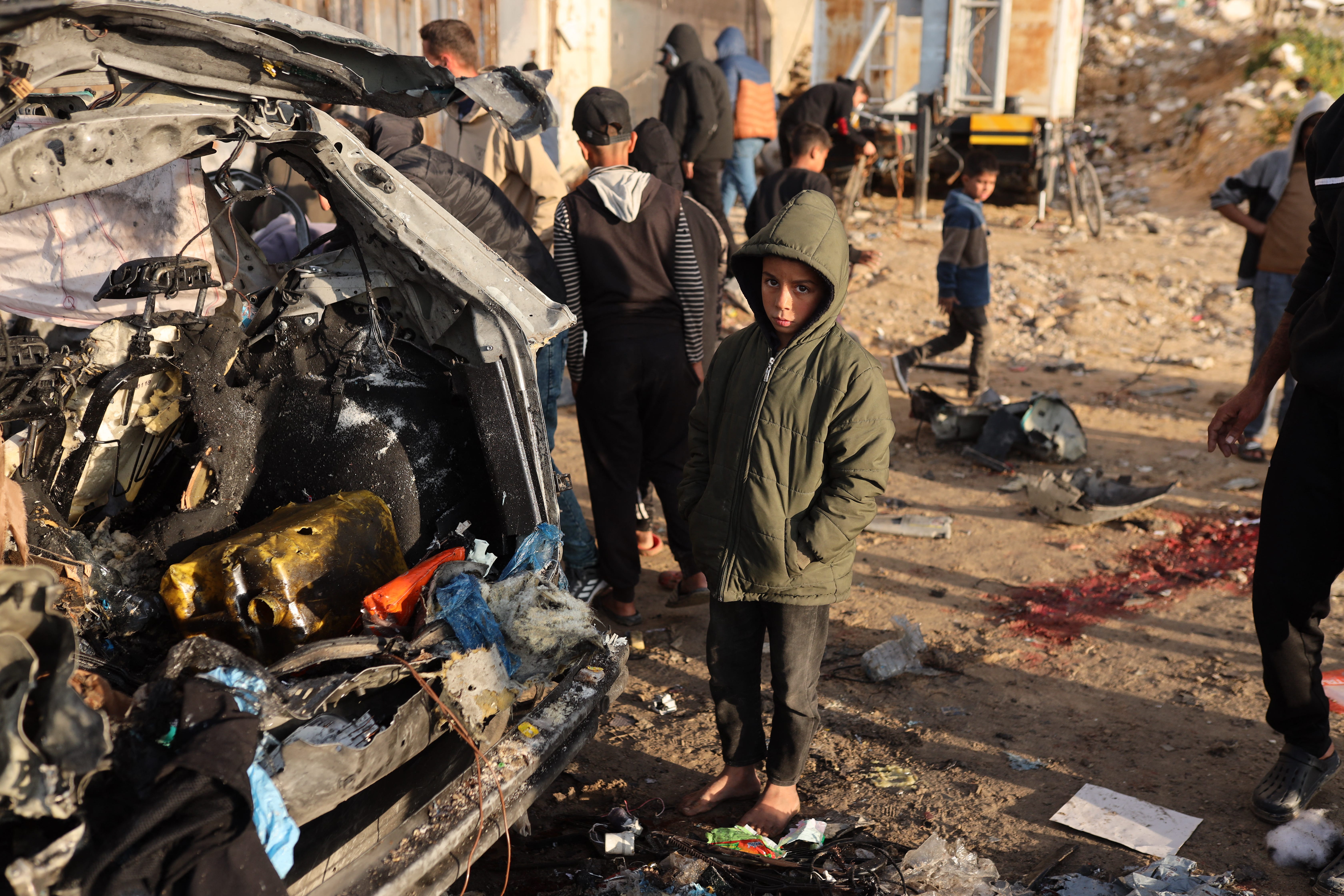
A boy stands near the wreckage of a car targeted by an Israeli airstrike, as others inspect
 the car on Al-Rashid Street in Gaza City, on Dec. 13, 2025. Four Palestinians were killed. 

The genocide is not over. Yes, the pace has slowed. But the intent remains unchanged. It is slow motion killing. The daily numbers of dead and wounded - with increasing numbers falling sick and dying from the cold and rain - are not in the hundreds but the dozens.

December saw an average of 140 aid trucks allowed into Gaza each day - instead of the promised 600 - to keep Palestinians on the edge of famine and ensure widespread malnutrition. In October, some 9,300 children in Gaza under five were diagnosed with severe acute malnutrition, according to UNICEF. Israel has opened the border crossing into Egypt at Rafah, but only for Palestinians leaving Gaza. It is not open for those who want to return to Gaza, as stipulated in the agreement. Israel has seized some 58 percent of Gaza and is steadily moving its demarcation line - known as “the yellow line” - to expand its occupation. Palestinians who cross this arbitrary line - which constantly shifts and is poorly marked when it is marked at all - are shot dead or blown up - even if they are children.

Palestinians are being crammed into a shrinking, fetid, overcrowded concentration camp until they can be deported. Ninety-two percent of Gaza’s residential buildings have been damaged or destroyed and around 81 percent of all structures are damaged, according to UN estimates. The Strip, only 25 miles long and seven-and-a-half miles wide, has been reduced to 61 million tons of rubble, including nine million tons of hazardous waste that includes asbestos, industrial waste, and heavy metals, in addition to unexploded ordnance and an estimated 10,000 decaying corpses. There is almost no clean water, electricity or sewage treatment. Israel blocks shipments of construction supplies, including cement and steel, shelter materials, water infrastructure and fuel, so nothing can be rebuilt.

Eighty-two percent of Israeli Jews support the ethnic cleansing of the entire population of Gaza and 47 percent support killing all civilians in cities captured by the Israeli military. Fifty-nine percent support doing the same to Palestinian citizens of Israel. Seventy-nine percent of Israeli Jews say they are “not so troubled” or “not troubled at all” by reports of famine and suffering among the population in Gaza, according to a survey conducted in July. The words “Erase Gaza” appeared more than 18,000 times in Hebrew-language Facebook posts in 2024 alone, according to a new report on hate speech and incitement against Palestinians.

The newest form of genocidal celebration in Israel - where social media and news channels routinely chortle over the suffering of Palestinians - is the sprouting of golden nooses on the lapels of members of the far-right political party Otzma Yehudit, Israel’s version of the Ku Klux Klan, including one worn by National Security Minister Itamar Ben-Gvir.


They are pushing a bill through the Knesset which seeks to mandate the death penalty for Palestinians who “intentionally or indifferently causes the death of an Israeli citizen,” if they are said to be motivated by “racism or hostility toward a public,” and with the purpose of harming the Israeli state or “the rebirth of the Jewish people in its land,” the Israeli human rights group Adalah explains. More than 100 Palestinians have been killed in Israeli jails since Oct. 7. If the new bill becomes law - it has been cleared through its first reading - it will join the wave of more than 30 anti-Palestinian laws enacted since October 7.

The message the genocide sends to the rest of the world, more than a billion of whom live on less than a dollar a day, is unequivocable: We have everything and if you try and take it away from us, we will kill you.

This is the new world order. It will look like Gaza. Concentration camps. Starvation. Obliteration of infrastructure and civil society. Mass killing. Wholesale surveillance. Executions. Torture, including the beatings, electrocutions, waterboarding, rape, public humiliation, deprivation of food and denial of medical care routinely used on Palestinians in Israeli prisons. Epidemics. Disease. Mass graves where corpses are bulldozed into unmarked pits and where bodies, as in Gaza, are dug up and torn apart by packs of ravenous wild dogs.

We are not destined for the Shangri-La sold to a gullible public by fatuous academics such as Stephen Pinker. We are destined for extinction. Not only individual extinction - which our consumer society furiously attempts to hide by peddling the fantasy of eternal youth - but wholesale extinction as temperatures rise to make the globe uninhabitable. If you think the human species will respond rationally to the ecocide, you are woefully out of touch with human nature. You need to study Gaza. And history.

If you live in the Global North, you will get to peer out at the horror, but slowly this horror, as the climate breaks down, will migrate home, turning most of us into Palestinians. Given our complicity in the genocide, it is what we deserve.

Empires, when they feel threatened, always embrace the instrument of genocide. Ask the victims of the Spanish conquistadors. Ask Native Americans. Ask the Herero and Nama. Ask the Armenians. Ask the survivors of Hiroshima or Nagasaki. Ask the Indians who survived the Bengal famine or the Kikuyu who rose against their British colonizers in Kenya. Climate refugees will get their turn. This is not the end of the nightmare. It is the beginning."