StatCounter

Monday, December 15, 2025

Chet Raymo, "Exile "

"Exile"
by Chet Raymo

 "Are we truly alone
With our physics and myths,
The stars no more
Than glittering dust,
With no one there
To hear our choral odes?"

"This is the ultimate question, the only question, asked here by the Northern Irish poet Derek Mahon. It is a poem of exile, from the ancient familiar, from the sustaining myth of rootedness, of centrality. A poem that the naturalist can relate to, we pilgrims of infinite spaces, of the overarching blank pages on which we write our own stories, our own scriptures, having none of divine pedigree.

Yes, we feel the ache of exile, we who grew up with the sustaining myths of immortality only to see them stripped away by the needy hands of fact. We scribble our choral odes. Who listens? We speak to each other. Is that enough? Having left the home we grew up in, we make do with where we find ourselves, gathering to ourselves the glittering dust of the here and now. Are we truly alone? Mahon again:
 "If so, we can start
To ignore the silence
Of infinite space
And concentrate instead
on the infinity
Under our very noses -
The cry at the heart
Of the artichoke,
The gaiety of atoms."

Better to leave the blank page blank than fill it with sentimental hankerings for home, with those prayers of our childhood we repeated over and over until they became a hard, fast crust on the page. Incline our ear instead to the faint cry that issues from the world under our very noses, from there, the tomato plant on the window sill, the ink-dark crow that paces the grass beyond the panes, the clouds that heap on the horizon - the dizzy, ditzy dance of atoms and the glitterings of stars."
"I like the stars. It's the illusion of permanence, I think. I mean, they're always flaring up and caving in and going out. But from here I can pretend... I can pretend that things last. I can pretend that lives last longer than moments. Gods come and Gods go. Mortals flicker and flash and fade. Worlds don't last; and stars and galaxies are transient, fleeting things that twinkle like fireflies and vanish into cold and dust. But I can pretend...
- Olethros, in "Sandman"

The Poet: David Whyte, "Sweet Darkness"

"Sweet Darkness"

"When your eyes are tired the world is tired also.
When your vision has gone no part of the world can find you.
Time to go into the dark where the night has eyes
to recognize its own.
There you can be sure you are not beyond love.
The dark will be your womb tonight.
The night will give you a horizon further than you can see.

You must learn one thing: the world was made to be free in.
Give up all the other worlds except the one to which you belong.
Sometimes it takes darkness and the sweet confinement of your aloneness
to learn anything or anyone that does not bring you alive is too small for you."

- David Whyte,
"House of Belonging"

"Benedicto"

"Benedicto"
"May your trails be crooked, winding, lonesome, dangerous, leading to the most amazing view. May your mountains rise into and above the clouds. May your rivers flow without end, meandering through pastoral valleys tinkling with bells, past temples and castles and poets' towers into a dark primeval forest where tigers belch and monkeys howl, through miasmal and mysterious swamps and down into a desert of red rock, blue mesas, domes and pinnacles and grottos of endless stone, and down again into a deep vast ancient unknown chasm where bars of sunlight blaze on profiled cliffs, where deer walk across the white sand beaches, where storms come and go as lightning clangs upon the high crags, where something strange and more beautiful and more full of wonder than your deepest dreams waits for you - beyond that next turning of the canyon walls."
- Edward Abbey

"It's True Object..."

"The summit is believed to be the object of the climb. But its true object - the joy of living - is not in the peak itself, but in the adversities encountered on the way up. There are valleys, cliffs, streams, precipices, and slides, and as he walks these steep paths, the climber may think he cannot go any farther, or even that dying would be better than going on. But then he resumes fighting the difficulties directly in front of him, and when he is finally able to turn and look back at what he has overcome, he finds he has truly experienced the joy of living while on life's very road."
- Eiji Yoshikawa

"The Unraveling"

"The Unraveling"
by John Wilder

"The unraveling continues. In one sense, what’s happening is predictable. Looking back in history, while not everything happens in the same way, things very much rhyme. That’s why certain aspects of the current financial collapse are very, very familiar.

The Fed® still has enough influence that it can stop a snowball. Can the Fed® stop an avalanche? Not so much. They may have some tricks to push the day of reckoning down the line if it isn’t off the rails. Again, like a presidential election, it’s a short-term solution to a long-term problem.

If it were merely a financial problem, the actions might be enough. But it’s not just financial. Other problems include extreme societal decadence. Decadence is a strong word. When I was a kid, it was applied to places like the late Roman Empire, or Willy Wonka’s® Chocolate Factory™ where those Umpa-Loompas wore those scanty tight outfits.

But when people take kids – elementary-age kids – to Pride®©™ parades that contain actual nudity and sex acts between adults, and then suggest putting hormones into five-year-olds because they pretended to cook in a pretend kitchen one day, you know that this is the point where God told Noah, “Get the boat,” and told Lot, “Tell everyone to wear sunglasses – I don’t care if it’s night.”

Whatever fetish sex act that any individual wants to do “because it’s Thursday” now seems to take the place of virtue. Replacing actual virtue with temporary individual passions is exactly what every single functioning society in history has avoided to in order to remain functioning. When people follow passions that are productive, like building rockets, they add to society. When people act on passions counter to virtue? Those passions consume and destroy society. Period.

We don’t live in a world where “if it feels good, do it” can ever be a policy that lead to a productive society. At some point, we must be guided by virtue, we have to have a shared vision for a future, and a shared desire to build. Can you imagine a single event that would bring us all together again? I can’t. We have to have that shared vision – if nothing else, to survive. Do we have it?

We do not. We are divided. The idea of a selfless devotion to duty seems to have (in many places) evaporated. Cops are supposed to put themselves into danger to save the innocent – that’s the only reason we put up with the rest of the nonsense that they get up to. If they have changed their motto from “Protect and Serve” to “Hide Until We Can and Give Traffic Tickets to People That Don’t Scare Us” then they’re not much use.

Globalism is likewise something that sounds good, but isn’t. I can understand the need for some places like, say, deserts to import grain and Alaska to import medicine and export oil and good vibes. But can someone tell me that we’re in a better and safer position as a country now that we depend on far-flung nations for things. When I talked to The Boy about careers, the advice I gave him was simple – don’t do anything that someone can do over the Internet. If you do, you’re competing with a job with millions or billions of people.

We have reached the stage of cultural collapse. I’m in favor of capitalism – but amoral capitalism is different. When capitalism is allowed to meet any need, the result isn’t good. Like any system, it needs boundaries. As John Adams said, “Our Constitution was made only for a moral and religious people. It is wholly inadequate to the government of any other.”

Freedom needs boundaries. Freedom needs responsibility. Liberty, real liberty, requires obligation for stability. Otherwise? It descends into chaos.

So, we’ve established that we’re in a difficult place. The things that we depended upon are slowly slipping away. The economy is in a very precarious place, culturally we’re shattered to the point that not even another 9-11 would bring us together. The difficulties that we see from here on out won’t serve to bring us together, they will bring us apart. How about the economic difficulties related to just high fuel prices alone?

The Lefties love it, even as it destroys our economy. Heck destruction of the economy might even be the point. But stresses have consequences. If I drop an orange, it will fall. If we destroy an economy, it will fail. Some parts of it will be predictable: interest rates going up will make housing prices go down. Simple.

The one thing that I can tell you, is what comes next won’t be like what came before. The problems that we have rhyme with the problems of the past, but they’re not the same. During the Great Depression, we were at least (mostly) homogeneous as a country. Now, not so much. The end state is tied to the initial conditions. And the initial conditions of the Great Depression were greatly different than they are today, so there’s no way that we’ll see the same results. And things will never go back to “normal” because we simply cannot go back in time, and there isn’t any such thing as “normal” nor any time period which is “normal”. They will be different.

What we have, though, is the rhyme. It won’t allow us to predict perfectly. But it will allow us to see, dimly."

"Decide..."

"We're all going to die. We don't get much say over how or when, but we do get to decide how we're gonna live. So, do it. Decide. Is this the life you want to live? Is this the person you want to love? Is this the best you can be? Can you be stronger? Kinder? More Compassionate? Decide. Breathe in. Breathe out and decide."
- Richard, "Grey's Anatomy"

"Rebranding Genocide"

"Rebranding Genocide"
by Chris Hedges

"First, it was Israel’s right to defend itself. Then it was a war, even though, by Israel’s own military intelligence database, 83 percent of the casualties were civilians. The 2.3 million Palestinians in Gaza, living under an Israeli air, land and sea blockade, have no army, air force, no mechanized units, no tanks, no navy, no missiles, no heavy artillery, no fleets of killer drones, no sophisticated tracking systems to map all movements, or an ally like the United States, which has given Israel at least $21.7 billion in military aid since Oct. 7, 2023.

Now, it is a “ceasefire.” Except of course, as usual, Israel only abided by the first of the 20 stipulations. It freed around 2,000 Palestinian captives held in Israeli prisons - 1700 of whom were detained after Oct. 7 - as well as around 300 bodies of Palestinians, in exchange for the return of the 20 remaining Israeli captives.

Israel has violated every other condition. It has tossed the agreement - brokered by the Trump administration without Palestinian participation - into the bonfire with all the other agreements and peace accords concerning Palestinians. Israel’s extensive and blatant flouting of international agreements and international law - Israel and its allies refuse to abide by three sets of legally binding orders by the International Cout of Justice (ICJ) and two ICJ advisory opinions, as well as the Genocide Convention and international humanitarian law - presage a world where the law is whatever the most militarily advanced countries say it is.

The sham peace plan - “President Donald J. Trump’s Comprehensive Plan to End the Gaza Conflict” - in an act of stunning betrayal of the Palestinian people, was endorsed by most of the U.N. Security Council in November, with China and Russia abstaining. Member states washed their hands of Gaza and turned their backs on the genocide.

The adoption of resolution 2803 (2025), as the Middle East scholar Norman Finkelstein writes, “was simultaneously a revelation of moral insolvency and a declaration of war against Gaza. By proclaiming international law null and void, the Security Council proclaimed itself null and void. Vis-à-vis Gaza, the Council transmuted into a criminal conspiracy.”

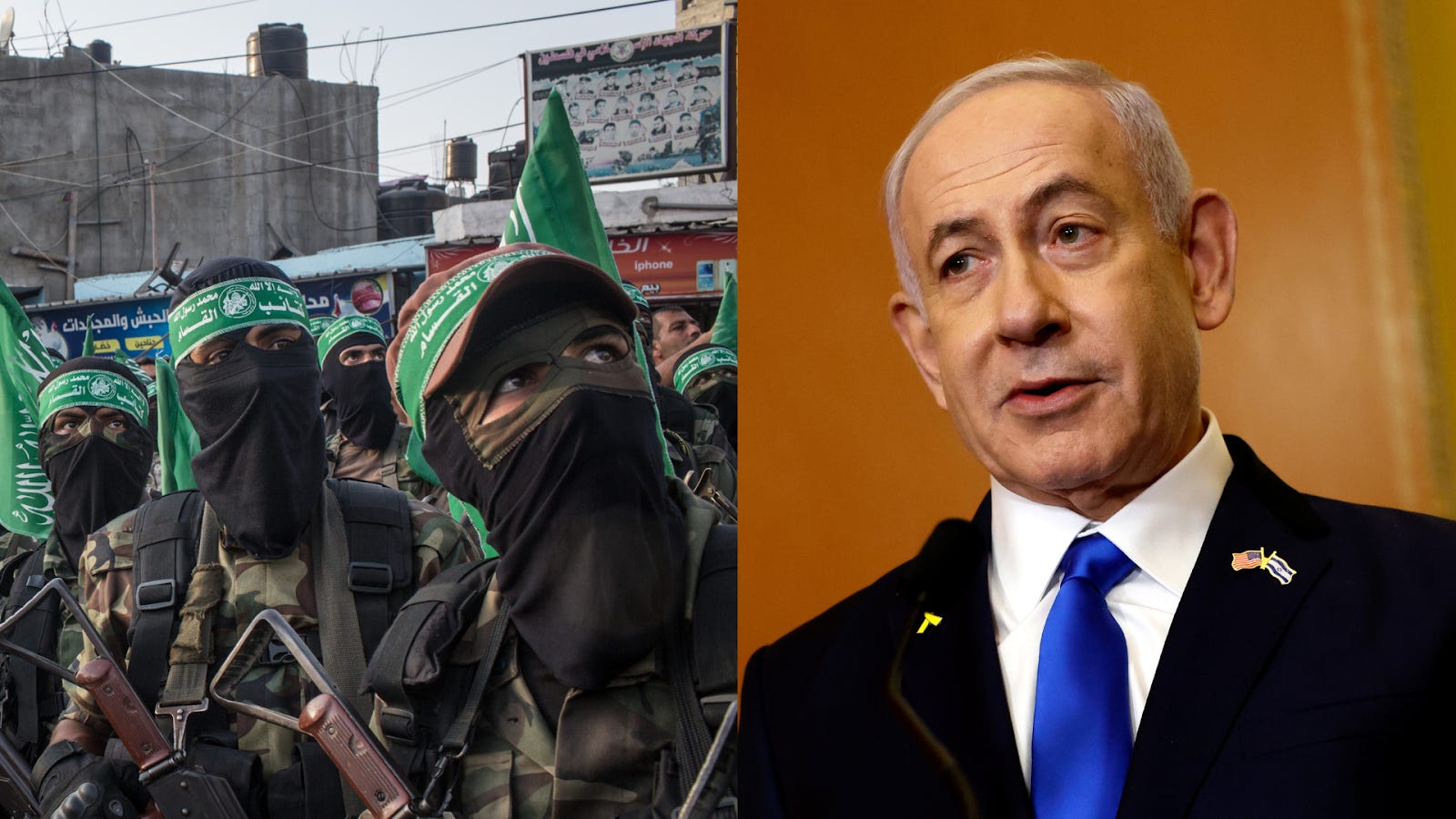
The next phase is supposed to see Hamas surrender its weapons and Israel withdraw from Gaza. But these two steps will never happen. Hamas - along with other Palestinian factions - reject the Security Council resolution. They say they will disarm only when the occupation ends and a Palestinian state is created. Prime Minister Benjamin Netanyahu has vowed that if Hamas does not disarm, it will be done “the hard way.”

Hamas (Photo by Chris McGrath/Getty Images) | 
Benhamin Netanyahu at the U.S. Capitol Building 

The “Board of Peace,” headed by Trump, will ostensibly govern Gaza along with armed mercenaries from the Israel-allied International Stabilization Force, although no country seems anxious to commit their troops. Trump promises a Gaza Riviera that will function as a “special economic zone” - a territory operating outside of state law governed entirely by private investors, such as the Peter Thiel-backed charter city in Honduras. This will be achieved through the “voluntary” relocation of Palestinians - with those fortunate enough to own land offered digital tokens in exchange. Trump declares that the U.S. “will take over the Gaza Strip” and “own it.” It is a return to the rule of viceroys - though apparently not the odious Tony Blair. Palestinians, in one of the most laughable points in the plan, will be “deradicalized” by their new colonial masters.

But these fantasies will never come to fruition. Israel knows what it wants to do in Gaza and it knows no nation will intercede. Palestinians will struggle to survive in primitive and dehumanizing conditions. They will, as they have so many times in the past, be betrayed.

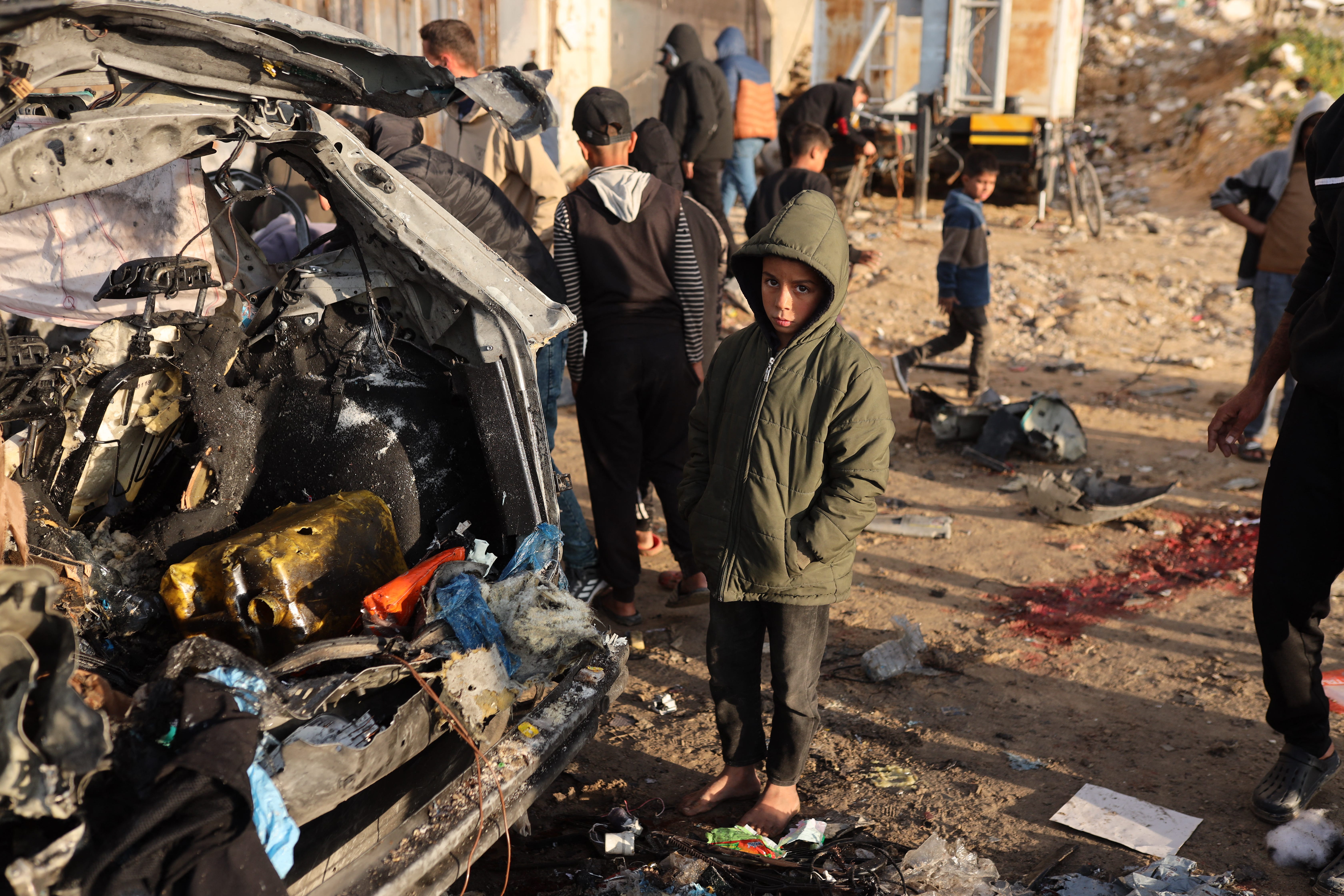
Israel has committed 738 violations of the ceasefire agreement between Oct. 10 and Dec. 12, including 358 land and air bombardments, the killing of at least 383 Palestinians and the injuring of 1,002 others, according to the Government Media Office in Gaza and the Palestinian Health Ministry. That’s an average of six Palestinians killed daily in Gaza - down from an average of 250 a day before the “ceasefire.” Israel said it killed a senior Hamas commander, Raed Saad, on Saturday, in a missile strike on a car on Gaza’s coastal road. Three others were also apparently killed in the strike.

A boy stands near the wreckage of a car targeted by an Israeli airstrike, as others inspect
 the car on Al-Rashid Street in Gaza City, on Dec. 13, 2025. Four Palestinians were killed. 

The genocide is not over. Yes, the pace has slowed. But the intent remains unchanged. It is slow motion killing. The daily numbers of dead and wounded - with increasing numbers falling sick and dying from the cold and rain - are not in the hundreds but the dozens.

December saw an average of 140 aid trucks allowed into Gaza each day - instead of the promised 600 - to keep Palestinians on the edge of famine and ensure widespread malnutrition. In October, some 9,300 children in Gaza under five were diagnosed with severe acute malnutrition, according to UNICEF. Israel has opened the border crossing into Egypt at Rafah, but only for Palestinians leaving Gaza. It is not open for those who want to return to Gaza, as stipulated in the agreement. Israel has seized some 58 percent of Gaza and is steadily moving its demarcation line - known as “the yellow line” - to expand its occupation. Palestinians who cross this arbitrary line - which constantly shifts and is poorly marked when it is marked at all - are shot dead or blown up - even if they are children.

Palestinians are being crammed into a shrinking, fetid, overcrowded concentration camp until they can be deported. Ninety-two percent of Gaza’s residential buildings have been damaged or destroyed and around 81 percent of all structures are damaged, according to UN estimates. The Strip, only 25 miles long and seven-and-a-half miles wide, has been reduced to 61 million tons of rubble, including nine million tons of hazardous waste that includes asbestos, industrial waste, and heavy metals, in addition to unexploded ordnance and an estimated 10,000 decaying corpses. There is almost no clean water, electricity or sewage treatment. Israel blocks shipments of construction supplies, including cement and steel, shelter materials, water infrastructure and fuel, so nothing can be rebuilt.

Eighty-two percent of Israeli Jews support the ethnic cleansing of the entire population of Gaza and 47 percent support killing all civilians in cities captured by the Israeli military. Fifty-nine percent support doing the same to Palestinian citizens of Israel. Seventy-nine percent of Israeli Jews say they are “not so troubled” or “not troubled at all” by reports of famine and suffering among the population in Gaza, according to a survey conducted in July. The words “Erase Gaza” appeared more than 18,000 times in Hebrew-language Facebook posts in 2024 alone, according to a new report on hate speech and incitement against Palestinians.

The newest form of genocidal celebration in Israel - where social media and news channels routinely chortle over the suffering of Palestinians - is the sprouting of golden nooses on the lapels of members of the far-right political party Otzma Yehudit, Israel’s version of the Ku Klux Klan, including one worn by National Security Minister Itamar Ben-Gvir.


They are pushing a bill through the Knesset which seeks to mandate the death penalty for Palestinians who “intentionally or indifferently causes the death of an Israeli citizen,” if they are said to be motivated by “racism or hostility toward a public,” and with the purpose of harming the Israeli state or “the rebirth of the Jewish people in its land,” the Israeli human rights group Adalah explains. More than 100 Palestinians have been killed in Israeli jails since Oct. 7. If the new bill becomes law - it has been cleared through its first reading - it will join the wave of more than 30 anti-Palestinian laws enacted since October 7.

The message the genocide sends to the rest of the world, more than a billion of whom live on less than a dollar a day, is unequivocable: We have everything and if you try and take it away from us, we will kill you.

This is the new world order. It will look like Gaza. Concentration camps. Starvation. Obliteration of infrastructure and civil society. Mass killing. Wholesale surveillance. Executions. Torture, including the beatings, electrocutions, waterboarding, rape, public humiliation, deprivation of food and denial of medical care routinely used on Palestinians in Israeli prisons. Epidemics. Disease. Mass graves where corpses are bulldozed into unmarked pits and where bodies, as in Gaza, are dug up and torn apart by packs of ravenous wild dogs.

We are not destined for the Shangri-La sold to a gullible public by fatuous academics such as Stephen Pinker. We are destined for extinction. Not only individual extinction - which our consumer society furiously attempts to hide by peddling the fantasy of eternal youth - but wholesale extinction as temperatures rise to make the globe uninhabitable. If you think the human species will respond rationally to the ecocide, you are woefully out of touch with human nature. You need to study Gaza. And history.

If you live in the Global North, you will get to peer out at the horror, but slowly this horror, as the climate breaks down, will migrate home, turning most of us into Palestinians. Given our complicity in the genocide, it is what we deserve.

Empires, when they feel threatened, always embrace the instrument of genocide. Ask the victims of the Spanish conquistadors. Ask Native Americans. Ask the Herero and Nama. Ask the Armenians. Ask the survivors of Hiroshima or Nagasaki. Ask the Indians who survived the Bengal famine or the Kikuyu who rose against their British colonizers in Kenya. Climate refugees will get their turn. This is not the end of the nightmare. It is the beginning."

The Daily "Near You?"

Scottsboro, Alabama. USA. Thanks for stopping by!

"We're All Sinking..."

"We're all sinking in the same boat here. We're all bored and desperate and waiting for something to happen. Waiting for life to get better. Waiting for things to change. Waiting for that one person to finally notice us. We're all waiting. But we also need to realize that we all have the power to make those changes for ourselves."
- Susane Colasanti

"Americans Are Skipping Meals And Healthcare Because Of The High Cost Of Living"

Full screen recommended.
Epic Economist, 12/15/25
"Americans Are Skipping Meals And Healthcare
 Because Of The High Cost Of Living"
"64% of Americans are buying less food just to get by. A third are skipping meals entirely. People are refusing ambulances and avoiding doctors because they literally cannot afford to survive. This is not a fringe issue. This is the majority of the country struggling to afford the basics while being told the economy is doing great. In this video we look at the real stories behind the data. Families choosing between groceries and rent. Workers with full time jobs who still can't afford three meals a day. People flying to other countries for medical care because American healthcare has become unaffordable. Food banks running out of food. And a system that seems designed to keep people struggling. This is the reality millions of Americans are living right now. Not the propaganda version. The truth."
Comments here:

Adventures With Danno, "Kroger Shopping Deals After Massive Snowstorm!"

Full screen recommended.
Adventures With Danno, 12/15/25
"Kroger Shopping Deals After Massive Snowstorm!"
Comments here:

"The Bills Are Crushing America - This Is Where Everything Breaks!"

Full screen recommended.
Dan, I Allegedly, 12/15/25
"The Bills Are Crushing America - 
This Is Where Everything Breaks!"
"The economic collapse nobody sees coming – it’s happening right before our eyes, and so many are unprepared. In this video, I cover the latest news on layoffs, inflation, skyrocketing prices, and how AI is reshaping industries. From record-breaking unemployment to insane concert ticket prices, the economy is shifting in ways that are affecting all of us. I also share stories about unclaimed funds, business strategies, and the shocking changes happening with major brands like Anheuser-Busch and Urban Outfitters. Stay tuned. This is breaking news, and things are moving fast."
Comments here:

"How It Really Is"


"Societal Collapse"

"Societal Collapse"
by The ZMan

"Most people think of societal collapse as something like a zombie apocalypse where everything suddenly stops working. Instead of people turning into brain eating zombies, they stop going to work. The “system” collapses, so everyone just stops doing what they normally do all of a sudden. The next day, people divide up into gangs and begin to guard their turf using what is left of modern weapons. Life quickly returns to a hunter-gatherer existence with modern clothes.

This image of collapse is a powerful one. Google the phrase “United States collapse” or some version of it and you get results going back many years. Most of them start with economics but some start with culture. Right now, the people we call the Left for some reason think America is on the verge of collapse because they cannot force people to nod along with their weird morality. Many normal people think collapse is coming because they see the food bill every week.

Of course, there is a market for taking the contrary view. This is a popular gag for internet characters on what we continue to call the Right. They counter the claims from their fellow anti-leftists with arguments for why the “founding principals” will prevail and avoid societal collapse. Maybe they will point out that the magic of the free market has conquered communism, so it will conquer whatever is happening now. It is a form of strategic gainsaying to get attention.

The thing is societal collapse is a real thing that does happen just as civil wars, revolutions, wars and social upheavals are real things. Thirty years ago, the Soviet Union collapsed and we got to watch lots of it on television. When people suddenly realized that the guards were not going to shoot them if they tried to escape to the West, it did not take long before order broke down. Once the process started, there was no way to stop it and the system collapsed.

The thing is it did not happen overnight. The collapse actually started much earlier but people did not notice it. Little things stopped working. For example, people in Hungary began to notice that the border to Austria was not always guarded. Maybe the guards were there and ignored their duty or they just abandoned their post. Over time the border was not much of a border. Similar breakdowns of small systems became common over the course of the 1980’s.

Of course, the collapse of the Soviet Union did not send these societies back to the stone age either. Politics became increasingly chaotic. Law and order broke down to the point where criminal gangs were imposing their will on whole cities, because the police no longer had the ability or desire to stop them. The people got poorer in many small ways, but mostly in the breakdown of trust. They could not rely on the system, so they slowly abandoned it for alternatives.

We do not think of social trust as a part of the poverty equation, but in realty it is the key component of social happiness. High trust societies may not have unlimited consumer goods, but the people trust the system, because they trust one another. This allows for long term planning. Africa will never be rich, despite having massive natural resources, because social trust is near zero. Finland will never be poor because the Finns can count on their fellow Finns to always be Finnish.

Social collapse, like war and revolution, will reflect the material relations of the age because those reflect the resources of society. Revolution in the 18th century was peasants with pitchforks, because that is how you can revolt in an agrarian society operating under feudal rules. In the 19th century revolution was workers hurling homemade bombs and shooting at the authorities, because that is how you can stage a revolt in an industrial urban society.

This is the information age, so revolution will reflect the weapons we choose to use in this age, which will be money and knowledge. Money in all of its forms is a type of information that says things about the general state of affairs. In completely financialized societies like the West, money is the big weapon. It is also other information, like the government hiring clowns and carnies to nudge people in the “right direction” during the Covid panic.

The great tumult in the West over the last decade has been centered on the things that are important in the information age. The rise of a new group of oligarchs was made possible by the technological revolution. Just as agrarian people measured wealth in land and industrial people measured wealth in capital, technological people measure wealth in control of information flows. The reason Mark Zuckerberg is richer than Bill Gates is he controls something more valuable than PC’s.

Societal collapse in the information age will, at least at the beginning, reflect the socioeconomic relations of the age. Trust in what we are told by the media has collapsed, because it is easier to see the lying than in prior ages. In 1985 you could think the New York Times was biased, but predictably so. Today, you cannot trust anything they say because it is false in unpredictable ways. Trust in the media has collapsed because their information is chaotically false.

The slow collapse of trust in our information is spreading. We used to think that the courts were predictable, if not always fair. Poor people might not get the same justice as rich people, but the reason was understood. If you could afford a competent lawyer, he would get the most from the system for you. Today, no one knows what the hell will happen in a courtroom. Alex Jones just got fined a billion dollars because the regime supporters are still salty about the 2016 election.

Of course, trust in government is collapsing not because they do not fix the streets or make the buses run on time. Trust is falling because they lie. It is not about politicians lying, which is expected and predictable. It is the government itself. For example, they appear to be faking key economic data. Their inflation numbers are laughable as anyone who buys food will tell you. They also like to change the meaning of words, which puts an Orwellian spin on the lying.

Getting back to the topic of collapse, what happens in the information age when no one trusts the information? In a world where your bank may close down your account because they claim you hold the wrong opinions; how can you trust them to be straight about anything else? If the government is faking economic data, how can we trust anything else they are doing? When the people responsible for 100% of disinformation claim to be fighting disinformation, who can we trust?

When the Soviet system began to collapse, it was the symbols of its power that first came under pressure. When people stopped fearing the border guard, they slowly stopped fearing the system behind it. The same will be true in this age. When people stop trusting the information that runs this world, they will slowly begin to stop trusting the system behind it. It is at that point the system begins to slowly unravel as alternative trust networks form up to fill the void.

The bottom line is those waiting for collapse are mistaken. It is not a thing that is looming over the horizon. It is a thing that is happening now. Every day there is a new reminder that the system cannot be trusted. Maybe it is ten dollar gas in Germany or skyrocketing food prices in England or demonstrably false claims from the drug makers with regards to the Covid jab. These things chip away at trust in the system and like the game of Jenga, the result is inevitable."
Joseph Tainter, 
"The Dynamics of the Collapse of Human Civilization"

"We Are Not The First Civilization To Collapse, But We Will Probably Be The Last"

"We Are Not The First Civilization To Collapse,
 But We Will Probably Be The Last"
by Chris Hedges

"I am standing atop a 100-foot-high temple mound, the largest known earthwork in the Americas built by prehistoric peoples. The temperatures, in the high 80s, along with the oppressive humidity, have emptied the park of all but a handful of visitors. My shirt is matted with sweat.

I look out from the structure - known as Monks Mound - at the flatlands below, with smaller mounds dotting the distance. These earthen mounds, built at a confluence of the Illinois, Mississippi and Missouri rivers, are all that remain of one of the largest pre-Columbian settlements north of Mexico, occupied from around 800 to 1,400 AD by perhaps as many as 20,000 people.

This great city, perhaps the greatest in North America, rose, flourished, fell into decline and was ultimately abandoned. Civilizations die in familiar patterns. They exhaust natural resources. They spawn parasitic elites who plunder and loot the institutions and systems that make a complex society possible. They engage in futile and self-defeating wars. And then the rot sets in. The great urban centers die first, falling into irreversible decay. Central authority unravels. Artistic expression and intellectual inquiry are replaced by a new dark age, the triumph of tawdry spectacle and the celebration of crowd-pleasing imbecility.

“Collapse occurs, and can only occur, in a power vacuum,” anthropologist Joseph Tainter writes in "The Collapse of Complex Societies." “Collapse is possible only where there is no competitor strong enough to fill the political vacuum of disintegration.”

Several centuries ago, the rulers of this vast city complex, which covered some 4,000 acres, including a 40-acre central plaza, stood where I stood. They no doubt saw below in the teeming settlements an unassailable power, with at least 120 temple mounds used as residences, sacred ceremonial sites, tombs, meeting centers and ball courts. Cahokia warriors dominated a vast territory from which they exacted tribute to enrich the ruling class of this highly stratified society. Reading the heavens, these mound builders constructed several circular astronomical observatories - wooden versions of Stonehenge.

The city’s hereditary rulers were venerated in life and death. A half mile from Monks Mound is the seven-foot-high Mound 72, in which archeologists found the remains of a man on a platform covered with 20,000 conch-shell disc beads from the Gulf of Mexico. The beads were arranged in the shape of a falcon, with the falcon’s head beneath and beside the man's head. Its wings and tail were placed underneath the man’s arms and legs. Below this layer of shells was the body of another man, buried face downward. Around these two men were six more human remains, possibly retainers, who may have been put to death to accompany the entombed man in the afterlife. Nearby were buried the remains of 53 girls and women ranging in age from 15 to 30, laid out in rows in two layers separated by matting. They appeared to have been strangled to death.

The poet Paul Valéry noted, “a civilization has the same fragility as a life.”

Across the Mississippi River from Monks Mound, the city skyline of St. Louis is visible. It is hard not to see our own collapse in that of Cahokia. In 1950, St. Louis was the eighth-largest city in the United States, with a population of 856,796. Today, that number has fallen to below 300,000, a drop of some 65 percent. Major employers - Anheuser-Busch, McDonnell-Douglas, TWA, Southwestern Bell and Ralston Purina - have dramatically reduced their presence or left altogether. St. Louis is consistently ranked one of the most dangerous cities in the country. One in five people live in poverty. The St. Louis Metropolitan Police Department has the highest rate of police killings per capita, of the 100 largest police departments in the nation, according to a 2021 report. Prisoners in the city’s squalid jails, where 47 people died in custody between 2009 and 2019, complain of water being shut off from their cells for hours and guards routinely pepper spraying inmates, including those on suicide watch. The city’s crumbling infrastructure, hundreds of gutted and abandoned buildings, empty factories, vacant warehouses and impoverished neighborhoods replicate the ruins of other post-industrial American cities, the classic signposts of a civilization in terminal decline.

“Just as in the past, countries that are environmentally stressed, overpopulated, or both, become at risk of getting politically stressed, and of their governments collapsing,” Jared Diamond argues in "Collapse: How Societies Choose to Fail or Succeed." “When people are desperate, undernourished and without hope, they blame their governments, which they see as responsible for or unable to solve their problems. They try to emigrate at any cost. They fight each other over land. They kill each other. They start civil wars. They figure that they have nothing to lose, so they become terrorists, or they support or tolerate terrorism.”

Pre-industrial civilizations were dependent on the limits of solar energy and constrained by roads and waterways, impediments that were obliterated when fossil fuel became an energy source. As industrial empires became global, their increase in size meant an increase in complexity. Ironically, this complexity makes us more vulnerable to catastrophic collapse, not less. Soaring temperatures (Iraq is enduring 120 degree heat that has fried the country’s electrical grid), the depletion of natural resources, flooding, droughts, (the worst drought in 500 years is devastating Western, Central and Southern Europe and is expected to see a decline in crop yields of 8 or 9 percent), power outages, wars, pandemics, a rise in zoonotic diseases and breakdowns in supply chains combine to shake the foundations of industrial society. The Arctic has been heating up four times faster than the global average, resulting in an accelerated melting of the Greenland ice sheet and freakish weather patterns. The Barents Sea north of Norway and Russia are warming up to seven times faster. Climate scientists did not expect this extreme weather until 2050.

“Each time history repeats itself, the price goes up,” the anthropologist Ronald Wright warns, calling industrial society “a suicide machine.” In "A Short History of Progress"he writes: "Civilization is an experiment, a very recent way of life in the human career, and it has a habit of walking into what I am calling progress traps. A small village on good land beside a river is a good idea; but when the village grows into a city and paves over the good land, it becomes a bad idea. While prevention might have been easy, a cure may be impossible: a city isn't easily moved. This human inability to foresee - or to watch out for - long-range consequences may be inherent to our kind, shaped by the millions of years when we lived from hand to mouth by hunting and gathering. It may also be little more than a mix of inertia, greed, and foolishness encouraged by the shape of the social pyramid. The concentration of power at the top of large-scale societies gives the elite a vested interest in the status quo; they continue to prosper in darkening times long after the environment and general populace begin to suffer."

Wright also reflects upon what will be left behind: "The archaeologists who dig us up will need to wear hazmat suits. Humankind will leave a telltale layer in the fossil record composed of everything we produce, from mounds of chicken bones, wet-wipes, tires, mattresses and other household waste to metals, concrete, plastics, industrial chemicals, and the nuclear residue of power plants and weaponry. We are cheating our children, handing them tawdry luxuries and addictive gadgets while we take away what’s left of the wealth, wonder and possibility of the pristine Earth."

Calculations of humanity’s footprint suggest we have been in ‘ecological deficit,’ taking more than Earth’s biological systems can withstand, for at least 30 years. Topsoil is being lost far faster than nature can replenish it; 30 percent of arable land has been exhausted since the mid-20th century. We have financed this monstrous debt by colonizing both past and future, drawing energy, chemical fertilizer and pesticides from the planet’s fossil carbon, and throwing the consequences onto coming generations of our species and all others. Some of those species have already been bankrupted: they are extinct. Others will follow.

As Cahokia declined, violence dramatically increased. Surrounding towns were burned to the ground. Groups, numbering in the hundreds, were slaughtered and buried in mass graves. At the end, “the enemy killed all people indiscriminately. The intent was not merely prestige, but an early form of ethnic cleansing” writes anthropologist Timothy R. Pauketat, in "Ancient Cahokia and the Mississippians." He notes that, in one fifteenth-century cemetery in central Illinois, one-third of all adults had been killed by blows to the head, arrow wounds or scalping. Many showed evidence of fractures on their arms from vain attempts to fight off their attackers.

Such descent into internecine violence is compounded by a weakened and discredited central authority. In the later stages of Cahokia, the ruling class surrounded themselves with fortified wooden stockades, including a two-mile long wall that enclosed Monks Mound. Similar fortifications dotted the vast territory the Cahokia controlled, segregating gated communities where the wealthy and powerful, protected by armed guards, sought safety from the increasing lawlessness and hoarded dwindling food supplies and resources.

Overcrowding inside these stockades saw the spread of tuberculosis and blastomycosis, caused by a soil-borne fungus, along with iron deficiency anemia. Infant mortality rates rose, and life spans declined, a result of social disintegration, poor diet and disease.

By the 1400s Cahokia had been abandoned. In 1541, when Hernando de Soto’s invading army descended on what is today Missouri, looking for gold, nothing but the great mounds remained, relics of a forgotten past.

This time the collapse will be global. It will not be possible, as in ancient societies, to migrate to new ecosystems rich in natural resources. The steady rise in heat will devastate crop yields and make much of the planet uninhabitable. Climate scientists warn that once temperatures rise by 4℃, the earth, at best, will be able to sustain a billion people. The more insurmountable the crisis becomes, the more we, like our prehistoric ancestors, will retreat into self-defeating responses, violence, magical thinking and denial.

The historian Arnold Toynbee, who singled out unchecked militarism as the fatal blow to past empires, argued that civilizations are not murdered, but commit suicide. They fail to adapt to a crisis, ensuring their own obliteration. Our civilization’s collapse will be unique in size, magnified by the destructive force of our fossil fuel-driven industrial society. But it will replicate the familiar patterns of collapse that toppled civilizations of the past. The difference will be in scale, and this time there will be no exit."

John Wilder, "The Bright Side of Cultural Collapse"

"The Bright Side of Cultural Collapse"
by John Wilder

"If you’ve ever felt like America’s cultural compass is spinning like a drunk uncle at a Latvian wedding reception, you’re not wrong. I believe most of my readers can remember back to the 1970s and 1980s.At that time, Americans had a (mostly) shared reality, love it or hate it.

That shared reality kept the country rowing in roughly the same direction. Getting out of Vietnam was a political choice, and (we know now) hard-GloboLeftist Walter Cronkite was instrumental in getting us out after hard-GloboLeftist president LBJ got us involved. The media could start and stop wars, at will.

Now? It’s a fractured funhouse mirror where the Super Bowl® and presidential elections seem to be the last gasps of collective attention, like family reunions where everyone shows up but nobody talks afterwards. The rest of the time, we’re each siloed in our respective algorithm alcoves, each getting a different view of reality, sort of like the way she looked after six beers and the way she looked at 8AM. How’d we get here? Blame the usual suspects: tech titans and open-border overlords who can’t get enough of cheap labor and expensive ballots.

Picture this: pre-1930 America, a patchwork quilt of immigrants fresh off the boat around 1900, all crammed into cities like Ellis Island escapees. Cultures clashed harder than a bad blind date. Languages tangled, traditions tussled, and the “melting pot” was more like a slow simmer with occasional boil-overs. How bad was it? Immigration was essentially shut down with the Immigration Act of 1924 which sharply restricted numbers and essentially banned immigration from most non-Western cultures.

At this time, however, technology makes its appearance: enter radio, then television. These were the great homogenizers of America. From FDR’s fireside chats in the ’30s to Reagan’s ranch riffs in the ’80s, these boxes beamed a single narrative into every living room with little competition. Three networks – ABC®, CBS©, NBC™ – dictated the national conversation.

Commie Cronkite signed off with “And that’s the way it is,” and America, by and large, believed him. Why? Mainly because there were no other options except some fringe samizdat. Radio had replaced the town square and TV turbocharged it. Now it was I Love Lucy laughs for all, and heavy-handed M*A*S*H moralizing nationwide, with Johnny Carson‘s couch as the national nightcap.

This centralized media forced most of the immigrants into an ersatz Americana because there weren’t Slavic-language radio stations in most places. Right or wrong, it forged a (more or less) unified American ethos from 1930 to the mid-1990s. Sure, it was sanitized suburbia with a side of Cold War conformity and liberal-left inclusion, but it worked: shared heroes (John Wayne, anyone?), shared villains (Commies), shared laughs from non-stereotypical minorities who were, after all, just like us (Cosby before the fall and his final TV show: Women Say The Darndest Things).

We were one nation under three channels, indivisible, with sitcoms and soaps for all. Then the cracks came. First, cable TV in the 1980s splintered the spectrum, MTV™ for the kids, CNN® for the news junkies, ESPN© for the jocks. But the real wrecking ball? Then, the Internet appeared in the mid-1990s, and was supercharged by smartphones in 2007.

Suddenly, infinite choices: blogs, YouTube®, TikTok©, X®. Everyone is a broadcaster, nobody is the boss. Literally no one tells me what to write, I’m free to bring up uncomfortable truths. This resulted in something the GloboLeft hates: attention is atomized. Their rescue, though, is that now Faceborg™ and Google© could manipulate results and (mostly) keep ideas within politically acceptable limits.

The Super Bowl® still pulls 100M+ viewers, a rare ritual that the NFL™ is trying to destroy by featuring increasingly divisive halftime shows. Elections? They glue us to screens every four years, like national therapy sessions. But otherwise?

The GloboLefties lap up MSNBC® memes, righties rally on Rumble™ and there is no overlap. Also, there are no more “water cooler” moments since the odds of anyone watching the same things as you are very low.

Worse, massive immigration since the ’90s poured gasoline on the fire. Post-1965 reforms flipped the script: waves after wave from Latin America, Asia, Africa from clashing cultures. Traditional American values? Now they’re “racist,” “xenophobic,” “bigoted,” “transphobic,” “climate-denying,” “patriarchal” poison. Family, faith, freedom? Hate crimes.

The people didn’t vote for this mosaic meltdown; The GloboLeftElite engineered it. Cheap labor lured corporations; votes lured Democrats. As Lenin reportedly quipped, “The capitalists will sell us the rope with which we will hang them.” Here, the “rope” was imported workers who tilt 80% GloboLeft, hanging the old republic with demographic destiny. By 2026’s doorstep, consensus is kaput. COVID crackdowns under Biden tried to muzzle dissent: shadowbans, deplatforms, “disinfo” dossiers. But the dam burst.

GloboLeftElite’s iron fist? In the United States in 2025, it appears to be wholly rusted. Political correctness, once their shield, lies in tatters. Why? Dissenting elites like Musk and Trump flipped the script. X™ became a free-fire zone. Ideas flowed unfettered, exposing the emperor’s empty ethos. “Woke” went from weapon to punchline; folks stopped fearing the “racist” label like it was yesterday’s news.

So, where does this cultural shatter take us? Short-term: more balkanization. Red states redline GloboLeft policies, banning DEI diktats, booting illegals, building walls (literal and legal). Blue bubbles boil over with sanctuary silliness and virtue-vomiting, with California leading the country in giving free money to illegal freeloaders. No national narrative means that, right now, there are no peaceful national solutions.

America does have quite an advantage, though an armed citizenry and what remains of federalism, where I expect state freedoms will increase as the central government weakens. American was built as a country that could fight back against overlords with the preservation of the 1st and 2nd Amendments being so crucial to us not falling into the horrific tyranny we see places like England currently entering.

My take, long term? Free ideas forge fresh foundations, with a Tradright renaissance entirely possible: young men gymming, girls gardening, families flourishing in flyover fortresses. I do see that the GloboLeft’s grip will have to slips as their “diversity” devolves into division because the moslems in Dearborn and Somalisota hate gays and want Sharia. The GloboLeft cannot understand, at all, why their pets hate diversity. We’re not done. The rope the GloboLeftists sold? We’ll use it to climb."
o
Download "The Collapse of Complex Societies", 
by Joseph A. Tainter, here:

Bill Bonner, "Chicken Feed"

The world’s best-selling light pick up truck, the Toyota Hilux, 
is prohibitively expensive to import into the United States 
because of a 25% ‘Chicken Tax’ from the 1960s.
"Chicken Feed"
by Bill Bonner

Baltimore, Maryland - "How’s the trade war going? Short answer: as badly as expected. Last week, we saw how capricious tariffs showed the rest of the world that the US cannot be trusted. In the news on Friday was this from CNN: "Trump’s trade war is pushing Canada closer to China. Team Trump imposed...backtracked...exempted...and upped tariffs to 10%...25%...35% and 50% on Canadian goods. Were they levied to stop drugs? To stop competition? To prevent immigrants from slipping across the border...or just because POTUS didn’t like Canada quoting Ronald Reagan? No one knew for sure...but Canada got the message. Now it looks for a more reliable trading partner.

On China, the US imposed tariff taxes as high as 145%, before backing down. This caused the Chinese to diversify their trade among other foreign markets, leading to its biggest trade surplus ever - over $1 trillion. Asia Times: "China’s trade surplus hits $1 trillion for first time ever. The biggest single contributor to the Chinese success was automobiles, electric ones. China overtook Japan as the world’s leading car exporter only two years ago, despite the fact that the largest car market in the world (the US) was effectively off-limits. This year it has a $66 billion trade surplus in the automotive sector."

But in autos, as in so many other things, Donald Trump did not invent America’s dumbbell policies. Joe Biden inherited Trump’s tariffs left over from his first time in the Oval Office. Rather than toss them out, he increased them on China’s EVs - to 100%. This left China to focus on the rest of the world...while the US stewed in its own internal combustion juices. That single move - effectively banning Chinese EVs - cost American drivers, so far, about $20 billion, by our estimate. The average EV in the US sells for over $50,000. China’s EVs in Europe average only 25,000 euros.

By protecting markets from competition, the feds are condemning US producers to inferior output at excessive prices. The rule is simple: the greater the protection, the less competitive the producers become.

When Trump began his tariff wars, importers were paying an average of about 2.5% in tariffs. This went up to 20% or so by July, bringing the US treasury more than $30 billion per month in revenues. That money comes initially from the importers...and eventually comes out of the pockets of their customers, employees and owners.

Effectively, it is a tax. The Tax Policy Center estimates that it will cost the average family $2,100 next year alone. And like all taxes, it takes money from its rightful owners and shifts it to the feds. In both cases, the money is spent. But as long as it remains in the private sector it rewards people for making things other people want.

Government spending, on the other hand, is inherently wasteful and inefficient, depressing long-run GDP. The Penn Wharton Budget model, for example, estimates that the tariff policies will take about 6% off of GDP and 5% from wages...with a ‘lifetime loss’ of about $22,000 per middle-class household. And while the American public is losing wealth, so are the feds. Team Trump has dangled several carrots in front of the tariff nag. They might replace income taxes, for example. Or, he says the administration could share a ‘dividend’ with the public.

Income taxes currently raise about $2.5 trillion. Tariffs are headed to collect about $200 billion or $300 billion per year. Not exactly chicken feed, but nowhere near enough to eliminate income taxes. And let us say that each household gets a ‘dividend’ check for $2,000. That would absorb every penny of tariff revenue - and more. What would be the point? Tariffs would turn into another hole in the federal budget.

And the hole would get bigger. Forget about replacing the income tax. If the tariffs work at all, they squeeze off imports in favor of inferior domestic production at higher prices. And as the volume of imports goes down, so does the amount of tariff taxes we collect.

If Volkswagen, Mercedes, Kia, Toyota and Hyundai et al switched all their manufacturing to the US, for example, which is what the tariffs are designed to encourage, our tariff revenue on them would go to zero. In other words, the more the tariffs bite...the more America bleeds. Leon Hadar: "This is how nations decline: not through dramatic crises, but through the accumulation of poor choices defended by increasingly implausible rhetoric, while the real costs are distributed across millions of households too diffuse to mobilize politically. Trump’s tariff regime offers us a case study in this process, dressed up in the language of economic nationalism and US revival." Typical late, degenerate empire jackassery, in other words."