StatCounter

Monday, December 15, 2025

"We Are Not The First Civilization To Collapse, But We Will Probably Be The Last"

"We Are Not The First Civilization To Collapse,
 But We Will Probably Be The Last"
by Chris Hedges

"I am standing atop a 100-foot-high temple mound, the largest known earthwork in the Americas built by prehistoric peoples. The temperatures, in the high 80s, along with the oppressive humidity, have emptied the park of all but a handful of visitors. My shirt is matted with sweat.

I look out from the structure - known as Monks Mound - at the flatlands below, with smaller mounds dotting the distance. These earthen mounds, built at a confluence of the Illinois, Mississippi and Missouri rivers, are all that remain of one of the largest pre-Columbian settlements north of Mexico, occupied from around 800 to 1,400 AD by perhaps as many as 20,000 people.

This great city, perhaps the greatest in North America, rose, flourished, fell into decline and was ultimately abandoned. Civilizations die in familiar patterns. They exhaust natural resources. They spawn parasitic elites who plunder and loot the institutions and systems that make a complex society possible. They engage in futile and self-defeating wars. And then the rot sets in. The great urban centers die first, falling into irreversible decay. Central authority unravels. Artistic expression and intellectual inquiry are replaced by a new dark age, the triumph of tawdry spectacle and the celebration of crowd-pleasing imbecility.

“Collapse occurs, and can only occur, in a power vacuum,” anthropologist Joseph Tainter writes in "The Collapse of Complex Societies." “Collapse is possible only where there is no competitor strong enough to fill the political vacuum of disintegration.”

Several centuries ago, the rulers of this vast city complex, which covered some 4,000 acres, including a 40-acre central plaza, stood where I stood. They no doubt saw below in the teeming settlements an unassailable power, with at least 120 temple mounds used as residences, sacred ceremonial sites, tombs, meeting centers and ball courts. Cahokia warriors dominated a vast territory from which they exacted tribute to enrich the ruling class of this highly stratified society. Reading the heavens, these mound builders constructed several circular astronomical observatories - wooden versions of Stonehenge.

The city’s hereditary rulers were venerated in life and death. A half mile from Monks Mound is the seven-foot-high Mound 72, in which archeologists found the remains of a man on a platform covered with 20,000 conch-shell disc beads from the Gulf of Mexico. The beads were arranged in the shape of a falcon, with the falcon’s head beneath and beside the man's head. Its wings and tail were placed underneath the man’s arms and legs. Below this layer of shells was the body of another man, buried face downward. Around these two men were six more human remains, possibly retainers, who may have been put to death to accompany the entombed man in the afterlife. Nearby were buried the remains of 53 girls and women ranging in age from 15 to 30, laid out in rows in two layers separated by matting. They appeared to have been strangled to death.

The poet Paul ValĂ©ry noted, “a civilization has the same fragility as a life.”

Across the Mississippi River from Monks Mound, the city skyline of St. Louis is visible. It is hard not to see our own collapse in that of Cahokia. In 1950, St. Louis was the eighth-largest city in the United States, with a population of 856,796. Today, that number has fallen to below 300,000, a drop of some 65 percent. Major employers - Anheuser-Busch, McDonnell-Douglas, TWA, Southwestern Bell and Ralston Purina - have dramatically reduced their presence or left altogether. St. Louis is consistently ranked one of the most dangerous cities in the country. One in five people live in poverty. The St. Louis Metropolitan Police Department has the highest rate of police killings per capita, of the 100 largest police departments in the nation, according to a 2021 report. Prisoners in the city’s squalid jails, where 47 people died in custody between 2009 and 2019, complain of water being shut off from their cells for hours and guards routinely pepper spraying inmates, including those on suicide watch. The city’s crumbling infrastructure, hundreds of gutted and abandoned buildings, empty factories, vacant warehouses and impoverished neighborhoods replicate the ruins of other post-industrial American cities, the classic signposts of a civilization in terminal decline.

“Just as in the past, countries that are environmentally stressed, overpopulated, or both, become at risk of getting politically stressed, and of their governments collapsing,” Jared Diamond argues in "Collapse: How Societies Choose to Fail or Succeed." “When people are desperate, undernourished and without hope, they blame their governments, which they see as responsible for or unable to solve their problems. They try to emigrate at any cost. They fight each other over land. They kill each other. They start civil wars. They figure that they have nothing to lose, so they become terrorists, or they support or tolerate terrorism.”

Pre-industrial civilizations were dependent on the limits of solar energy and constrained by roads and waterways, impediments that were obliterated when fossil fuel became an energy source. As industrial empires became global, their increase in size meant an increase in complexity. Ironically, this complexity makes us more vulnerable to catastrophic collapse, not less. Soaring temperatures (Iraq is enduring 120 degree heat that has fried the country’s electrical grid), the depletion of natural resources, flooding, droughts, (the worst drought in 500 years is devastating Western, Central and Southern Europe and is expected to see a decline in crop yields of 8 or 9 percent), power outages, wars, pandemics, a rise in zoonotic diseases and breakdowns in supply chains combine to shake the foundations of industrial society. The Arctic has been heating up four times faster than the global average, resulting in an accelerated melting of the Greenland ice sheet and freakish weather patterns. The Barents Sea north of Norway and Russia are warming up to seven times faster. Climate scientists did not expect this extreme weather until 2050.

“Each time history repeats itself, the price goes up,” the anthropologist Ronald Wright warns, calling industrial society “a suicide machine.” In "A Short History of Progress"he writes: "Civilization is an experiment, a very recent way of life in the human career, and it has a habit of walking into what I am calling progress traps. A small village on good land beside a river is a good idea; but when the village grows into a city and paves over the good land, it becomes a bad idea. While prevention might have been easy, a cure may be impossible: a city isn't easily moved. This human inability to foresee - or to watch out for - long-range consequences may be inherent to our kind, shaped by the millions of years when we lived from hand to mouth by hunting and gathering. It may also be little more than a mix of inertia, greed, and foolishness encouraged by the shape of the social pyramid. The concentration of power at the top of large-scale societies gives the elite a vested interest in the status quo; they continue to prosper in darkening times long after the environment and general populace begin to suffer."

Wright also reflects upon what will be left behind: "The archaeologists who dig us up will need to wear hazmat suits. Humankind will leave a telltale layer in the fossil record composed of everything we produce, from mounds of chicken bones, wet-wipes, tires, mattresses and other household waste to metals, concrete, plastics, industrial chemicals, and the nuclear residue of power plants and weaponry. We are cheating our children, handing them tawdry luxuries and addictive gadgets while we take away what’s left of the wealth, wonder and possibility of the pristine Earth."

Calculations of humanity’s footprint suggest we have been in ‘ecological deficit,’ taking more than Earth’s biological systems can withstand, for at least 30 years. Topsoil is being lost far faster than nature can replenish it; 30 percent of arable land has been exhausted since the mid-20th century. We have financed this monstrous debt by colonizing both past and future, drawing energy, chemical fertilizer and pesticides from the planet’s fossil carbon, and throwing the consequences onto coming generations of our species and all others. Some of those species have already been bankrupted: they are extinct. Others will follow.

As Cahokia declined, violence dramatically increased. Surrounding towns were burned to the ground. Groups, numbering in the hundreds, were slaughtered and buried in mass graves. At the end, “the enemy killed all people indiscriminately. The intent was not merely prestige, but an early form of ethnic cleansing” writes anthropologist Timothy R. Pauketat, in "Ancient Cahokia and the Mississippians." He notes that, in one fifteenth-century cemetery in central Illinois, one-third of all adults had been killed by blows to the head, arrow wounds or scalping. Many showed evidence of fractures on their arms from vain attempts to fight off their attackers.

Such descent into internecine violence is compounded by a weakened and discredited central authority. In the later stages of Cahokia, the ruling class surrounded themselves with fortified wooden stockades, including a two-mile long wall that enclosed Monks Mound. Similar fortifications dotted the vast territory the Cahokia controlled, segregating gated communities where the wealthy and powerful, protected by armed guards, sought safety from the increasing lawlessness and hoarded dwindling food supplies and resources.

Overcrowding inside these stockades saw the spread of tuberculosis and blastomycosis, caused by a soil-borne fungus, along with iron deficiency anemia. Infant mortality rates rose, and life spans declined, a result of social disintegration, poor diet and disease.

By the 1400s Cahokia had been abandoned. In 1541, when Hernando de Soto’s invading army descended on what is today Missouri, looking for gold, nothing but the great mounds remained, relics of a forgotten past.

This time the collapse will be global. It will not be possible, as in ancient societies, to migrate to new ecosystems rich in natural resources. The steady rise in heat will devastate crop yields and make much of the planet uninhabitable. Climate scientists warn that once temperatures rise by 4℃, the earth, at best, will be able to sustain a billion people. The more insurmountable the crisis becomes, the more we, like our prehistoric ancestors, will retreat into self-defeating responses, violence, magical thinking and denial.

The historian Arnold Toynbee, who singled out unchecked militarism as the fatal blow to past empires, argued that civilizations are not murdered, but commit suicide. They fail to adapt to a crisis, ensuring their own obliteration. Our civilization’s collapse will be unique in size, magnified by the destructive force of our fossil fuel-driven industrial society. But it will replicate the familiar patterns of collapse that toppled civilizations of the past. The difference will be in scale, and this time there will be no exit."

John Wilder, "The Bright Side of Cultural Collapse"

"The Bright Side of Cultural Collapse"
by John Wilder

"If you’ve ever felt like America’s cultural compass is spinning like a drunk uncle at a Latvian wedding reception, you’re not wrong. I believe most of my readers can remember back to the 1970s and 1980s.At that time, Americans had a (mostly) shared reality, love it or hate it.

That shared reality kept the country rowing in roughly the same direction. Getting out of Vietnam was a political choice, and (we know now) hard-GloboLeftist Walter Cronkite was instrumental in getting us out after hard-GloboLeftist president LBJ got us involved. The media could start and stop wars, at will.

Now? It’s a fractured funhouse mirror where the Super Bowl® and presidential elections seem to be the last gasps of collective attention, like family reunions where everyone shows up but nobody talks afterwards. The rest of the time, we’re each siloed in our respective algorithm alcoves, each getting a different view of reality, sort of like the way she looked after six beers and the way she looked at 8AM. How’d we get here? Blame the usual suspects: tech titans and open-border overlords who can’t get enough of cheap labor and expensive ballots.

Picture this: pre-1930 America, a patchwork quilt of immigrants fresh off the boat around 1900, all crammed into cities like Ellis Island escapees. Cultures clashed harder than a bad blind date. Languages tangled, traditions tussled, and the “melting pot” was more like a slow simmer with occasional boil-overs. How bad was it? Immigration was essentially shut down with the Immigration Act of 1924 which sharply restricted numbers and essentially banned immigration from most non-Western cultures.

At this time, however, technology makes its appearance: enter radio, then television. These were the great homogenizers of America. From FDR’s fireside chats in the ’30s to Reagan’s ranch riffs in the ’80s, these boxes beamed a single narrative into every living room with little competition. Three networks – ABC®, CBS©, NBC™ – dictated the national conversation.

Commie Cronkite signed off with “And that’s the way it is,” and America, by and large, believed him. Why? Mainly because there were no other options except some fringe samizdat. Radio had replaced the town square and TV turbocharged it. Now it was I Love Lucy laughs for all, and heavy-handed M*A*S*H moralizing nationwide, with Johnny Carson‘s couch as the national nightcap.

This centralized media forced most of the immigrants into an ersatz Americana because there weren’t Slavic-language radio stations in most places. Right or wrong, it forged a (more or less) unified American ethos from 1930 to the mid-1990s. Sure, it was sanitized suburbia with a side of Cold War conformity and liberal-left inclusion, but it worked: shared heroes (John Wayne, anyone?), shared villains (Commies), shared laughs from non-stereotypical minorities who were, after all, just like us (Cosby before the fall and his final TV show: Women Say The Darndest Things).

We were one nation under three channels, indivisible, with sitcoms and soaps for all. Then the cracks came. First, cable TV in the 1980s splintered the spectrum, MTV™ for the kids, CNN® for the news junkies, ESPN© for the jocks. But the real wrecking ball? Then, the Internet appeared in the mid-1990s, and was supercharged by smartphones in 2007.

Suddenly, infinite choices: blogs, YouTube®, TikTok©, X®. Everyone is a broadcaster, nobody is the boss. Literally no one tells me what to write, I’m free to bring up uncomfortable truths. This resulted in something the GloboLeft hates: attention is atomized. Their rescue, though, is that now Faceborg™ and Google© could manipulate results and (mostly) keep ideas within politically acceptable limits.

The Super Bowl® still pulls 100M+ viewers, a rare ritual that the NFL™ is trying to destroy by featuring increasingly divisive halftime shows. Elections? They glue us to screens every four years, like national therapy sessions. But otherwise?

The GloboLefties lap up MSNBC® memes, righties rally on Rumble™ and there is no overlap. Also, there are no more “water cooler” moments since the odds of anyone watching the same things as you are very low.

Worse, massive immigration since the ’90s poured gasoline on the fire. Post-1965 reforms flipped the script: waves after wave from Latin America, Asia, Africa from clashing cultures. Traditional American values? Now they’re “racist,” “xenophobic,” “bigoted,” “transphobic,” “climate-denying,” “patriarchal” poison. Family, faith, freedom? Hate crimes.

The people didn’t vote for this mosaic meltdown; The GloboLeftElite engineered it. Cheap labor lured corporations; votes lured Democrats. As Lenin reportedly quipped, “The capitalists will sell us the rope with which we will hang them.” Here, the “rope” was imported workers who tilt 80% GloboLeft, hanging the old republic with demographic destiny. By 2026’s doorstep, consensus is kaput. COVID crackdowns under Biden tried to muzzle dissent: shadowbans, deplatforms, “disinfo” dossiers. But the dam burst.

GloboLeftElite’s iron fist? In the United States in 2025, it appears to be wholly rusted. Political correctness, once their shield, lies in tatters. Why? Dissenting elites like Musk and Trump flipped the script. X™ became a free-fire zone. Ideas flowed unfettered, exposing the emperor’s empty ethos. “Woke” went from weapon to punchline; folks stopped fearing the “racist” label like it was yesterday’s news.

So, where does this cultural shatter take us? Short-term: more balkanization. Red states redline GloboLeft policies, banning DEI diktats, booting illegals, building walls (literal and legal). Blue bubbles boil over with sanctuary silliness and virtue-vomiting, with California leading the country in giving free money to illegal freeloaders. No national narrative means that, right now, there are no peaceful national solutions.

America does have quite an advantage, though an armed citizenry and what remains of federalism, where I expect state freedoms will increase as the central government weakens. American was built as a country that could fight back against overlords with the preservation of the 1st and 2nd Amendments being so crucial to us not falling into the horrific tyranny we see places like England currently entering.

My take, long term? Free ideas forge fresh foundations, with a Tradright renaissance entirely possible: young men gymming, girls gardening, families flourishing in flyover fortresses. I do see that the GloboLeft’s grip will have to slips as their “diversity” devolves into division because the moslems in Dearborn and Somalisota hate gays and want Sharia. The GloboLeft cannot understand, at all, why their pets hate diversity. We’re not done. The rope the GloboLeftists sold? We’ll use it to climb."
o
Download "The Collapse of Complex Societies", 
by Joseph A. Tainter, here:

Bill Bonner, "Chicken Feed"

The world’s best-selling light pick up truck, the Toyota Hilux, 
is prohibitively expensive to import into the United States 
because of a 25% ‘Chicken Tax’ from the 1960s.
"Chicken Feed"
by Bill Bonner

Baltimore, Maryland - "How’s the trade war going? Short answer: as badly as expected. Last week, we saw how capricious tariffs showed the rest of the world that the US cannot be trusted. In the news on Friday was this from CNN: "Trump’s trade war is pushing Canada closer to China. Team Trump imposed...backtracked...exempted...and upped tariffs to 10%...25%...35% and 50% on Canadian goods. Were they levied to stop drugs? To stop competition? To prevent immigrants from slipping across the border...or just because POTUS didn’t like Canada quoting Ronald Reagan? No one knew for sure...but Canada got the message. Now it looks for a more reliable trading partner.

On China, the US imposed tariff taxes as high as 145%, before backing down. This caused the Chinese to diversify their trade among other foreign markets, leading to its biggest trade surplus ever - over $1 trillion. Asia Times: "China’s trade surplus hits $1 trillion for first time ever. The biggest single contributor to the Chinese success was automobiles, electric ones. China overtook Japan as the world’s leading car exporter only two years ago, despite the fact that the largest car market in the world (the US) was effectively off-limits. This year it has a $66 billion trade surplus in the automotive sector."

But in autos, as in so many other things, Donald Trump did not invent America’s dumbbell policies. Joe Biden inherited Trump’s tariffs left over from his first time in the Oval Office. Rather than toss them out, he increased them on China’s EVs - to 100%. This left China to focus on the rest of the world...while the US stewed in its own internal combustion juices. That single move - effectively banning Chinese EVs - cost American drivers, so far, about $20 billion, by our estimate. The average EV in the US sells for over $50,000. China’s EVs in Europe average only 25,000 euros.

By protecting markets from competition, the feds are condemning US producers to inferior output at excessive prices. The rule is simple: the greater the protection, the less competitive the producers become.

When Trump began his tariff wars, importers were paying an average of about 2.5% in tariffs. This went up to 20% or so by July, bringing the US treasury more than $30 billion per month in revenues. That money comes initially from the importers...and eventually comes out of the pockets of their customers, employees and owners.

Effectively, it is a tax. The Tax Policy Center estimates that it will cost the average family $2,100 next year alone. And like all taxes, it takes money from its rightful owners and shifts it to the feds. In both cases, the money is spent. But as long as it remains in the private sector it rewards people for making things other people want.

Government spending, on the other hand, is inherently wasteful and inefficient, depressing long-run GDP. The Penn Wharton Budget model, for example, estimates that the tariff policies will take about 6% off of GDP and 5% from wages...with a ‘lifetime loss’ of about $22,000 per middle-class household. And while the American public is losing wealth, so are the feds. Team Trump has dangled several carrots in front of the tariff nag. They might replace income taxes, for example. Or, he says the administration could share a ‘dividend’ with the public.

Income taxes currently raise about $2.5 trillion. Tariffs are headed to collect about $200 billion or $300 billion per year. Not exactly chicken feed, but nowhere near enough to eliminate income taxes. And let us say that each household gets a ‘dividend’ check for $2,000. That would absorb every penny of tariff revenue - and more. What would be the point? Tariffs would turn into another hole in the federal budget.

And the hole would get bigger. Forget about replacing the income tax. If the tariffs work at all, they squeeze off imports in favor of inferior domestic production at higher prices. And as the volume of imports goes down, so does the amount of tariff taxes we collect.

If Volkswagen, Mercedes, Kia, Toyota and Hyundai et al switched all their manufacturing to the US, for example, which is what the tariffs are designed to encourage, our tariff revenue on them would go to zero. In other words, the more the tariffs bite...the more America bleeds. Leon Hadar: "This is how nations decline: not through dramatic crises, but through the accumulation of poor choices defended by increasingly implausible rhetoric, while the real costs are distributed across millions of households too diffuse to mobilize politically. Trump’s tariff regime offers us a case study in this process, dressed up in the language of economic nationalism and US revival." Typical late, degenerate empire jackassery, in other words."

Jim Kunstler, "Free and Fair?"

"Free and Fair?"
by Jim Kunstler

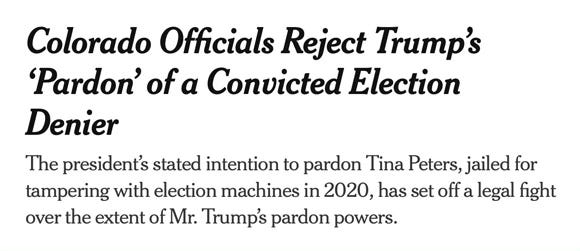
"The prison sentence made Ms. Peters, 70, a martyr for the 
election-denial movement, and launched a fruitless campaign
 by Mr. Trump’s followers to win her release from state prison." 
-The NY Times

“Election denier” is a curious term. It implies that anyone who even questions the validity of an election is not right in the head, maybe even. . . a heretic, a sociopath, a criminal, an enemy of the people! The New York Times flogs the term incessantly as a sort of talisman, to ward off suspicions (branded as evil) that US elections are anything but free, fair, and upright.
Tina Peters was County Clerk in Mesa County, western Colorado, at the time of the 2020 elections, which Donald Trump won in her county by a 63-percent margin, though “Joe Biden” won the state. In May, 2021, during a so-called “trusted build” update of her county’s Dominion ballot tabulation machine software, Tina Peters sought evidence that the machines were capable of being manipulated by wireless internet. She made copies of the hard drives and published passwords online, exposing proprietary software and sensitive system information. She was indicted in 2022 on 13 counts and convicted in August of 2024 on seven counts.

Judge Matthew Barrett threw the book at her, handing the then-69-year-old grandmother a nine-year stretch in state prison. His spoken remarks at sentencing included: “You are no hero. . .” “You’re a charlatan who used, and is still using your prior position to peddle snake oil that’s been proven to be junk time and time again. . .” “You’re as defiant as any defendant this court has ever seen. . .” “Prison is where we send people who are a danger to all of us, whether it be by the pen or the sword or the word of the mouth.”

Rather harsh treatment, wouldn’t you say? A classic case of someone being made an example of, as a caution to others who might dare to question an election. Of course, many of us who stayed up late Nov. 3-4, 2020, saw what looked like considerable shenanigans reported from voting precincts around the country. There were the weird flipperooskies in Michigan and Wisconsin where Mr. Trump was winning by a lot, and then, suddenly, at two o’clock in the morning, “Joe Biden” shot way ahead. The explanation has been that Republicans show up to vote on election day and their votes are counted early while more Democrats voted by mail-in ballots, which are counted later on.

That does not account for the thumping irregularities in the mail-in vote itself, the skeezy ballot-harvesting activities and drop-box stuffing of Democratic Party ward-heelers; the instances, statistically absurd, when all the votes in a late hour were cast only for “Joe Biden” and none for Trump; the $400-million that Mark Zuckerberg gave in grants - through his Center for Technology and Civic Life - to 2,500 election districts, which allowed him to replace local election officials with outside ringers; the monkey-business in Fulton County, GA, where a supposedly “broken toilet” closed down the operation while CCTV cameras recorded suitcases full of ballots hauled out from underneath the tables and duly tabulated during the “shutdown;” the arrival of a truck from Long Island loaded with boxes of ballots at the loading dock of the main Philadelphia precinct center in the wee hours of the morning. . . and much more. Not to mention whatever the Dominion machines were doing in the background.

What is even the necessity of the Dominion voting machines? All they do is provide superfluous complexity to the process and invite fraud. How did it become outside acceptable discourse to even ask about that? Answer: because the Democratic Party benefits from opportunities for fraud, and many Republicans go along with it because, you know, Trump Trump Trump. In any case, despite all the cries of “baseless claims” and “election denial,” and other patently disingenuous mantras, our elections give off the odor of fraud and the means for cleaning them up are obvious and simple - which I’ll spare you from rehearsing again. What’s more, we are just now learning about the extensive involvement of Venezuela in producing the Dominion machines and using them globally to engineer election outcomes. That might be the main reason our navy is parked off that nation’s coast just now.

For months, Mr. Trump’s Department of Justice attempted to intervene in the Tina Peters case and, at least, get here moved into a safer federal prison. Colorado officials fought all that. So, last week, Mr. Trump issued a pardon for Tina Peters. There is mixed opinion as to whether a president can pardon anyone convicted in a state jurisdiction. Colorado told Mr. Trump that his pardon will not apply - that they will keep Tina Peters in the state slammer. There are additional considerations as to whether anyone in “Joe Biden’s” DOJ might have unduly participated in or influenced the process that led to Tina Peters’ conviction. . . and, if so, whether that would make a presidential pardon apply.

Now, Mr. Trump says he will release new, additional information that the 2020 election was “rigged.” You might suppose that he is in a position to know. DNI Tulsi Gabbard likewise says she has proof that the Dominion voting machines were tampered with around the nation in 2020. Wouldn’t it be nice if, by Christmas Eve, the president sent a contingent of US marshals to Colorado demanding the release of Tina Peters into federal custody. . . and arrested any Colorado official, including Governor Jared Polis, who interferes with the process? Wouldn’t you like to see that?"

"“Six Figures Is Survival” – Even High Earners Are Drowning Financially As The U.S. Dollar Is Transformed Into Toilet Paper"

"“Six Figures Is Survival” – Even High Earners Are Drowning 
Financially As The U.S. Dollar Is Transformed Into Toilet Paper"
by Michael Snyder

"Inflation is a tax that nobody can escape. No matter how hard you may try, the rising cost of living is going to catch up with you eventually, and we live at a time when the cost of living has become exceedingly painful. The reason why the cost of living has become such an important issue is because those that are running the system have been treating our currency like toilet paper. Many of us warned what would happen when the Federal Reserve started printing money out of thin air and monetizing the debt. But instead of learning their lesson, they are beginning to do it again. And Congress is spending so much money that the monthly budget deficit for the month of October just set an all-time record. What they are doing to us is literally insane, and the middle class is dying right in front of our eyes.

In so many ways, the U.S. economy is starting to resemble the economy of the Weimar Republic just before hyperinflation kicked in. As the U.S. dollar rapidly loses value, even high earners are now struggling to stay afloat financially. If you doubt this, just consider the shocking results of a brand new Harris poll

• Six figures is survival, not success: 64% of six-figure earners say six figures is no longer a sign of wealth but survival mode - a paycheck that covers costs, not comfort. The benchmark of success has become the bare minimum to keep up.
• The American Dream feels out of reach: More than half of six-figure earners say the Dream no longer feels attainable, revealing a generation of professionals who have achieved everything on paper but feel they’re standing on financial quicksand.
• Where luxury used to live, the basics now move in: Groceries, housing, and healthcare are the top expenses draining even the top 10%. Vacations, savings, and wellness - once staples of comfort - have quietly slipped into the “nice-to-have” category.
• The illusion of wealth is exhausting: Many top earners say people assume they can afford it all, yet behind the image of success are quiet sacrifices: skipped purchases, delayed plans, and a fragile sense of security.
• Credit cards as life rafts: Three-quarters of six-figure earners have used a credit card in the past three months because they ran out of cash, not to collect points. For many, plastic has become the bridge between paychecks.
• Affluence, paid in installments: BNPL use is highest among $200k+ households - the top 10% now financing everyday life, from groceries to gas, in ways once reserved for those just getting by.
• The new middle class begins where old wealth used to end: Six-figure earners now define financial comfort at $200k+, and more than half say they’d need double their current income to finally feel secure. The top 10% are quietly struggling — so what happens to the other 90%?

If nearly two-thirds of six figure earners feel like what they are bringing in is only enough for “survival mode”, what does that say about our economy as a whole? The truth is that our leaders are systematically murdering the American Dream. I have been ranting about this for years, and now people all over the country are finally waking up to what they have done to us.

According to a new AP-NORC poll, 87 percent of Americans have noticed “higher than usual prices for groceries in the past few months”…"The survey indicates that it’s the level of prices — and not just the rate of inflation - that is the point of pain for many families. About 9 in 10 U.S. adults, 87%, say they noticed higher than usual prices for groceries in the past few months, while about two-thirds say they’ve experienced higher prices than usual for electricity and holiday gifts. About half say they’ve seen higher than normal prices for gas recently."

It is virtually impossible to get 87 percent of Americans to agree on anything. But somehow we are all convinced that grocery prices have been going up. When I go to the grocery store, I can hardly believe how high prices have become. Some things are now three or four times as much as they once were. Over the past 10 to 15 years, we have witnessed such a dramatic shift. But this is only just the beginning.

According to Fox Business, the proportion of U.S. small businesses that are raising their selling prices “jumped by an all-time high in November”…"The share of small businesses raising their selling prices jumped by an all-time high in November as inflationary pressure continued to impact businesses and consumers, according to a new report by the National Federation of Independent Businesses (NFIB). NFIB’s monthly report on small business economic trends for November found a 13-point jump in the net percent of owners who reported raising their average selling prices, which was the largest monthly jump in the history of the survey."

That pushed the percent of owners saying they’re raising average selling prices to a net of 34%, which is the highest reading in the survey since March 2023. That’s also well above the monthly average of a net 13%. What this means is that our cost of living crisis is accelerating. If your paycheck is not keeping up, you are losing ground.

Meanwhile, mass layoffs continue to occur all over the United States. According to Challenger, Gray & Christmas, U.S. employers have announced a grand total of almost 1.2 million job cuts so far this year…"Americans are growing increasingly terrified about layoffs – and with good reason. Cuts are accelerating, and no industry feels safe. All told, employers have announced roughly 1.2 million cuts so far this year, according to layoff tracker Challenger, Gray & Christmas – that’s 54 percent more than during the first 11 months of 2024. Perhaps the most unsettling is that industries once seen as safe harbors for employees – tech, manufacturing and even small business – are now among the hardest hit. That’s left millions of workers asking the same pressing question: How do I avoid getting the chop?"

Retail is one of the industries that has been hit particularly hard. So far in 2025, retailers have announced almost 140 percent more job cuts than they did during the same period in 2024…
"For the year so far, the industry has announced 91,954 job cuts, up nearly 140% from the same period in 2024. The cuts are primarily attributable to softening demand, tariff uncertainty and changing consumer preferences, per the report."

As I discussed last week, the tourism industry has also fallen on extremely hard times. In New Orleans, a lack of tourists is causing the streets to be quieter than they have been in a long, long time…"But in the quieter areas, things are, well, quieter. On a cool December evening as raindrops polka-dotted the pavement, longtime street performer Onunze Ubaka, 72, crooned Motown classics to a virtually empty corner off the usually busy Jackson Square in the French Quarter. Few tourists passed by. Even fewer stopped to drop dollar bills into his white tip bucket.

“You can feel the change,” Ubaka said in between songs from Lou Rawls and The Temptations. Inside his tip bucket, a small pile of greenbacks barely covered the 15-pound dumbbell he started putting in after a young man tried to run off with it. Ubaka said there’s been a general economic slowdown, in particular a loss of international tourists."

Just look around. Everything is changing. You would have to be blind not to see it. Sadly, a whole lot more pain is on the way. Printing more money won’t solve our problems. It will only make things even worse. Borrowing and spending more money won’t solve our problems either. Our leaders kicked the can down the road for many years, but now the entire road is coming to an end. They kept trying to outrun the laws of economics, and for a while they actually thought that they were getting away with it. But now a time of reckoning has arrived, and it is not going to be fun."

"Economic Market Snapshot 12/15/25"

"Economic Market Snapshot 12/15/25"

Down the rabbit hole of psychopathic greed and insanity...
Only the consequences are real - to you!
"It's a Big Club, and you ain't in it. 
You and I are not in the Big Club."
- George Carlin
o
Market Data Center, Live Updates:
Financial Stress Index

"The OFR Financial Stress Index (OFR FSI) is a daily market-based snapshot of stress in global financial markets. It is constructed from 33 financial market variables, such as yield spreads, valuation measures, and interest rates. The OFR FSI is positive when stress levels are above average, and negative when stress levels are below average. The OFR FSI incorporates five categories of indicators: creditequity valuationfunding, safe assets and volatility. The FSI shows stress contributions by three regions: United Statesother advanced economies, and emerging markets."
Job cuts and much more.
Commentary, highly recommended:
"The more I see of the monied classes,
the better I understand the guillotine."
- George Bernard Shaw
Oh yeah... beyond words. Any I know anyway...
And now... The End Game...
o

Sunday, December 14, 2025

"This Is Getting Serious: Warning Signs Everywhere, They're Losing Control"

Full screen recommended.
Jeremiah Babe, 12/14/25
"This Is Getting Serious:
 Warning Signs Everywhere, They're Losing Control"
Comments here:

"Israel Poised to Strike Iran – Not If, But When"

Prof. Mohammad Marandi, 12/14/25
"Israel Poised to Strike Iran – Not If, But When"
Comments here:
o

Musical Interlude: Matt Simons, "After The Landslide"

Full screen recommended.
Matt Simons, "After The Landslide" (Remix)
o
Matt Simons, "After The Landslide"
(Official release.)

Oh yeah, we're in the landslide alright...

"A Look to the Heavens"

"From our vantage point in the Milky Way Galaxy, we see NGC 6946 face-on. The big, beautiful spiral galaxy is located just 20 million light-years away, behind a veil of foreground dust and stars in the high and far-off constellation of Cepheus. From the core outward, the galaxy's colors change from the yellowish light of old stars in the center to young blue star clusters and reddish star forming regions along the loose, fragmented spiral arms.
NGC 6946 is also bright in infrared light and rich in gas and dust, exhibiting a high star birth and death rate. In fact, since the early 20th century at least nine supernovae, the death explosions of massive stars, were discovered in NGC 6946. Nearly 40,000 light-years across, NGC 6946 is also known as the Fireworks Galaxy. This remarkable portrait of NGC 6946 is a composite that includes image data from the 8.2 meter Subaru Telescope on Mauna Kea.”
o
Full screen recommended.
Carl Saga, "Humility"

"Too Often..."

"The majority of us lead quiet, unheralded lives as we pass through this world. There will most likely be no ticker-tape parades for us, no monuments created in our honor. But that does not lessen our possible impact, for there are scores of people waiting for someone just like us to come along; people who will appreciate our compassion, our unique talents. Someone who will live a happier life merely because we took the time to share what we had to give. Too often we underestimate the power of a touch, a smile, a kind word, a listening ear, an honest compliment, or the smallest act of caring, all of which have a potential to turn a life around. It’s overwhelming to consider the continuous opportunities there are to make our love felt."
- Leo Buscaglia

"Tourism Apocalypse Begins As No One Can Afford To Travel To America Anymore"

Full screen recommended.
Epic Economist, 12/14/25
"Tourism Apocalypse Begins As No One
 Can Afford To Travel To America Anymore"
"America's tourism industry is collapsing and nobody wants to talk about it.
Airports that used to be the busiest in the world are now empty. International travelers are paying hundreds of dollars in cancellation fees just to avoid coming here. Disney parks are deserted in the middle of summer. Las Vegas tourism has declined for seven straight months. And instead of fixing any of this, they're adding new visa fees and raising prices everywhere.
This isn't a slow decline. This is a full blown tourism apocalypse happening in real time. Billions of dollars in lost revenue. Workers going months without shifts. Entire local economies feeling the collapse. And the worst part? All of it is completely self inflicted.

In this video we're breaking down everything from the empty airports to the canceled trips to the ghost town theme parks. We're looking at why international travelers are choosing Europe over America, why families are deciding the trip just isn't worth it anymore, and why charging people more money to feel unwelcome is somehow the strategy. If you've noticed things feel different lately or you work in tourism and you're feeling the impact, drop your experience in the comments. I want to hear what you're seeing out there."
Comments here:

"Red Square Epic Winter Market 2025"

Full screen recommended.
Lisa The Russian, 12/14/25
"Red Square Epic Winter Market 2025"
Comments here:

The Daily "Near You?"

Fredericton, New Brunswick, Canada. Thanks or stopping by!

"'Beatitude': Poet John Keene’s Spell Against Despair"

"'Beatitude': 
Poet John Keene’s Spell Against Despair"
by Maria Popova

"How do we live whole in a breaking world? It helps to bless what is simply for being. It helps to thank everything for its unbidden everythingness. And still we need help — help holding on to the beauty amid the brutality, help stripping the armors of certainty to be complicated by contraction and more tenderly entire with one another, help seeing the variousness of the world more clearly in order to love it more deeply.

The help of a lifetime comes from John Keene’s poem “Beatitude” — a poem partway between mantra and manifesto, a protest in the form of prayer, a spell against indifference, broadening Amiri Baraka’s instruction to “love all things that make you strong” and deepening Leonard Cohen’s instruction for what to do with those who harm you, carrying the torch Whitman lit when he urged us to “love the earth and sun and the animals” and every atom of one another, all the while speaking in a voice entirely original yet sonorous with the universal in us. It is read here to the accompaniment of ZoĂ« Keating’s perfect “Optimist"
"Beatitude"
by John Keene, read by Maria Popova.

"Love everything
Love the sky and sea, trees and rivers,
mountains and abysses.
Love animals, and not just because you are one.
Love your parents and your children,
even if you have none.
Love your spouse or partner,
no matter what either word means to you.
Love until you create a cavern in your loving,
until it seethes like a volcano.
Love everytime.
Love your enemies.
Love the enemies of your enemies.
Love those whose very idea of love is hate.
Love the liars and the fakes.
Love the tattletales and the hypercrits, the hucksters and the traitors.
Love the thieves because everyone has thought
of stealing something at least once.
Love the rich who live only to empty
your purse or wallet.
Love the poverty of your empty coin purse or wallet.
Love your piss and sweat and shit.
Love your and others’ chatter and its proof of the expansiveness
of nothingness.
Love your shadows and their silent censure.
Love your fears, yesterday’s and tomorrow’s.
Love your yesterdays and tomorrows.
Love your beginning and your end.
Love the fact that your end is another beginning,
or could be, for someone else.
Love yourself, but not too much
that you cannot love everything and everyone else.
Love everywhere.
Love in the absence of love.
Love the monsters breeding
in every corner of the city and suburb,
all throughout the soil of the countryside.
Love the monster breeding inside you and slaughter him
with love.
Love the shipwreck of your body, your mind’s
salted garden.
Love love."

“Beatitude” comes from the elixir that is Keene’s "Punks: New & Selected Poems" (public library). Couple it with Ellen Bass’s kindred ode to the courage of tenderness, then revisit George Saunders on how to love the world more and Rumi on the art of choosing love over not-love.

"Never Fair..."

"Life is never fair,
and perhaps it is a good thing for most of us that it is not."
- Oscar Wilde

"He Cannot Help..."

“A person who has not been completely alienated, who has remained sensitive and able to feel, who has not lost the sense of dignity, who is not yet ‘for sale’, who can still suffer over the suffering of others, who has not acquired fully the having mode of existence – briefly, a person who has remained a person and not become a thing – cannot help feeling lonely, powerless, isolated in present-day society. He cannot help doubting himself and his own convictions, if not his sanity.”
- Erich Fromm

"An End-Time Extinction Level Event, Or A Very Predictable Yet Cataclysmic Mini Ice Age Due To The Oncoming...

"An End-Time Extinction Level Event, Or A Very
Predictable Yet Cataclysmic Mini Ice Age Due To The Oncoming...
by State Of The Union

Excerpt: "But how do the NWO globalists know that this particular Grand Solar Minimum and subsequent mini ice age, among all of those ever recorded, will be such a protracted catastrophic event for all of humanity?

ANSWER: Because all the most accurate GSM comparative analyses and unadulterated scientific data reflect an extended climatological event that will likely surpass the last major GSM known as the “Maunder Minimum”. However, the real problem in 2025 and beyond is that the world community of nations is woefully unprepared for such a mini ice age because the most informed governments, at the direction of the predatory power elite, have intentionally not disclosed the stark realities (see the exposĂ© posted below). After all, the New World Order globalist cabal has as their long planned objective the using of this epochal calamity as a global depopulation event down to 500,000,000 slaves.
Submitted by Cosmic Convergence Research Group
SOTN Exclusive

By now it should be both intuitively and factually obvious to every digitally connected person on the planet that the anthropogenic CO2-driven Global Warming hoax concocted back in the early 1990s was launched as a MASSIVE red herring. Similarly, that the absurdly contrived Climate Change scam that soon followed was put on super steroids worldwide to further distract the entire planetary civilization from what is really on the climatological horizon.

KEY POINTS: So is there climate change or not? Yes, there is, but it’s not taking place because of the ridiculous reasons coming from officialdom. First, it’s crucial to understand that the NWO geoterrorists and geoengineers can manufacture catastrophic weather events and calamitous climate trends, respectively, anywhere they want to as evidenced by the extremely severe drought conditions they have engineered throughout the greater Tehran metro region for the last five to six years. In this way, these genocidal weather warriors have artificially fabricated fake weather disasters worldwide as an ongoing false advertisement for Global Warming. The absurdly fraudulent “Green New Deal” and annual Kabuki theater known as the UN Climate Change Conference (COP30 in 2025) are just two of the government initiatives launched to keep this globalist hoax going until the painful realities of the slowly manifesting Grand Solar Minimum overwhelm the human race. Secondly, there is the very real climate change being caused by the currently unfolding Grand Solar Minimum which the United Nations has yet to even acknowledge.

All of which means that it was certainly no coincidence or quirk of fate that OPERATION COVID-19 was executed in January of 2020 as the Covid Super Vaccination Agenda was rolled out later in December. Five long years have since gone by since that massive and quite purposeful global psyop was first carried out…which is exactly why so very few folks really understand the sheer enormity and gravity of what the human race is now facing."
Full, most highly recommended article, is here:
o

"How It Really Is. WTF?!"

And how about you, Good Citizen? How's that job going? Current with all the bills? Health insurance affordable, keeping you well? If you're in Appalachia I hope you're wisely spending that $750 they gave you to replace losing your home and everything you owned, if you could even apply... But of course your own food stamp balance and available cash balances look like this, right?
10 MILLION illegals in the last year alone automatically get $5,000 pre-paid debit cards and free transportation wherever they like? Free health care and housing? While 600,000 Americans are homeless, including 60,000 veterans, 22 of whom commit suicide EVERY day?! 150,000 drug overdoses in the last year! $901 BILLION for the War Dept! Trump said $359 BILLION for Ukraine, God knows how many BILLIONS to Israel, and you, Good Citizen, what do they do for YOU?!
WTF, and I repeat WTF is wrong with this country?!

Joel Bowman, "On Borrowed Time"

"On Borrowed Time"
Household debt from one End of the Americas to the other...
by Joel Bowman

“Change is the only constant.”
~ Heraclitus (c.535 – 475 BC)

Buenos Aires, Argentina - "There’s a saying down here on the Pampas: Go away for a short time and you’ll come back to find everything changed; leave for a long time and you’ll return to find everything the same. Though Borgesian in tone, the apparent paradox makes perfect sense once you’ve witnessed the sudden, sometimes violent upheavals here. The mood changes quickly, from apathetic to alarmed, composed… to concerned… to full blown crisis mode. There’s a run on the banks, say… or the national football team was beaten in round one (by Saudi Arabia!)… or, most likely, the currency is suddenly in free-fall… again. Indeed, when it comes to phony fiat shenanigans, change (in the form of currency devaluations and the ever-present threat of hyperinflation) is the only constant.

When we moved to Argentina, a decade and a half ago, a 100 peso bill was plenty sufficient to cover a dinner for two... with appetizers, juicy Argentine steaks, coffee and deserts, plus a bottles (or two) of delicious malbec and a generous tip. This morning, that same 100 peso note is worth about 7 cents. The largest bill currently in circulation is the 20,000 peso note. In 2010, that would have been worth $5,750. Today, it is worth about $14.

Creative Accounting: You can imagine what that means for anyone trying to do business here… the “creative accounting” that has to go into pricing goods and services, forecasting and budgeting costs, managing inventory, meeting payroll, maintaining employee contracts, and plenty more besides… all without access to credit. And yet, a certain degree of exposure to such suboptimal circumstances can antifragilize a population. For one thing, most people here don’t carry a whole lot of debt. Household debt, for example, is practically non-existent. By way of comparison…

According to the latest BIS and IMF data, household debt as percentage of the size of the overall economy in the United States stands at about 70-75% of GDP. That is, dividing the $18.5-18.6 trillion in total household debt (per the Federal Reserve/New York Fed’s Q3 2025 figures) by the size of the US population (~340 million) equals roughly $54,000-55,000 per person.

Here in Argentina, the latest available figures (CEIC data for late 2024), shows total household debt equal to roughly $28-30 billion, or about 5% of GDP. Shared among a population of ~46 million, that comes to about… $600-650 per person.

Measured purely in total dollar terms, the average American’s personal debt load is about 85-90 times higher than an Argentine’s. Of course, Americans and Argentines don’t earn nearly the same amount of dollars… but even adjusting for this discrepancy we still see a gaping chasm.

In the US, the median annual salary for full-time worker at $63,000, meaning the average American carries almost a full year’s work (11 months) in debt. With an average of salary of $1,000 to $1,200 USD per month (the median for registered private workers in Argentina, according to the latest from INDEC), the average Argentine carries… about two weeks worth of debt.

Doghouse to Penthouse: The figures are even more alarming for other, highly indebted nations… South Korea’s household debt to GDP stands at 91.7 %… Canada’s comes in around 99–100 %… and topping the charts, Australia’s household debt weighs in an an eye-watering 113% of GDP (meaning, in simple terms, for every A$100 Australia produces in a given year, households on average shoulder about A$113 of debt…mostly mortgage loans).

In many ways, Argentina is still very much a tabula rasa, with vastly underdeveloped credit markets on the one hand… and enormous “collateral/equity” in the form of vast and untapped natural resources on the other. Where other nations have extended themselves, arguably beyond their means, Argentina has spent the past several decades in the proverbial doghouse, locked out of international markets and sleeping on the sofa. And yet, as we’ve been following in these Notes, that wheel is changing too… such that a traveler returning here after a long absence might well find everything changed, and much for the better…"