StatCounter

Tuesday, November 11, 2025

"A Very Short History Of The F-word"

"A Very Short History Of The F-word"
Today, the F-word is enjoying a renaissance the
likes of which it hasn’t seen since, well, the Renaissance.
by Kevin Dickinson

"The first unambiguous use of the F-word comes from "De Officiis", a treatise on moral conduct by Cicero. No, the Roman philosopher didn’t gift English its soon-to-be favorite obscenity. Rather, in 1528, an anonymous monk scrawled this parenthetical into the margins of a De Officiis manuscript: “O d f*ckin’ Abbot.” It isn’t obvious whether the monk’s remark aimed to belittle the abbot or reference his less-than-celibate hobbies. Either way, it seems brazen to us today that a 16th-century monk would scribble such fresh language in a book like some edgelord middle schooler. And it was brazen, too, but not for the reasons you may think.

That lone “d” served as a stand-in for damned - as in “Oh, damned f*ckin’ abbot.” This bit of self-censorship reveals that in the Middle Ages, the unmentionable indecency wasn’t the F-word. It was flippantly evoking matters of religious significance. In fact, this medieval mindset still hangs on in our contemporary euphemisms for vulgar language, such as swearing, profanity, and curse words.

A century later, the roles would begin to reverse. One obscenity would transform into a PG-rated curse, while the other would ascend to become the naughtiest of naughty utterances. It’s all part of the weird and mysterious history of this infamous four-letter word.

Where did the F-word come from? Etymologists aren’t entirely sure where the word originated. It must have been in use for it to appear in our monk’s saucy marginalia, but if we push past 1528 and deeper into written history, things start to get blurry. In 1503, for example, William Dunbar, a Scottish court poet and ordained priest, penned this dirty ditty: “He held fast, he kissed and fondled,/As with the feeling he was overcome;/It seemed from his manner he would have f*cked!/‘You break my heart, my bonny one.’” In the original Scots, Dunbar’s rhyme scheme was to pair chukkit (“fondled”) with fukkit (“f*cked”), showing the word had taken also root in English’s sister language.

Another early instance comes from a 1475 poem written in an English-Latin hybrid: “Non sunt in celi / quia fuccant uuiuys of heli.” Translation: “They [the monks] are not in heaven because they f*ck the wives of [the town of] Ely.”

The word certainly goes back further still and we see hints of its usage - and the more relaxed attitudes surrounding it - in the names of people and places. A favorite picnic spot could be labeled “F*ckinggrove” on the map and no one would think twice about it. And people from the 1200s signed documents with monikers such as “Henry F*ckbeggar” and “Simon F*ckbutter.” In fact, Chester County documents reveal that between September 1310 and May 1311, one “Roger F*ckebythenavele” was called to court three times before being “outlawed.” (Historians can only guess as to his crimes.)

From there, the etymological trail goes cold. People have proposed various theories regarding the word’s origin, some more absurd than others. One popular theory is that the word is an acronym for “fornicate under the command of the king.” But this idea supposes that everyone in Merrie England went around fornicating until the king commanded them to do it so often they had to coin a shorter term. Unlikely.

In "Nine Nasty Words: English in the Gutter," a book this article is greatly indebted to, linguist John McWhorter offers two more likely scenarios. The first is that our F-word comes from an Old English one now lost to us. Neither a gratifying nor surprising answer. As McWhorter points out, we only have about 34,000 Old English words, compared to the roughly 225,000 you’ll find in a standard desk dictionary. What’s more, the Old English texts that have survived are mostly official or religious documents.

Another possibility is that the word was on loan from another language. Various Germanic words have been floated as possible contenders, among them ficken (meaning “to make quick movements to and fro, or flick”). McWhorter suggests another candidate in the now obsolete Norwegian word fukka.

As this theory goes, the Vikings’ invasion of England wasn’t a hit-and-run operation. Many stayed and settled. They started farms, took English wives, and became part of the culture. Naturally, their word for such a common activity came with them and blended into the local vernacular. This theory may also explain Dunbar’s fukkit as the Vikings heavily settled Northumbria (a kingdom that once consisted of the North of England and south of Scotland).

“We will likely never be absolutely sure which of these origin stories is the right one,” McWhorter writes. “Overall, however, our word shall likely ever remain the mysterious little f*ck that it is, turning up off in a corner of the lexical firmament sometime after the Battle of Hastings.”

A big effing deal: Even after the 16th century, the English language doesn’t use the word much - in print at least. “In the 1500s and before, it was, to be sure, naughty,” McWhorter writes. “However, since the Renaissance, f*ck has been the subject of a grand cover-up, the lexical equivalent of the drunken uncle or the pornography collection, under which a word known well and even adored by most is barred from public presentation.”

For instance, the word didn’t appear in an English-language dictionary until 1966 when The Penguin Dictionary broke the taboo. The American Heritage Dictionary wouldn’t offer entry until 1969, and even then not without also printing a “clean” edition to compensate. A notable exception to this rule was Queen Anna’s New World of Words, an Italian-English dictionary printed by John Florio in 1611.

One reason for the word’s conspicuous absence has to do with the nature of the written word. For most of history, the majority of people could neither read nor write. Those who could were often the social elite, and they wrote for other elites. To further separate themselves from the bawdy riffraff, they coded their language to mark their status. One way to do that was to not use the obscene language associated with the lower classes - except maybe in omission, and always from the safe distance of the moral high ground.

As print and literacy became more widespread, these norms remained firmly entrenched. Most historical examples come to us from underground entertainment, such as folk songs, erotic comics, and pulpy literature. However, the social, cultural, and artistic aftershocks of the two World Wars began to slowly nudge profanity back into print. In the 1924 play "What Price Glory?" the soldiers swore like, well, soldiers, but without dropping a single F-bomb. Ernest Hemingway included damn in The Sun Also Rises (1926) but had to settle for the oblique muck in "For Whom the Bell Tolls" (1940). And Norman Mailer famously substituted fug in "The Naked and the Dead" (1948).

The watershed moment wouldn’t come until 1960, with the obscenity trial of "Lady Chatterley’s Lover." D.H. Lawrence’s now-revered novel was initially banned or censored across the English-speaking world for its use of the word and explicit sexual descriptions. In the U.K., Penguin Books, the novel’s publisher, was brought to trial for violating the Obscene Publications Act 1959. The prosecution argued the novel would “deprave and corrupt” readers, but the jury found Penguin not guilty on account that such literature fell under the act’s public good provision. Other courts soon followed, and the novel is today viewed as a milestone in the counterculture movements that would usher in our more permissive social mores.

Evolution of the F-word: Since then, things seem to have come full circle. Once unutterable in polite society, the word has lost much of its stigma and can now be heard in the office, on TV, and even at the family dinner table (assuming the kids are playing in the other room). (Or not - CP) As linguist Valerie Fridland points out, it is 28 times more common in literature today than when Lawrence wrote of Lady Chatterly’s illicit affair - to say nothing of its marquee status in titles. It’s the most tweeted cuss word by Americans, and in a truly stunning upset, it recently surpassed bloody as the favored obscenity among the British “This suggests that something has changed over the decades that has made such language less offensive, at least to a significant portion of the population,” Fridland writes. “And, even more than just an uptick in use, what is especially striking is how omnipresent even more offensive ‘bad’ words have become.”

A 2023 study looked at the word’s usage among British teens over several decades. It found that the word has undergone “delexicalization,” the process by which a word expands its range of contextual uses different from its original meaning. In this case, the word has become more functional than definitional. Much like that anonymous monk of yore, we use it today for that kick of expressive spice.

Fridland, who was not involved in the research, offers the example, “It’s f*cking hot in here.” This usage no longer carries any literal meaning. It’s there to amplify and emphasize just how hot it is. She writes: “By picking a word that has some shock value and takes a bit of verbal risk owing to its associated taboo use, it carries more impact. […] As swear words get put to work in less traditional/literal ways, their negative connotations are less likely to be the first thing that comes to mind upon hearing them.”

Even so, in some settings or groups, the word hasn’t completely lost its edge, and that’s for the best. We need words that give our expressions that emotional oomph and inform others just how disgusted, ecstatic, or angry we are. We need to be able to signal when our social hair is down or that we’re part of the in-group. And sometimes, we just need an easy way to distinguish the pastors from the shock jocks.

Should the day ever come when the word no longer fulfills these roles - hitting instead with all the impact of a “golly gee” - you can bet another one will step up to take its place. Until then, it will continue to evolve in our language in ever-resourceful and interesting ways."

The Daily "Near You?"

Stillwater, Oklahoma, USA. Thanks for stopping by!

"Rise and Fall of the Neuralink Society - The Will to Order"

"Rise and Fall of the Neuralink Society -
The Will to Order"
by: Mattias Demet

At the beginning of September, I settled for a couple of weeks in the Himalayas in northern India. I was there to give a few contributions at a conference on local economies.“Where exactly in the desert sand of this life is the  line drawn that separates fiction from non-fiction?”

… that thought occupies me as the Airbus 320 prepares to land at the airport of Leh. I’m not quite sure why I begin this text with that thought. What I actually want to write about is the human urge for order - and its connection to totalitarianism.

The plane weaves its way between mountain peaks that disappear into the clouds on either side. The ochre-grey rock of the Himalayan giants sometimes seems to come alarmingly close to the dipping and swaying tips of the wings. It feels more like stunt flying than commercial aviation. Just before the plane drops onto one of the highest public airstrips in the world, we’re informed that, should we feel the need to vomit from lack of oxygen right after landing, we can make use of the plastic bag in the seat pocket in front of us.

Leh airport stands at 3,500 meters, in what can best be compared to a majestic lunar landscape - a cold desert above the tree line. The building itself is nothing but a series of barracks, where tourists gasp for air in the thin atmosphere and hope they won’t fall prey to altitude sickness. A rickety conveyor belt bravely rattles its loads of suitcases inside. I drag off my large green suitcase, skip the long queue in front of the three sparse toilet doors, step out onto the asphalt square at the main exit, and after some searching, find a taxi to take me to the Slow Garden Guesthouse.

The first images of the Himalayas pass like a film across a taxi’s window smeared with grease marks and dust, accompanied by a soundtrack of incessant honking. The view shudders to the rhythm of a road full of potholes, flanked on either side by unfinished sidewalks, heaps of stones, and leftover construction debris.Behind them rises a strip of houses and shops built from grey-brown cement blocks. Their fronts are often completely open, with segmented gates that are pulled down at night. Why all this honking from the taxi driver? I observe his weathered face beside me. There is no sign of irritation or frustration.

We approach the center of the city. A mass of pedestrians moves through the streets like a sluggish bloodstream - along the sidewalks and right through the middle of the road. Cows, donkeys, and dogs trudge resignedly along in this procession of everyday life. The crowd moves organically, parting for the honking taxi like a murky Red Sea before an ordinary Moses.

What do the animals eat in this desert of cement and asphalt? Cardboard and plastic, I am told time and again. A single blade of grass is a feast. After a few days in Leh, I begin to recognize certain animals as I wander the streets - the leather-colored dog with the black muzzle, the cow with a white patch on her chest that lies down each noon beside a car at a construction site, the five donkeys that seek out a terrace where they can huddle together for the night. I greet them and sometimes try to touch them with my fingertips. Together we wander, lost in thought, along this path of life - unknowing, moving toward a destination we dream of but cannot conceive.

They tell me that the cows are fed a little in winter, because they give milk. The bulls, dogs, and donkeys must fend for themselves. They often die in the winter ice, somewhere beneath a canopy or against a garden wall, while the mountain peaks that rise above the city stand as silent and unyielding witnesses to the end of their inglorious existence.

During the past four days, it has rained as much as it usually does in several years. The mud bricks used for building here cannot withstand it. Left and right, walls have partially collapsed; roads are impassable because of fallen bridges. Here and there I see gaping holes in walls, some roughly covered with tarpaulin. I look inside living rooms with tottering furniture - grayish burrows from which eyes peer out above incomplete rows of teeth.

“Are you happy here?” I ask the taxi driver. “Of course, Sir!” he replies. I glance at him hesitantly. His face radiates. Their shuffling gait and their chatter as they stand before their stalls or lay bricks with mud - the Ladakhis have nothing compared to me. But they have far more time  time to do nothing. Time to Be. “Through everything you possess, you are possessed,” Nietzsche once said.

Helena Norberg-Hodge, the economist who invited me to her conference in the Himalayas, tells me a few hours later about the time when she first arrived here, fifty years ago. There were no paved roads, no electricity, no running water. In the meantime, the people of Leh have been rescued from their pitiable condition. Now there are basic utilities, and owning a mobile phone is more the rule than the exception. The number of suicides has risen, over that half-century of modernization, from one every twenty-five years to one per month.

Everywhere in Leh, construction is underway. New houses and small hotels rise from the ground like formations of mushrooms on damp autumn soil. The stones are made on site, from a mixture of mud and cement. The cement has only recently been added, giving the new buildings a grayish hue that is hardly an aesthetic improvement. The people of Leh build without plans. They stack stones one on top of another without following the straight line of a mason’s cord. They simply see where they end up - “on touch and feel,” as the English say. The result gives their houses an organic look. In nature, straight lines are rare, and so they are in the houses of Leh.

Here and there, a house stands out because it is more orderly, more carefully maintained than the rest. The organic shapes of such a house adhere more faithfully to an architectural idea; the garden around it is not strewn with rubble and debris. To me, these houses are a relief - a successful marriage between the spontaneous, unrestrained creative power of life itself and the crystalline order of the Platonic world of ideas.

The urge toward order and regularity is intrinsic to human nature. Man seeks lawfulness. He reduces the overwhelming multiplicity of the Real into straight lines and regular figures; he searches for rule, formula, and theory. He does this to avoid being drowned by the Real, to keep from being passively swept away by the tide of the unfamiliar. He tries to reshape the world around him according to the ideas in his mind; he reforms the chaos that surrounds him. He levels undulating terrain into flat squares, straightens winding paths, channels water into canals, molds buildings according to geometry and the Golden Ratio, directs cars to the left or right, confines pedestrians to sidewalks, delineates plots of land in cadastral maps, and channels a man’s sexual drive into the narrow bed of a marriage contract with a single woman.

Societies and cultures differ greatly in their degree of order. Indian society has a low degree of order and a high tolerance for chaos. Visit New Delhi and you will see what I mean. People wash in the street under a rusted showerhead mounted on a façade; one need not be a vagrant to sleep on a bench or a sidewalk; scooters weave through crowds and piles of merchandise at markets; and it is not unusual to see someone driving against the current on the highway.

Japan lies on the opposite end of the spectrum, with its tendency to subject nearly every act of daily life to social rules. The Japanese delight in ritualizing existence. The tea ceremony illustrates this - one of the great cultural creations of that fascinating island. Every movement is performed according to protocol, with prescribed rhythm, duration, and intensity. The apprentice must allow even the smallest details of his actions to be governed by a language of form and motion passed down through generations. Yet the goal of this discipline is not forced correctness. The apprentice becomes a master only when he performs these culturally imposed gestures fluidly, with the spontaneity of a child. He is pressed like a turbid liquid through the fine sieve of culture, losing himself at first, only to rediscover himself on the other side - transformed and purified.

The drive for order is essential to humanity. Without it, man would not be human. But that drive can overflow its banks and become detrimental to life. This is evident, to some extent, in the high rates of depression and suicide in highly ordered societies such as Japan. When the mesh of culture is woven too tightly, more and more people suffocate as they are forced through it.

The will to order becomes truly destructive in totalitarian systems. Unlike great cultures such as Japan, totalitarian regimes have no ambition to raise man above law and rule. The totalitarian system gives birth to no tea masters or samurai warriors. It regards the submission of man to a proliferating web of bureaucratic rules as an end in itself. Its aim is not to cultivate and sublimate human impulses but to break and subjugate man entirely. In the totalitarian state, the will to order has become completely emancipated from Love.

Aldous Huxley, one of the keenest literary observers of the phenomenon of totalitarianism, saw in the escalation of the “will to order” one of its defining characteristics: "‘It is in the social sphere, in the realm of politics and economics, that the Will to Order becomes really dangerous. Here the theoretical reduction of unmanageable multiplicity to comprehensible unity becomes the practical reduction of human diversity to subhuman uniformity, of freedom to servitude. In politics the equivalent of a fully developed scientific theory or philosophical system is a totalitarian dictatorship. In economics, the equivalent of a beautifully composed work of art is the smoothly running factory in which the workers are perfectly adjusted to the machines. The Will to Order can make tyrants out of those who merely aspire to clear up a mess. The beauty of tidiness is used as a justification for despotism. Organization is indispensable; for liberty arises and has meaning only within a self-regulating community of freely cooperating individuals. But, though indispensable, organization can also be fatal. Too much organization transforms men and women into automata, suffocates the creative spirit and abolishes the very possibility of freedom. As usual, the only safe course is in the middle, between the extremes of laissez-faire at one end of the scale and of total control at the other." (Aldous Huxley, "Brave New World Revisited", 1958, pp.26-28).

Totalitarian rulers seek to reorder the entire fabric of nature according to their ideology. They attempt, through eugenic principles, to create a pure race, or through communism to materialize the ultimate society; now they plan to equip every living being with nanotechnology and to monitor and correct them through the great state computer. As heads of state, they subject the political, public, and private spheres to a sprawling system of bureaucratic regulation.

Yet even there the totalitarian will to order does not stop. The inner space of the human mind, too, must be organized and subdued. That is the function of propaganda: man must also, in his thoughts, conform to totalitarian ideology; he must believe that the totalitarian fiction coincides with fact. For part of the population, this works quite well. They watch the news broadcasts of the national television and believe they are witnessing reality itself.

Until now, the ordering and subjugation of the human spirit to the state has occurred by psychological means - through classical propaganda. But we stand at the threshold of a moment where psychological manipulation may be replaced by biological–material intervention. Since the 1950s, the American military apparatus has worked diligently on brain chips. Elon Musk brings this underground project now into the public sphere through his company Neuralink.

The brain chip will render every process of consciousness transparent; criminal thoughts will be detected before they can lead to criminal acts. The rules of the road, the workplace, and the living room will be projected directly onto one’s retina. At the first sign of transgression, intervention will occur proactively. The fine for your not-yet-committed crime will automatically be deducted from your social credit score and your CBDC account. The total (in)justice of the system punishes crime before it is committed. In the Soviet Union, totalitarian zeal had already reached similar extremes - see the treatment of “objective crimes” under Stalinism.

The totalitarian elite, driven by its will to order, becomes pathologically obsessed with rules; but the totalitarian subject - the group that allows itself to be totalitarized - fares no better. He becomes addicted to rules. Eventually, he can no longer cope with situations in which there is no rule to cling to. Someone must surely be responsible - someone must pay when something goes wrong. We need more lines on the asphalt, traffic lights with six rather than three signals. We must be able to determine exactly who was in the wrong place at the wrong time. All this, of course, in anticipation of the Neuralink chip.

In all of this one sees how the modern human being - estranged from himself and from the Other - seeks to contain his fear and disorientation through order and control. Modernist architecture reduces houses to abstract forms that can be conceived by the brain with geometric precision; cameras record every movement in homes, doorways, and gardens; shutters, refrigerators, and air conditioners connected to the internet are kept in line from a distance with a single touch; in hotels, digital keys regulate access to elevators and rooms; the movements and dealings of children are tracked by apps and, if necessary, corrected; pets are fitted with microchips; cows on their Animal Farm are guided from the milking station to the feeding trough by digital collars. The hyper-ordered, hyper-controlled society is imposed upon the human being from above - yet that human being also chooses it himself.

On the sixth day of the conference, we visit a small Himalayan village where life still appears as it has for thousands of years - or at least, something resembling it. Likir is a village of twenty-eight families that provides almost all of its own food. Each household also keeps a dozen small Himalayan cows for milk and cheese. The young man who shows us around tells us proudly that they are leaving behind their tradition of eating meat. It’s better for the climate, he says. They didn’t yet know that Bill Gates would change his mind a few weeks later - the climate doom scenarios turned out to be exaggerated after all.

That is typical of totalitarian schemes: they rise up and collapse again before they can subjugate reality. One need only read the history of Stalin’s grand projects - one megalomaniac plan after another carried unfinished to the grave. Most of the villagers are also vaccinated against COVID. They had no mental defense against the missionaries of artificial immunity. Bill Gates, meanwhile, has come to new insights there as well: the vaccine ultimately did not deliver what had been hoped. Still, for now, he presses on - the wonder-vaccine will and must bear his name.

I walk further to a small grain mill powered by a trickle of water. I crawl halfway beneath the stone structure, trying to understand its simple yet ingenious gear system. The splashing water disturbs my vision in its urge to see. The miller cannot explain it to me; he doesn’t speak English. The little mill has ground the village’s wheat for hundreds of years, without electricity or combustion engine. The flavor of its flour is mild and complex - perhaps because the slowly turning stone never heats the grain as it grinds.

A young woman tends a relatively large vegetable garden of some five hundred square meters. She is one of the few young people who have chosen to remain in the village. The others head for the city. I probably would have done the same. Perhaps we all must be pressed through the sieve of the over-ordered society before we can re-discover ourselves - transformed, returning to what we had left behind.

I see a dozen women in traditional dress spinning wool from sheep, weaving it into almost everything one needs to keep warm through winter. They chat cheerfully while the threads grow agonizingly slowly longer on their spindles. Who would want to sit here for days spinning a single sweater? - the thought passes through my mind.

Instead of spending hours a day spinning or growing vegetables for their neighbors, people now spend hours behind screens. Unlike the women of the village, they often do not know the purpose of their labor. More than forty percent of people today say they have a bullshit job - a job they themselves believe contributes nothing of value to society. The will-to-order, and its companion the will-to-digitize, drain meaning from the human body and plunge it into lethargy.

Yuval Noah Harari writes in "Homo Deus "that if a surgeon were to open the skull of a human being, he would find nothing but biochemistry. There is no Soul there, and no Free Will. Man does not make choices. Neuroscience, he argues, shows that a person’s decision is already made in the brain before the person experiences the act of choosing:

In the nineteenth century Homo sapiens was like a mysterious black box, whose inner workings were beyond our grasp. Hence when scholars asked why a man drew a knife and stabbed another to death, an acceptable answer said: ‘Because he chose to. He used his free will to choose murder, which is why he is fully responsible for his crime.’ Over the last century, as scientists opened up the Sapiens black box, they discovered there neither soul, or free will, nor ‘self’ – but only genes, hormones and neurons that obey the same physical and chemical laws governing the rest of reality. Today when scholars ask why a man drew a knife and stabbed someone to death, answering ‘Because he chose to’ doesn’t cut the mustard. Instead, geneticists and brain scientists provide a much more detailed answer: ‘He did it due to such-and-such electrochemical processes in the brain, that were shaped by a particular genetic make-up, which in turn reflect ancient evolutionary pressures coupled with chance mutations.’ ("Homo Deus", pp. 328-329).

In other words: our brain-machine makes the choice for us; we are slaves to the Great Machine, finding our opium in the gossamer-thin illusion of freedom. When I was eighteen, that too seemed to me an inescapable truth: everything we do or think is determined by the biochemistry of our brain. Like Spinoza, I felt compelled to believe that on our path we are no freer than a stone falling to the ground. There is nothing I am more grateful for than having found a way out of that kind of thinking. Those tiny particles that seem to form the rock-solid foundation of materialism - they are such stuff as dreams are made on.

To see the human being as a creature thrown into life - in need of time to discover and refine his own choices - is a sign of gentleness and humanity; for even responsibility requires time to become response-ability. Man is bound to a narrative and a position into which he has been placed by the Other, by a family, by a culture; he clings like a speck of metal drawn to the magnet of addictions; the glow and sparkle of his eyes is dimming under a thousand social rules and power structures; his laughter turns into muffled sobs because his desire is occupied day after day by the demands of the Other.

But deep beneath the knots of a thousand chains, there truly lies a point at which the shackled human being can make a choice - and inevitably does. In the end, we are not merely the lead actors in the drama of our lives; withdrawn deep into the shadows of the theatre, we find ourselves also as the director. The act of choosing is our very essence. We are not the matter of our body, nor are we determined by the material conditions in which we find ourselves. Even in the most impossible circumstances, if we choose what is good at every turn, something of our essence will remain standing - and perhaps even grow. With the words of Emerson: “Nothing is at last sacred, but the integrity of your own mind”.

Alexander Solzhenitsyn describes something of this kind in his iconic "The Gulag Archipelago." In Stalin’s concentration camps, he met a fellow prisoner known as Alyosha the Baptist. The man entered the camp sickly, tormented by rheumatism and other ailments, yet he clung steadfastly to his ethical and religious principles. When another prisoner stole his food or clothing, he refused to steal in turn, even if that meant facing the freezing Siberian cold, underfed and nearly naked. He generally obeyed the guards - except when their orders conflicted with his ethical principles. Then he refused, even at the cost of brutal punishment. And he never complained. Whatever God placed on his path, he accepted as rightly given.

Alyosha the Baptist survived years in a camp where nearly everyone perished within months. More than that: he even left his ailments behind. In a chapter entitled “The Soul and Barbed Wire,” Solzhenitsyn writes the following about him: “I remember thinking: I have seen what a pure soul can do with a body. He seemed freer than any of us - freer even than the camp commandant. For freedom does not reside in things, but in the Soul.”

It is in our choice that we realize ourselves; it is in our choice that we are one with the immense process of creation that unfolds at every level of nature. Theologians will affirm that in this love for man, even God meets His limit: He cannot prevent us from plunging into misery; He must allow us to choose wrongly, for otherwise He would make us slaves. That is why love seldom coerces. It safeguards the freedom of the Other, knowing that in doing so, it safeguards the Other’s very essence.

I used to look at my garden and want to impose my order upon it. I had a preconceived idea, an ideal image of how the trees and shrubs should grow, where the grass should stop and the flowerbeds and orchard should begin. Now I see, more and more, that the tree which deviates from the ideal often speaks most deeply to the Soul - the tree half-uprooted by a storm, the one whose limbs broke under too heavy a harvest, the one whose trunk and branches twist in eccentric curves yet still rise toward the heavens.

There beckons an open door to a vibrant joy in keeping porous the order we impose upon life. I see that the forms appearing in my garden have their own desires and inclinations. Clumps of thyme sow themselves in the gravel of a pathway; wildflowers choose a place in the middle of the lawn; tendrils from spontaneously sprouted tomato seeds weave through and over pumpkin plants; maize and sunflower seeds dropped from bird feed grow into stalks that tower here and there above the creeping plants; the gnarled, irregular language of the pollard willow forms a sublime counterpoint to the elegance of flowers and grasses. Here and there, man must call the swelling green and the winding branches to order - but not so strictly that the freedom and joy of growing life are smothered, not so strictly that the essence and the soul of things can no longer speak or sing.

Totalitarianism, with its frenetic will to order and its excess of bureaucracy, is ultimately a campaign against the Soul. It represents a law elevated to absurdity, a rule that has lost all touch with love. It forces life into servitude; it transforms man into a soulless machine. With the imminent merging of man and technology, this process reaches its final stage - the point where this derailed force rises to its maximum and, at the same time, collapses."

"Philadelphia’s Fentanyl Apocalypse: The City That America Left Behind"

Full screen recommended.
US Homeless Stories, 11/11/25
"Philadelphia’s Fentanyl Apocalypse:
 The City That America Left Behind"
"Philadelphia - once the birthplace of American freedom - now stands as a city consumed by chaos and addiction. In this 2025 episode of US Homeless Stories, we walk through Kensington Avenue, where fentanyl has unleashed an apocalypse that turned hope into heartbreak. This raw documentary reveals how one city became a symbol of America’s failure to protect its own people. Streets once filled with life are now lined with tents, needles, and silence. Through powerful interviews and unfiltered footage, we show the human cost of this collapse - people abandoned by the system, surviving one day at a time in a place the nation forgot. Question For You : Do you think there’s still a way back for Philadelphia - or is this America’s warning to itself? Share your thoughts below."
Comments here:
o
Full screen recommended.
US Homeless Stories, 11/11/25
"Arizona Homeless Crisis 2025: 
The Burning Reality Behind America’s Desert State"
"Arizona - famous for its endless sunshine and vast desert beauty - hides a growing humanitarian disaster beneath the heat. In this episode we uncover the burning reality faced by thousands struggling to survive without shelter in one of America’s hottest states. From the streets of Phoenix to the outskirts of Tucson, this documentary reveals the human cost of extreme temperatures, addiction, and economic collapse. Every day, people battle dehydration, exhaustion, and hopelessness under the unforgiving desert sun. Through raw interviews and street-level footage, we expose what happens when the American Dream dries up in the heat - and no one comes to help. Question For You: Could you survive a single summer on Arizona’s streets? Comment your thoughts below."
Comments here:

"Free Money Frenzy - Why ‘Free Cash’ Might Collapse the Economy in 2026"

Full screen recommended.
Dan, I Allegedly, 11/11/25
"Free Money Frenzy - Why ‘Free Cash’ 
Might Collapse the Economy in 2026"
"Free Money Frenzy is here! In today’s video, I break down what’s driving the flood of giveaways and incentives, from government bonuses to free healthcare rebates, and how it’s affecting small businesses, the economy, and all of us. Is this the solution we need or a recipe for bigger problems? I also dive into the current state of hiring, gold and silver predictions, and the chaos in professional sports. Plus, we’re talking about Rivian’s massive pay package and the wild world of electric vehicles. There’s so much to unpack!"
Comments here:
o
Full screen recommended.
Snyder Reports, 11/11/25
"Bill Passed: US Government Set To Reopen; 
Trumps $2,000 Check"
Comments here:
o
Dire Straits, "Money for Nothing"

"How It Really Is"


Bill Bonner, "The Real Secret of Government"

A human skull from the Killing Fields, outside Phnom Penh, 
Cambodia, site of massacres by Pol Pot and the Khmer Rouge
"The Real Secret of Government"
by Bill Bonner
Baltimore, Maryland - "Like a slumbering dog on a sunny porch, we crack open an eyelid to see what is going on. John Dienner: "Large layoffs are again in the news. General Motors is to lay off 3,300 workers in its EV and battery departments as a result of slack EV sales. Paramount has begun laying off 2,000 positions. Target is to lay off 1,800 corporate jobs, UPS is to eliminate 48,000 jobs. Amazon plans to eliminate 30,000 positions, and accounting firm PwC has abandoned plans to increase its staff by 100,000 hires. More jobs will be cut by Molson Coors, Rivian, and Booz Allen. These layoffs prove that corporations are desperately seeking to rein in their costs. Reducing headcount is the quickest way to do so. "

Ray Dalio sees more trouble coming too: "The worsened condition is due to years of excesses, like overeating fatty foods and smoking over a lifetime. The cumulative effects have brought about the current conditions... and the great excesses that are now projected will likely cause a debt-induced heart attack in the relatively near future – I’d say three years, give or take a year or two."

Qz.com: "Auto-loan delinquencies are now higher than both credit-card and mortgage delinquencies, with one in five borrowers paying more than $1,000 a month for a car. The median age of a first-time homebuyer has surged to 40, the highest on record, as prices and rates lock younger Americans out of ownership entirely. Even travel has lost altitude - Las Vegas visitor traffic is down 9% this year, the steepest drop since 2008."

None of this is ‘good news.’ But what is? Our destination today is not just the deteriorating US economy. It’s about how policy makers never know what they are talking about.  Good economy? Bad economy? They don’t know the difference.

The reason for this was best described by Friedrich Hayek in his ‘Fatal Conceit.’ The feds just don’t have the detailed knowledge necessary to make intelligent decisions. And the more they try to run things, the more damage they do.  There is not much real dispute about this: when it comes to government, the real secret is ‘pas trop gouverner.’ [Don’t do too much of it.]

Probably the most ambitious attempts to control economies were made by the Soviet Union, 1917 to 1991, Cambodia in the 1970s and North Korea today. Every detail of where people lived, worked, how they dressed and how they addressed each other was managed by the feds. Factories were nationalized, farms were collectivized, and families were forced to live, work, and even love, as dictated by the government. 

The Khmer Rouge took control of Cambodia in 1975. Forced marriages were used to extend rulers’ power into the most intimate recesses of private life.  But that was probably the least harmful thing the leaders did. The Khmer Rouge exterminated anyone they regarded as an intellectual. Wearing glasses, for example, was practically a death sentence. They exalted the peasantry. The cities were cleared out...with forced marches into the countryside, where former accountants and drug store clerks were required to labor in the fields from sunup to sunset.  So exhausting was the work...and so brutal was the regime (including widespread torture)...that a quarter of the entire population died - the equivalent of about 80 million Americans today. 

The murders got the world’s attention. Hardly noticed was the economy...because, after the communist takeover, it disappeared. You could not say ‘the economy declined.’ There was no economy. PressXpress: "On May 20, 1975, Pol Pot addressed a gathering in Phnom Penh, where he formally declared the Khmer Rouge’s economic vision. He stated, “Stop using money and eliminate markets. If there are markets and bartering, there will be the oppressed and the oppressor. Therefore, the people must stop using money. If they use money, it is very hard for us to control. Money creates bribery. We should turn cooperatives into special cooperatives. A small bag of belongings is enough even for a district chief.” 

Unlike the Soviet Union or China, which maintained centrally planned economies but continued to use money, the Khmer Rouge attempted to function without a currency. This radical experiment proved disastrous. Pol Pot:  “No sale, no exchange, no gain, no theft, no robbery, no personal ownership.”

No one reading this is worried about being sent on a forced march to Oklahoma to hoe tomato plants. No one expects a leader as looney as Pol Pot who will simply abolish the market economy. Nor have US stocks ‘priced in’ the danger of a murderous regime that will wipe out millions of college graduates.  Our challenges are different. And our guess is that markets have not priced them in either. To be continued..."

"New York City Enters A Death Spiral As Hundreds Of Thousands Of Law-Abiding Citizens Prepare To Flee"

"New York City Enters A Death Spiral As Hundreds 
Of Thousands Of Law-Abiding Citizens Prepare To Flee"
by Michael Snyder

"What will the loss of hundreds of thousands of law-abiding citizens mean for New York City? It doesn’t take a rocket scientist to answer that question. When large numbers of law-abiding citizens leave any area, conditions get worse. And when conditions get worse, that motivates even more law-abiding citizens to leave. Meanwhile, the election of Zohran Mamdani will make the Big Apple a magnet for criminals, gang members, radical Islamists, economic parasites, far left political activists and those that have entered this country illegally. New York City has entered a horrifying death spiral, and there is little hope that this death spiral can be reversed any time soon.

According to a poll that was taken just before Mamdani’s victory, 9 percent of the entire population of New York City indicated that they would “definitely” leave if Mamdani won…"Hundreds of thousands of New Yorkers are prepared to bolt from the Big Apple if socialist candidate Zohran Mamdani wins Tuesday’s mayoral race - potentially setting the stage for the largest population flight in US history, an alarming new poll warned early Monday.Around 765,000 people of the 8.4 million residents who call New York City home are preparing to leave, with about 9% of New Yorkers sharing that they would “definitely” leave the city if Mamdani is elected the 111th mayor, the Daily Mail reported, citing a survey conducted by J.L. Partners."

We have never seen anything quite like this before. If 765,000 people actually leave the Big Apple, that will be roughly equivalent to the entire population of Washington DC…"If those residents were to leave, it would be equal to the population of Washington, DC, Las Vegas, or Seattle fleeing the city. Another 25% of New Yorkers - about 2.12 million - said they would “consider” packing up and leaving.

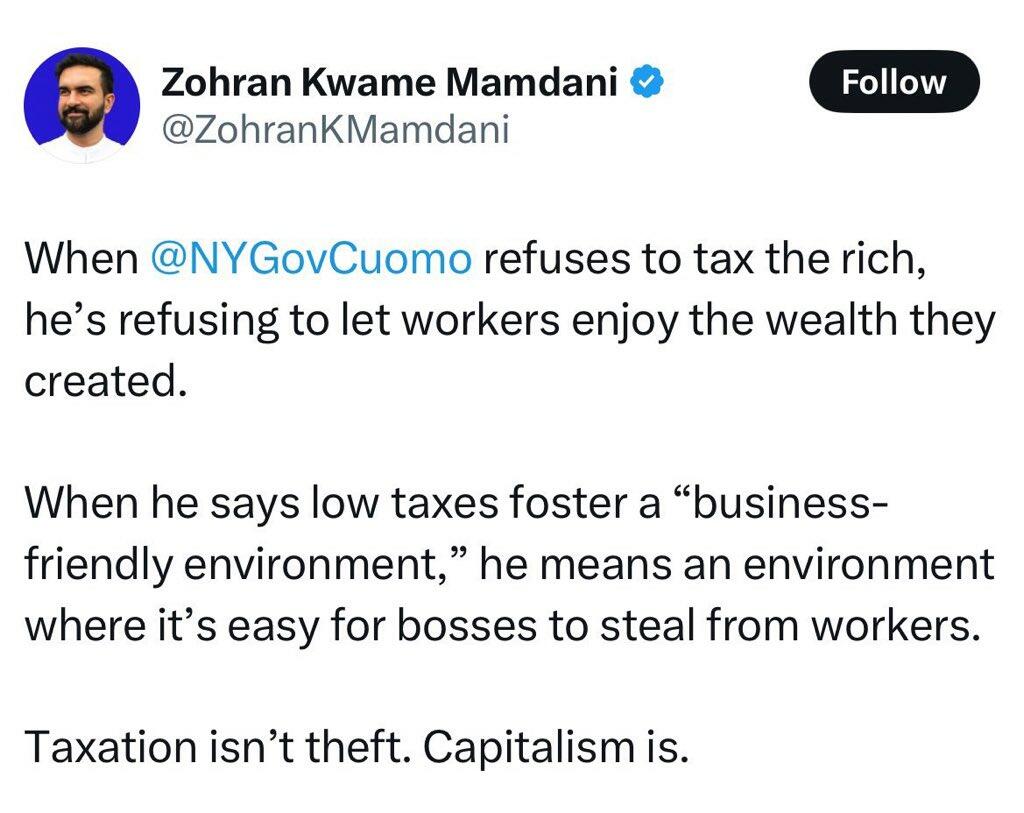
But it isn’t just the sheer number of people that are threatening to leave that is the issue. One of the reasons why New York City is one of the most important cities on the entire planet is because of the vast amount of wealth that is located there. Now that Mamdani has won, wealthy New Yorkers are freaking out because he believes that capitalism is “theft”

A lot of ultra-wealthy residents are threatening to flee, and that is a major problem, because the top 1 percent of all income earners pay close to 50 percent of all the taxes… The top 1 percent of earners in New York pay around half the city’s income taxes. With a significant proportion of them departing the city’s finances would collapse and there would be less money to pay for Mamdani’s policies, which involve subsidizing various parts of the city’s economy.

New York City is already facing an absolutely massive budget deficit next year. So how will Mamdani be able to pay for all of his new social programs if ultra-wealthy New Yorkers start leaving in large numbers? And how will Mamdani be able to maintain order if police officers start leaving in large numbers?

When Mamdani was asked about this, he openly acknowledged that the city is facing a “retention crisis”…"Socialist mayor-elect of New York City Zohran Mamdani said Friday that he is not concerned about backlash from law enforcement following his election victory and reiterated his plan to have social workers carry out certain duties currently done by law enforcement. During a visit to Puerto Rico, Mamdani was asked if he was “worried” about backlash from the “law enforcement community.” “I’m not worried about the backlash. What I’m worried about, frankly, is the continuation of a retention crisis that we’ve seen only deepen during the course of this campaign,” Mamdani said.

Mamdani is a smooth talker. But there is no way that he is going to be able to talk his way out of this mess. Every single day more New Yorkers are relocating, and one of the most popular destinations is Florida…"Election anxiety in New York City has turned into a real estate windfall in South Florida. Developer Isaac Toledano, CEO of Miami-based BH Group, told Fox News Digital that his company has closed more than $100 million in signed contracts from New York buyers in just the past few months – about twice last year’s volume. “I think the election accelerated how people make decisions,” Toledano said. “I think people are nervous [for] what’s coming, how it’s going to affect their lifestyle, the quality of life, taxes, potential of crime [or] no crime.”

Florida is already way too crowded. This is going to make things even worse. One real estate agent says that there is currently a lot of interest in waterfront properties “in the $20 million to $30 million range”…‘We are seeing interest from New York City intensify because of the election,’ Dina Goldentayer, a Douglas Elliman agent in Florida, told the Daily Mail. ‘The city’s area codes 917 and 212 are popping up now almost as much as they did at the height of the Covid pandemic. ‘Most of the calls are from buyers, many Wall Street execs, looking in the $20 million to $30 million range. Specifically for waterfront houses or oceanfront condos.’

The weather in southern Florida is so nice for most of the year. But is it a place that you would really want to be during the chaotic times that are coming? Needless to say, it would certainly not be my first choice. Up until just recently, many long-time New Yorkers never imagined that they would leave. But now everything has changed.

It has been pointed out that voters that have lived in New York City for less than 10 years are the reason why Mamdani was victorious…
We are seeing similar patterns all over the nation. In fact, it is being reported that this month we saw “a record forty-two Muslim candidates elected to public office across the United States”… They told us the plan. Now we’re watching it unfold - in real time. This week, terror-linked Islamic organizations are celebrating a stunning milestone: a record forty-two Muslim candidates elected to public office across the United States, the most significant wave of Muslim political victories in American history.

According to the Council on American-Islamic Relations’ (CAIR) own data, the newly elected officials span at least nine states - New York, Virginia, Michigan, New Jersey, Maryland, Washington, Ohio, Pennsylvania, and North Carolina. The list includes five mayors, four state legislators, two judges, and dozens of city council, county, and school board members.

The electorate has been transformed by decades of mass immigration. This is something that many of us have been ranting about for a very long time, but there is no way to turn back the clock now. Those that wanted to “fundamentally transform” America have largely succeeded, and now a 34-year-old Islamic communist that wasn’t even a U.S. citizen a decade ago is going to be the next mayor of New York City. The largest city in the United States is about to descend into a state of complete and utter chaos, and everyone can see that this is a story that is not going to have a happy ending."

Free Download: Erich Maria Remarque, “All Quiet on the Western Front”

Ask her if it was worth it...
o
“You still think it's beautiful to die for your country. The first bombardment
taught us better. When it comes to dying for country, it's better not to die at all.”
- "Paul Baumer", "All Quiet on the Western Front" (1930)

Freely download “All Quiet on the Western Front”, 
by Erich Maria Remarque, here:
http://explainallquietonthewesternfront.weebly.com/
o
And these chickenshit Neocon chickenhawk 
politicians are determined to get us all killed...

"Veterans Day 2025"

Elvis Presley, "An American Trilogy"

"A Tribute to Sgt. Henry Gunther"

"A Tribute to Sgt. Henry Gunther"
by Brian Maher

"107 years ago today - at the 11th month, 11th day and 11th hour - the guns went quiet on the Western Front…And the white doves of peace took wing. Today we turn from the hurly-burly of the present. We turn from the world of manna, from the election, from the Bitcoin exchanges and the rest. Instead we reflect upon that morning of Nov. 11, 1918, so many years distant - a neglected chapter of history.

It is a tale of waste. It is a tale of tragedy. It is a tale of ambition. That is, it is a tale all too human...By 5 a.m. on Nov. 11, official word came down. Hostilities would cease at 11 a.m. The news went immediately fanning out across the Western Front. It would ultimately reach the remotest switch trench. The long, homicidal nightmare, beginning in August 1914, was ending - to the relief of all. More accurately, to the relief of most…

Not all were so eager to spike the guns and lay down the rifles that morning. Who were these recalcitrants? And why their reluctance? Historian Joseph Persico: "Allied commanders wanted to punish the enemy to the very last moment, and career officers saw a fast-fading chance for glory and promotion. Gen. John “Black Jack” Pershing, boss of American forces— for example - considered the armistice terms far too lenient. He was hot to teach the hell-sent Hun “a lesson.”

Thus Black Jack and his glory dogs reached for their lesson planners, grabbed the chalk and took to the blackboard…They chose to invade German positions that morning — clear through to 11. Not until the referee blew the whistle would they call a halt. One divisional commander promised court-martial for any artillery chief who hadn’t emptied out his entire magazine by 11.

They were claw-mad for battle. Near 8 a.m. the furious assaults commenced…American forces took a severe trouncing crossing the River Meuse that morning - a river they could have conquered unmolested had they only waited until 11.

Meantime, men of the 89th Division were ordered to seize the pinprick village of Stenay. Why? So the men could bathe. That is correct - so the men could bathe. The village housed public bathing facilities. And the 89th’s senior officer decided his grimy men should take the waters of the charming French village. You may not believe it. Yet that was the explanation on offer.

The attack commenced. Perplexed and disbelieving German gunners attempted to wave off the marauding Americans: “Der Krieg ist vorbei!” But the men of the 89th steeled their nerves, lowered their chins and advanced, as if proceeding into sheets of hail…The reluctant Germans responded as they must. The war ended three hours later. Yet 61 men of the 89th would not see it. Another 304 would take their baths in a hospital… where they licked their needless wounds.

We hazard all 365 would have happily waited until 11:01 that morning — when the baths would have been theirs for the asking. In all: At least 320 Americans fell dead that needless and crimson morning of Nov. 11, 1918. More than 3,240 suffered grievous wounds.

Why the needless bloodspilling… when peace was but hours away? Careers hung in balance. As did ambition…Recall the divisional chieftain who condemned 61 of his men to the grave that morning so that others might bathe - a certain William Mason Wright. This human gem received promotion to Executive Assistant to the Chief of Staff of the Army after war’s end. He could claim the distinction, after all, of capturing the final American objective of the war.

A less gaudy distinction fell to a young man under this man’s command that morning of Nov. 11, 1918. We refer here to Sgt. Henry Gunther, aged 23 years, of our former city of Baltimore. This poor fellow was the last allied fatality of that fateful morning - and of the Great War itself. His time of death: 10:59 a.m.

The United States Army was so decent as to decorate Sgt. Gunther for “exceptional bravery and heroic action that resulted in his death one minute before the Armistice.” Yet true decency would demand a formal apology from the same United States Army. True decency would demand a formal apology, that is, for ordering Baltimore’s Sgt. Henry N. Gunther, aged 23 years, needlessly into battle that morning… True decency would demand a formal apology, that is, for placing this man’s life beneath the career ambitions of a Gen. Wright - the subsequent Executive Assistant to the Chief of Staff of the Army.

You deserved far better, Sgt.Gunther. You deserved a chance in life… the chance denied you that morning of Nov. 11, 1918…One minute before the doves flew."

"We’re Done Dishonoring Our Dead"

"We’re Done Dishonoring Our Dead"
by E.M. Burlingame

"In the dim, smoke-choked haze of this campfire somewhere in the mountains of Idaho, I think. Who knows, I’ve been in the bottom of not a bottle but bottles for days. Wherever I am, I sit here, hunched over a fifty-year-old scotch strong enough to burn away the memories. But it doesn’t, won’t, can’t. The demons don’t drown - they just whisper louder, angrier, clawing at my skull, demanding to know what and why. What the f*ck did they die for? Why did we bleed and break and lose everything for a system that just says, “thank you for your service,” while we’re left choking on the decaying cadavers of their lives, our civilization and world?

Jeremy’s dead. Died on some commando raid, brains out, trying to drag an Air Force TAC off a road alive, PKM rounds ripping the air. Took one to the head - bam - blood speckled grey matter painting the dirt before his boys could even suppress the fire. And for what? So we could hand that shithole back to the enemy years later like it was a used hooker. Would he have done it if he knew? If he knew we’d just piss it all away? Yeah, probably. That’s the kind of solid motherf*cker he was. There for his boys, not the f*cking locals. The best of us. His mother and sister - they’re walking corpses since, hollowed out, crushed under a weight that’ll never lift.

Dawson’s gone too. Christmas Eve, he ate a bullet. Self-inflicted, they say, like that makes it cleaner. Couldn’t take the pain - the broken back, the scrambled brain from tumbling off a cliff in the black of night on some pointless patrol. They pumped him full of pills, turned him into a junkie, but it didn’t touch the real hurt: the betrayal. Would he have signed up if he knew? If he knew the government was brewing a plague to fatten Big Pharma’s wallets, a vaccine jacking the “unexpected death rate” up, whatever the f*ck that is, by 40%, while the suits in government, business and banking count their stolen trillions? Hell no! None of us who knew him will ever fill that hole he left. Good men like him don’t survive this soulless meat grinder of a world.

Pepper died in some goddamn qalat, in some nowhere village that’s never mattered in the whole stinking history of man. Honestly, I don’t know much about it. What kind of f*cking friend was I? I only know he took a round to the femoral artery - bled out fast, hot and red, in the hands of his 18D teammate and buddy who’s carrying that shit nightmare to this f*cking day. His wife back home? She’s got nothing now but a flag and a fading memory. Why’d he enlist? Because the 2008 financial crisis - those slick Financialists pulling strings - stripped him broke which shoved him into the Army. Would he have served if he knew it was all a rigged game, a wealth grab for the rapists at the top? Maybe. Who the hell knows. He was also a quiet, solid motherf*cker.

Eric’s dead too. Blown into five wet chunks by an IED he was disarming to keep little local kids from getting shredded. My team had to find the parts, scrape him up, bag him, ship him home to his boys and a closed casket funeral - two little guys under seven who’ll never again see their adored dad. His EOD junior, Ken, lost an arm, his brain turned to mush in the blast, condemned to stumble through life half a man. Would Eric have left those boys if he’d known? If he knew the lunatics in charge - teachers, social workers, doctors, government freaks - might one day try to trans them, pump them full of estrogen, carve up their bodies, throwing their genitals in the fire? Hell no. He lost himself trying to save strangers’ kids. That great father sonofabitch died for a future that’s turning to poison.

Three of my other boys offed themselves within ten months of one another. Few years back. Died back here in the States, not even on the battlefield. Brain injuries, career problems, divorces, courts ripping their kids away, handing them to unfit mothers while the system took half of everything they’d ever built, would ever build. Every one of them with at least two years in straight up combat. Would they have pushed so hard to be selected, to wear the beret, if they knew? If they knew their own government would flood our streets with the same enemies we fought for twenty-five years - rape gangs, murderers, human traffickers all protected by the insane, by academics, politicians, NGOs, cops and judges, while good men rot in jail for fighting back? If they’d known our intelligence agencies and law enforcement would be flooding fentanyl into our streets, killing hundreds of thousands of our own? Not in a million f*cking years!

What the f*ck are we doing? Fighting for these bastards, these f*cking antihumanist viruses. These parasites that create nothing. That do nothing but take, as they send us away to murder the innocent to collect on their debts! What the f*ck are we doing guarding their accumulation of even more wealth by slaughtering humans in their sleep - their wives and kids just “getting in the way.” All so some pedophile, some predator, some Financialist Resentful can cash in on a ten-million-dollar “performance” bonus this year, while our families have barely enough to eat.

What do we get for it? Millions of civilians dead, our own minds and bodies shattered, our own souls sold as if we were nothing more than cheap whores, our own friends and colleagues broken for life and dead - so they can flood our towns with drugs and poverty and slave and worse, with scum who hate us, just so landlords and the banks behind them can suck up rent paid for votes made by human garbage.

Elections stolen right in front of us, dissenters calling it out locked in solitary for years, a global web of pedophiles and genocidal murderers, slavers all - entertainers, politicians, royals, bankers, bureaucrats and businessmen - running the show, and not one of them made to pay for their blatant crimes. A trillion dollars a year in trafficking, and that’s only drugs and humans. Laundered through the major banks at four and a half percent, keeping the whole racket going. The economy’s gutted, 80% of the numbers pure made up bullshit, the middle class is ash, veterans killing themselves faster than bullets ever could, more dead at their own hands than in all wars combined since WWII.

Yeah, the elites are scrambling hard to patch their regime, to regain trust, to reset the contract, to make us believe in their superiority, but it’s too late. Way too f*cking late, man. Something’s broken - snapped clean through. The kind where it can’t be welded and there ain’t no more spare parts. It’s all just broken and gotta be completely replaced as a whole. A reckoning that’s not coming; it’s here. A reckoning in blood and guts and gore. Twenty-five years of the most ruthless hunting and killing in every corner and community of the world. And all that knowledge is resident in tens and hundreds of thousands here at home who just don’t believe or care anymore who dies, nor how, to make it right.

The elites believe we’re sitting still for this? That we’ll leave it in their hands. The very useless or abusive or predatory hands created this very problem. We’re not f*cking insane. We don’t do the same thing and expect a different result. Well, not anymore. Voting ain’t getting us out of this. And we know it. F*ck it all into nothing! We’re not letting them destroy us, our families, our dead, our civilization and way of life so many of our own have died for. Not anymore. We won’t dishonor our dead any longer by doing nothing. We know what’s left: smash it, burn it all, and kill. Soon. We feel it in our bones. When exactly and how, I’ve no f*cking idea, no one does, no one can. We just know, when it all goes, this reckoning that’ll wash over our homelands as purging fire, this time, it’ll be TRAITORS FIRST!"

"Alert! Russian Decapitation Plan! USA Declares Full-Scale War Mobilization"

Full screen recommended.
Prepper News, 11/11/25
"Alert! Russian Decapitation Plan! 
USA Declares Full-Scale War Mobilization"
Comments here:

Monday, November 10, 2025

"Why 'Capitalism' Isn’t Working"

"Why 'Capitalism' Isn’t Working"
by Andrew Torba

"Before you can build an economy, you must first have a nation. Not just lines on a map or a government bureaucracy, but a people unified by faith, blood, tradition, and a shared destiny. A real economy requires a protected home market, a common legal framework, and above all, a population bound together by mutual interest.

What we have today is none of that, instead we have an abomination: an economic system without a home, a soul, or a flag. It is an economy of rootless financial parasites, where the only sacred truth is the steady climb of the almighty green line. This system feels no loyalty to Ohio’s factory towns or Michigan’s working families. It has no conscience. It serves nothing but the numbers on a screen no matter how many lives, communities, or generations are devoured in the process.

For decades our political leaders taught us that the great battle of our time was Capitalism versus Socialism and that to be a patriot was to chant free market slogans like “socialism sucks” while our factories were packed up and shipped to China. They convinced us that economic freedom meant cheering as our industries were offshored and our towns were hollowed out for the sake of a higher corporate profit margin.

Zohran Mamdani’s victory in New York City should therefore not come as a surprise. It is the direct and festering symptom of the very disease I am describing. It is the political manifestation of an economic system that has abandoned its native population. When you systematically impoverish and displace a people you do not get gratitude. You get Mamdani.

His victory is a scream of pain from a generation that has been left with nothing to lose. They are not voting for socialism because they have read Marx; they are voting for “free” buses and “free” childcare because the alternative is a life of impossible financial pressure.

Of course there’s a much bigger elephant in the room that no one seems to want to address: nearly half of the people in New York City are foreign-born. In a state that was once an engine of American industry and a beacon of our shared national culture, most of the population now has its primary cultural and familial ties, its deepest loyalties and first loves, elsewhere.

This massive demographic shift is the root cause of the political and economic sickness we see across the nation. It is the reason a leftist radical with a name like “Zohran Mamdani” can rise to power in a great American city. He offers socialist palliatives to a native population squeezed out of its own future and the promise of free stuff to the new permanent underclass of foreigners. The reason housing costs are stratospheric in the first place is because demand is artificially inflated by endless streams of these new arrivals. It is also the reason wages remain stagnant, as a permanent, imported underclass is used to undercut the bargaining power of American workers.

What is the answer from our leadership to this man-made crisis? A fifty-year mortgage and another $2,000 stimulus check.

We did not vote for this. We mobilized, we fought, and we sent a message that was supposed to be unmistakable. We demanded a restoration of sovereignty. We demanded the reclamation of our economy. The rallying cry was not for creative financing and a lifetime of usury. It was for the removal of the foreign labor army that undermines our wages and our communities. It was a demand for fifty million deportations to restore the bargaining power of the American worker and make housing affordable again through the sane, natural laws of supply and demand.

We did not ask for a longer leash. We asked for our freedom. We do not want fifty years of mortgage payments. We want fifty million deportations. We want an economy that works for our people. We want a nation that puts its own children first. Anything less is not a compromise. It is a surrender. And we will not surrender.

It is one of the great ironies of modern history that the very regime we are taught to revile above all others achieved what our own leaders insist is impossible. While we are relentlessly instructed on the horrors of National Socialism, we are never told of its economic miracle. A revival so stunning it lifted a nation from the ashes of despair and turned it into an industrial leader within a handful of years.

While our system plunges young men into lifelong debt for the chance at a home, the National Socialists offered marriage loans, slashed unemployment to zero, and prioritized the stability of the family as the core of national strength. They understood a fundamental truth our leaders deny: that an economy must serve its own people first. They did not outsource their future or replace their workforce. They valued their workers, celebrated mothers, and forged an economic engine that hummed with purpose and productivity.

We are told their system was pure evil, yet ours, which impoverishes our youth, dissolves our borders, and laughs at the very concept of national interest, is presented as moral and just. The question screams to be asked: who are the real monsters? Those who built a nation for their people, or those who are selling ours off piece by piece?

This globalist economic system has been the most effective weapon ever deployed against the American people. It destroyed our industrial heartland through a coordinated betrayal by our own leaders. It corrupted our culture by replacing a sense of shared heritage and common good with a hollow, consumerist individualism that leaves us isolated and powerless. It attacked our people, making us strangers in our own land and competing against the entire world for jobs, housing, and a sliver of the dream.

We’ve been importing the third-world for decades and suddenly everyone is shocked that we’re getting third-world politics. A nation cannot survive when it becomes a mere territory, a hotel for the world. A nation is a people. It is a shared blood, a shared story, a shared destiny.

A healthy economy is not an accident. It is built with intention and defended with conviction. For decades, we were fed the lie that capitalism and the invisible hand of the free market would be the tide that lifts all boats. We were told to trust the market to self-correct, to believe the invisible hand would forge a nation our children could inherit. It’s time to wake up and smell the roses: the boats are sinking and the invisible hand has robbed us blind.

The spiritual cost is even greater than the economic one. A young man without meaningful work is a man without a purpose. He is denied the fundamental dignity of being a provider, of building something tangible with his hands and his mind. This idleness, this forced dependency, is a poison that erodes the soul. It leads to despair, to addiction, to the breakdown of the family itself.

The globalist system has created a generation of men who are told they are unnecessary, that their strength and their capacity for hard work are relics of a bygone era. This is a lie told to break their spirit and make them compliant. To the young men who are reading this I need you to listen to me very carefully: you are necessary, you matter, and we are going to win.

We will restore the covenant between the economy and the people. An economy is healthy when it strengthens the nation, when it provides for the common defense and promotes the general welfare, as our founding documents intended. It is sick when it enriches a handful of rootless cosmopolitans while impoverishing the heartland. We must judge every economic policy by a simple standard: does this make our people stronger? Does this provide a future for our children? Does this preserve our national character?

Capitalism unmoored from national interest is a suicide pact. It sacrifices the long-term health of the nation for the short-term profits of a cosmopolitan elite. The “green line going up” on a screen in Manhattan is a pathetic substitute for the prosperity of a thousand Main Streets across the country.

The old conservative mantra is bankrupt. We don’t need to be yelled at about how bad socialism is. We need a movement that recognizes the globalist system we live under is the disease, and that a patriotic, pro-worker, nationalist economics is the only cure. The goal isn’t to make the line go up. The goal is to make our people strong, our nation secure, and our future our own again.

The answer is not to abandon enterprise or ownership, but rather to chain them firmly to the nation they are meant to serve. This requires economic patriotism enacted into law through trade policies that make it more profitable to build and hire at home than to exploit cheap labor abroad. It demands a full moratorium on all worker visa programs until every young American who wants a job can find one that pays a family sustaining wage. It calls for a national mission of reindustrialization, a united effort to bring our critical industries, from microchips to medicines, back to our shores. Most importantly, it requires an explicit rejection of the globalist creed. Corporations and their leaders must owe their primary allegiance to the nation that provides their customers, their security, and their very identity.

This is not an argument against prosperity. It is an argument for a prosperity that endures. It is a vision of an economy where profits serve the people, not the other way around. It is a system where a young man can earn enough on a single income to support a wife and children with dignity. It is a future where a young woman can see hope and opportunity in the same town where she was raised.

That is the only economy worth fighting for. Anything less is merely organized national suicide, and our youth are the ones being sacrificed on its altar. The stakes are nothing less than the soul and survival of America itself. We will not go quietly into their managed decline. We will fight, we will build, and we will win."

Jeremiah Babe, "Banks Are Terrified Of A Liquidity Crisis"

Jeremiah Babe, 11/10/25
"Banks Are Terrified Of A Liquidity Crisis"
Comments here"

"Banks Are Suffering Big Outages: Millions Of Accounts Wiped Out"

A horrifying must-view!
Full screen recommended.
Epic Economist, 11/10/25
"Banks Are Suffering Big Outages: 
Millions Of Accounts Wiped Out"
"Something very serious is happening in America’s financial system and almost nobody is talking about it. Across the country, ordinary people are waking up to find their bank accounts completely wiped out. Paychecks, savings, gone overnight. Meanwhile, the Federal Reserve is quietly injecting billions of dollars into the system to keep struggling banks alive. Even federal banks are running dry. Military workers are reporting missing paychecks. And yet… the mainstream media stays silent. Why? Because they don’t want panic. But the truth is, panic might already be setting in. In this video, I break down what’s really going on behind the scenes, what the Fed doesn’t want you to know, and what you can do right now to protect yourself and your family."
Comments here:

Musical Interlude: Alan Parsons Project, “Ammonia Avenue”

Alan Parsons Project, “Ammonia Avenue”