StatCounter

Monday, October 13, 2025

"The Three Elements of the Good Life"

"The Three Elements of the Good Life"
by Maria Popova

"To be a true person is to be entirely oneself in every circumstance, with all the courage and vulnerability this requires. And yet because a person is a confederacy of parts often at odds and sometimes at war with each other, being true is not a pledge to be a paragon of cohesion, predictable and perfectly self-consistent - the impossibility of that is the price of our complex consciousness - but a promise to own every part of yourself, even those that challenge your preferred self-image and falsify the story you tell yourself about who you are.

There is a peace that comes from this, solid as bedrock and soft as owl down, which renders life truer and therefore more alive. Such authenticity of aliveness, such fidelity to the tessellated wholeness of your personhood, may be the crux of what we call “the good life.”

That is what the pioneering psychologist Carl R. Rogers (January 8, 1902–February 4, 1987) explores in a chapter of his 1961 classic "On Becoming a Person" (public library), anchored in his insistence that “the basic nature of the human being, when functioning freely, is constructive and trustworthy” - a bold defiance of the religious model of original sin and a cornerstone of the entire field of humanistic psychology that Rogers pioneered, lush with insight into the essence of personal growth and creativity.

Drawing on a lifetime of working with patients - the work of guiding people along the trajectory from suffering to flourishing - he writes: "The good life… is the process of movement in a direction which the human organism selects when it is inwardly free to move in any direction, and the general qualities of this selected direction appear to have a certain universality."

He identifies three pillars of this process: In the first place, the process seems to involve an increasing openness to experience… the polar opposite of defensiveness. Defensiveness [is] the organism’s response to experiences which are perceived or anticipated as threatening, as incongruent with the individual’s existing picture of himself, or of himself in relationship to the world. These threatening experiences are temporarily rendered harmless by being distorted in awareness, or being denied to awareness. I quite literally cannot see, with accuracy, those experiences, feelings, reactions in myself which are significantly at variance with the picture of myself which I already possess.

The necessary illusions Oliver Sacks wrote of are a form of that defensiveness - they help us bear the disillusionments difficult to bear: that we are invulnerable, immortal, congruent with our self-image - and yet they render us captives of the dream of ourselves, unfree to live the reality of our own complexity. Rogers writes:

"If a person could be fully open to his experience, however, every stimulus - whether originating within the organism or in the environment - would be freely relayed through the nervous system without being distorted by any defensive mechanism. There would be no need of the mechanism of “subception” whereby the organism is forewarned of any experience threatening to the self. On the contrary, whether the stimulus was the impact of a configuration of form, color, or sound in the environment on the sensory nerves, or a memory trace from the past, or a visceral sensation of fear or pleasure or disgust, the person would be “living” it, would have it completely available to awareness."

The reward of this willingness to be fully aware is profound self-trust: "The individual is becoming more able to listen to himself, to experience what is going on within himself. He is more open to his feelings of fear and discouragement and pain. He is also more open to his feelings of courage, and tenderness, and awe. He is free to live his feelings subjectively, as they exist in him, and also free to be aware of these feelings. He is more able fully to live the experiences of his organism rather than shutting them out of awareness.

Out of this “movement away from the pole of defensiveness toward the pole of openness to experience” arises the second element of the good life: “an increasing tendency to live fully in each moment” and discover the nature of experience in the process of living the experience rather than in your predictive models, which are only ever based on the past. When you are fully open to your experience, Rogers observes, each moment is entirely new - a “complex configuration of inner and outer stimuli” that has never before existed and will never again exist in that exact form, which means that who you will be in the next moment will also be entirely new and cannot be predicted by you or anyone else - that lovely freedom of breaking the template of yourself and the prison of your story."

 Rogers writes: "One way of expressing the fluidity which is present in such existential living is to say that the self and personality emerge from experience, rather than experience being translated or twisted to fit preconceived self-structure. It means that one becomes a participant in and an observer of the ongoing process of organismic experience, rather than being in control of it. Such living in the moment means an absence of rigidity, of tight organization, of the imposition of structure on experience. It means instead a maximum of adaptability, a discovery of structure in experience, a flowing, changing organization of self and personality.
[…]
Most of us, on the other hand, bring a preformed structure and evaluation to our experience and never relinquish it, but cram and twist the experience to fit our preconceptions, annoyed at the fluid qualities which make it so unruly in fitting our carefully constructed pigeonholes."

By discovering experience in the process of living it, we arrive at the third element of the good life - a growing ability to trust ourselves to discover the right course of action in any situation. Most of us, Rogers observes, consciously or unconsciously rely on external guiding principles in navigating life - a code of conduct laid down by our culture, our parents, our peers, our own past choices. He writes:

"The person who is fully open to his experience would have access to all of the available data in the situation, on which to base his behavior; the social demands, his own complex and possibly conflicting needs, his memories of similar situations, his perception of the uniqueness of this situation, etc., etc. The data would be very complex indeed. But he could permit his total organism, his consciousness participating, to consider each stimulus, need, and demand, its relative intensity and importance, and out of this complex weighing and balancing, discover that course of action which would come closest to satisfying all his needs in the situation."

What makes this process most vulnerable to error is our continual tendency to lens the present through the past: "The defects which in most of us make this process untrustworthy are the inclusion of information which does not belong to this present situation, or the exclusion of information which does. It is when memories and previous learnings are fed into the computations as if they were this reality, and not memories and learnings, that erroneous behavioral answers arise."

Rogers paints a portrait of the person who has braided these three strands of the good life: "The person who is psychologically free… is more able to live fully in and with each and all of his feelings and reactions. He makes increasing use of all his organic equipment to sense, as accurately as possible, the existential situation within and without. He makes use of all of the information his nervous system can thus supply, using it in awareness, but recognizing that his total organism may be, and often is, wiser than his awareness. He is more able to permit his total organism to function freely in all its complexity in selecting, from the multitude of possibilities, that behavior which in this moment of time will be most generally and genuinely satisfying. He is able to put more trust in his organism in this functioning, not because it is infallible, but because he can be fully open to the consequences of each of his actions and correct them if they prove to be less than satisfying.

He is more able to experience all of his feelings, and is less afraid of any of his feelings; he is his own sifter of evidence, and is more open to evidence from all sources; he is completely engaged in the process of being and becoming himself."

"On Becoming a Person" is a revelatory read in its entirety. Complement this fragment with E.E. Cummings, writing from a wholly different yet complementary perspective, on the courage to be yourself and Fernando Pessoa on unselfing into who you really are."

"Some Things..."


"You Are Not What Happened to You"

"You Are Not What Happened to You"
By Thomas

"In psychology, learned helplessness is a common affliction that we all experience occasionally. It refers to the inability to take control over external events and a tendency to accept one’s fate as inevitable. When something bad happens to us (a failure, rejection, loss), we tend to assume that it is beyond our control and that we are powerless against it.

The thought process usually goes like this: “What did I do wrong? Why does this keep happening to me? There must be something about me that makes people not want to be around me or associate with me”. And if we are surrounded by people who constantly reinforce these ideas and make us feel even more miserable about ourselves, then things can spiral out of control quickly, and we may very well develop full-blown depression.

The stories we tell ourselves can do more harm than good. So many people feel stuck or dissatisfied with their current life because they can’t derail their negative perceptions of themselves. The people in your life may pull at you and cause some pain, but they can’t hold you back if you don’t let them. You are not what happened to you; you are what you choose to become.
“The world will ask you who you are, 
and if you don’t know, the world will tell you.” 
- Carl Jung

In the words of Carl Gustav Jung, a psychiatrist and psychoanalyst who founded analytical psychology, “I am not what happened to me, I am what I choose to become.” According to Jung, our past experiences, whether good or bad, can influence us in many ways, including shaping our personality, values, and beliefs. However, he believed that it is not the experiences themselves that define us, but rather our response to them. In other words, we are not defined by what happens to us but by how we choose to respond to those events.

People are shaped by their personal experiences but also possess the power to shape their own lives. Jung thought people have a unique capacity to overcome their past experiences and transform their lives in meaningful ways. He observed people are not passive victims of circumstances or events, but active agents who can make choices and exercise their free will to create their own futures.

Jung emphasizes the importance of personal agency and the ability to choose your own path in life rather than being defined by past experiences or external circumstances. We all have the power to transform ourselves by confronting our deepest fears, desires, and conflicts. The courage to face our past or personal struggles can help us gain a greater understanding of ourselves.

“The most terrifying thing is to accept oneself completely. Your visions will become clear only when you can look into your own heart. Who looks outside, dreams; who looks inside, awakes,” argues Carl Jung. When you view your life as a series of experiences and opportunities rather than as something that happened to you, you are much more likely to find the silver lining in any dark cloud that might be hanging over your head.

You are the sum of the choices you make and the actions you take today. No matter what life throws your way, you have the power to choose how you respond and choose who you want to become. Your path in life is determined by the decisions you make, the goals you strive for, and the life you create for yourself. You are in control of the direction your life takes. The choices you make today can shape the person you will be tomorrow.

Get comfortable with your truth. “The privilege of a lifetime is to become who you truly are,” Jung said. The self-awareness journey requires us to ask ourselves tough questions and to open up to the possibility of change. It asks us to confront our fears and embrace our true self’s beauty. It is a privilege to peel away the layers of our identity and become the person we were born to be.

Navigating the self-discovery process can be daunting; many people never try to know themselves deep enough. However, there is a tremendous sense of satisfaction that comes from understanding and exploring who you are and what makes you special. It is a privilege to pursue this journey and gain a greater understanding of yourself and your place in the world. It is a chance to live a life of purpose and clarity and to gain a greater sense of self-awareness.

According to Jung, “people will do anything, no matter how absurd, to avoid facing their own souls.” He believed that true personal growth requires a willingness to face one’s own shadow and integrate the unconscious aspects of the self into consciousness. Living your truth requires total acceptance. That means confronting your unconscious mind and the shadow aspects of your personality. The shadow refers to the aspects of our personality that we repress or deny, such as negative emotions, impulses, and desires.

By acknowledging and integrating these aspects of ourselves, we can achieve greater wholeness and self-awareness. You can develop greater empathy and understanding of others by exploring your own unconscious biases and prejudices. When you explore your emotions and motivations, you will better understand your reactions to situations and develop greater emotional awareness and regulation. By turning your attention inward and exploring your own inner world, you can awaken to your unique potential and sense of purpose in life."

"The Forbidden Thought"

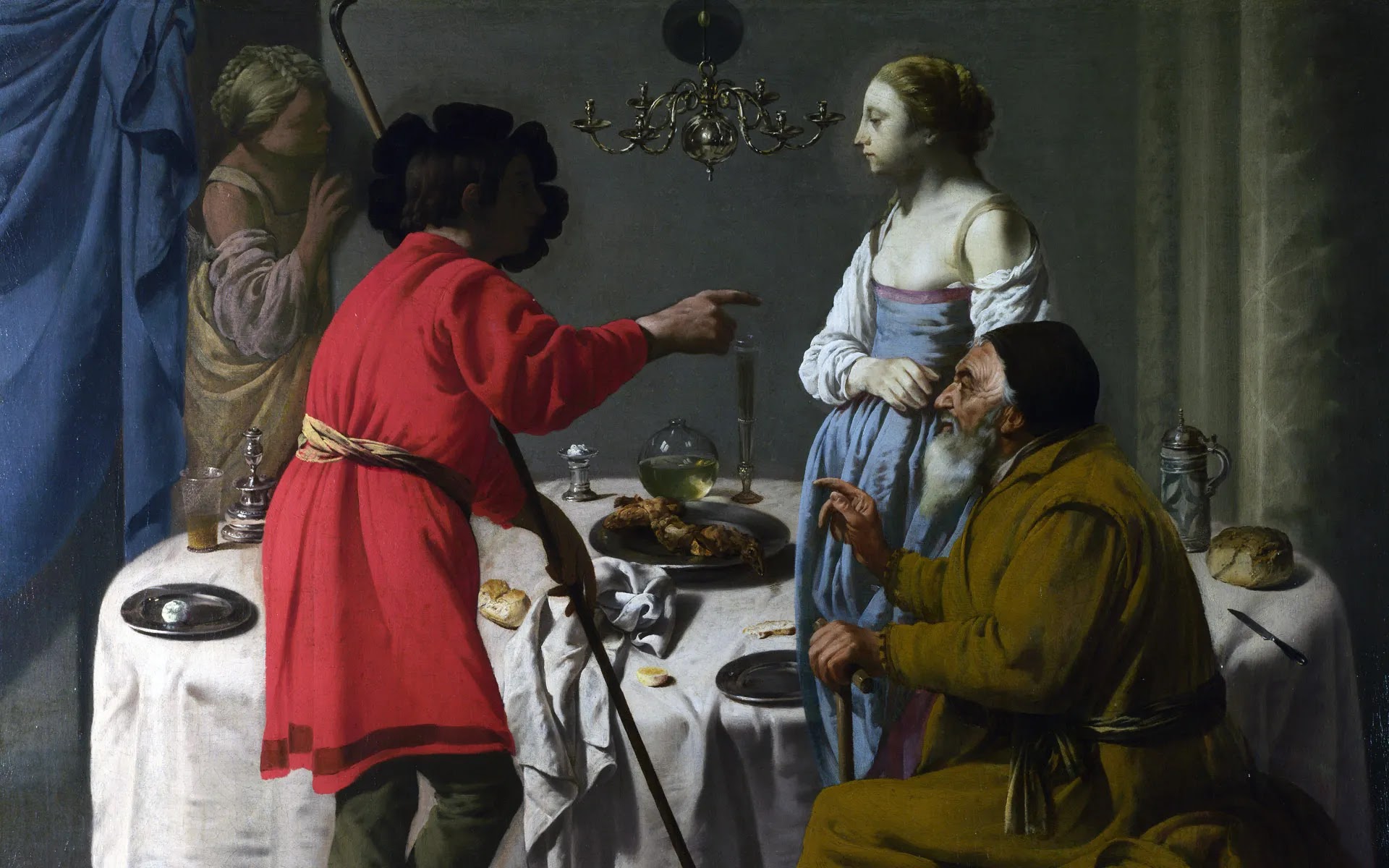
Hendrick ter Brugghen, "Jacob Reproaching Laban"
"The Forbidden Thought"
by Paul Rosenberg

"The dominating systems of our world require us to feel weak, afraid, and insufficient. They couldn’t continue if most of us didn’t feel that way. And so the friends and operators of these systems must suppress the opposite thought: that we are not inadequate. I’ve watched popular culture for a lot of years, and I can tell you that since the 1970s, one concept, above all, has been forbidden in intellectual circles: Man as a glorious creature.

If you’d like to prove that to yourself, say a few things like these at a cocktail party:
• Western civilization has accomplished so many good things that it’s mind-blowing.
• Most people are basically decent and don’t need to be controlled.
• I see so much goodness in humanity.
 • Humanity is ascending toward the gods (or heaven, or whatever).

Then, if you’d really like to see a reaction:
• The human race is magnificent.

The responses you get should be educational.

Why This Thought Is Hated: One reason why people respond so violently to this idea is simply self-defense: At this point, nearly every adult has built his or her world around the belief that people are bad: They’ve taught it to their children, showed their enlightenment by stating such things at parties and so on. To admit the opposite wouldn’t just be to admit they were wrong; it would tear down their infrastructure of meaning and status. Few people have the courage for such things.

Another reason is simply that they fear being shamed. People who say such heretical things are quickly ridiculed by holders of status. That’s tyrannical, of course, but it’s all too easy to stay inside the conspiracy of compliance. It’s dangerous, even if heroic, to defy powerful people.

Buckminster Fuller described the institutional necessity of inadequacy back in 1981: "There’s a built-in resistance to letting humanity be a success. Each one claims that their system is the best one for coping with inadequacy." In other words, the dominance hierarchies running things all claim that theirs is the right way to fix human inadequacy. So, if you claim that humans are adequate, you’re also saying that those systems aren’t necessary… and ruling systems don’t like to be called unnecessary.

Promoting Darkness Is a Big Business: It’s also the case that the promotion of darkness is a huge business. News channels are little more than fear delivery systems, but they are a major business. Social media is considerably worse. And, obviously, advertisers need you to feel insecure. Ads that don’t make you feel insecure, inadequate or guilty don’t pull nearly as well as those which do.

It can be interesting to see how all of this appears to outsiders. Back in the 1950s, the new president of Indonesia, Sukarno, visited the US and had this to say: "I find only one fault with Americans. They’re too full of fear. Afraid of B.O. Afraid of bad breath. They’re haunted by the fear that they’ll never get rid of dandruff. This state of mind I cannot understand."

And we shouldn’t understand it either. We are magnificent creatures… the only creatures in the known universe who create willfully and seemingly without limit. We’ve eradicated diseases, learned to feed billions of people, created machines that move us across the ground tremendous distances safely and reliably, created machines that fly us around the world and at incredible speed; we’ve harnessed the information stores of humanity and made them available to anyone, almost for free and almost anywhere. None of that is arguable, and yet we still think we’re just a step above refuse.

Take An Honest Look: Turn off the TV, turn off your cell phone. Walk through a park for a while to let the stream of negativity subside a bit. Then take a fresh look around. Yes, some dark things can still be found, but you’ll see most people simply going about their business: working, cooking, shopping, tending to children, driving their cars. They do these things well, or at least well enough, nearly all the time. Shouldn’t they get credit for that?

We are improving, unfolding, evolving creatures. Much improvement remains, but we are moving in that direction. And consider this, please: The sea of negativity that surrounds us is an anti-evolutionary poison. It serves stasis and sacrifice-collecting; it does not serve progress.

I’ll close with another quote (slightly edited) from Bucky Fuller: "I decided man was operating on a fundamental fallacy: that he was supposed to be a failure. I decided that man was, in fact, designed to be an extraordinary success. His characteristics were magnificent. We are not inadequate, we’ve just been made to think so."

"How It Really Is"


"Top 6 Moscow Metro Stations Ahead of the Future!"

Full screen recommended.
Window To Moscow, 10/13/25
"Top 6 Moscow Metro Stations Ahead of the Future!"
"Step into Moscow’s metro of tomorrow - six futuristic 
stations in crisp 4K. No talk, just immersive train ambience."
Comments here:

Judge Napolitano - Judging Freedom, "Scott Ritter, A Palestinian Victory!"

Full screen recommended.
Judge Napolitano - Judging Freedom, 10/13/25
"Scott Ritter, A Palestinian Victory!"
Comments here:
o
Judge Napolitano - Judging Freedom, 10/13/25
"Max Blumenthal: How Soon Will IDF Attack Gaza?"
Comments here:

Dan, I Allegedly, "It’s 1929 All Over Again - Protect Yourself Now!"

Full screen recommended.
Dan, I Allegedly, 10/13/25
"It’s 1929 All Over Again - 
Protect Yourself Now!"
"Could this crash really be WORSE than 1929? In today’s video, I break down the alarming parallels between today’s financial landscape and the events leading up to the Great Depression. From the skyrocketing margin debt and troubling corporate leverage to the cascading issues in real estate and retail sectors, we’re facing a potential storm of economic instability. I also dive into troubling trends like the trucking industry’s depression, auto market scams, and how unsold inventory is piling up. Plus, what is the mysterious black swan event that could trigger it all? Watch as I connect the dots and discuss how to prepare, protect your portfolio, and navigate these uncertain times."
Comments here:

Jim Kunstler, "The Matrix Abides"

Jolly Antifas on Parade
"The Matrix Abides"
by Jim Kunstler

"Somebody once observed that so much of leftism is 
pretending not to understand things that everyone understands." 
- Kurt Schlichter on "X"

"Of the 251 hostages seized in the Oct 7, 2023, Hamas raid on Southern Israel, 20 came out alive today. World opinion has not processed this in the heat of this moment, with the Gaza War ostensibly resolved, for now... or so we’ll see. Soon, the captives’ stories will be told.

Of course, world opinion is not what it used to be even a few years ago. These days, it oscillates around the poles of sane/insane. The Lefty-Woke wine-ladies of the Boston suburbs and their nose-ring Ivy League daughters must have the blues today over the implicit surrender of their heroes, Hamas. The keffiyeh is headed out as a fashion accessory. Who will be their next pet oppressed minority? (The Eskimos? The New York Times will put out a whole cooking section on blubber.) Note to the men (so-called) in their orbits: the gals will be loading up on Paxil and Klonopin, on top of all that Chardonnay. Consider hiding the car keys.

Meanwhile, over at Conflict Central, the action shifts to Sharm el-Sheikh, Egypt, today for a “peace summit” among the various parties involved in a war settlement, many of them Arab nations of the region, plus key Euroland players. Somebody will have to police the joint, probably some combo of Gulf State soldiers and American troops. The UK, France, and Germany will have to content themselves with pretending to participate, as they have their hands full just now pretending to ignite a war with Russia. Turkey could be in the mix, too, though the odor of pre-1918 Ottoman subjugation lingers on in that corner of the world. Don’t expect a whole lot to be sorted out quickly.

Donald Trump will take a few brief victory laps and, by Tuesday, all that nasty business might be behind him, at least for a while... maybe. Mr. Trump has a whole lot of fish to fry back here. He is fixing to disassemble the entire armature of Democratic Party sedition by wrecking the armature of NGOs that feed it - and you should not be surprised to learn that billions of the dollars sloshing through that colossal money-laundry originate in US government tax receipts.

For instance, the diligent “X” account known as “DataRepublican (small r)” reports that the National Endowment for Democracy (NED) with gross receipts of $363,001,576 received $362,047,237 from taxpayers, mainly through the State Department (including pre-Trump 2.0 USAID). The org, initially founded by Reagan Republicans, is now controlled by Democrats and their Neocon cronies bent on “nation-building” and color revolutions. Wherever there is turmoil in the world - Ukraine, Sudan, Pakistan, Myanmar - the NED has a piece of the action.

Stanford University, with an endowment of $23,780, 883,880, received $1,518,836,616 in taxpayer funds (those are billions), used to sponsor its Stanford Internet Observatory (SIO), which spun off the Election Integrity Project (EIP) and the Virality Project. The former was dedicated, under “Joe Biden,” to assist Christopher Wray’s FBI and the State Department’s Global Engagement Center, in censoring social media on matters such as the Hunter Biden Laptop .

The Election Integrity Project ran a parallel op under “Joe Biden” tracing 2020 election “disinformation” - i.e., anybody who reported ballot fraud - and the EIP worked to censor such content across platforms like Twitter, Facebook, and YouTube with help from Homeland Security’s Cybersecurity and Infrastructure Security Agency (CISA) and the Global Engagement Center (GEC). The Virality Project likewise dedicated itself to Covid-19 speech suppression. A lot of this money was funneled through subsidiary NGOs such as the National Science Foundation, the Hewlett Foundation, and the Omidyar network (the eBay fortune).

You see what I mean by armature? (And that was a mere schematic sketch of a small part of it.) This is a vast edifice of funny-money. The Democratic Party had captured all of it, and has been using it largely to maintain its power, which is to say, to keep the colossal money-laundry operating, because the salaries of all the people employed in these supposedly beneficent endeavors support a huge managerial cohort of officers who circulate in and out of government and comprise much of what’s called the “Swamp,” the “blob” or the “Deep State.”

This matrix is the same source of funding for Antifa and other Lefty-Woke outfits seeking to sow chaos through our country. The next big event on the agenda is another national “No Kings” protest, scheduled for Saturday, October 18, in over 2,000 US towns and cities. It’s organized by the umbrella NGO, Indivisible, with cash from George and Alex Soros’s Open Society Foundation, the Berger Action Fund (the philanthropic vehicle of Swiss billionaire Hansjörg Wyss), the Tides Foundation, and the Act Blue donation platform (currently under DOJ investigation for campaign contribution fraud). These outfits supply placards, transportation, and protesters’ stipends for what amounts to an “astroturf” (fake grassroots) spectacle.

Things should heat up and get spicy this week as that great day approaches. Antifa is not done trolling the ICE buildings in Portland, Chicago, and the Boston field office in Burlington, Mass. Former National Security Advisor John Bolton will likely get indicted in the days ahead for possessing classified documents he was not entitled to keep (boo hoo). And don’t be surprised if tremors rock the financial markets. Gold (nearing $4100) and silver (nearing $50) are sending ominous signals."

"Economic Market Snapshot 10/13/25"

"Economic Market Snapshot 10/13/25"
Down the rabbit hole of psychopathic greed and insanity...
Only the consequences are real - to you!
"It's a Big Club, and you ain't in it. 
You and I are not in the Big Club."
- George Carlin
o
Market Data Center, Live Updates:
Financial Stress Index

"The OFR Financial Stress Index (OFR FSI) is a daily market-based snapshot of stress in global financial markets. It is constructed from 33 financial market variables, such as yield spreads, valuation measures, and interest rates. The OFR FSI is positive when stress levels are above average, and negative when stress levels are below average. The OFR FSI incorporates five categories of indicators: creditequity valuationfunding, safe assets and volatility. The FSI shows stress contributions by three regions: United Statesother advanced economies, and emerging markets."
Job cuts and much more.
Commentary, highly recommended:
"The more I see of the monied classes,
the better I understand the guillotine."
- George Bernard Shaw
Oh yeah... beyond words. Any I know anyway...
And now... The End Game...
o

Sunday, October 12, 2025

"3I/ATLAS Just Split in Two - And Both Fragments Are Headed Toward Earth!"

A Terrifying Must-View!
Full screen recommended.
RevVolt, 10/12/25
"3I/ATLAS Just Split in Two - 
And Both Fragments Are Headed Toward Earth!"
"Astronomers have just confirmed that Comet 3I/ATLAS has SPLIT into two massive fragments - and both are now on a trajectory heading toward Earth. This shocking development has stunned NASA and the global scientific community."
Comments here:
o
Full screen recommended.
Space Discovery, 10/12/25
“3I/Atlas: NEW Details Reveal It's Way Scarier Than You Think”
"NASA and astronomers worldwide are on high alert after new data from 3I/ATLAS revealed terrifying details no one saw coming. What was once thought to be just another interstellar comet is now showing bizarre patterns, radio emissions, and unexplainable structural changes - and it’s getting closer to the inner Solar System.  From mysterious course shifts to possible intelligent signals, these findings are rewriting what we thought we knew about space visitors. Some astronomers are calling it the most unsettling interstellar object ever recorded - and for good reason. Is 3I/ATLAS just a cosmic rock… or something far more advanced than we can imagine?"
Comments here:
o
Full screen recommended.
Michio Kaku, 10/12/25
“3I/ATLAS Just Sent a Warning Signal 
That Has NASA in Panic Mode”
Comments here:

Musical Interlude: 2002 , "Love of My Life"

Full screen recommended.
2002 , "Love of My Life"
"This song is from our new album "Time Traveler." This album was inspired by memories of the paths we chose to follow and of the friends that journeyed with us. Some friends now live only in our hearts, immortal. But somewhere, someday we will pick up again, right where we left off. The journey never ends."

"A Look to the Heavens"

“Few butterflies have a wingspan this big. The bright clusters and nebulae of planet Earth's night sky are often named for flowers or insects, and NGC 6302 is no exception. With an estimated surface temperature of about 250,000 degrees C, the central star of this particular planetary nebula is exceptionally hot though - shining brightly in ultraviolet light but hidden from direct view by a dense torus of dust. 
 Click image for larger size.
This dramatically detailed close-up of the dying star's nebula was recorded by the Hubble Space Telescope soon after it was upgraded in 2009. Cutting across a bright cavity of ionized gas, the dust torus surrounding the central star is near the center of this view, almost edge-on to the line-of-sight. Molecular hydrogen has been detected in the hot star's dusty cosmic shroud. NGC 6302 lies about 4,000 light-years away in the arachnologically correct constellation of the Scorpion (Scorpius).”

"This Should Terrify You: America Is Convinced The Party Will Never End; 2025 Looks A Lot Like 1928"

Full screen recommended.
Jeremiah Babe, 10/12/25
"This Should Terrify You: America Is Convinced The 
Party Will Never End; 2025 Looks A Lot Like 1928"
Comments here:
o
Full screen recommended.
Snyder Reports, 10/12/25
“Americans Feel Defeated, 
New Inflation Scare Causes Millions To Panic”
Comments here:
o
Full screen recommended.
Michael Bordenaro, 10/12/25
“Record-Breaking Auto Repos Signal Major Crisis”
Comments here:

Chet Raymo, “Salt And Nerves”

“Salt And Nerves”
by Chet Raymo

“I like to think that every day offers at least one unique revelation, some one thing seen or experienced that has not been seen or experienced before, at least not in the same emotional state, in the same context, in the same slant of light. So I walk wary, as the poet Sylvia Plath says, "ignorant/ Of whatever angel may choose to flare/ Suddenly at my elbow." Nature seldom disappoints.

Let me introduce you to another poet, my colleague here at the college, Anna Ross. In the particular poem I want to share she is walking with a companion and comes upon the bleached skeleton of an elk, its upturned ribcage "picked white as crocus tips in the long grass." An animal skeleton, in a place where such an encounter is not unexpected. But this skeleton, "skull nosing/ the green suggestion of water/ in the run-off ditch" brings the walkers up short. They see their house in the distance, and the weather coming east, "skinning the gray jaw-lines of the ridges." The poet's language holds the elk in a context of earth and sky: "skinning," "jaw-lines.

The angel flares. "Do we find these things," asks the poet, "or are they in us like salt and nerves?" This of course is the fundamental question of philosophy: Do we perceive reality objectively, or do we create reality? The scientist and the poet stake out their claims somewhere along a spectrum of objectivity/subjectivity, and hone their tools accordingly. Anna Ross asks the question - do we find these things or are they in us? - and lets it hang there, unanswered, in the pregnant air, as she and her companion turn back toward home, encountering, as they do, a grouse in the path, "a frenzy of dust and wing-beat," and chicks that rise, "hang uncertain," and veer away.

The question goes unanswered, but the title of the poem tells us all we need to know: "Evidence." Those elk bones, the weather, the gray jaw-lines of the ridges, the grouse and her chicks - mute evidences of the only thing that matters, the angel, the revelation, the sudden gift of grace that comes unexpectedly - I quote Plath again - "thus hallowing an interval/ Otherwise inconsequent/ By bestowing largesse, honor/ One might say love."

Travelling with Russell, "Shopping in Russia's Best Supermarket: EuroSpar"

Full screen recommended.
Travelling with Russell, 10/12/25
"Shopping in Russia's Best Supermarket: EuroSpar"
"What does Russia's best supermarket look like inside? Join me on a tour of a typical Russian supermarket on the outskirts of Moscow, Russia. EuroSpar Supermarket is considered the best supermarket in Russia."
Comments here:

Dan, I Allegedly, "Black Christmas - The Debt Trap Waiting Under Your Tree"

Full screen recommended.
Dan, I Allegedly, 10/12/25
"Black Christmas -
 The Debt Trap Waiting Under Your Tree"
"Discover the dangerous truth about "Buy Now, Pay Later" and why this holiday season could leave many in deeper financial trouble. In this video, I break down how rising consumer debt, stagnant wages, and easy credit approvals are creating a perfect storm for January regrets. From maxed-out credit cards to fintech companies reshaping banking, we cover it all. Plus, hear why small businesses are struggling with fees and delays, and the hidden costs behind ghost kitchens and dynamic pricing at your favorite stores."
Comments here:

"The Worst Part..."

"Our world is not safe. It is a toxic swamp populated by predators and parasites. The odds are stacked against us from the moment of conception. We survive only because we fight the elements, hunger, disease, each other. And, although civilization promises us safe harbor, that promise is a fairy tale. Only the storm is real. It comes for each of us. And we cannot win. We can only choose how we will suffer our defeat. We can meekly take our beatings, and die like lemmings, finding solace in the belief that we shall one day inherit the earth. Or, we can plunge into the chaos with eyes wide open, taking comfort instead from the bruises, scars, and broken bones which prove that we fought to live and die as gods."
 - J.K. Franko, "Life for Life"
"The worst part is wondering how you'll find the strength tomorrow to go on doing what you did today and have been doing for much too long, where you'll find the strength for all that stupid running around, those projects that come to nothing, those attempts to escape from crushing necessity, which always founder and serve only to convince you one more time that destiny is implacable, that every night will find you down and out, crushed by the dread of more and more sordid and insecure tomorrows. And maybe it's treacherous old age coming on, threatening the worst. Not much music left inside us for life to dance to. Our youth has gone to the ends of the earth to die in the silence of the truth. And where, I ask you, can a man escape to, when he hasn't enough madness left inside him? The truth is an endless death agony. The truth is death. You have to choose: death or lies. I've never been able to kill myself."
- Louis-Ferdinand Celineo

"It Will Happen Suddenly"

"It Will Happen Suddenly"
by Jeff Thomas

"As the Great Unravelling progresses, we shall be seeing many negative developments, some of them unprecedented. Only a year ago, the average person was still hanging on to the belief that the world is in a state of recovery, that, however tentative, the economy was on the mend. And this is understandable. After all, the media have been doing a bang-up job of explaining the situation in a way that treats recovery as a general assumption. The only point of discussion is the method applied to achieve the recovery, but the recovery itself is treated as a given.

However, as thorough a distraction as the media (and the governments of the world) have provided, the average person has begun to recognize that something is fundamentally wrong. He now has a gut feeling that, even if he is not well-versed enough to describe in economic terms what is incorrect in the endless chatter he sees on his television, he now senses that the situation will not end well.

I tend to liken his situation to someone who suddenly finds all the lights off in his house. He stumbles around in the dark, trying to feel his way. Although he can picture in his mind what the layout of his house is, he is having trouble navigating, often bumping into things. This is similar to the attempt to see through the media and government smokescreens during normal times.

But soon, as his government undergoes collapse, he will be getting some bigger surprises. He will find that the furniture has inexplicably been moved around. Objects are not where they are supposed to be, and it is no longer possible to reason his way through the problem of navigating in the dark. Many of those who observe the daily news reports are beginning to figure out that they are being fed misinformation. Many are beginning to recognize that neither political party truly represents them or, for that matter, is even concerned for their welfare. These folks are now navigating in the dark.

But the bigger surprises have not yet occurred. There will be a certain amount of lead-up, plus a great deal of confusion, but the actual occurrences will be sudden. No one will be able to predict the dates on which they occur, except those very few people who control the triggers to these events.

Crashes in the Markets: Major bull markets rarely end with a whimper. They end with a major upside spike. And, unfortunately, brokers and investors alike tend to think that, if the market has been up for the last week, the last month, or the last year, it can be expected to be up again tomorrow. This makes them prime pickings for governments who may choose to falsely inflate a given market, creating an upside spike to encourage investors to toss their last few coins into the pot, just before the bottom drops out.

In previous eras, it could take time for people to sell, and even in panic times, the bloodletting was not instantaneous. However, with the Internet, all that is necessary is a major sell-off by one entity - one that goes through the stops of a large number of investors, and in a flash, the market goes though the floor. (Editor’s note: Stops are orders placed with a broker to sell a security when it reaches a certain price.) The average investor wakes in the morning to find that he has been wiped out.

Commitments by Governments: Should there be a currency crash, as is expected in many countries, promises made by governments will be abandoned suddenly, as though they had never existed. Whilst millions of people will find themselves lost, unable to function without their entitlements, governments will evade their guilt through finger-pointing. Tories will blame Labor; Labor will blame the Tories. (The equivalent will take place in other countries.) The net result will be the disappearance of entitlements, either in part or in total. The public will take out its anger through increased hatred of whichever party it is that they already consider to be the evil one. They will fail to understand that collapse was unavoidable.

Assumed National Strengths Will Vanish: International alliances will fall away. Former allies will suddenly not be at the side of the failing nation. Former friends will sign alliances with the other side. Trade agreements will suddenly cease. Wealth, initiative, and favor will flow to the new foremost country and its allies.

All of the above will happen incrementally - not by any means on the same day - but in each case, the actual occurrence will be sudden. Just as Julius Caesar was at his peak of power when his fellow members of the Senate drew their knives, a powerful nation is coddled right until the time of its fall. In this regard, the US will see the greatest abandonment of loyalties that any nation will experience. (The greater the empire, the greater the pretense of loyalty to it. And the greater the abandonment when the fall comes.)

When an empire collapses, it dies slowly. Unless it comes to an end through conquest, it deteriorates in a series of sudden jolts. Its leaders grasp at anything that might cause a delay, even if this means a worse outcome in the end. The process may take years and even decades. However, it is in the first few years that the major events occur - the events that create the most significant damage.

This occurs for two reasons. The first is that the leaders of the country, believing in their own power, believe that they can maintain control of their trade, their overseas control, their military, etc. and find that, when the crashes come, the rats desert the ship in every area. The second reason is that any empire builds its strength upon lies and exaggeration as much as it builds on its true attributes. After a crash, these lies and exaggerations fall away, and in a short time, it becomes clear that the empire was, in its latter stages, a house of cards.

The warning signs are already taking place but are not heavily publicized. The stage is set, and we are approaching the first major events. The victims in this play are, unfortunately, the average people, who simply hope to have a decent life. They will be caught unawares and unable to even understand what has occurred, let alone take action to save themselves. Those who have not spent the previous years educating themselves and preparing an alternative life will suffer most greatly.

All who live in a country that is undergoing collapse will be negatively affected. Some will do better than others, but to live on this slim hope is much like being fortunate enough to live on the outskirts of Hiroshima in 1945. There is little comfort in being one of the least injured. Better to have been in another country altogether - both during the actual event and during the terrible time that is sure to follow."

The Daily "Near You?"

Long Beach, California, USA. Thanks for stopping by!

“For Those Who Have Died”

“For Those Who Have Died”
“Eleh Ezkerah” (“These We Remember”)

“Tis a fearful thing
To love
What death can touch.
To love, to hope, to dream,
And oh, to lose.
A thing for fools, this,
Love,
But a holy thing,
To love what death can touch.
For your life has lived in me;
Your laugh once lifted me;
Your word was a gift to me.
To remember this brings painful joy.
Tis a human thing, love,
A holy thing,
To love
What death can touch.”

- Chaim Stern
Graphic: “Into The Silent Land”,
by Henry Pegram, 1905

We will all some day cross the bridge into eternity,
 and there we shall meet again...
Full screen recommended,
Moody Blues, "The Day We Meet Again"

Until then...
Full screen recommended.
Moody Blues, "Candle of Life"