StatCounter

Sunday, September 7, 2025

"Lessons From The Unraveling Of The Roman Empire: Simplification, Localization"

"Lessons From The Unraveling Of The Roman Empire:
 Simplification, Localization"
The fragmentation, simplification and localization of the 
post-Imperial era offers us lessons we ignore at our peril.
by Charles Hugh Smith

"There is an entire industry devoted to "why the Roman Empire collapsed," but the post-collapse era may offer us higher value lessons. The post-collapse era, long written off as The Dark Ages, is better understood as a period of adaptation to changing conditions, specifically, the relocalization and simplification of the economy and governance.

As historian Chris Wickham has explained in his books "Medieval Europe" and "The Inheritance of Rome: Illuminating the Dark Ages 400-1000," the medieval era is best understood as a complex process of social, political and economic natural selection: while the Western Roman Empire unraveled, the Eastern Roman Empire (Byzantium) continued on for almost 1,000 years after the fall of the Western Roman Empire, and the social and political structures of the Western Roman Empire influenced Europe for hundreds of years.

In broad-brush, the Roman Empire was a highly centralized, tightly bound system that was remarkably adaptive despite its enormous size and the slow pace of transport and communication. Roman society was both highly hierarchical--the elites claimed superiority and worked hard to master the necessary tools of authority-- slaves were integral to the building and maintenance of Rome's vast infrastructure--and open to meritocracy, as the Roman Army and other classes were open to advancement by anyone in the sprawling empire: every free person became a Roman Citizen once their territory was absorbed into the Empire.

When the Empire fell apart, the model of centralized control/power continued on in the reigns of the so-called Barbarian kingdoms (Goths, Vandals, etc.) and Charlemagne (768-814), over 300 years after the fall of Rome. (When the Ottomans finally conquered Constantinople in 1453, they also adopted many of the bureaucratic structures of the Byzantine Empire.)

Over time, however, the feudal model of localized fiefdoms nominally loyal to a weak central monarchy replaced the centralized model of governance. This adaptation fit the highly fragmented nature of European societies in this era.

But centralized influence never went away. The Christian churches based in Rome and Constantinople continued to exert centralized influence in politically fragmented regions, and monarchies continued to exist, in various states of strength and weakness. The Holy Roman Empire--as Voltaire is reputed to have observed, "neither Holy, Roman or an Empire"--had an enormously complex history in Germany and the rest of Europe. The monarchies in England and France remained in place, and the city-states of northern Italy wielded influence via trade and shifting alliances.

In other words, the Medieval era was ultimately a complex competition between overlapping models of governance and sharing resources, a competition between centralized and localized (what Wickham calls "cellular") nodes of power and the various ways that rulers and those they ruled dealt with each other.

Throughout the era, the legitimacy of rulers ultimately flowed from public assemblies, a tradition inherited from Rome that manifested in aristocratic courts and the church's leadership (bishops, etc.) and eventually, in parliaments. This tension played out in the sharing of costs and resources and the general direction of the state.

As a general rule, when monarchs consolidated too much power, they engaged in catastrophically costly and doomed wars (The Hundred Years War) because they were able to override or ignore the cautious counsel of elite assemblies. Understood as a selective process of adapting to changing circumstances, this history offers us valuable lessons and templates for our future.

Once the centralized power of Rome fragmented, economic, social and political power simplified and relocalized. Trade volume shrank and trade routes vanished. Once the bureaucratic and military structures dictated by Rome collapsed, regions and localities were on their own.

Elites naturally sought out the best means to consolidate and expand their power, and residents (as a general rule, the peasantry and town-dwellers) sought to improve their own lives by reducing costs and securing access to resources.

The immense geographic, cultural, social and economic diversity of Europe was in effect freed to play out. This diversity is still evident; the European Union may have unified the European financial system, but cultural and social divisions have not dissolved.

Wickham distinguishes between two primary sources of income and wealth accessible to elites and governments: land and taxes. Collecting taxes requires an immense bureaucracy to identify and assess property owners, tenant farmers, merchants, collect duties on trade flows, etc. Taxes are the only reliable way to fund professional armies and the stupendous bureaucracy required to manage a complex centralized empire. The Byzantine Empire survived multiple rivals, invasions, etc. largely due to its competent tax collection bureaucracy, and European monarchies could only fund long, costly wars once they established tax collection bureaucracies.

Wealth from land--surplus skimmed from the labor of peasants--was adequate to fund highly localized nobility (many of which had one or two castles and a small fiefdom), but it wasn't reliable enough or large enough to support professional armies or vast centralized states.

How does this history offer a template for the next 20 years? I have long held that the dominant global forces binding the global economy are globalization and financialization. Both have greatly increased the income and wealth that nation-states can tax to fund their vast structures: military, social welfare, and bureaucracies of management, regulation and control.

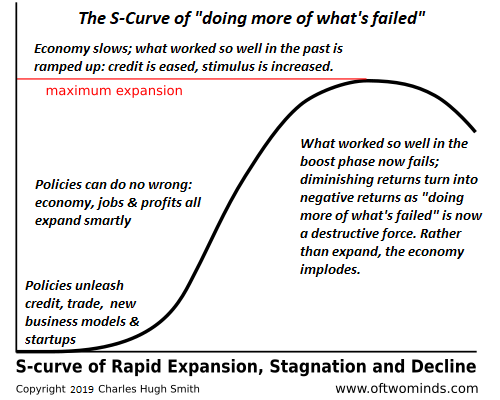
I have also held that globalization and financialization became hyper-structures prone to over-extension and the diminishing returns of the S-Curve. (see chart below) Both have reversed and are now in decline, a decline that I anticipate will accelerate unpredictably and rapidly as each dynamic is centralized and tightly bound, meaning each subsystem is highly interconnected with other subsystems. Should one break, the entire system unravels.
Globalization may appear to be decentralized, but the vast majority of global trade and capital flows through a few centralized nodes, and many aspects of trade depend on a very small number of routes and suppliers. This makes global trade exquisitely sensitive to disruption should any critical supplier or node fail.

Financialization is equally centralized and tightly bound, to the absurd degree that obscure financial structures (reverse repos, etc.) can trigger cascading crises in the real-world economy.

I anticipate a global simplification of trade and finance as fragile hyper-structures collapse as the failure of subsystems cascade through the entire system. These systems have greatly accelerated extremes of wealth-income inequality by their very nature, and these vast distortions and imbalances are unsustainable. Also unsustainable is the immense expansion of the plundering of the planet's remaining resources via globalization and financialization. These dynamics will collapse under their own weight.

What will be left? Once the income and wealth that supported enormously costly nation-state governments contracts, central governments will no longer be able to fund their gargantuan systems. (States that attempt to fund their activities by printing money will only speed the collapse of their finances and thus their coherence.)

As in the post-Roman era, central authority may well continue, but its actual power and influence will be greatly reduced. Without expanding income and wealth to tax, the central state may attempt to extract most of the nation's surplus, but this stripmining of elites and commoners alike will trigger pushback and revolt.

A more sustainable response would be to offload most of the central government's financial burdens onto states, provinces, counties, etc., in effect pushing the impossible task of maintaining entitlements and promised spending on local entities.

Given the diversity of cultures, social values and economic dynamics in large nations and regions, we can anticipate a flowering of adaptations to these greatly reduced means. Some localities will favor increasing authoritarian controls, others will favor reducing authoritarian controls and ceding authority to the smallest units of public assembly.

Locales (shall we call them fiefdoms?) will divide naturally along geographic boundaries, just as fiefdoms in medieval Europe fell into natural boundaries shaped by rivers, valleys, mountain ranges, etc., and along economic and cultural borders.

This relocalization may manifest in the well-known forecasts of the US breaking into multiple regional states, or it might manifest as I suggest in a much-weakened but still influential central government ceding power to local political structures which may themselves fragment or form alliances with nearby entities with whom they share cultural and economic ties.

In other words, a churn of evolutionary adaptations can be expected. Just as there was no one post-Roman adaptation that worked equally well everywhere, we can expect there to be some adaptations of roughly equal success and many that are unsuccessful.

As individuals and households, we want to be located in successful adaptations that share our values and offer us agency, i.e. a say in public assemblies and the freedom to move and work as we see fit.

As I have outlined many times in the blog and in my books, locales that are highly dependent on long global supply chains and distant capital for their essentials will fare very poorly once those supply chains break and the capital dries up. Regions and locales that generate their own essentials (food, energy, metals, concrete, electronics, etc.), talent and capital are much more likely to generate enough resources to satisfy both local elites and the public.

As I explain in my book "Self-Reliance," we who have lived in the past 75 years of expanding production and consumption of Everything have lost touch with both the natural world that sustains us and the social and practical skills needed to endure and prosper in an era in which the engines of centralized power and wealth (globalization and financialization) decay and collapse.

Some locales will choose to foster relocalization and individual agency. Others will cling on to failing models of authoritarian control and globalization/financialization. Ironically, perhaps, the most successful regions will be prone to indulging in hubris and denial, just as the Roman elites, basking in their centuries of dominance, dismissed the "Barbarians" and clung to their delusions of grandeur even as their world fragmented around them. Those locales left behind by globalization and financialization may well offer much better opportunities for successful adaptation, relocalization and individual/household agency.

It is human nature to find reasons to dismiss the storm clouds on the horizon. We look around and find solace in the apparent strength of our institutions and economy, while ignoring their sobering dependence on unsustainable hyper-globalization and hyper-financialization.

The fragmentation, simplification and localization of the post-Imperial era offers us lessons we ignore at our peril. It's important to view these lessons not just as an academic abstraction but as a guide to your own decisions about what places are most conducive to your security and well-being. Not every locale will do equally well, and the culture of many places may not be a great match for your own values and goals. If you decide to move, sooner is better than later."

"Even With Good People..."

"Cause even with good people, even with people that 
you can kinda trust, if the truth is inconvenient,
and if the truth doesn't, like, fit, they don't believe it."
- Marie Adler

"Message From the Future: Your Acceptance of Evil Has Condemned Us All"

"Message From the Future:
Your Acceptance of Evil Has Condemned Us All"
by Chris Floyd

"Sometime in December 2016, a strange transmission began bleeding through, ghost-like, on various computers around the world. It would suddenly appear for a few flickering moments while people watched movies or shopped on-line or looked at social media, then it would fade away. It purported to be a message from the future and showed an aged man who claimed he was a chrono-quantum technician whose work had been banned by the authorities to prevent me from doing exactly what I am doing now, at long last - sending a warning to our ancestors. The message was brief, but it was usually badly garbled by visual and aural static; it took weeks to compile, through crowd-sourcing, the full text. For what it's worth, the message - minus the brief intro - is presented below.

"You are taking a path into darkness. It began years ago, with your acceptance of crimes and inhuman practices on a vast scale. In the late 20th century, your leaders once confessed on national television that they had killed 500,000 innocent children with death-dealing sanctions - then declared this atrocious massacre was worth it. Yet there was no outcry, no outrage, no uprising, not even a peep of protest. Indeed, the leader who carried out this massive slaughter of innocent children ended his reign at new heights of popularity and forever after was considered a beloved elder statesman. Your next leader lied brazenly to start a war that killed a million innocent people and led directly to decades of murderous instability in numerous countries. He too ended his days in wealth and comfort and public regard. Your next leader refused to prosecute the crimes of aggression and torture openly committed by his predecessor; instead, he continued his practices, enshrining many of the heinous practices into settled law, waging undeclared war in more than half a dozen countries and personally signing off on extrajudicial murders every week of his reign.

By this time, the moral degradation of the people was so complete - they had countenanced, cheered or ignored so many crimes and so much corruption on so many levels - that they easily fell prey to a voracious, half-crazed demagogue and the forces of fascism, feudalism and lawless rule that he brought into power. This was the nominal end of your democracy, but it was already deeply rotted from within - rotted by your years of turning a blind eye to monstrous crimes committed in your name by both factions in your power structure.

Because of your shameful acquiescence, your shallow understanding of the forces that ruled you and used you and manipulated you, your bedazzlement by public image, your astonishing credulity at the transparent lies and hollow, sinister pieties you were fed, we, your descendants, have lived in squalor, rancor, violence and despair all our lives, for generations. There is no hope for us unless you abandon your slavish ignorance, your adherence to partisan fantasies about the factions of the power structure that rules you and rise up to overthrow it. Instead bring fearless clarity to bear on the reality of what you have accepted. The murder of 500,000 children. The millions murdered in the wars you started and the wars bred by your wars. Assassination. Torture. Dehumanization and demonization of your fellow human beings, both at home and abroad.

It is your acceptance of these things that has brought you to the final turning point. Now there is nothing left for you to do but resist: resist with all your might, with every means at your disposal - but always, always, with the full knowledge of how you came to this place, and your own connivance and collusion in this descent. Keep this in mind as you fight, so that it doesn't happen again. You are not exceptional, you are not plucked out by God for special favor: you are human beings like all the rest, and like so many human beings in so many societies down through the ages, you have failed to look your own evil in the eye, you have failed to confront and condemn acts that make you shudder with horror when you hear of them committed by other nations.

Own this knowledge - this terrible, tragic knowledge - and let it guide as you fight the putrescence that past crimes have now brought gushing forth, and as you build something better in the aftermath. Otherwise, you are lost, and we are lost, the world itself is lost."

"How It Really Is"

"Americans Can’t Keep Up With the Cost of Living Anymore"

Full screen recommended.
A Homestead Journey, 9/7/25
"Americans Can’t Keep Up With 
the Cost of Living Anymore"

"Americans are being crushed under the cost of living crisis in 2025. From skyrocketing grocery prices and soaring food costs to record-high rent, housing, and utility bills, families across America are realizing they simply can’t keep up anymore. Inflation may be slowing on paper, but in reality, everyday people are paying more than ever for basic necessities like food, housing, healthcare, gas, and insurance. This video dives into how the rising cost of living in America is pushing millions to the breaking point. With inflation eating away at paychecks, households are being forced to cut back, take on debt, or even go without. The dream of stability is slipping further out of reach as wages stagnate while prices climb higher every month.

If you’ve been feeling the pinch every time you step into the grocery store, pay your rent, or fill up your gas tank, you’re not alone. This is the reality of America’s growing economic collapse, where financial struggles are becoming the new normal for middle-class and working families alike. Stay tuned as we explore why so many Americans can’t afford life in 2025 - and what it means for our future."
Comments here:
o
JJ Buckner, 9/7/25
"The Collapse of Daily Life in America Has Begun"
Comments here:

Dan I Allegedly, "Buy a Texas Ranch for $6.75? Is it Shenanigans?"

Full screen recommended.
Dan I Allegedly, 9/7/25
"Buy a Texas Ranch for $6.75?
 Is it Shenanigans?"

"Imagine owning 76 acres of beautiful Texas ranch land for just $6.75 - or taking home $300,000 in cash instead! In today's video, I break down the fascinating story of Jason and Katie Bullard, two attorneys who turned their dream ranch into a unique raffle opportunity. Located in Mason, Texas, their 76-acre ranch is now up for grabs in this unconventional sale. I’ll explain how the raffle works, the role of Raffle (the company ensuring transparency), and why this method might be the future of property sales. What do you think - would you buy a ticket for a shot at this incredible prize?

We also dive into the current real estate challenges, including plummeting condo prices in Florida and rising costs tied to aging homes. Plus, we discuss why gold could skyrocket to $5,000 an ounce and why silver is in high demand with EVs and solar energy. With so many changes in the housing market and the economy, now’s the time to stay informed - whether you're considering property raffles or precious metals investments"
Comments here:

"Inside a Brand New Russian Children's Hospital"

Full screen recommended.
Travelling with Russell , 9/7/25
"Inside a Brand New Russian Children's Hospital"
"What does a Russian children's hospital look like inside? Join me on a tour of the brand new Children's Hospital in Moscow, Russia. St. Vladimir's Children's City Clinical Hospital of Moscow is the newest and most technologically advanced Hospital in all of Russia."
Comments here:

Adventures with Danno, "Amazing Sales at Kroger!"

Full screen recommended.
Adventures with Danno, 9/7/25
"Amazing Sales at Kroger!"
Comments here:

"The Obedience Cult"

"The Obedience Cult"
by Paul Rosenberg

"Not too many years back, warnings of Peak Oil circulated widely, and they made me consider something a good deal more dangerous: Peak Obedience. If that concept strikes you as odd, there’s a reason: We’ve all been living inside an obedience cult.

In our typical “scary cult” stories, we find people who have given up their own functions of choice and do crazy things because they are told to by some authority. But so long as people are within the cult, none of it appears crazy. So, inside a cult of obedience, obedience would seem righteous, and more than anything else it would seem normal. And I think that very well describes the Western status quo.

Obedience, however, should not seem normal to us. Obedience holds our minds in a child state, and that is not fitting for any healthy person past their first years of life. It also presupposes that the people we obey have complete and final knowledge; and in fact, they do not: politicians, central bankers, and the other lords of the age have been wrong – obviously and publicly wrong – over and over. So, obedience is not a logical position to take. Nonetheless, the mass of humanity believes that something horrible will happen if they don’t obey. After that, they merely need to be supplied with a defensible reason to comply.

But all of that, even though true, isn’t what I’d like you to take away from this discussion. My primary point is this: When we obey, we make ourselves less conscious; we make ourselves less alive.

Why Obedience Is Peaking: Over the past two centuries, authority has benefited from a perfect storm of influences. There was never such a time previously, and there probably will never be another. Briefly, here’s what happened:

Morality was broken: For better or worse, Western civilization had a consistent set of moral standards from about the 10th century through the 17th or 18th century. Then, through the 20th century, those standards were broken. Note that I did not say morality was changed. The cultural morality of the West was not replaced, but broken. The West has endured a moral void ever since. Previously, people routinely compared authority’s decrees to a separate standard (most often the Bible), to see if they held up. But with Western morals broken, authority was freed from examination, and thus from restraint.

Economies of scale: Factories made it much cheaper to produce large numbers of goods than the old way, in individual workshops. Economists call this an economy of scale. Thus a cult of size began, making “obedience to the large” seem normal.

Fiat currency: Fiat currency has allowed governments to spend money without consequences. It allowed politicians to wage war and to provide free food, free education, and free medicine… all without overtly raising taxes. Fiat currency made it seem that politics was magical.

Mass conditioning: Built on the factory model, massive government institutions undertook the education of the populace. And more important than their overt curriculum (math, reading, etc.) was their invisible curriculum of obedience to authority. Here, to illustrate, is a quote from the esteemed Bertrand Russell, who is himself quoting Johann Gottlieb Fichte, a founding father of public schooling: "Education should aim at destroying free will so that after pupils are thus schooled they will be incapable throughout the rest of their lives of thinking or acting otherwise than as their school masters would have wished."

Mass media: Mass media turbocharged authority and obedience in the 20th century, followed by the free account vultures of Facebook, Google and others. All of this went beyond authority’s grandest dreams. These things created an unnatural peak for authority. But now, this perfect storm is thinning.

Peak Obedience Is Brittle: Through the 20th century, the people of the West built up a very high compliance inertia. They complied with the demands of authority and taught their children to do the same, until it became automatic. People obeyed simply because they had obeyed in the past. Authority quickly became addicted to this situation, basing their plans on receiving every benefit of the doubt.

Automatic obedience, however, is a brittle thing. Economies of scale are failing, the money cartel has been exposed, government schools have lost respect, mass media is fading away and everyone knows that Facebook is an addiction. The game continues because the populace is distracted and afraid, but that won’t last forever.

And Then? It has long been understood that complex systems breed more complexity, and eventually break themselves. As central authorities try to solve each problem they face, they inevitably create others. Eventually the system becomes so complex, and its costs become so great, that new challenges cannot be solved. Then the system and its authority fail, as they did in the Soviet Union.

But again, that’s not my primary point. Rather, it’s this: Obedience disengages our best parts. Obedience degrades our creativity; it undercuts our effectiveness and especially our sense of satisfaction. Don’t sign away your life, no matter how many others do."
For more, please see "The Twilight of Authority."

Saturday, September 6, 2025

Musical Interlude: The Civil Wars, "Kingdom Come"

Full screen recommended.
The Civil Wars, "Kingdom Come"

"A Look to the Heavens"

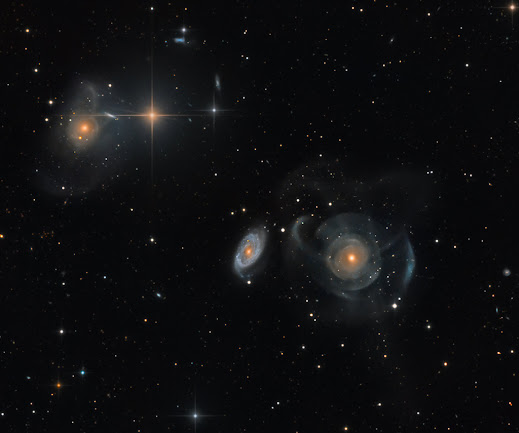
"This intergalactic skyscape features a peculiar system of galaxies cataloged as Arp 227 some 100 million light-years distant. Swimming within the boundaries of the constellation Pisces, Arp 227 consists of the two galaxies prominent right of center, the curious shell galaxy NGC 474 and its blue, spiral-armed neighbor NGC 470. 
The faint, wide arcs or shells of NGC 474 could have been formed by a gravitational encounter with neighbor NGC 470. Alternately the shells could be caused by a merger with a smaller galaxy producing an effect analogous to ripples across the surface of a pond. The large galaxy on the top lefthand side of the deep image, NGC 467, appears to be surrounded by faint shells too, evidence of another interacting galaxy system. Intriguing background galaxies are scattered around the field that also includes spiky foreground stars. Of course, those stars lie well within our own Milky Way Galaxy. The field of view spans 25 arc minutes or about 1/2 degree on the sky."

The Poet: Theodore Roethke, "In a Dark Time"

"In a Dark Time"

"In a dark time, the eye begins to see,
I meet my shadow in the deepening shade;
I hear my echo in the echoing wood-
A lord of nature weeping to a tree.
I live between the heron and the wren,
Beasts of the hill and serpents of the den.

What’s madness but nobility of soul
At odds with circumstance? The day’s on fire!
I know the purity of pure despair,
My shadow pinned against a sweating wall.
That place among the rocks- is it a cave,
Or winding path? The edge is what I have.

A steady storm of correspondences!
A night flowing with birds, a ragged moon,
And in broad day the midnight come again!
A man goes far to find out what he is-
Death of the self in a long, tearless night,
All natural shapes blazing unnatural light.

Dark, dark my light, and darker my desire.
My soul, like some heat-maddened summer fly,
Keeps buzzing at the sill. Which I is I?
A fallen man, I climb out of my fear.
The mind enters itself, and God the mind,
And one is One, free in the tearing wind."

- Theodore Roethke

"The Donkey and the Meaning of Eternity: Nobel-Winning Spanish Poet Juan Ramón Jiménez’s Love Letter to Life"

"The Donkey and the Meaning of Eternity: Nobel-Winning
 Spanish Poet Juan Ramón Jiménez’s Love Letter to Life"
by Maria Popova

Excerpt: "Beneath our anxious quickenings, beneath our fanged fears, beneath the rusted armors of conviction, tenderness is what we long for - tenderness to salve our bruising contact with reality, to warm us awake from the frozen stupor of near-living. Tenderness is what permeates Platero and I (public library) by the Nobel-winning Spanish poet Juan Ramón Jiménez (December 23, 1881–May 29, 1958) - part love letter to his beloved donkey, part journal of ecstatic delight in nature and humanity, part fairy tale for the lonely.

Living in his birthplace of Moguer - a small town in rural Andalusia - Jiménez began composing this uncommon posy of prose poems in 1907. Although it spans less than a year in his life with Platero, it took him a decade to publish it. At its heart is a simple truth: What and whom we love is a lens to focus our love of life itself.

The tenderness with which Jiménez regards Platero - whom he addresses by name over and over, like an incantation of love - is the tenderness of living with wonder and fragility. He celebrates Platero’s “big gleaming eyes, of a gentle firmness, in which the sun shines”; he reverences him as “friend to the old man and the child, to the stream and the butterfly, to the sun and the dog, to the flower and the moon, patient and pensive, melancholy and lovable, the Marcus Aurelius of the meadows.” He beckons him: “Come with me. I’ll teach you the flowers and the stars.”

And so he does: "Look, Platero, so many roses are falling everywhere: blue, pink, white, colorless roses… You’d think the sky was crumbling into roses… You’d think that from the seven galleries of Paradise roses were being thrown onto the earth… Platero, it seems, while the Angelus is ringing, that this life of ours is losing its everyday strength, and that a different strength from within, loftier, more constant, and purer, is causing everything, as if in fountain jets of grace… Your eyes, which you can’t see, Platero, and which you are mildly raising skyward, are two beautiful roses."

Together, poet and donkey traverse the Andalusian countryside in a state of rapturous harmony with each other and the living world: "Through the low-lying roads of summer, draped with tender honeysuckle, how sweetly we go! I read, or sing, or recite poetry to the sky. Platero nibbles the sparse grass of the shady banks, the dusty blossoms of the mallows, the yellow sorrel. He halts more than he walks. I let him.
[…]
Every so often Platero stops eating and looks at me. Every so often I stop reading and look at Platero."

There are echoes of Whitman in Jiménez’s exultations: "Before us are the fields, already green. Facing the immense, clear sky, of a blazing indigo, my eyes - so far from my ears! - open nobly, welcoming in its calm that indescribable placidity, that harmonious, divine serenity which dwells in the limitlessness of the horizon."

This longing for the infinite accompanies the young man and the old donkey as they cross the hills and valleys on their daily pilgrimages: "The evening extends beyond its normal limits, and the hour, infected with eternity, is infinite, peaceful, unfathomable."

Again and again, Platero’s presence magnifies the poet’s relishing of beauty, deepens his contact with the eternal: "I remain in ecstasy before the twilight. Platero, his black eyes scarlet with sunset, walks gently to a puddle of crimson, pink, and violet waters; he softly immerses his lips into the mirrors, which seem to liquefy as he touches them."

Punctuating these ecstasies are the inevitable spells of melancholy stemming from the fact that the price of being awake to life is being also awake to mortality. Aware that this enchanted life with his beloved Platero is only for the time being, Jiménez reaches into the sorrow of the future to consecrate it with joy: "Platero. I shall bury you at the foot of the large, round pine in the orchard at La Piña, which you like so much. You will remain alongside cheerful, serene life. The little boys will play and the little girls will sew beside you on their little low chairs. You will get to hear the verses that the solitude will inspire in me. You’ll hear the older girls singing when they wash clothes in the orange grove, and the sound of the waterwheel will be a joy and a solace to your eternal peace. And all year long the goldfinches, greenfinches, and vireos, in the perennial freshness of the treetop, will create for you a small musical ceiling between your tranquil slumber and Moguer’s infinite, ever-blue sky."
Full, wonderful article is here:

The Daily "Near You?"

Pretoria, South Africa. Thanks for stopping by!

"Winter Is Coming"

"Winter Is Coming"
by John Wilder

"The last few years have seen more change than the last twenty years, combined. This is to be expected, especially if you give Strauss and Howe’s "The Fourth Turning" idea any credence. A short version of The Fourth Turning (also known as Kondratieff Wave Theory) is that there is a roughly 80-year cycle of human affairs. Let me use the life of my Dad, Pa Wilder, to describe it:

When Pa Wilder was young he spent most of his childhood in Winter, the first defining experience of his life was the Great Depression. Back then, they had printed versions of the Internet that they would get delivered to their house every day, called newspapers. They also had cell phones that never needed charging, and that you could never lose because they were in the living room and conveniently connected by a cord to the wall.

I’m sure all of the kids on the playground talked with Pa about how obvious it was that the Federal Reserve’s® monetary policy, combined with bankers lending to anyone with a pulse led to near financial collapse. Oh, and how their parents couldn’t afford shoes. Thankfully, Pa lived in a farming community, and every little house in town had a very large garden out back. Food from the grocery store?

Why would you spend money on food when you had to pay for the mortgage? That’s the sort of lesson that bored itself into Pa Wilder’s mind. As a kid, he saw people lose houses, he saw people lose fortunes. He saw a nation nearing collapse.
Click image for larger size.
Economic collapse led to the second thing that defined Pa Wilder’s youth: World War II. Not long after Japanese planes attacked Pearl Harbor he was in boot camp in Ft. Sill and before long was a 2nd lieutenant in the Army. The next four years he spent on an all-expenses-paid European vacation

The end of the war was the end of Kondratieff Winter. What followed was Spring. In post-war United States, growth and unrivaled prosperity followed from 1945-1965. Pa Wilder, like the rest of the G.I. generation, came back and built families and factories and farms. They looked out at a world that was shattered, and they made fortunes rebuilding it. They even found Dean Martin’s favorite eel. Don’t remember that? It’s a moray.

Spring was characterized by extreme faith in government institutions – sure the government had fumbled the ball in the Great Depression, but it had unified the country for World War II. It stayed back enough to allow growth, and Eisenhower’s America got out of North Korea and planted the seeds for the Super Science® projects that would provide unmatched weapons systems and the seeds of space exploration.

Spring gives over to Summer. Around 1965, the spiritual awakening was followed in 1975 by the “Me” decade. In Summer, the economy is humming along, the weather is great, and the first questioning of the previous ideas that led to the success of the country begins. It’s probably no coincidence that the disastrous Immigration Act of 1965, the arguably unconstitutional Civil Rights Act of 1964, and Lyndon Johnson’s voter-plantation Great Society acts (1964 and 1965) took place at the start of Summer when Americans were questioning their values, questioning the things that made America great.

Pa Wilder was an established businessman, working as the president of a very conservative farm bank. You could get a loan, but only if you had collateral and a good income stream. Pa Wilder told more people “no” than “yes” for loans. That bothered him, with the exception of the fact that he told me, “I’ve never had to foreclose on a house, son.” To him, it was a moral duty. Thankfully Pa never served in the paratroopers, otherwise, they would have called him “debt from above.”

In society, however, the big splits had started in 1965. The subversion of colleges started and would be nearly complete by the 1980s. Religious decline started, and Nixon got tired of hiding the fiscal shenanigans of the country that gold was exposing. His solution? Get rid of gold.

But Summer was still a good time. Autumn, however, is harvest. Pa Wilder was pretty close to retirement at this point, and the real economic power had moved to the Boomers. Pa’s natural fiscal conservatism led to a strong and stable business. The people that took over from him, however, would “give a loan to anyone with a pickup and a backhoe.” They even loaned out money on haunted houses, places they were sure were going to be repossessed.

Inertia is important in an economic system. But in 1985 the financial systems of the United States began to be harvested. “Greed is good” became the motto, and systems were run entirely for near-term economic benefit. Everyone from Pa Wilder’s generation was dead or retired – the new people in charge had no living memory of the national crisis brought on by The Great Depression.

The end of Autumn is the first chill of Winter, and the end result was the Great Recession (right on time!) in 2007-2008. In the Winter, things fall apart. I’ve been really quite amazed that things have held together so well since that first cold snap. Obama was, well, a disappointment. Trump seemed (in many ways) overwhelmed by the system and couldn’t figure out how to move the levers of power in any significant and lasting ways – which makes sense on a failing system.

That was the starter’s gun on the crisis, the date Winter began. We should have been a long way through it by now, but this Winter is different: The United States had a uniquely dominant position at the start of Winter, having both complete military dominance as well as a strong economic dominance of the world. The Federal Reserve© decided to just print all the money that it could to spend its way into continued prosperity.

Sure, sometimes government wants to stop a crisis so that the citizens can have a stable country. Sometimes. But other times, governments are waiting for the crisis, looking forward to it. Planning on it. In one article titled Sometimes the world needs a crisis: Turning challenges into opportunities, the Brookings Institute lists the things they love about crises. I admit that some of them are positive, but here are a few that I think are a bit more ominous – these descriptions are directly from Brookings:

Systemic Change: Global crises that crush existing orders and overturn long-held norms, especially extended, large-scale wars, can pave the way for new systems, structures, and values to emerge and take hold. Without such devastation to existing systems and practices, leaders and populations are generally resistant to major changes and to giving up some of their sovereignty to new organizations or rules.

Dramatic Policy Shifts: Sometimes the fear generated from a crisis and corresponding public outcry enables and even forces leaders to make bold and often difficult policy moves, even in countries not involved in or affected by the crisis.

COVID-19 was the big crisis they were waiting for.  As the economic systems unwinded under the unsustainable debt the ‘Rona was the perfect opportunity. Imagine the tapestry of that you see was planned. What end was being sought? Well, they told us already. Systemic Change. Changes to virtually every system in the United States. Want to have a nice, neat, prosperous, and orderly community? Too bad. That’s not a thing that’s going to happen. The police will be neutered. How badly will communities suffer? Here’s how bad it was:

● Leftist controlled Chicago: arrests/stops were down 53 percent, murders are up 65 percent.
●Leftist controlled New York City: arrests/stops were down 38 percent, murders are up 58 percent.
●Leftist controlled Louisville: arrests/stops were down 35 percent, murders are up 87 (not a typo) percent.
●Leftist controlled Minneapolis: arrests/stops were down 42 percent, murders are up 64 percent.
●Leftist controlled Los Angeles: arrests/stops were down 33 percent, murders are up 51 percent.
● Leftist controlled St. Louis: in 2020, the murder rate hit “a 50-year high, with 87 out of every 100,000 residents being murdered.”

When there is murder and mayhem there is control. This is their plan. This is the crisis. Remove police – replace with ideological commissars that aren’t bound by law. Now, if they see a “crime” that they feel is wrong, they can punish it however they see fit. Most commonly, this will just be by removing the protection of the law and letting the mob do the rest. The biggest crimes? The crimes against the Left. That’s just the first of the planned Systemic Changes. There are more planned.

● Universal basic income.
● Boards to approve hiring at private companies.
● Equity everywhere.
●More rules than you can imagine. All of them will be based on some fear – guns in rural areas will be restricted because people in the city can’t stop killing each other.
● Climate change lunacy: to meet climate goals, Americans would be restricted to four pounds (344 milliliters) of meat a year. This will be walked back.
● And your ideas: they probably won’t be as bad as the real plans.

To be clear: Winter is here. The Left has an endless list of Leftist goals to accomplish during the crisis to come. The Winter will be dark. Where are our goals? The Right cannot just have the goals of “what the Left wants, but less,” or, “the opposite of what those guys want."After that? Organization. And leadership. And longjohns. Winter is here."

"Wars And Rumors Of War: The Middle East"

Col. Douglas Macgregor, 9/6/25
"What They’re Hiding About 
Israel Will Make You Angry!"
Comments here:
o
"Honey Badgers"
Scott Ritter has humorously described the Yemeni Houthis as "the honey badgers of the Middle East, absolutely fearless and relentlessly ferocious." They just simply don't care. They've declared war on Israel while all the other Muslim states just talk, and daily send missiles and drones to attack Israel. They totally control the 12 mile wide Bab-el-Mandab ("Gate of Grief") strait connecting the Red Sea and the Arabian Sea, which transits 40% of the world's oil. Closing that would have catastrophic consequences on global economies, and the Houthis know it. And so it is...
"Honey Badger Takes Savagery to a Whole New Level"
"Honey badgers are the Italian mafia of the animal kingdom. No one, and I mean no one, wants to mess with these savages. They literally woke up and chose violence on the daily. They are regarded as the most fearless animal in the wild and they back that up every day, all while looking like a ferret on steroids.

Honey badgers woke up and chose violence. They'll combat anything from lions, leopards, hyenas and even cobras and pythons. But how did they become so fearless? How do these compact sized danger-weasels take on the deadliest predators like it was a regular Sunday’s brunch with the girls? These are moments of honey badgers being straight up savages. Let's get into it."
Comments here:

"How It Really Is"


"Hyundai Caught in Illegal Workforce Scandal! The Dark Truth"

Full screen recommended.
Dan, I Allegedly, 9/6/25
"Hyundai Caught in Illegal 
Workforce Scandal! The Dark Truth"
"Hyundai is in hot water after an immigration raid at their electric car and battery plant south of Savannah, Georgia uncovered 475 illegal workers! In this video, I break down the shocking details of this scandal: unsafe working conditions, expired visas, and how these undocumented workers were paid under the table. This isn’t just about Hyundai - it’s about the rules we all follow while corporations bend them. Do you think heads will roll for this? We also discuss other eye-opening stories, like rising beef prices, food truck robberies across the country, and the latest updates on the housing market and mortgage rates. Things are tough, and the headlines keep piling up. From declining job numbers to major brands like Lululemon and PBS facing financial struggles, it’s clear - we’re navigating a time of big changes."
Comments here:

"Millions Of Homeowners Are Losing Money Now"

Full screen recommended.
Michael Bordenaro, 9/6/25
"Millions Of Homeowners Are Losing Money Now"
"Mortgage rate buy downs were the preferred method of home builders to offer incentives and discounts on properties over the past few years to get them sold without actually lowering the price. However, fast-forward to today, not only are home builders offering mortgage rate buy downs, but they're also offering price reductions and people who bought at peak prices are now starting to see their mortgage payments spike to much higher levels and now that the buy downs are expiring, many of these people are now losing money on the sale of their home."
Comments here:

Jeremiah Babe, "Two Bubbles Are About To Burst, Labor Market Nightmare"

Jeremiah Babe, 9/6/25
"Two Bubbles Are About To Burst, 
Labor Market Nightmare"
Comments here:

"The Employment Numbers Are Screaming That We Have A Major Crisis On Our Hands"

"The Employment Numbers Are Screaming 
That We Have A Major Crisis On Our Hands"
by Michael Snyder

"The employment numbers for the month of August were just released, and they are horrible. Sadly, they have now been horrible for several months in a row, and many economists are warning that conditions will get even worse during the months ahead. Other than during the early days of the pandemic in 2020, we haven’t seen anything like this since the Great Recession. If you have a job that you value, hold on to it very tightly, and if you are currently looking for work try to find something as soon as you can before competition for jobs becomes even more intense.

Each month, the U.S. economy must add about 150,000 new jobs just to keep up with population growth. According to the BLS, the U.S. economy only added 22,000 new jobs during the month of August… U.S. job growth continued to slow down in August, with just 22,000 new jobs—a sign that the labor market is deteriorating markedly. Friday’s report adds to a summer of slow hiring and points to a stagnant job market that has lengthened job searches, shut young people out of employment and increased unemployment for Black workers. This number was much worse than most analysts were projecting.

After the report was released, one prominent economist stated that it looks like the U.S. economy is “heading into turbulence without the soft landing achieved”… “The job market is stalling short of the runway,” said Daniel Zhao, chief economist at jobs site Glassdoor. “The labor market is losing lift, and August’s report, along with downward revisions, suggests we’re heading into turbulence without the soft landing achieved.”

Just like we have seen so many times before, the figure for the month of August will probably end up much lower once it is revised. So by the time it is all said and done, I expect that the final number for the month of August will actually be negative.

Interestingly, the number for the month of June was just revised down into negative territory…"On Friday, the BLS revised the prior two months’ data, showing that employers shed 13,000 jobs in June, revising the month’s hiring downward by 27,000 fewer jobs. That marks the first monthly decline in hiring since December 2020, when the U.S. was in the midst of an economic crisis caused by the pandemic." Please read that last sentence again.

Thanks to the birth-death model, it is very difficult for the BLS to actually produce a negative number. The last time it happened there were lockdowns all over the nation due to the pandemic. But now the number for June is negative.

That is a huge red flag, and Mark Zandi is suggesting that the U.S. economy may have already entered the next recession… “It’s clear the job market is struggling,” Mark Zandi, chief economist at Moody’s Analytics, told Fortune. “The economy is on the edge of recession: In fact, we may already be in one. As more revisions come in, it will probably show that employment is declining in a consistent way.”

Overall, during the first eight months of this year the U.S. economy has added the fewest jobs that we have seen since 2009.

Do you remember 2009? The Great Recession was a very difficult time. Would our country be able to handle another downturn of that magnitude? Personally, I think that it is a really bad sign that our economy continues to bleed manufacturing jobs…"The United States lost 12,000 manufacturing jobs for the month, continuing a downward trend since its most recent peak in February 2023, according to the federal Bureau of Labor Statistics."

This wasn’t supposed to happen. But it is happening. As I discussed yesterday, the numbers that we are getting are confirming over and over again that the U.S. economy is heading in the wrong direction. Unfortunately, we are being warned that our problems could soon accelerate even more. One economist is telling us that “the labor market has headed off a cliff-edge”… “August’s employment report confirmed that the labor market has headed off a cliff-edge,” Bradley Saunders, North America economist at Capital Economics, said in a Friday research report."

That doesn’t sound good at all. If you want to look for a silver lining, the good news is that it looks like the Federal Reserve will probably give us a rate cut next month. One economist is urging the Fed to give us rate cuts in October and December too…“The Federal Reserve needs to cut interest rates in September and probably October and December, too. The ‘no hiring’ economy is turning to a layoff economy and if that worsens, it will lead to a recession. This needs to be stopped,” Heather Long, chief economist at Navy Federal Credit Union, said in an email."

Hopefully those rate cuts will actually happen, because we desperately need them. But cutting rates will not reverse our economic momentum. And the government numbers are not giving us the full picture. As I have documented in previous articles, government economic numbers almost always make things look better than they actually are.

I believe that the numbers that we get from private sources are much more accurate. According to a new report that was just released by Challenger, Gray & Christmas, the number of announced job cuts in August was 39 percent higher than it was in July…"U.S.-based employers announced 85,979 job cuts in August, up 39% from the 62,075 announced in July. It is up 13% from the 75,891 announced in the same month last year, according to a report released Thursday from global outplacement and business and executive coaching firm Challenger, Gray & Christmas."

August’s total was the highest for the month since 2020 when 115,762 job cuts were recorded. After 2020, it is the highest August total since the thick of the Great Recession in 2008, when 88,736 cuts were announced. August marks the sixth time this year that the job cut total surpassed that of the corresponding month one year prior. Can anyone out there think of a way to make those numbers look good? Because I can’t.

Overall, the number of announced job cuts in the United States is up 66 percent compared to last year…So far this year, companies have announced 892,362 job cuts, the highest YTD since 2020 when 1,963,458 were announced. It is up 66% from the 536,421 job cuts announced through the first eight months of last year and is up 17% from the 2024 full year total of 761,358. That last number totally blew me away. We still have four months left to go in 2025, and we have already beat last year’s grand total by 17 percent.

Let’s be very honest with ourselves. We have a major crisis on our hands. And as bad as things are now, the truth is that they will soon get even worse. The consequences of decades of incredibly bad decisions are starting to catch up with us in a major way. Brace yourselves and your families for what is coming next, because the months ahead are not going to be pretty."

Friday, September 5, 2025

Musical Interlude: 2002, “Deep Still Blue”

Full screen recommended.
2002, “Deep Still Blue”

"A Look to the Heavens"

"Is this one galaxy or two? The jumble of stars, gas, and dust that is NGC 520 is now thought to incorporate the remains of two separate disk galaxies. A defining component of NGC 520 - as seen in great detail in the featured image from the Hubble Space Telescope - is its band of intricately interlaced dust running vertically down the spine of the colliding galaxies. A similar looking collision might be expected in a few billion years when our disk Milky Way Galaxy to collides with our large-disk galactic neighbor Andromeda (M31). 
The collision that defines NGC 520 started about 300 million years ago. Also known as Arp 157, NGC 520 lies about 100 million light years distant, spans about 100 thousand light years, and can be seen with a small telescope toward the constellation of the Fish (Pisces). Although the speeds of stars in NGC 520 are fast, the distances are so vast that the battling pair will surely not change its shape noticeably during our lifetimes."

The Poet: Mary Oliver, "Mysteries, Yes"

"Mysteries, Yes"

"Truly, we live with mysteries too marvelous
to be understood.
How grass can be nourishing in the
mouths of the lambs.
How rivers and stones are forever
in allegiance with gravity
while we ourselves dream of rising.
How two hands touch and the bonds
will never be broken.
How people come, from delight or the
scars of damage,
to the comfort of a poem.
Let me keep my distance, always, from those
who think they have the answers.
Let me keep company always with those who say
"Look!" and laugh in astonishment,
and bow their heads."

~ Mary Oliver

"Reality Avoidance"

"Reality Avoidance"
by Morris Berman

"It’s quite amazing how the news is endlessly about filler, which is what I call it. Very little of this has anything to do with reality, which the Mainstream Media and the American people avoid like the plague. What then is real?

1. The empire is in decline; every day, life here gets a little bit worse; all our institutions are corrupt to varying degrees; and there is no turning this situation around.

2. A crucial factor in this decline and irreversibility is the low level of intelligence of the American people. Americans are not only dumb; they are positively antagonistic toward the life of the mind.

3. Relations of power and money determine practically everything. The 3 wealthiest Americans own as much as the bottom 50% of the population, and this tendency will get worse over time.

4. The value system of the country, and its citizens, is fundamentally wrong-headed. It amounts to little more than hustling, selfishness, narcissism, and a blatant disregard for anyone but oneself. There is a kind of cruelty, or violence, deep in the American soul; many foreign observers and writers have commented on this. Americans are bitter, depressed, and angry, and the country offers very little by way of community or empathy.

5. Along with this is the support of meaningless wars and imperial adventures on the part of most of the population. That we drone-murder unarmed civilians on a weekly basis is barely on the radar screen of the American mind. In essence, the nation has evolved into a genocidal war machine run by a plutocracy and cheered on by mindless millions.

Most Americans hide from these depressing, even horrific, realities by what passes for ‘the news’, but also by means of alcohol, opioids, TV, cellphones, suicide, prescription drugs, workaholism, and spectator sports, to name but a few. This stuffing of the Void is probably our primary activity. In a word, we are eating ourselves alive, and only a tiny fraction of the population recognizes this."

"The Cost Of Raising Kids Is Completely Out Of Control!"

Full screen recommended.
Michael Bordenaro, 9/5/25
"The Cost Of Raising Kids 
Is Completely Out Of Control!"
Comments here:

"This Proves Everything: Don't Say I Didn't Warn You!"

Full screen recommended.
Steven Van Metre, 9/5/25
"This Proves Everything: 
Don't Say I Didn't Warn You!"
Comments here: