"The West That Was, Part 4"
by Paul Rosenberg
"America, 1776: The development of the American colonies moved in an arc. They began with a lot of oppression (after the old world model), shook it off as the arc rose toward 1776 and the revolution, then headed slowly back down. My job today is to give you some feel of the times, and I’ll begin with some background.
Perhaps the most important accident of the early America period was a British policy that later became known as salutary neglect. This salutary (healthful) neglect began in 1722, when a Whig named Robert Walpole became the king’s chief minister. The Whigs held what we might call libertarian opinions, and Walpole wanted to govern loosely, to avoid government meddling, and to let natural forces bring prosperity to England. Under Walpole, many of the regulations upon American trade were simply ignored.
This policy lasted, more or less, until 1760, after which the impositions we normally associate with the American Revolution began. The most enduring expressions of this line of development came from George Mason, Thomas Jefferson, and Thomas Paine. But more important than the words of the most eloquent Americans were the words and deeds of working people. In 1773, for example, the people of Hubbardston, Massachusetts, a town of about 300, published this in a declaration:
"We are of the opinion that rulers first derive their power from the ruled by certain laws and rules agreed upon by rulers and ruled, and when a ruler breaks over such laws… and makes new ones… then the ruled have a right to refuse such new laws and… to judge for themselves when rulers transgress.
In Worcester, a town of a few thousand, a similar letter was published at about the same time: "It is our opinion that mankind are by nature free, and the end design of forming social compacts… was that each member of that society might enjoy his life and property, and live in the free exercise of his rights… which God and Nature gave." Notice in both these cases, that we are seeing working men and women making firm and confident pronouncements about the world.
At the same time, a group of creditors, lawyers, and judges (again, people of the political means) posed a threat to the small farmers and artisans of Worcester county. In response, the people formed their own legal system, abandoned government courts and used arbitration to resolve their disputes.
Events like these were common all through the colonies. These people believed in their individual right to judge the world and to act upon it without permission, and that’s the first thing to understand about this era: These people had been far enough from power, and for long enough, that they felt they had the right to judge it.
This was the real revolution, according to John Adams, a man deeply and even centrally involved. He maintained that it had almost nothing to do with the external events. In a letter to Thomas Jefferson, dated August 24, 1815, he wrote this: "What do we mean by the Revolution? The war? That was no part of the revolution; it was only an effect and consequence of it. The revolution was in the minds of the people, and this was effected from 1760-1775, in the course of fifteen years, before a drop of blood was shed at Lexington."
The Americans of 1776, then, or a large number of them, had moral and political references outside those authorized by power. Upon consideration, they had no interest in being ruled by the English king. And while they weren’t particularly looking for a war (at least most weren’t) they did want the king’s enforcers to leave.
The outside points of reference these people had were primarily two: The Bible and John Locke’s "Second Treatise on Government." The Bible is a large book, written by a significant number of people over many centuries. And while it can be used to support varied ideas, it very clearly places rulers in a highly critical light, and as less righteous than the virtuous poor.
"Locke’s Second Treatise on Government" is a fundamental work of political theory, and should still be read by most everyone. (It’s not long and the old language isn’t that hard to understand.) The American founders (Sam Adams in particular) revered it and referred to it often.
To understand this moment, then, we need to understand the mind of someone who looks at current events from a point outside of them. Looking at the world as an outsider reduces the power of propaganda. And if the ruler doesn’t have myths and legends that will make the masses swell with emotion, he’s left with convincing people to slave their lives away for his benefit. And that’s precisely what failed in the colonies.
The British Americans of 1776 had lost their bias toward rulership. They no longer gave it a continual benefit of the doubt. The began to see power for what it was, not what it was promoted as. As a result, power could no longer hold its grip. The farmers, mechanics and so on lost their awe for “the institution,” and walked away from it. The Americans who still supported the king were mainly those who had something go gain from it (a considerable percentage), and, of course, those who wanted to believe the old myths. Bear in mind that Americans had been fending for themselves for a long time. They knew from actual practice that they really didn’t need the king.
Three Underlying Factors: As we know, the colonists weren’t allowed to walk away, nor were they allowed to vote on secession. Rather, they were forced to fight, and that requires a far deeper conviction than most people possess; that’s why despised rulers stay in power: working people simply don’t want to engage in fights to the death (that’s what war is). And so rulers – employing men who will fight to the death – have a massive advantage… an advantage allows them to abuse without consequence for long periods of time. The American colonists were able to transcend that advantage, and walk into gigantic fights to the death, because of three primary factors:
Religious faith. This is a large subject by itself, but beneath it lies a simple observation: The people who display serious courage are overwhelmingly people of faith. These may not be deeply observant people, but they do have beliefs. This is obviously a complex subject, but the observation holds, and there is clearly an internal organizing power to beliefs. And very certainly these people had strong beliefs; that was a crucial part of their ability to stand up to the king’s armed men.
Deep drives. Deep psychological drives, like the need for heroic and historic meaning, compel us. By far most humans have lived and died without suitable outlets for such desires. That is, they find no accessible ways to overtly change the world. The rebellion against the British, however, gave these colonists such an opportunity. Moreover, their pressures toward this were somewhat higher than the same pressures we feel today. Beyond the electronic perma-distractions of our time, these people faced shorter and less certain lifespans than we do. If you have one shot at a historic life and few years in which to take it, you’re as likely as not to jump upon the opportunity at hand. And so these people did.
An acceptance of the tragic aspect of life. This goes hand in hand with the above, but it’s a bit different. Death was more of a companion in pre-modern times. Babies often died, infections could sometimes be deadly, and so on. More than that, people frequently died at home, where other family members would see it up close. It seems to me that our modern separation from death is perhaps better for us, but it has definitely insulated us from the tragedy of life. These people, then, accepted that tragedy was part of life, making it easier for them to step into a tragic war.
Understanding The Culture: Moving along from the outer aspects of the West of this era, let’s look at the more important part: The culture of the time, incorporating the daily lives and thoughts of these people. There’s a lot to understand, of course (these people were fundamentally as complicated as we are), but we do have a number of telling aspects to look at.
Intellectual life. Intellectual life in the American colonies took place primarily in churches, taverns and newspapers. Newspapers were more or less unconstrained after 1735, were very widely read and were generally well-written. The urban populace was well informed, as were most of the farmers, albeit some days later than the cities, owing to delivery times.
The churches were likewise centers of intellectual life. Firstly, of course, were the weekly sermons, which were taken very seriously (many were transcribed and published) and also related to current events. As I’ve noted before, churches were strongly attended and a place where most people dealt with serious thoughts for at least an hour or two every week. And, quite contrary to Europe, American Christians of different sects learned, even if grudgingly, to get along, as Historian Merrill Jensen wrote:
"The back countrymen were of various religious sects, and while perhaps not tolerant by conviction, they were so on necessity on the frontier where so many religious groups had settled. The taverns were where men went to discuss, argue about and plan the events of their times. A very large percentage of the American rebellion from Britain was forged in the taverns of America. And yes, the consumption of alcohol, per capita, was quite a bit higher at this time than it is today."
On the whole, we can say that the people of this era took their ideas very seriously, and were quite willing to act upon them. Between the “no myth” issue we covered in The West That Was #3 and the fact that they had been so substantially on their own, the came to find importance and meaning in important ideas.
Commercial life. The American colonies had what we can call a strongly bourgeois culture. That is, it was a culture dominated by shopkeepers, small farmers, mechanics and merchants. Many other commercial activities existed, but these were the most common.
Slavery and large farms (plantations) accounted for a good deal of commerce in the South, of course, but even there the bourgeois model was strong. For example, in 1766 the rebellious Sons of Liberty of Charleston, South Carolina (a slave state), were composed of, “six carpenters, three painters, three clerks, two blacksmiths, two coach-makers, two saddlers, two wheelwrights, a glass-grinder, one carver, one upholsterer, one butcher, one tailor, one schoolmaster, and one merchant.”
This “shopkeeper” model of life creates an assumption of self-reliance, as well as assumptions of capability. These are strongly positive ways for people to view themselves, and the colonists embodied a great deal of it… another of the forces that made them feel competent to judge kings.
Liberation from class. European life, during this era, was strongly class-based. The aristocracy was separated from the peasants by law and treated very differently. City life differed frequently, but the vast majority of the populace remained rural in the 18th century. Americans in the 18th century were very clear on the fact that they had far more opportunity than their relatives back in Europe. Their self-images often featured this fact and their actions were very often impelled by either gratitude for it, or a need to show they deserved it.
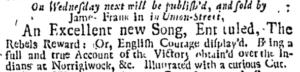
The arts. The usual comment about arts in the America colonies is that they were miserable. To an extent this was true, as survival in the wilderness (which is what most of America was in those days) leaves little room for the production of fine arts. Still American homes featured reproductions of European art, even good reproductions. More than that, however, music was a significant business in the colonies. Here, for example (apologies on the quality; it’s from 300 years ago), is an ad for sheet music. It ran in the New England Courant in 1724:
Here, from a Philadelphia paper of 1740, is an advertisement for sheet music being sold for the sake of charity:
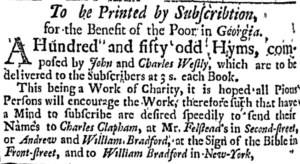
These people, then, while a long way from the centers of production for fine arts, still cared enough about them that they’d buy sheet music and learn new songs in their homes, performing them for family and friends at least.
The Fruits: As always, these people were essentially us, albeit in different circumstances. And what grew out of their circumstances were most notably self-reliance and self-trust. We further see that these virtues led men and women to sift and compare ideas, arriving at a conclusion that their rough liberty was better than the polished servitude of the kingdoms, and that they believed it enough to suffer for it."


.jpeg)


