StatCounter

Sunday, May 4, 2025

Free Download: Jiddu Krishnamurti, “The Book of Life”

"You must understand the whole of life, not just one little part of it.
That is why you must read, that is why you must look at the skies,
that is why you must sing and dance,
and write poems and suffer and understand, for all that is life."
- Jiddu Krishnamurti
Freely download “The Book of Life”, by Jiddu Krishnamurti, here:

"A Refining Process..."

“Life is a refining process. Our response to it determines whether we’ll be ground down or polished up. On a piano, one person sits down and plays sonatas, while another merely bangs away at “Chopsticks.” The piano is not responsible. It’s how you touch the keys that makes the difference. It’s how you play what life gives you that determines your joy and shine.”
- Barbara Johnson

"Trump’s Trade War Is Starving the Economy, And Every American Will Pay"

"Trump’s Trade War Is Starving the Economy, 
And Every American Will Pay"
by T.J. Johnson

"Donald Trump’s reckless trade war is gutting America’s supply chains and dragging us back into a crisis we barely survived. If you thought pandemic shortages were bad, wait until this economic siege hits your neighborhood. This time, no one’s safe—not Democrats, not Republicans, not independents. This is a full-blown assault on the American economy.

The Next Economic Crisis Has a Name: Trump: This isn’t just a blunder - it’s a blueprint for collapse. Donald Trump is using trade policy like a wrecking ball, smashing through America’s fragile supply chains and sending shockwaves through every grocery store, pharmacy, and small business in the country.

And even if he stopped today, the damage is already locked in. We’re staring down the barrel of months - maybe years - of shortages, price hikes, and vanishing choices. This isn’t a side effect of some well-meaning policy. This is a calculated strike against the working people of America. And this time, the pain won’t be confined to blue states or liberal strongholds - it will hit red, blue, and purple America alike.

From Pandemic Panic to MAGA Mayhem: You remember 2020. Empty shelves. Sky-high prices. Fear. Now imagine going through that all over again - but this time it’s not a virus. It’s Trump. As supply chain expert Bryan Gross puts it, “We are in a period of unprecedented disruption that’s not going to stop.” The system is broken, and Trump is making sure it stays that way - stacking erratic trade moves on top of global unrest.

Business leaders, economists, and even his own advisors are warning: we’re just weeks away from new shortages. Back-to-school season? Jeopardized. Halloween? Slim pickings. The holidays? Don't count on it. The screws are tightening - and it’s not accidental.

Chaos Is the Plan: Businesses need predictability. They need time to plan, order, budget. But Trump’s off-and-on tariffs make that impossible. Today’s deal is tomorrow’s disaster. And while he grandstands on the world stage, American consumers are left wondering why everyday essentials are suddenly scarce - or unaffordable.

Mark Malek from Siebert Financial lays it bare: “Just about everything we purchase in the U.S. in some way relies on a supply chain that starts outside of the U.S.” That includes your medicine, your phone, your kids’ school supplies. Trump’s trade war doesn’t just target China. It targets you. Of course, Trump’s Treasury mouthpiece Scott Bessent insists this is all under control. Retailers “planned” for this, he says. Just like they “planned” for the pandemic when shelves were stripped bare and hospitals ran out of PPE.

Fewer Choices, Higher Prices Everywhere: Supply chain experts like Jason Miller are clear: the pressure point is coming fast. Even if the ports don’t grind to a complete halt, the variety of goods we’ve come to rely on will shrink. What’s left will cost more, arrive later, and benefit fewer. And if the tariffs are suddenly lifted? It’s not relief - it’s a stampede. Bottlenecks, backorders, more chaos. Once the gears of global trade grind to a halt, they don’t just flip back on with a switch.

The Tipping Point Is Here: Port traffic is slowing. Orders are down. Retailers are panicking. The time to act was yesterday, but Trump is still throwing matches at the fuse. “We’re already past the tipping point,” says Gross. This is more than economic mismanagement. This is a controlled demolition of the system we all depend on. Red states, blue states - it doesn’t matter. Every single American is caught in the crosshairs of this ideological war waged through your wallet.

This is Trump’s America: chaos, scarcity, and crisis - by design. If you don’t take steps now, you’ll be left behind when the bottom drops out. This isn't just about politics. It’s about survival."

"My Biggest Warning Yet - Days Away from Chaos!"

Full screen recommended.
Steven Van Metre, 5/4/25
"My Biggest Warning Yet - Days Away from Chaos!"
"The unthinkable is about to hit the U.S. equity market and you're
 not ready for this. Stay tuned because we're days away from chaos!"
Comments here:

The Daily "Near You?"

Liberty, South Carolina, USA. Thanks for stopping by!

“7 Best Shakespeare Insults”

“7 Best Shakespeare Insults”
by The Huffington Post

"You should be women and yet your beards forbid me to interpret that you are so." Shakespeare employs this biting insult in "Macbeth" to establish the complete and utter repulsiveness of the three witches. Their "withered and wild" features cause Macbeth and Banquo to question if the sisters are even human beings.

"Methinks thou art a general offence, and every man should beat thee. I think thou wast created for men to breathe themselves upon you." In "All's Well That Ends Well," Lafeu hits infamous liar and coward Porolles with this blunt put-down after being finally fed up with his antics. Although, knowing Porolles and his mischievous ways, he probably deserved the jab.

"I must tell you friendly in your ear, sell when you can, you are not for all markets." Beggars can't be choosers is the modern way of getting this point across, but Shakespeare's version is far more biting. "As You Like It" showcases Shakespeare's gift of saying the meanest of things in the most eloquent ways in this insult Rosalind doles out to Phebe.

"Thou art a base, proud, shallow, beggarly, three-suited, hundred-pound, filthy worsted-stocking knave; a lily-liver'd, action-taking, whoreson, glass-gazing, superserviceable, finical rogue; one-trunk-inheriting slave; one that wouldst be a bawd in way." Possibly the most elaborate jab he has ever written, Shakespeare pulls out all the stops in "King Lear" when the Earl of Kent replies to Oswald's innocent question of, "What dost thou know me for?" with nearly every insult in the book. And if that verbal attack wasn't enough to put Oswald down, the Earl of Kent proceeds to physically beat him!

"I'll beat thee, but I should infect my hands." In Shakespeare's "Timon of Athens," protagonist Timon and his least favorite dinner companion, Apemantus, insult each other to no end in a verbal smack-down that lasts half of the scene. While Apemantus tries to rally with comebacks as cruel as, "A plague on thee! Thou are too bad to curse," it seems Timon reigns supreme with this precise one-liner.

"Away, you cut-purse rascal! you filthy bung, away! By this wine, I'll thrust my knife in your mouldy chaps, an you play the saucy cuttle with me. Away, you bottle-ale rascal! you basket-hilt stale juggler, you!" This put-down was said by prostitute Doll Tearsheet, who was notorious for having a sharp tongue, to Pistol in Act II of "Henry IV Part II."

"Thou art a boil, a plague sore, an embossed carbuncle in my corrupted blood." King Lear calls his daughter, Regan, these terrible names only to revoke his insult and promise not to punish her. Regardless of how fast he apologizes to her for his spiteful words, it's still a grade-A insult.”

"Our Dilemma..."

"Our dilemma is that we hate change and love it at the same time;
what we really want is for things to remain the same but get better. "
- Sydney J. Harris

The Poet:Kuroda Saburo, "I Am Completely Different"

"I Am Completely Different"

"I am completely different.
Though I am wearing the same tie as yesterday,
am as poor as yesterday,
as good for nothing as yesterday,
today
I am completely different.

Though I am wearing the same clothes,
am as drunk as yesterday,
living as clumsily as yesterday, nevertheless
today
I am completely different.

Ah...
I patiently close my eyes
on all the grins and smirks,
on all the twisted smiles and horse laughs -
and glimpse then, inside me
one beautiful white butterfly
fluttering towards tomorrow."

- Kuroda Saburo

"Chance, Choice, and How to Claim Your Life"

"Chance, Choice, and How to Claim Your Life"
by Maria Popova

"Only a fool or an egomaniac would deny that chance shapes the vast majority of life. The time, place, culture, family, body, brain, and biochemistry we are born into, the people who cross our path, the accidents that befall us - these dwarf in consequence the sum total of our choices. Still, our choices are the points of light that flicker against the opaque immensity of chance to illuminate our lives with meaning, just as stars, all the billions of them, comprise a mere 0.4% percent of a universe made mostly of dark energy and dark matter, and yet those same sparse stars made everything we know and are.

The most life-shaping choices we can make are those of our mindset - we can choose the best orientation toward the world, we can choose the best orientation toward each other, but where we seem to struggle the most is orienting with clarity and compassion toward our own lives, toward the choice we have in the dialogue between our inner world and our circumstances.

The novelist and poet D.H. Lawrence (September 11, 1885–March 2, 1930) took up these questions in a moving letter to his closest friend, Cynthia Asquith, found in the out-of-print treasure "The Letters of D.H. Lawrence" (public library).

The two had met as young writers both searching for their voice, both hungering to be heard - he was working as a kind of literary assistant to titans like T.S. Eliot and Ezra Pound, and she as a secretary to "Peter Pan" creator J.M. Barrie. Their friendship was quick and deep and largely epistolary, their letters a sandbox for playing out the life of the mind that becomes literature, a found of mutual encouragement for the twin arts of writing and living. On these pages addressed to the other, they each became themselves.

Shortly after his thirtieth birthday, a year into the world’s first global war, he sent her what he called a “parting letter” - he was about to make one of the most courageous, disorienting, transformative choices a human being could make: to leave everything one knows and loves, to dismantle the superstructure of daily life that houses the life of the spirit, and begin again someplace new. He didn’t just choose another city, or another country - he chose another continent, another culture of young and untested idealism. He tells his friend:

"I feel I must leave this side, this phase of life, for ever. The living part is overwhelmed by the dead part, and there is no altering it. So that life which is still fertile must take its departure, like seeds from a dead plant. I want to transplant my life. I think there is hope of a future, in America. I want if possible to grow toward that future."

"He knew that Cynthia did not have this kind of freedom. He knew that, despite her talent and her passion, she felt trapped in her circumstances - a marriage too small for her, to which she felt tethered by her children, in a country still too corseted by Victorian mores to allow a woman the full freedom to claim her life. But he also knew the power of personal choice in any given set of circumstances. A generation before Viktor Frankl in his stirring memoir of surviving the concentration camps that “everything can be taken from a man but one thing: the last of the human freedoms - to choose one’s attitude in any given set of circumstances, to choose one’s own way,” Lawrence urges his friend in that way we have of giving others the pointed advice we most urgently need ourselves:

"You must get the intrinsic reality clear within your soul - even if you betray it in reality, yet know it: that is everything. And know that in the end, always you keep the ultimate choice of your destiny: to abide by the intrinsic reality, or by the extrinsic: the choice is yours, do not let it slide from you, keep it always secure, reserved… Keep the choice of the right always in your own hands. Never admit that it is taken from you… Keep the choice of life… always in your hands: don’t ever relinquish it.

Couple with A Life of One’s Own - psychoanalyst Marion Milner’s pseudonymous masterpiece published just after Lawrence’s untimely death - then revisit Lawrence himself (lensed through Anaïs Nin) on the key to living fully, the strength of sensitivity, the balance of intimacy and independence in love, and how to live whole with the parts we carry."
o
Freely download "The Letters Of D.H. Lawrence" here:

"How It Really Is"

"The End of The Road"

Full screen recommended.
"The End of The Road"
by Joel Bowman

“Use your eyes. Use your ears. Use your brains…if you've got any.”
~ Agatha Christie, "Death on the Nile" (1937)

Aswan, Egypt - "The old taxi bumped along, wending down the rustic track known here as the “agricultural road.” Outside, the blazing heat fell on the backs of the field workers, covered from head to toe in soiled cloth and stooped over their crops. Not yet midday, the temperature was still rising.

Save for the occasional, mechanized tiller or cultivator, the work was done mostly by hand and animal. Along the road, children no older than our daughter drove donkey carts, laden with the fresh cut harvest. “Tomatoes for Germany,” our driver informed us, “And here, wheat and maize, for Saudi and the Emirates.”

We watched the fertile planes pass by the window, imagining the scene as it might have existed a thousand… two-thousand… five-thousand years ago. For these people, not much has changed.

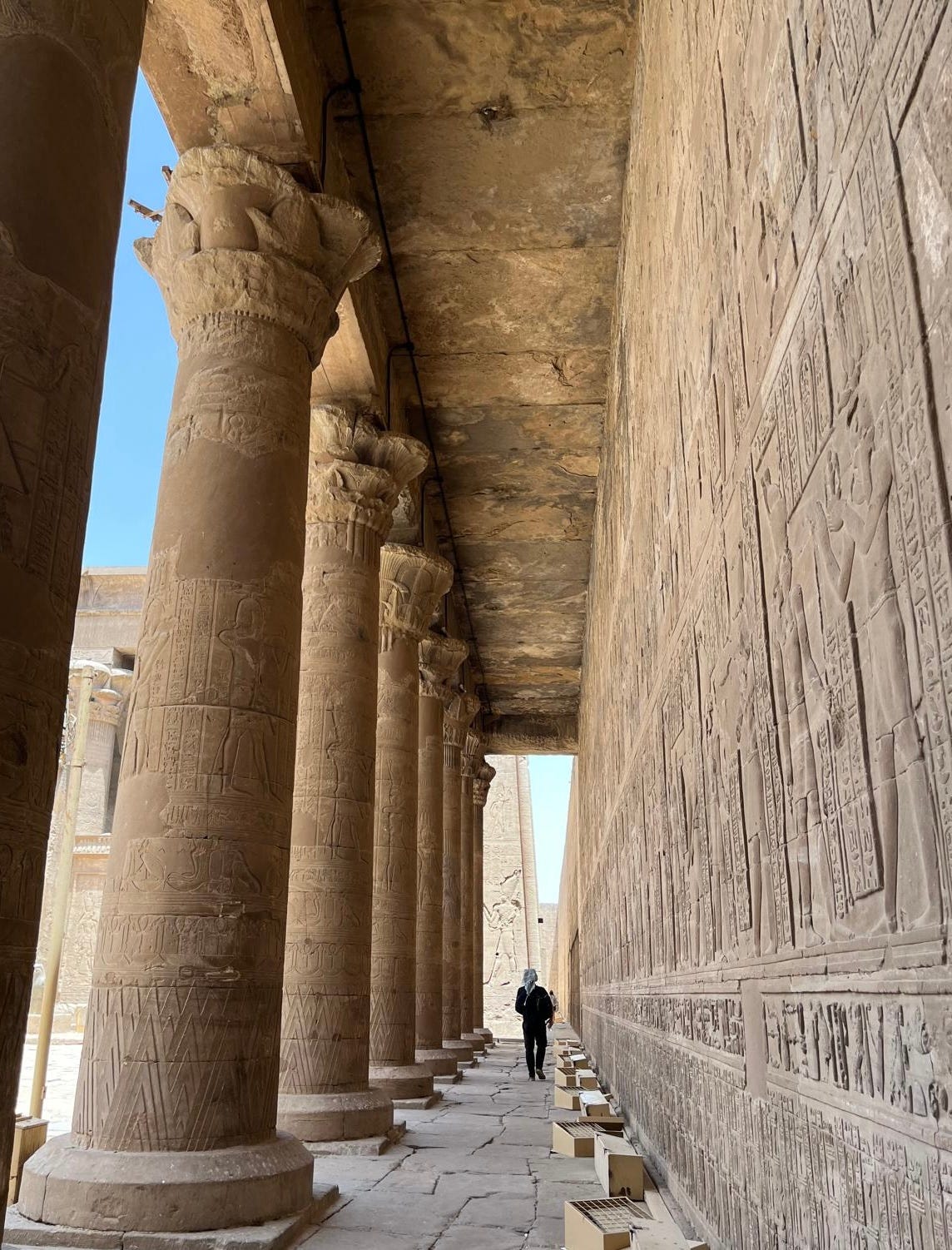
Following the Nile south, the ride from Luxor to Aswan is about three and a half hours on the new highway… or twice that if you want to see the grand temples of Khnum, Edfu and Kom Ombo, over on the East Bank.
Your one-armed author, keeping two eyes open in Edfu temple, Egypt. 

The temples are indeed impressive, impossibly vast monuments to dead kings… built on the backs of countless slaves. As Agatha Christie mused in her classic murder mystery, "Death on the Nile": “Take the Pyramids. Great blocks of useless masonry, put up to minister to the egoism of a despotic bloated king. Think of the sweated masses who toiled to build them and died doing it. It makes me sick to think of the suffering and torture they represent."

Mrs. Allerton said cheerfully: "You’d rather have no Pyramids, no Parthenon, no beautiful tombs or temples - just the solid satisfaction of knowing that people got three meals a day and died in their beds." The young man directed his scowl in her direction. "I think human beings matter more than stones.”

But as confronting as past may be, the present day can be equally difficult to square. (See clip, above…) After a eventful spell here in Egypt, we’ve got plenty to say about the place… and the region in general… most of which is probably best kept until we are safely returned to modern civilization. In the meantime…"

"15 Survival Grocery Products You Must Get Before End of May 2025"

Full screen recommended.
Epic Economist, 5/4/25
"15 Survival Grocery Products 
You Must Get Before End of May 2025"
"Something crazy is happening right now, and it's moving fast. I was just on Shein yesterday and noticed prices on some stuff jumped by 300% overnight. And it's not just them - I've been tracking Amazon sellers who are sneakily bumping up prices on everything from toilet paper to canned goods.

Look, I'm not trying to freak you out, but this is different from 2020. Back then, it was just people panicking. This time? The stuff literally isn't coming. The ships aren't moving. The factories aren't producing. And trust me, I'm already seeing the empty spots on shelves that give me that sick feeling in my stomach. This isn't just "oh prices are going up" territory. We're talking about things straight-up disappearing.

So in this video, I'm going to walk you through 15 everyday items that are already vanishing from stores near you. I'm not making this up - I'm literally driving to different stores every day and documenting what's happening. If you depend on any of these items, you need to get them now. Not next week. Now."
Comments here:
o

Dan, I Allegedly, "Warren Buffett Owns This? Unbelievable Discoveries!"

Full screen recommended.
Dan, I Allegedly AM 5/4/25
"Warren Buffett Owns This? Unbelievable Discoveries!"
"Hey everyone, it’s Dan from IAllegedly! Today, I’m taking you inside the incredible Berkshire Hathaway Shareholders Meeting in Omaha, Nebraska. Did you know Warren Buffett owns everything from Dairy Queen to Duracell, NetJets, and even Squishmallows? It’s unbelievable what this company has under its umbrella, and I’ll walk you through the event, showcasing booths from Forest River RVs, Geico, Pampered Chef, and even Pilot gas stations! You’ll see how brilliantly this convention highlights the scale of Berkshire Hathaway’s empire."
Comments here:
o
Full screen recommended.
Dan, I Allegedly, PM 5/4/25
"End of an Era - The Future Looks Challenging"
"Warren Buffett’s final bow? A Meeting to Remember! I got the chance to attend the unforgettable Berkshire Hathaway shareholders meeting, and it felt like the end of an era. At 94 years old, how many more of these does Warren Buffett have left? This incredible experience gave me a glimpse into his legacy and the announcement of Greg Abel as the future CEO. I met amazing people, including longtime shareholders, and gained inspiration for new business ideas. From Midwest hospitality to reflections on life’s fleeting moments, this trip was everything I hoped for and more." 
Comments here:

"Markets, A Look Ahead: The Dollar Is A Corpse, The System Is Rotting Faster"

Gregory Mannnarino, 5/4/25
"Markets, A Look Ahead: 
The Dollar Is A Corpse, The System Is Rotting Faster"
Comments here:
o
"Let me break down what is happening. What this $1.32 Trillion Spending Bill will do. Massive deficit spending = more Treasury issuance = more debt monetization by the Fed, especially as buyers dry up. (As you all know, the goal of every central bank is the same, to become both the buyer and lender of last resort- to own it all). This historic spending bill IS just what The Fed. ordered.

Foreign demand for U.S. debt is vanishing, literally. Who buys when nobody else will? The Fed. That’s QE whether they admit it or not. This MASSIVE spending spree shreds faith in the dollar, and faith is the only thing propping it up. The entire system only operates because people believe that it will - and that is the illusion. Result? More dollar devaluation. Accelerated.

Bottom Line: This massive spending bill isn’t just inflationary, it’s a signal to the world that the U.S. dollar is a burning ship, and no one’s appears to be steering however- this epic spending bill has the deep imprint of a dark shadow pulling the stings.

The Bigger Picture: Debt. Terminal Acceleration Toward System Lock-Up: The U.S. is already running $1+ trillion deficits PER QUARTER. Obviously, this adds to that, without real revenue increase. The debt/death spiral is now self-reinforcing. Interest on debt grows the deficit → more borrowing → higher interest → doom loop. Result? Debt explodes, interest expense cannibalizes the entire budget, and the hyper-debt bubble accelerates toward implosion.

The Economy. More Fake Growth: In the short term, you’ll see a sugar high, temporary GDP bump from government cash injection. But underneath? Private investment is being crowded out, real productivity is flat. This is a fiat-funded illusion. It looks like “growth” but it’s a corpse.

The Bigger Picture. This is not just reckless spending, it’s the weaponization of debt as control. They know the system’s on the edge. This “budget: isn’t "conservative." It’s an act of economic warfare."
- Gregory Mannarino

"Russia Victory Day Parade"

Full screen recommended.
Times Now World, 5/4/25
"Russia Victory Day Parade"
Comments here:

Saturday, May 3, 2025

"This is Bad and Things Are About to Escalate: Here's What Will Happen Next"

Full screen recommended.
Canadian Prepper, 5/3/25
"This is Bad and Things Are About to Escalate:
 Here's What Will Happen Next"
Comments here:

"Welcome To Mad Max: Desperate Homeless Living Off The Grid In The Desert Trying To Survive"

Full screen recommended.
Jeremiah Babe, 5/3/25
"Welcome To Mad Max: Desperate Homeless
 Living Off The Grid In The Desert Trying To Survive"
Comments here:

"Economic Collapse Begins Next Week - It's a Nightmare! I'm Afraid"

Full screen recommended.
Steven Van Metre, 5/3/25
"Economic Collapse Begins Next Week - 
It's a Nightmare! I'm Afraid"
"Trade’s crashing, paycheck’s are shrinking, and delinquencies 
are about to spike. What’s coming can only be described as a nightmare."
Comments here:

Musical Interlude: Two Steps From Hell, "Evergreen Extended"; "Downstream"

Full screen recommended.
Two Steps From Hell, "Evergreen Extended"
Full screen recommended.
Two Steps From Hell, "Downstream"

"A Look to the Heavens"

"Braided, serpentine filaments of glowing gas suggest this nebula's popular name, The Medusa Nebula. Also known as Abell 21, this Medusa is an old planetary nebula some 1,500 light-years away in the constellation Gemini. Like its mythological namesake, the nebula is associated with a dramatic transformation.

The planetary nebula phase represents a final stage in the evolution of low mass stars like the sun, as they transform themselves from red giants to hot white dwarf stars and in the process shrug off their outer layers. Ultraviolet radiation from the hot star powers the nebular glow. The Medusa's transforming star is near the center of the overall bright crescent shape. In this deep telescopic view, fainter filaments clearly extend below and to the left of the bright crescent region. The Medusa Nebula is estimated to be over 4 light-years across.”

Chet Raymo, "Seeing"

"Seeing"
by Chet Raymo

"There was a moment yesterday evening when the elements conspired to evoke these few lines, spoken by Macbeth:
"Light thickens,
And the crow makes wing to the rooky woods,
Good things of day begin to droop and drowse."

The fading light. The crows gliding down the fields to the trees in Ballybeg:

"Light thickens,
And the crow makes wing to the rooky woods,
Good things of day begin to droop and drowse."

It's all there, in those few lines - the mysterious power of poetry to infuse the world with meaning, to anoint the world with a transforming grace. One could spend an hour picking those lines apart, syntax and sound, sense and alliteration. The t's of light thickening, tongue against the teeth. The alar w's making wing. The owl eyes of the double o's. The d's nodding into slumber - day, droop, drowse.

The poet Howard Nemerov says of poetry that it "works on the very surface of the eye, that thin, unyielding wall of liquid between mind and world, where somehow, mysteriously, the patterns formed by electrical storms assaulting the retina become things and the thought of things and the names of things and the relations supposed between thing." It works too in the mouth, in the physical act of speech - tongue, teeth, those d's gliding deeper into the darkness of the throat.

I stand in the gloaming garden and the black birds glide, down, down to Ballybeg, and I marvel that with so few syllables Shakespeare can - across the centuries - teach me how to see."

"In A Nation Ruled By Swine..."

“In a nation ruled by swine, all pigs are upwardly mobile - and the rest of us are f****d until we can put our acts together: not necessarily to win, but mainly to keep from losing completely. We owe that to ourselves and our crippled self-image as something better than a nation of panicked sheep.”
- Hunter S. Thompson, “The Great Shark Hunt”

"We Deserve Better..."

"We are the world. We are the people and we 
deserve better, not because we're worth it, but because no 
worth can be put on the incalculable, on the infinite, on life."
- Nick Mancuso
“Each of us inevitable; Each of us limitless -
 each of us with his or her right upon the earth; 
Each of us allowed the eternal purports of the earth; 
Each of us here as divinely as any is here.”
- Walt Whitman

The Daily "Near You?"

McHenry, Illinois, USA. Thanks for stopping by!

"All The Money You Make..."

“All the money you make will never buy back your soul. ”
- Bob Dylan

"A Deal With the Devil"

"A Deal With the Devil"
Now the Devil is demanding his due…
by Charles Hugh Smith

"Unbeknownst to most people, America's leadership made a pact with the devil. Rather than face the constraints and injustices of our economic-financial system directly, a reckoning that would require difficult choices and some sacrifice by the ruling financial-political elites, our leaders chose the devil's Pact: Substitute the creation of asset-bubble "wealth" in the hands of the few for widespread prosperity.

The devil's promise: that some thin trickle of the trillions of dollars bestowed on the few would magically trickle down to the many. This was as visibly foolish as the promise of immortality on Planet Earth. But our craven, greedy leadership quickly sealed the deal with the devil and promptly inflated the greatest credit-asset bubble in human history. Rather than trade away one's soul, America's leaders traded away the future security and stability of the nation.

Sacrificing Innocents at the Altar of the Gods: By refusing to deal with the real problems exposed by the collapsing financial scams in 2008-09, our leaders – both the unelected Federal Reserve and the elected "best government money can buy" – chose to bail out the scammers who had greased their palms so generously and sacrificed the prosperity of the many to do so. This is more or less the equivalent of sacrificing innocents at the altar of the gods to ensure the leaders' rule will continue to be successful.

The devil was delighted to serve up the illusion of godlike powers to our corrupt, greedy leaders. The deal looked oh-so win-win: we enrich the top few percent and offload the costs and sacrifices on the powerless many, who were told that they would benefit from the trickle of cash leaking out of the super-wealthy's bulging pockets.

Of course, the Federal Reserve and the rest of the Savior State has saved us from the financial consequences of rampant speculation for decades. As a result, few of those in the casino have the necessary experience of hardship and losses to accurately assess risk. The vast majority have only experienced being saved: the most profitable response to a losing bet is to double-down on the next bet because the house (the Fed) will amply reward every "buy the dip."

The Devil Is Demanding His Due: But as I often point out, risk cannot be extinguished, it can only be transferred. Risk has been offloaded from speculators to the entire financial system itself, and so rather than a few speculators going down in flames, the entire casino will collapse.

Now the devil is demanding his due: the unprecedented credit-fueled bubbles in stocks, bonds and real estate are popping, and America's corrupt leaders can only stammer and spew excuses and empty promises. All this amounts to begging the devil to renegotiate the deal because now the downside is not just visible but inevitable. So sorry, America's leadership – the devil doesn't respond to pleas or threats. Sorry about that; the deal stands as agreed. All your bogus gains and powers will evaporate, and then the destruction really begins.

How does all this end? In ruin, of course. Our craven, self-serving leadership may well bleat, "the devil made us do it!" but that is not true: they fell all over themselves to sell the future stability and security of the nation for the quick-fix riches of bubbles and corruption. And of course, we’re staring at recession. But hey, look on the bright side…

Recessions Aren’t All Bad: Everyone looking at the inevitability of recession with alarm is forgetting the many upsides of recession, especially one that crushes all attempts to reverse it with the usual tricks. Let's not forget the simple joys of lighter traffic, faster commutes and the relative ease of getting a table at your favorite bistro – if it survives the bust.

Graveyard levity aside, there really is no equivalent to the positive force of crushing recessions. Only recessions which defy the usual tricks of monetary easing (create trillions of new dollars) and fiscal stimulus (give away a few of those new trillions) have the power to cleanse a system clogged with dysfunction, waste, fraud, corruption and financial zombies that soak of resources while doing little more than enriching the few at the expense of the many.

The problem with free money is that there's no mechanism to distinguish between waste and productive investment or fraud and productive utilization. All uses of free money are equally beneficial because if this free money is squandered, there's always more to spend tomorrow. In other words, in a system in which free money is the solution to all problems, there's no motivation to limit waste, friction or fraud because there's always enough free money for both waste, friction and fraud and needed spending and investment.

Time for Some Discipline: Recessions driven by inflation and the collapse of speculative bubbles aren't fixable with free money because free money fires up the afterburner of inflation. Once there are limits on how much free money can be created and distributed, squandering what's left means there's not enough left to fund essential services and to invest in the only real-world source of income and wealth. That’s productivity increases – doing more with less capital, labor and resources.

Only crushing recessions introduce the discipline of having to choose between waste, friction and fraud and essential services and investments. Waste, friction and fraud aren't simply gargantuan drains on resources… They corrupt the system by incentivizing friction (unproductive complexity and gatekeeping) and fraud (collusion, fraudulent billing, buying political favors, insider trading, etc.) and giving the recipients of friction and fraud the financial means to protect their fiefdoms with complexity thickets and political protection.

Recession Is the Only Cure: Financial systems that never experience crushing recessions can't tell the difference between a speculative mania driven by corporate buybacks and a bull market driven by improving productivity that lifts both profits and wages. The phony charade of speculative bubbles inflated by the Federal Reserve's spew of free money for financiers fatally distort the entire incentive structure of the financial system, which then balloons up and fatally distorts the entire economy.

Unbeknownst to those trembling in fear of a crushing recession, the crushing recession they fear is the only curative for a fatally distorted system which has lost touch with reality. Yes, there is a difference between speculative bubbles and bull markets. And yes, there is a difference between an economy riddled with the cancers of waste, friction and fraud and one strengthened by incentives and corrective mechanisms that bury unproductive zombie financial entities and reward those who actually increase productivity rather than destroy it. Recession will mean short-term pain but long-term gain."
Stipendium peccati mors est...
Full screen recommended.
"Doctor Faustus, Final Monologue And Ending" (1967)
"A most fantastic and moving performance by the late, great Richard Burton in this dazzling adaptation of Christopher Marlowe's astonishing work. The way the vision of Helen of Troy cackles and mocks Faust is so cruel and honest as we see the poor, lost soul accept the fate of eternal damnation, wrought entirely by his own hand." - ScarletDusk99

Freely download "The Tragical History of The Life
And Death Of Doctor Faustus", by Christopher Marlowe, here:

"A Full Confession"

"A Full Confession"
by Paul Rosenberg

"You can’t write about this till I’m gone,” he said, “but that won’t be long.” I hadn’t been to Jay’s Bar in a while, but I was invited by my old friend Martin. He was a basically nice guy who ended up working for an elite group.

I ran into Martin at my old gym, as I stopped one day to visit. He wasn’t looking well. I knew he had a fairly serious condition and was getting on in years, but he had been holding it at bay the last time I saw him. This time he was clearly close to his end, and had come to the gym to say his goodbyes. And so, when he invited me to meet him at Jay’s (“the same place I saw you last time”), I had to go.

We sat in a quiet spot, and I listened as he told me how close he was to death. That was two weeks ago as I write this. I saw his obituary this morning but will skip the funeral for reasons that may shortly become clear.

The Confession Begins: Martin ordered a triple scotch. I had never seen him drink before, except for a bit of white wine. But I followed his pattern, ordering a scotch on the rocks. “I have things that I need to tell you,” he began. “You know most of it fairly well, but you’ve never had confirmation before, and that makes a difference.” I nodded.

“I’ve read two of your books and half a dozen issues of your newsletter, you know.” “No, I didn’t,” I replied, “but thank you.” He smiled, raised his glass slightly, and took a big drink. He seemed like he was trying to relax, but his body was limited in its ability to feel comfort. It was an odd and troubling thing to notice. “Let’s start with the industrial revolution, shall we?” “That’ll be fine.”

“As iron and steam power moved across the continent they brought an economic revolution, and political revolutions followed. Through the middle 1800s nearly every monarchy was disrupted in one way or another. The aristocracy was pulled off the stage. Such people, however, don’t just accept displacement, and they fought to retain lordship in some form. I haven’t read it yet, but you wrote on this, didn’t you?” “Yeah, I said that these people seem to have demonetized silver and moved into central banking.” “Well, it wasn’t ‘seemed to.’ They very definitely did.” “Thank you,” I said. And he was right, getting confirmation helped me in some internal way.

He went on. “Land was no longer the store of value it had been since the beginning, and currency was taking over. And so the aristocrats plunged into banking. This put the British royals at the top of the hill, since they retained their positions and had a central bank that used debt as currency.

So the displaced aristocrats opened one central bank after another, on the model of the Bank of England. And since they had connections to Queen Victoria, they could be authorized by the major power of the day, the owner of the most important currency. Central banks became new duchies, keeping their owners in elevated positions.”

Then he stopped and took another long pull from his scotch. He was clearly using it as a painkiller. I took a sip of mine. "You realize that this isn’t going to change anything,” he said. I said nothing and waited.

“I’m telling you these things because I care about you. You’re an honest man, and you shouldn’t be stuck in uncertainty. But telling this to the world won’t change anything. They’ll just tune you out. They already tune you out, don’t they?” “Yeah, Martin, lots of them do.” “It deprives them of illusions. They can’t live without them.” “Well, I’m not sure it’s just illusions. A lot of them are so battered by daily events that the outside voice soon fades away.”

“I think you’re being kind to them, Paul. I have studies saying that they live in a ‘society’ bubble and can’t listen anything outside it.” He had a point, of course, but I quickly responded with, “Not all of them, though.” “What do you mean?” “I have people who’ve subscribed to my newsletter for years. Not a huge number, but still I have them. They pay to hear things that go past the illusions… or at least as well as I can get past them.”

“You do plenty well,” he said, to which I responded with a non-verbal thank you. “And these people stay with you over some significant period?” “Ten years or more for many of them.” “Well, then perhaps there is some hope… but we’re still talking about a tiny fraction.” “True enough,” I admitted.

The Thorn In Their Side: Our conversation paused for a few minutes, while the afternoon bartender came around, asking if we wanted anything else. (We didn’t.) We each had a few of the nuts he left on our table, and we sipped more of our drinks.

“America was a thorn in everyone’s side,” he said. “Even after they had a central bank. These people believed they were given their rights by God… and it made no end of trouble.” “How do you mean, Martin?” “Oil was the big one. None of the rulers saw the internal combustion engine coming, and once it did oil and refining become huge… but Americans owned the mineral rights to whatever land they held. That meant that the greatest new source of wealth was firmly in the hands of plebs… of common people. That was a problem.”

“Yes,” I injected,” I heard an old oil man talking about that once. In Europe mineral rights remained with the rulers, not the land-owner.” “Right, which is why American oil production led the way, and why American oil companies weren’t state-owned, like in Europe. Huge power fell into the wrong hands…” “As your old bosses saw it, at least,” I quickly added.

“Yes, of course,” he said. “I’m giving you their point of view. But,” he went on, “ that only mattered until the industry was developed. After that, our groups could just hire American engineers. Then they could do things as well as the Americans, and our groups gathered the oil everywhere else.”

Martin continued talking for a while, but mainly about his childhood and early career. Then, he moved back to the problem that America posed to rulers. “In America, at least in the early days, people believed they were the primary factors; that they created rulership structures for their own sake… that the structures had no validity, except to serve them.”

I hesitated at his statement. I had written about this at some length, and while I very much support that concept (and a lot of colonials did too), there were people with power (Alexander Hamilton and the Federalists in particular) who pushed the opposite view. “Aren’t you sounding like an idealist here, Martin?”

He stopped, thought for a moment, then said, “Yes, I suppose I am, but that’s not the case. When you look at it from the perspective of my groups, it seemed that way. In every other country people felt like creatures of the state, but in America we kept running into roadblocks, because people believed the state to be a creature of their own making.” “Ah…” I said. “That would be a frustration on the other side.”

Then he explained that he was the person who got the “We can’t contaminate a culture” dogma into "Star Trek," and into the "Next Generation" series in particular. He had lived and worked in LA for some years and pushed this idea to the money-men behind the venture. “The purpose of the whole thing,” he said, “was to reverse this American ideal. And we were terribly successful. Even the spin-off series maintain the illusion that people derive from cultures, rather than the other way around.”

“It’s funny,” I told him, “that always rubbed me the wrong way, though for the longest time I wasn’t sure why.” He smiled, pleased to have given me a gift. Then he motioned to the bartender and asked for another triple scotch. I demurred. We sat in silence till his drink arrived and he took another two swigs. He was getting drunk by this point, but he was finally sitting comfortably… loosening up in his speech too.

“I’m glad to be back here,” he said while making a wide gesture with his arm. “I grew up with people like these (the half-full bar included pretty much everything from manual laborers to lawyers), and I still like them…” Then he stopped and eyed two men and a woman in the corner who had to be politicians. “Except the little cluster of parasites,” he spat out, which surprised me. “Didn’t you work with politicians?” I asked. “Yeah!” he went on, a bit too loudly, “and do you know how eagerly and cheaply they sell themselves?”

“I have some idea.” “A fraction of one percent of a project,” he said. “So,” I added with a smile, “you’re like Rick in Casablanca. You don’t mind a parasite, but you object to a cut-rate one.” At that he burst into laughter; it was the only time I’d ever seen him laugh like that. Then he composed himself, finally realizing that he was too loud.

“I guess that’s true, but they really are cut-rate parasites. As long as they get enough money for publicity campaigns, they’ll sell you anything you want…” He paused, and looked like he might not finish the thought. “What?” I half-demanded.

He looked at me hard, deciding about something, then went on. “The sickest part of it all,” he said, “is that people respond to them, no matter how stupid they are. Every election they spout the same bullshit, which any sane adult knows is bullshit, and they vote for them just the same.”

“Yeah, I know.” “No, Paul. You don’t!” I waited. “I made a living only because most people support their abusers… they respond to any and every fictional fear… their imaginations are weaponized against themselves.” I paused a moment, then nodded my understanding, not just of his statement, but what he was implying. We sat in silence for what seemed a long time, until his phone rang. It was his wife, who would drive by and pick him up in twenty minutes.

What’s Next: I knew this would be my last time with Martin, and that he didn’t want to speak any further of his failing health and impending death.

“And what of the near future?” I asked. “2009 was a colossal mistake,” he said. “They could have survived a crash then. They had cooperative national leaders and willingness to believe was still riding the 9/11 surge. Plus, there was no alternative to the banking system. A crash would have hurt, but the game would have gone on.

“Now they’ve got people with fear fatigue, sex fatigue, ridiculous rulers and serious alternative currencies. On top of that, European banking is in uncharted waters, tied to a hopeless system of bond-issuance. They’re facing real trouble. They have amazing surveillance systems, but everything else is in question.”

“The surveillance concerns me deeply,” I said. “Yes, I understand… None of us could believe our luck with Facebook and Google. The whole world fell for the oldest scam in the book, selling their souls for services they could have purchased for a few dollars per month. No one expected that.

“But during those same years, politicians became true believers. We have 20-somethings in the US congress, who know almost nothing and who actually believe in socialism, for God’s sake! And we have an inveterate self-promoter in the White House who will do who-knows-what tomorrow morning. The politicians on the left actually believe the bullshit they sell, and many on the right see Trump as a demi-god. Who could have imagined that? It threw a wrench into the gears.”

“So what’s next?” “At some point, something will go wrong and financial structures will break. Already Facebook and their friends are getting ready for the dollar to fail. Wal-Mart’s in the game too. They talk nice, but they’d love to supplant the central banks. And if my group can fight them off, what of Bitcoin? They can’t do everything at once, and they’ve already attacked Bitcoin a dozen times with no enduring effect.”

I asked for an explanation of that statement, and he provided it. “They got the Department of Justice to sell all the Bitcoin they had seized. They did it in coordinated dumps at critical times. They succeeded in beating the hell out of the Bitcoin price, but the thing refuses to die.” I couldn’t help smiling, but remained silent. “Incredibly, the commercial systems of the world may end up resting on your Bitcoin people… if they can bear the load. My groups had the greatest lucky streak in history, but it seems to be running out.”

Then his phone beeped. It was a text from his wife. She was a couple of blocks away and would pull up in front. We started, slowly, to extract ourselves from the booth, pay the bill, and head to the front door. “Do you think your Bitcoiners can survive that pressure, Paul? Can they be the adults in the room?” “I know some of them can, Martin.” “I hope it’s enough,” he said.

His wife pulled over and we walked the five or ten steps to where she stopped. “I won’t see you again,” he said. I hugged him, we both shed a few tears, and I helped him into the car. But before the door shut, he turned and said, “I hope your people can do it.” Then the door shut and he was gone. And so I leave it with you. Can we rise to the occasion and be the adults? Because it might come down to us."

* As noted previously, all events related to Jay’s Bar are fictional, though often related to real people and/or events.

"How It Really Is"


"The Blind Indifference..."


The Poet: Henry Austin Dobson, “The Paradox Of Time"

“The Paradox Of Time"

“Time goes, you say? Ah no!
Alas, Time stays, we go;
Or else, were this not so,
What need to chain the hours,
For Youth were always ours?
Time goes, you say? – ah no!
Ours is the eyes’ deceit
Of men whose flying feet
Lead through some landscape low;
We pass, and think we see
The earth’s fixed surface flee;
Alas, Time stays, – we go!

Once in the days of old,
Your locks were curling gold,
And mine had shamed the crow.
Now, in the self-same stage,
We’ve reached the silver age;
Time goes, you say? – ah no!
Once, when my voice was strong,
I filled the woods with song
To praise your ‘rose’ and ‘snow’;
My bird, that sang, is dead;
Where are your roses fled?
Alas, Time stays, – we go!

See, in what traversed ways,
What backward Fate delays
The hopes we used to know;
Where are our old desires?
Ah, where those vanished fires?
Time goes, you say? – ah no!
How far, how far, O Sweet,
The past behind our feet
Lies in the even-glow!
Now, on the forward way,
Let us fold hands, and pray;
Alas, Time stays, – we go!”

- Henry Austin Dobson