“Most people, sad to say, are too rushed, frightened, and confused to think about what they really want out of life. They are hustled through school, forced into long-term decisions before they’re ready to face them, then held to those decisions by fear and shame. They choose from a limited set of options, and they know that change will be punished. Eventually they get old and find time to think, but by then they can’t bear to question too deeply; that would jeopardize their self-worth, and they haven’t time to rebuild it.
For an intelligent, creative, and expansive species like ours, this rush to nowhere is among the greatest of evils. And yet it continues, mostly unquestioned. At no point in the usual Western life do we stop, take some serious time for ourselves, and think about the overall:
• What’s life about anyway? What’s the point of what we do?
• What’s the purpose of a career? Why should I care about it above everything else?
• Why should I glorify the existing system? Why should I agree to support it?
• Who paid for everything I learned in school?
• Should I have a family? If so, why? If not, why not?
• What do I think is fun? Does it really coincide with the beer ads on TV?
• What’s the purpose of being like everyone else? Why am I so afraid to be different?
We don’t address such questions. Rather, we’re pushed past them. Even in a church or synagogue – places where larger questions are supposed to be addressed – the person in the pulpit wants us to become and/or remain a member of the congregation; their job depends upon it. There are true ministers and rabbis, but for most it’s all too easy to push their audience into what’s convenient. As a result, we see little motivation in the modern West, save for the basest of motivators: things that match a line from the Bible that says, “Whose god is their belly.”
Mind you, I’m not against wealth, good food, or sex. I think those are fine things. They are not, however, the whole of life. We are much bigger than that. We ought not be limited to belly-level aspirations. But when we’re rushed, that’s all we’re able to see.
Status and Fear: The two big motivators we face in this rush through life – fear and status – are both negative. Fear is a manipulation technology; people who make you afraid are hacking your mind. They want you to ignore reason and obey them fast. I wish I could cover this in depth here, but we haven’t space. When we’re afraid, we make our worst choices. Put plainly, fear makes us stupid. But we encounter it on a daily basis… and it destroys us by inches.
Status is the compulsion to compare ourselves with others, and whether we’re looking for the ways we’re better than others or looking for our shortcomings, it is deeply destructive. It’s also irrational, but the advertising business would crash without it and advertisers currently own the collective eyeballs of humanity.
Fear and status are, in a broad sense, drugs, and if you had a choice between smoking pot every day or being on fear and status every day, I’d definitely recommend the pot.
Confusion: Let’s be clear on something: Nearly every adult in the West will agree that politicians are liars and thieves… and yet they obey them without question. Is there any possibility we’d do such things if we weren’t harried and confused? When we are confused, we pass over our own minds and their deliberations. There’s an old joke: “Who are you gonna believe, me or your lyin’ eyes?” But that’s precisely what confusion does to us, and under the pressures of confusion and authority, most people will ignore their own eyes.
Such things do not happen to people who are calm and confident. But the existing hierarchies of the West couldn’t function with a calm and confident populace; their operations require people to be frightened, confused, and blindly chasing status.
As a Result… As a result, most of us hurry through life, never knowing why. We live as others do, simply because that path is streamlined for us, exposing us to a minimal level of fear and shame. But that path does something else: It keeps us from experiencing ourselves. Seldom has this problem been put more succinctly than in this quote from Albert Einstein: “Small is the number of them who see with their own eyes and feel with their own hearts.”
"A great madness sweeps the land. There are no limits on extremes in greed, credulity, convictions, inequality, bombast, recklessness, fraud, corruption, arrogance, hubris, pride, over-reach, self-righteousness and confidence in the rightness of one's opinions. Extremes only become more extreme even as the folly of previous extremes wearies rationality.
Imaginary sins are conjured out of thin air to convict the innocent while those guilty of the most egregious fraud and corruption are lauded as saviors.
The national mood is aggrieved and bitter. The luxuries of self-righteousness, indignation, entitlement and resentment have impoverished the national spirit. Bankrupted by these excesses, what little treasure remains is squandered on plots of petty revenge.
Blindness to the late hour is cheered as optimism, confidence in the false gods of technology is sanctified while doubters of the technocratic theocracy are crucified as irredeemable infidels.
Witch-hunts and show trials are the order of the day as those who cannot stomach the party line are obsessively purged, as healthy skepticism is condemned as a mortal sin by brittle true believers who secretly fear the failure of their cult.
Mired in a putrid sewer of suspected subversion and disloyalty to The One True Cause, heretics are everywhere to those caught up in the mass hysteria. In this choking atmosphere of toxic hubris, self-righteousness, indignation, entitlement and resentment, humility is for losers, prudence is for losers, caution is for losers, skeptical inquiry is for losers.
Completely untethered from cause and effect, those confident in the inevitability of a glorious future of unlimited expansion cling to past glory as proof of future glory, even as their hubris leads only to a treacherous path of decay and decline. As they stumble into the abyss, their final cries are of surprise that confidence alone is not enough.
Those who see the madness for what it is have only one escape: go to ground, fade from public view, become self-reliant and weather the coming storm in the nooks and crannies where cause and effect, skeptical inquiry, humility, prudence and thrift can still be nurtured."
arrives in San Francisco Bay bearing gifts for Silicon Valley
"Mag Seven Deep Sixed"
by Bill Bonner
"More investment does not necessarily lead to more innovation."
- Liang Wenfeng, Founder of company that created DeepSeek
Baltimore, Maryland - "We’ve got a good idea where the Big Loss will come from. This month, a bombshell hit the whole cluster of AI-enhanced capital values. As Dan reported, AI chips - the foundation of Nvidia’s $3 trillion market cap - suddenly face an unexpected competitor. The Daily Beast: "Chinese AI Upstart Sparks $1 Trillion Market Rout After Trump Hyped AI Megadeal." "A Chinese artificial intelligence startup’s latest AI model spooked markets Monday, leaving U.S. and European technology stocks on track for a $1 trillion wipeout, a week after President Donald Trump threw his weight behind a $500 billion private sector investment in AI infrastructure."
DeepSeek is the product of $6 million, not billion (in rented GPU hours), of investment by Chinese entrepreneur, Liang Wenfeng. Despite spending $200 billion a year to dominate the AI space, the four leading US tech giants - Microsoft, Amazon, Meta, and Alphabet - have let Wenfeng steal a march on them.
Typically, a bubble attracts its own pin. By trying to contain Chinese innovation, the Trump/Biden administrations seem to have sharpened its point. And now, it heads straight for those tech oligarchs standing in the second row during Trump’s inauguration. Now valued at $17 trillion, collectively, the Magnificent 7 were already headed for trouble. That’s what normally happens. Bubbles deflate. Peaks lead to valleys. And new technology is always followed by newer technology.
But this time, Palo Alto might soon resemble Gaza City. Seeking Alpha: "Major averages tumbled on Monday as concerns about the AI rally ramped up in the face of buzz about China AI startup DeepSeek, sparking a risk-off move. Early on and the Nasdaq Composite was -2.7%. AI names like Nvidia (NVDA) and Super Micro Computer (SMCI) were down more than 10%. "
What could you expect? Protectionism and containment lead to decay and backwardness, not to growth and progress. Despite US efforts to stop then, China’s chip exports have actually gone up for 14 consecutive months. Forced to experiment, they developed new tactics and new technology. Forbes: "US export controls on advanced semiconductors were intended to slow China’s AI progress, but they may have inadvertently spurred innovation."
Over at The Unz Review, the report is even more alarming: "In a matter of days, the news of China’s AI sensation, DeepSeek Ri, has gone from a gentle breeze to a Force 5 hurricane. The ‘capital of tech’ has moved from ‘Palo Alto to Hangzhou,’ says Unz: "It’s clear now that no one in Silicon Valley or Washington DC had the slightest idea that their world was about to be turned upside-down by an innovative new product that would shift the geopolitical plates further eastward. In short, the agenda is being set by people with different priorities, values and beliefs who live 10,000 miles away."
Venture Beat: "Unlike o1 (Open AI) which is available only to paying ChatGPT subscribers of the Plus tier ($20 per month) and or expensive tiers (such as Pro at $200 per month), DeepSeek R1 was released as a fully open source model, which also explains why it has quickly rocketed up the charts...everyone in AI is freaking out about DeepSeek."
The sell-off in tech may be ‘overblown,’ says Barrons. The deeper challenge, though, is probably under blown. Republic World: "Chinese Universities Surge Ahead of MIT, Oxford, Stanford, Caltech. Harvard University retains the top position in the Nature Index, but the rest of the top ten spots are dominated by Chinese institutions."
Last week, Trump announced $500 billion to be invested in Stargate AI – to ‘secure American leadership’ and ‘elevate humanity’. It’s already looking like money down the drain."
"The shocking truth about negative equity in cars is here, and it’s hitting harder than ever! In today’s video, I’m sharing real stories, surprising stats, and practical advice to help you avoid the trap of being upside down on your auto loan. From the skyrocketing number of people facing negative equity to smart tips on how to stay ahead—and even save big on your car expenses—I’ve got you covered. Plus, I’m sharing my personal experience and some advice from trusted sources like Edmunds and Auto Biscuit to help you make better financial decisions. Trust me, this is a conversation you don’t want to miss."
“Scanning the skies for galaxies, Canadian astronomer Paul Hickson and colleagues identified some 100 compact groups of galaxies, now appropriately called Hickson Compact Groups. The four prominent galaxies seen in this intriguing telescopic skyscape are one such group, Hickson 44, about 100 million light-years distant toward the constellation Leo. The two spiral galaxies in the center of the image are edge-on NGC 3190 with its distinctive, warped dust lanes, and S-shaped NGC 3187. Along with the bright elliptical, NGC 3193 at the right, they are also known as Arp 316.
The spiral in the upper left corner is NGC 3185, the 4th member of the Hickson group. Like other galaxies in Hickson groups, these show signs of distortion and enhanced star formation, evidence of a gravitational tug of war that will eventually result in galaxy mergers on a cosmic timescale. The merger process is now understood to be a normal part of the evolution of galaxies, including our own Milky Way. For scale, NGC 3190 is about 75,000 light-years across at the estimated distance of Hickson 44.”
“A few lines from Mary Oliver's poem "Wild Geese":
"You do not have to be good. You do not have to walk on your knees for a hundred miles through the desert, repenting. You only have to let the soft animal of your body love what it loves."
"I've quoted these lines before, if not here, then elsewhere. When I first read them back in the late 80s, they resonated with what I felt at the time. I had spent part of my earliest adulthood walking on my knees, both literally and metaphorically, seeking to tame what I took to be the animal within. Saint Augustine was whispering in my ear, and Bernanos' gloomy country priest walked at my side. I was ready to follow Thomas Merton into the desert; indeed, I once took myself briefly to the monastery at Gethsemane, Kentucky, where Merton was in residence. That was a journey of more than a hundred miles, and I was busy repenting, although of what I don't know.
As I read those lines from Mary Oliver in middle age, I had long been cultivating the "soft animal" within, immersing myself in the is-ness of things, the flesh and blood, the gorgeously sensual. No more walking on my knees, repenting. I walked proudly upright, with my sketchbook and my watercolors, my binoculars and my magnifier, sniffing the world like an animal on the prowl. I was letting my body learn to "love what it loves." Those were the years I wrote "The Soul of the Night" and "Honey From Stone" - the most intensely creative years of my life. The world offered itself to my imagination, if I may borrow another line from "Wild Geese."
And now, another half-lifetime has passed. The soft animal dozes, the body seeks repose. And I think of the first line quoted above: "You do not have to be good." What could the poet have possibly meant by that? Of course one has to be good. In a cell at Gethsemane or on the bridge over Queset Brook, one has to be good. And so one tries, one tries. The soft animal of the body that nature has contrived for us is not fine-tuned for goodness.”
"You do not have to be good. You do not have to walk on your knees for a hundred miles through the desert repenting. You only have to let the soft animal of your body love what it loves. Tell me about despair, yours, and I will tell you mine. Meanwhile the world goes on. Meanwhile the sun and the clear pebbles of the rain are moving across the landscapes, over the prairies and the deep trees, the mountains and the rivers. Meanwhile the wild geese, high in the clean blue air, are heading home again. Whoever you are, no matter how lonely, the world offers itself to your imagination, calls to you like the wild geese, harsh and exciting over and over announcing your place in the family of things."
"Contrary to first impressions, I am not a doom-and-gloomer; I'm a systems-cycles-er, meaning I'm interested in where systems and cycles are heading. Cycles work because we're still running Wetware 1.0 which entered beta testing around 200,000 years ago and was released, bugs and all, around 50,000 years ago. Since the processes and inputs haven't changed, neither do the outputs.
Nature is a mix of dynamic, semi-chaotic systems (fractals, etc.) and cyclical patterns which tend to operate within predictable parameters. Why should human nature and human constructs (societies, economies and political realms) be any different?
So longterm success breeds complacency, hubris, economic and intellectual sclerosis, draining political infighting and the overproduction of parasitic elites, to use Peter Turchin's apt description. Consumption of resources expands to soak up every last bit of what's available and then the supply of goodies plummets for a multitude of completely natural and predictable reasons (sunspot/solar activity, El Nino, etc.) and a host of unpredictable but equally natural semi-chaotic extremes (100-year droughts, floods, etc.).
Wetware 1.0's go-to solutions to all such difficulties are rather limited:
1. Ramp up magical thinking. If a couple of human sacrifices ensured good harvests in the good old days, let's slaughter a couple hundred now - and if that doesn't work, then...
2. Do more of what's failed spectacularly and slaughter a couple thousand fellow humans, because darn it, maybe everything will turn around if we just kill another couple dozen. This requires ignoring the novelty of the current challenges and clinging to what worked so well in the past even as whatever worked in the past can't possibly work now because circumstances are fundamentally different.
3. Seek scapegoats. It's those darn witches. Burn a bunch of them and our troubles will magically disappear.
4. Go take what we need from some other tribe. What's our oil doing under their sand?
5. Consolidate power and wealth in the hands of elites whose failures exacerbated the crisis. Because the obvious solution (to the elites with cushy offices around the palaces and temples) to repeated failures of a leadership that only excels in one thing, squandering rapidly depleting resources on infighting and self-aggrandizement, is to give us all the remaining wealth and power. Hey, this makes perfect sense once you understand #2 above.
6. Demand sacrifices of the many to protect the privileges of the few. The Empire needs some warm bodies to fend off the Barbarians, because it would be a real shame if the Barbarians reached our palatial estates and disrupted the flow of wine and festivities. No worries when you come back on your shield; the bureaucracy will give you a decent burial and your spouse and kids can join the multitude of half-starved beggars waiting for the dwindling distributions of bread and circuses. But never mind that, did you hear about the upcoming games in the Coliseum? Good seats are going fast.
7. Eat your seed corn to keep the party going awhile longer. Not every human group had the luxury of borrowing "money" to keep the fast-unraveling party going awhile longer, so they consumed their seed corn and drained the last of their reserves--which is the same thing as borrowing "money" from a future with diminishing resources and productivity.
8. Maintain supreme confidence that "it will all work out fine because it's always worked out fine" without any sacrifice required of "those who count." What's forgotten is that the luxe greatness that is now teetering on the precipice of ruin was won by the sacrifices of the elites far exceeding the sacrifices of the many.
Back in the day, joining the elite and maintaining one's position required constant sacrifices on behalf of the common good, and strict adherence to public virtue. Now that's all forgotten, and all that remains are elites possessed by the demons of shameless greed and self-interest.
The idea that debt, leverage, speculation, greed, exploitation and parasitic elites can expand exponentially forever is magical thinking. Yet that is precisely what America and the rest of the global economic order insists is true and will always be true, forever and ever.
By all means, reject those horrid, awful doom-and-gloomers who look at systems and cycles. Everything will be fine as long as you secure seats for the next games at the Coliseum - they should be spectacular - but not in the way you expect."
"The New Poor! Americans Living Off Their Credit Cards!"
"America's debt crisis just continues to get worse as we continue to carry higher and higher balances from month to month, at a time when credit card interest rates are practically at all time highs. At the same time, we have more and more people only paying the minimum payments each month. Americans are essentially living off their credit cards right now. But how long can that last?"
"'The Law of Jante?' Of course I had never heard of this, so he explained what it was. I continued on my journey and discovered it is hard to find anyone in any of the Scandinavian countries who does not know this law. Although the law exists since the beginning of civilization, it was only officially declared in 1933 by writer Aksel Sandemose in the novel “A Refugee Goes Beyond Limits.”
The sad truth is that the Law of Jante is a rule applied in every country in the world, despite the fact that Brazilians say that “this only happens here,” and the French claim that “unfortunately, that’s how it is in our country.” Now, the reader must be annoyed because he/she is already half way through the column and still does not know what the Law of Jante is all about, so I’ll try to explain it here briefly in my own words:
“You aren’t worth a thing, nobody is interested in what you think,
mediocrity and anonymity are your best bet.
If you act this way, you will never have any big problems in life.”
The Law of Jante focuses on the feeling of jealousy and envy that sometimes causes so much trouble for people. This is one of its negative aspects, but there is something far more dangerous. And this law is accountable for the world being manipulated in all possible manners by people who have no fear of what the others say and end up practicing the evil they desire. We have just witnessed a useless war in Iraq, which is still costing many lives; we see a huge abyss between the rich and the poor countries of the world, social injustice on all sides, unbridled violence, people being forced to give up their dreams because of unfair and cowardly attacks. Before starting the second world war, Hitler sent out several signals as to his intentions, and what encouraged him to go ahead was the knowledge that nobody would dare to defy him because of the Law of Jante.
Mediocrity may be comfortable, up to the day that tragedy knocks at the door and people start to wonder: “but why did nobody say anything, if everybody could see that this was going to happen?” Simple: nobody said anything because the others did not say anything either. So in order to prevent things from growing any worse, maybe this is the right moment to write the anti-Law of Jante:
“You are worth far more than you think. Your work and presence
on this Earth are important, even though you may not think so."
Of course, thinking in this way, you might have many problems because you are breaking the Law of Jante – but don’t feel intimidated by them, go on living without fear and in the end you will win.”
“Whatever your fate is, whatever the hell happens, you say, “This is what I need.” It may look like a wreck, but go at it as though it were an opportunity, a challenge. If you bring love to that moment - not discouragement - you will find the strength there. Any disaster you can survive is an improvement in your character, your stature, and your life. What a privilege! This is when the spontaneity of your own nature will have a chance to flow. Then, when looking back at your life, you will see that the moments which seemed to be great failures, followed by wreckage, were the incidents that shaped the life you have now. You’ll see this is really true. Nothing can happen to you that is not positive. Even though it looks and feels at the moment like a negative crisis, it is not. The crisis throws you back, and when you are required to exhibit strength, it comes.”
"The old FedEx envelope was clever, a work of art even, optimistic and colorful, signifying speed and progress. What a beautiful contrast to the plainness of the U.S. Postal Service. For years, I can recall dropping off these treasures and paying maybe $10 to assure their delivery across the country, even the world. For me, it was a fabulous symbol of an improved life, living proof that progress was baked into the historical trajectory.
But a few days ago, the clerk at the FedEx office confirmed a different ethos. There was no doing business without a scan of my government-issued ID. I asked for confirmation: So if I did not have this, there is simply no way that I could send a package? Confirmed. Then came the envelope. It was the color of the brown bag I took to school when I was a kid. Serviceable, drab, dull. Also the new one is stamped with a big green marker: recyclable. There is no design, no art, certainly no beauty. It’s all gone.
Its main message is suffering. What happened to the old envelopes? They’ve been replaced, the clerk explained firmly, with no more detail. A recycle exhortation suggests shortage. We have to reuse everything because there just isn’t enough to go around. We must sacrifice. The color suggests privation. It’s an aesthetic of sadness and penance. Then of course the price tag came: $26 for delivery not tomorrow but in two days. So compared with some years ago, we pay 2½ times as much for service half as good as it was.
Don’t complain. It’s just the new way. It’s the new way of life. What happened to progress? It’s been replaced. The new path is flagellantism: in politics, culture, economics and everywhere.
The flagellants were a medieval movement of public penitents that roamed from town to town in garbs of woe, flogging themselves and begging as penance for pestilence and war. They were infused with a fiery, apocalyptic and millenarian passion that they could see terrible moral realities to which others were blinded. The theory was that plagues were being visited upon the Earth by God as punishment for sin. The answer was contrition, sorrow and acts of penance as a means of appeasement, in order to make the bad times go away.
It’s true that there were people who did so in private but that was not the main point. The central focus and purpose of the flagellant movement was to make one’s suffering public and conspicuous, an early version of the virtue signal. In the guise of personal sorrow, they were really about spreading guilt to others. They would show up at any public celebration with a message: Your happiness is causing our suffering. The more you party, the more we are forced to bear the burden of the need to be in pain for your sins. Your joy is prolonging the suffering of the world.
Flagellantry is most recognizable in the aesthetic. The first signs I recall seeing of this occurred immediately during the panic of March 2020 when it was proclaimed from on high that a terrible virus was visiting the U.S. Read on for the ugly details…
"Flagellantism: The New Political Ritual"
by Jeffrey Tucker
"No, you couldn’t see the virus, but it is highly dangerous, everywhere present, and should be avoided at all costs. You must wash constantly, douse yourself with sanitizer, cover your face, dress in drab color and be sad as much as possible. Fun things were banned: public gatherings, singing, house parties, weddings and all celebrations. This whole scene took on a political patina, as people were invited to think of the invisible virus as a symbol of a more tangible virus in the White House, an evil man who had invaded a holy space whose malice had leaked out in the culture and now threatened to poison everything.
The more you complied with mandatory misery, the more your work made a contribution to making the pestilence go away while we wait for the inoculation. That could take two forms: driving him from the White House or releasing the vaccine which everyone would accept.
Joseph Campbell was correct about the role of religious impulses in the human mind. They never go away. They just take on different forms according to the style of the times. Every single feature of traditional religion found a new expression in the COVID religion.
We had masking rituals that were rather complicated but learned and practiced quickly by multitudes: mask on while standing and mask off when sitting. We had sacramentals like social distancing and communion with vaccination. Our holy water became sanitizer and our prophets on Earth were government bureaucrats like Fauci.
Flagellantism did not disappear once the old president left and the new one came. Even after the pandemic ended, there were new signs that God was angry. There was the ever-present climate change which was a sign of Earth’s anger for being drilled and carved up for energy sources. And the bad country said to be responsible for the unwelcome invader of the White House - Russia - was now rampaging through the holy land of its neighbors.
In addition, the broader problem was capitalism itself, which gave us things like meat, gasoline, fur and other signs of evil. And what gave rise to capitalism? The answer should be obvious: imperialism, colonialism, racism and the existence of whiteness - each of which called for mass penance.
The pandemic unleashed it all. It was during this period that corporations decided that profitability alone required signs of suffering and hence the rise of ESG and DEI as new ways to assess economic value of corporate culture. And new practices were added to the list of the highly suspect: monogamy, heterosexuality and religious traditions such as Christianity and Orthodox Judaism that should now be regarded as deprecated, even as part of the underlying problem.
It was during this period when I found myself on an apartment hunt and observed a newly remodeled offering. I asked why the owner had not replaced the flooring. I was corrected: These are new floors. Impossible, I thought. They are gray and ghastly. That’s the new fashion, I was told. Looking it up, it was true. Gray flooring was being installed everywhere.
How does wood become gray? It dies. It starts to decay. It is swept away by rivers and floats around for years, alternatively soaked, baked by the sun and soaked again, until every bit of color is drained away. It becomes driftwood, a survivor of the elements and a symbol of the brutality of the cycle of life. Gray flooring is therefore the ideal symbol of the age of suffering, the proper material on which to move back and forth pondering the evils of the world.
In a world governed by flagellantism, ugly formlessness rises to replace aspirational art and imaginative creativity. This is why public art is so depressing and why even the clothing we can afford at the store all looks dreary and uniform. In this world, too, gender differences disappear as luxurious signs of decadence we can no longer afford.
Two other anecdotes. The overhead bins on the flight just now were largely empty, simply because most passengers chose the cheaper basic economy fare. This also requires they have no carry-on luggage and hence be forced to pay for checked luggage or travel with all their belongings in a backpack. We’ve gone from gigantic Louis Vuitton steamer trunks to stuffing things in pockets and hiding them from authorities.
Another case in point. I asked the man in the high-end shoe shop why none of the shoes had leather soles. Instead all shoes have these cushy rubber soles that seem weak and pathetic, and make no noise when one steps. “Everything has changed since COVID,” he said. “All shoes are house shoes now.”
I had no words and walked away, my entire thesis confirmed. Sure enough, all the data we have suggests the mighty triumph of flagellantism. Fertility is down dramatically. Life spans are shortening. People are sicker. Excess deaths are rising. We learn less, read less, write less, create less, love less.
Personal trauma is everywhere. The groceries are more expensive so we eat whatever we can, when we can, while hoping for breezes and whatever sunlight there is to provide just the essential energy we need to slog through another day.
Degrowth is the economic model of flagellantism, reducing consumption, embracing privation, acquiescing to austerity. We no longer declare recessions to be on their way because recession is the new way we live, the realization of the plan. The word “recession” implies a future of recovery, and that is not in the cards.
“Decolonization” is another watchword. It means feeling so guilty about the space you inhabit that your only moral action is to stay put and reflect on the sufferings of those you have displaced. You can of course say a prayer of supplication to them, so long as you never appropriate any aspect of their culture, since doing so would seem to affirm your rights as a human being.
You want joy, beauty, color, drama, adventure and love? It’s not gone entirely. Park yourself on a yoga mat on your gray floor and open your computer. Stream something on one of many streaming services you have been provided. Or become a gamer. There you will find what you seek. The experiences you seek you can only observe as an outsider looking in. It is not participatory. Social distancing never went away; it is how we live in a new age of unending penance.
So, you see, it’s not just about eating bugs. It’s about a whole theory and practice of life and salvation itself, a new religion to replace all the old ones. Cough up your government-issued ID, send your package if you must, think twice before complaining about anything on social media and figure out a way to channel your depression and despair into quiet humble gratitude and acquiescence. Don’t forget to recycle. The flagellants have taken over the world."
"In a scene from the 1975 film "Monty Python and the Holy Grail," a group of monks are depicted singing plainchant while on a procession through the streets of a medieval village. After chanting the first few lines of text, the monks abruptly hit themselves in the face and repeatedly do so during their procession. Although this scene was undoubtedly filmed for comedic purposes, and the movie, in general, propagates a number of historically questionable stereotypes of the Middle Ages, the act of monks singing while engaging in self-harm is historically sound. In fact, this scene reflects the practices of a group of traveling medieval flagellants who would whip themselves while singing songs of penance for the purpose of placating God."
"The Retail Apocalypse is here, and 2025 is shaping up to be the most devastating year yet for brick-and-mortar stores. With 15,000 retail locations expected to close across industries like clothing, auto parts, fast food, and even hardware, we're seeing a massive shift in how people shop. Online shopping is booming, with platforms like Teemu and Shein crushing traditional stores. Meanwhile, iconic brands like Macy's are shutting down locations at record rates. What does this mean for consumers, businesses, and local economies?
In this video, I break down the staggering numbers, why this is happening, and how companies like Amazon are making drastic decisions like closing fulfillment centers. I also touch on the rise of online therapy, the struggles of government employees heading back to offices, and even how the diamond industry has taken a massive hit. From layoffs to declining retail sales to the closure of unique businesses like a 174-year-old bookstore, there's a lot to unpack."
Empires, for example, rise and fall. There are no exceptions.
They get ‘good’ leaders and ‘bad’ leaders. But mostly they get leaders
who do what they have to do to take the Empire where it needs to go.
by Bill Bonner
Baltimore, Maryland - "Can you really get ‘there’ from ‘here?’ Here we are... a late, degenerate empire sitting on a debt bubble that is ready to blow sky high... run by people who benefit from inflation and deficits. ‘There’ is a peaceful, ‘soft landing’... bringing debt under control without a depression... avoiding a meltdown and controlling inflation.
Javier Milei, in Argentina, seems to be headed ‘there.’ Inflation has been reduced by 90%. Government payrolls have been trimmed by 30,000 employees. And the nation ran its first budget surplus in 123 years. But Milei did not start from ‘here’...he started from a much different place, with 250% inflation and half the population living in poverty. It would be nice to think that earnest leaders could follow him. But things do not happen just because you want them to.
Empires, for example, rise and fall. There are no exceptions. They get ‘good’ leaders...and ‘bad’ leaders...but mostly they get leaders who do what they have to do to take the Empire where it needs to go. The Roman Empire was the most successful political organization since humans left Olduvai Gorge. It lasted 450 years. Emperors generally expanded the reach of their power until Trajan died in 117. Thereafter, the best they could do was to hold it together...which...finally, they couldn’t. The big loss was obvious. The Visigoths sacked Rome in 410... 66 years later Rome was finished.
Where was the Big Gain? Broadly, the center of gravity for Western Civilization shifted to Northern cities - first to those of north Italy - Florence and Venice... and then over the Alps to Paris...London...Amsterdam...and New York. A tiny patch of ground in Manhattan, not worth anything in the 15th century, today sells for millions...
But we don’t have a millennium for our investment guesses to play out. Our look-ahead period is only ten years. And to make a guess about where you’re going...according to our cosmology...you have to know where you are now. And here in the USA, 2025, things are getting weirder and weirder... but not yet desperate.
We saw on Friday how non-weirdness works. Asset prices go up. Then they go down. The Primary Trend gave us only three major highs in the 20th century – ’29, ’66, and ’99. Each one was followed by a predictable sell-off. Up, down, up again; that’s the way it works.
But after a short collapse in 2000-2003, stocks went into a weird and unnatural phase. They dyed their hair green and said they were neither bull nor bear...but something preposterous and strange. They were ‘market fluid,’ they said, asserting a right to use whichever bathroom they wanted.
After the huge run-up of the stock market – 1982-1999 – the logical, historically determined, Primary Trend should have been down...and should have taken the Dow all the way to five ounces of Dow/gold.
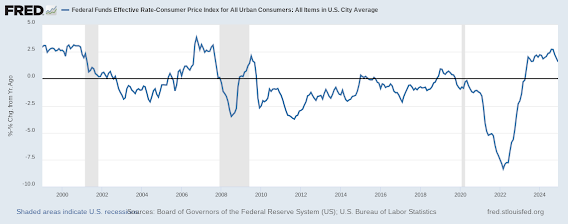
Instead, the Fed manipulated interest rates - cutting 500 bps to try to reverse the sell-off - and managed to get stocks moving up again. Thence, the trajectory was up...up...up... with only a brief pause in 2008...followed by another 500-basis point cut...and more than ten years of negative real interest rates (below the rate of inflation).
Real interest rates - the Effective Federal Funds Rate minus the official year-over-year change in Consumer prices, have been negative for most of the 21st century.
During that period, too (2000 to today), the feds added over $30 trillion to US debt - the biggest stimulus ever. Even those extreme interventions could not stop the Primary Trend...which, in terms of gold, cut the value of the Dow stocks in half. But in trying to stop ‘normal’...the feds made things very weird.
As Tom says, it was as if they had suspended gravity. Asset prices floated freely, untethered to the real world of the main street economy, goods and services, earnings, or costs. Without maps or compass, investors got lost. They didn’t know if they were coming or going...climbing up or tumbling down. Cryptos, NFTs, fractionalized assets...and then came MicroStrategy (whose only real value is the bitcoin it owns... but whose stock price suggests its BTC is worth twice its real market value)...Fartcoin... and even a new coin from a dead man, John McAfee.
And who would have imagined that a man preparing to take on the gravest responsibility known to humans would launch a new crypto currency named after himself, just hours before taking office? You’d think he’d have other things on his mind.
The Fed inflated asset prices. Then, the inflated assets created distortions of their own. At current prices, stock owners feel they have gained nearly $50 trillion worth of stock market capital so far this century (US stocks had a total market value of $15 trillion at the end of 1999...and close to $63 trillion today). And out of the blue, crypto holders have a claim on another $3.3 trillion.
There is little connection between this new wealth and any real earnings in the real economy. But having made so much, they are eager for more, awaiting the next Fartcoin like children watching the chimney on Christmas Eve."
“Once Trump runs out of easy ways to unf*ck the federal government,
his administration will hit a crossroads moment, probably sooner rather than later.”
- Matt Taibbi
"That’s the sound of a swamp being drained. And much fetid water is still backed up over the 68.3 square miles that comprise the District of Columbia. You might be just realizing that the “Joe Biden” regime was not a government at all, but rather, a colossal racketeering operation. And let’s be clear and precise: racketeering is making money dishonestly. Thus: the grubby Biden Family itself at the top of that putrid food-chain, and their smalltime harvesting of mere table-scraps. Where trillions got creamed off by the big gators, the Bidens risked all for a measly few million, like newts gorging on gnats in a drainage ditch.
Are you so cynical - as the Marxians are in their so-called “critique” of capitalism - that you think all human transactions of making-and-doing are dishonest? That is yet another misreading of reality, which the recent years of nonstop official propaganda and gaslight have catastrophically aggravated to the degree that half of America can no longer think at all.
Capitalism is not a political ideology despite the “ism” incorrectly attached to it, like the tail pinned on a donkey. Capitalism is simply the management of surplus wealth. The catch is, in a hyper-complex society, the management itself becomes complex to an extreme. And that can easily lead to mismanagement, which will deform and pervert the very mechanisms that superintend wealth, sometimes so badly that the wealth disappears altogether.
These are the dynamics faced by the newborn Trump command. Both political parties, per se, have fallen into a dismal habit of racketeering in this sclerotic state-of-empire. But now Mr. Trump has seized control of the Republican apparatus, at least, and the Party’s entrenched ol’ crocs and pythons descry that under DJT the regular feeding frenzy is over. Hence: the hand-wringing over Pete Hegseth setting foot in the Pentagon, as he will sometime this dawning day. The dollars pounded down that rat-hole in this century could have funded start-ups of several empires, but instead the swag just landed in the index funds of countless board members parasitically lodged in a dark cosmos of G.I. procurement circle-jerks. A lot of that can and will be stopped. And the ones who just won’t quit are liable to be found out.
Now, the Democratic Party faces more perplexing quandaries. It, too, is constructed as a gigantic grift machine. But if you subtract the employees of the multitudinous NGOs and non-profit orgs set up in recent years to receive government largess - which have spawned like smelts in the San Joaquin delta - you would eliminate much of the party’s rank-and-file. (The rest are apparently embedded in government itself and the teachers’ union.) A whole lot of activists would lose their platforms for activism in the process.
These crypto-bureaucracies have become the places where the Democratic Party stashes the “elite over-production” of Woked-up Marxian semi-morons from America’s diploma mills - in which orgs they are lavishly paid to conduct the aforementioned propaganda and gaslighting operations that wrecked so many American minds. The funding spigot to many of those is getting shut down. It will result in an employment crunch for a large cohort of professional crybabies. They could possibly adapt to their new circumstances by ceasing to be crybabies, and finding other, more useful things to do. That would portend some very significant cultural shiftings, which might include the death of the Democratic Party as we’ve known it. Or, they could all just join Antifa (if they’re not already in it) and go make trouble in the streets.
The first seven days of Mr. Trump have been sheer razzle-dazzle. He and the people around him have torn through the zeitgeist like front-end-loaders through a homeless encampment. He has yet to meet a crisis. Some of the obvious traps are avoidable. For instance: seeking further injury to Russia as a way of ending the stupid Ukraine war - started by us in 2014, thanks a lot Victoria Nuland & Company - since both the US and Russia are just about unconditionally desirous of stopping the damn thing as soon as possible. It’s had no benefit for anybody but the Raytheon war lobby and the Zelensky regime’s legion of grifters. Mr. Trump’s recent tough talk has been entirely for show, just a mass of rhetorical lube to un-stick the lingering “Joe Biden” stasis in that sad-sack corner of the world.
If crisis awaits, it’s probably lurking in the financial realm, where the operations of debt have put nearly every country on Gawd’s Green Earth behind the eight-ball. There is just too much of it that everybody knows can’t possibly be paid back - or soon even serviced - and the grand managers of these matters are finally out of tricks for pretending things can go on. Nor, here in America, can Mr. Trump cut spending fast enough to rebalance accounts. And if he somehow could, government employment has become such a big piece of the total economy that we would land post-haste in a new great depression That predicament is yet-to-be faced, but hold your breath because it is hard upon us.
Meanwhile, this is the week when the most hardcore of Mr. Trump’s cabinet warriors go ‘splainin’ before committees in the US Senate: Bobby Kennedy, Jr., Tulsi Gabbard, and Kash Patel. Prepare for some heat and light. And then, the deluge."