StatCounter

Sunday, December 8, 2024

Greg Hunter, "Democrat Party Going Extinct"

"Democrat Party Going Extinct"
By Greg Hunter’s USAWatchdog.com

"Legendary financial and geopolitical cycle analyst Martin Armstrong is back with some important new predictions. But first, long before the 2024 Election, Armstrong’s Socrates computer correctly predicted a Trump landslide. Armstrong also predicted the GOP would win the House and the Senate while the Lying Legacy Media (LLM) were telling us all how popular Kamala Harris was and how she would take it all in 2024. Armstrong said Kamala’s real approval rating was around 10% (not 50%), and the Dems and the LLM knew it but lied anyway. Armstrong’s Socrates computer program also predicted Joe Biden would pardon his son Hunter, even though Biden, the Dems and the LLM repeatedly told us there would be no pardon of Hunter.

This is where it get’s interesting. Armstrong says, “You have to understand, it wasn’t for Hunter. Yes, my computer (Socrates) was showing Biden would pardon Hunter, and it was basically showing the collapse in the rule of law, and this is what this is about now. All the corruption started in 2014 in Ukraine. By pardoning Hunter all the way back to 2014, it means he can be compelled to testify. How much money did you get out of Ukraine? Where did it go? Did it go to the Big Guy? Hunter can’t be prosecuted, so he can’t claim the 5th Amendment. He could be thrown in prison for contempt of court for refusing to testify.”

Armstrong was held in prison for a record seven years for contempt of court. Armstrong says the law says the sentence should only have lasted 18 months. Still, Hunter could be thrown in jail. Armstrong says Joe will pardon many more, such as those involved in the J-6 prosecutions like Liz Cheney or people like Anthony Fauci, overseer of the CV19 bioweapon vax. Armstrong says, “The computer has been showing, and we published these reports at our November 2024 conference, that this is most likely the final nail in the coffin for the Democrat Party. The pardons will have a real detrimental impact on the Democrat Party. It’s going to basically make the Democrat party look like a bunch of thieves and crooks. The Democrat Party is going extinct.”

When asked if we are still going to war with Russia, Armstrong said, “I hate to say this, but yes, and the (Socrates) computer is never wrong.” Armstrong fears dirty tricks, such as a false flag in Europe, that could get it going and blame the Russians for something they did not do. They want to do this before Trump takes office. Armstong says he is still recommending a big food supply, gold and cash. He is also predicting that government wants to do away with paper money and do all digital so they can track everything. Will this work? Armstrong says no, but they are going to try anyway.

Armstrong says even though Trump is looking good here before he’s sworn in, he’s going to have a tough four years. Armstrong says, “What I have heard is that they are planning on a major protest for his inauguration. They want to make it so bad that he has to call out the National Guard, and then they will say, see, he’s a dictator. I am concerned. I do not see four years of bliss in the Trump Administration. The computer says from 2026 on, it does not look good, particularly going into 2027 and 2028. This may be our last election. This is a war now with the Deep State. They are not going to take this lightly. They are going to try to obstruct Trump anyway they can. You are taking the trough away from all the pigs, and they are not going to have anything to eat. They are going to fight for their very lives.” There is much more in the 1-hour and 9-minute interview.”

Join Greg Hunter on Rumble as he goes One-on-One with Martin Armstrong 
where he gives his analysis on Trump winning and Biden pardoning everyone.

"How Russia Could Destroy the Entire World in 5 Minutes"

Full screen recommended.
Armored Power, 12/6/24
"How Russia Could Destroy the Entire World in 5 Minutes"
"In today’s world, the threat of global annihilation is a very real possibility. Among the nations with the power to end all civilization in a matter of minutes, Russia stands out as number 1. With advanced weapons systems capable of unparalleled destruction, Russia could trigger the end of the world in just five minutes. In this video, we will reveal how these deadly weapons work and how quickly they could bring humanity to its knees."
Comments here:
o
"Russia Puts Advanced Sarmat 
Nuclear Missile System On ‘Combat Duty’"

"Moscow has put into service an advanced intercontinental ballistic missile that Russian President Vladimir Putin has said would make Russia’s enemies “think twice” about their threats, according to reported comments by the head of the country’s space agency. Yuri Borisov, the head of the Russian space agency Roscosmos, said Sarmat missiles have “assumed combat duty”, according to Russian news agency reports.

“The Sarmat strategic system has assumed combat alert posture,” the state-run TASS news agency quoted the Roscosmos chief as saying. “Based on experts’ estimates, the RS-28 Sarmat is capable of delivering a MIRVed warhead weighing up to 10 tonnes to any location worldwide, both over the North and South Poles,” TASS said in its report.

Putin said in February that the Sarmat – one of several advanced weapons in Russia’s arsenal, is deployed now. In 2022, some two months after Russian troops invaded Ukraine, Putin said the Sarmat would “reliably ensure the security of Russia from external threats and make those, who in the heat of aggressive rhetoric try to threaten our country, think twice”.

The Sarmat is an underground silo-based missile that Russian officials say can carry up to 15 nuclear warheads, though the United States military estimates its capacity to be 10 warheads. Known to NATO military allies by the codename “Satan”, the missile reportedly has a short initial launch phase, which gives little time for surveillance systems to track its takeoff.

Weighing more than 200 tons, the Sarmat has a range of some 18,000km (11,000 miles) and was developed to replace Russia’s older generation of intercontinental ballistic missiles (ICMBs) that dated from the 1980s. Russia test-fired the Sarmat missile in April 2022 in the Plesetsk region of the country, located some 800km (almost 500 miles) north of Moscow, and the launched missiles hit targets on the Kamchatka peninsula, in Russia’s far east region."
o
RS-28 Sarmat
15 warheads per missile, 11,000 mile range, hypersonic speed of 15,880 mph.
One Sarmat can destroy an area the size of Texas or France.
A hypersonic nuclear missile launched from Russia will hit Washington, DC in 23 minutes.
Do we really want to do this? Pray to God we don't...
o
Full screen recommended.
The Poseidon torpedo with a 100 megaton warhead explodes deep underwater, causing a 1,600 foot high tidal wave which destroys everything on the U.S. East Coast as far inland as West Virginia. England would simply disappear beneath the waves...

"How It Really Is"

(With U.S. debt now at $36 trillion, the cost of the interest bill
alone on all that borrowing is about $3 billion a day. A quick calculation:
the USA is paying out over a trillion in interest this year. This is  was our money, folks.)

Musical Interlude: Justin Hayward, "Celtic Heart"

Full screen recommended.
Justin Hayward, "Celtic Heart"

"The Reality Of Life..."

"Despite my firm convictions, I have been always a man who tries to face facts, and to accept the reality of life as new experience and new knowledge unfolds it. I have always kept an open mind, which is necessary to the flexibility that must go hand in hand with every form of intelligent search for truth." - Malcolm X
“We all got problems. But there’s a great book out called “Too Soon Old, Too Late Smart.” Did you see that? That book says the statute of limitations has expired on all childhood traumas. Get your stuff together and get on with your life, man. Stop whinin’ about what’s wrong, because everybody’s had a rough time, in one way or another.”
- Quincy Jones

The Poet: Charles Bukowski, "The Mind, Go All The Way"

Full screen recommended.
Charles Bukowski, "The Mind, Go All The Way"
Read by Tom O'Bedlam

"Nothing New Under the Sun"

"Nothing New Under the Sun"

"Yes, the times change with the tides; yet the tales, like the surf, sound on in familiar perpetuity and with steady repetition. In the modern era, during the great clash of civilizations currently underway, there will be no new, great and ghastly crusades. Only resistance or surrender. In America, just as her tide recedes from the world, in the end it may become Man overboard, and every man for himself. The sun rises. The sun sets.

As sand through an hour-glass, or waves rolling over every shore, so too, do our journeys mark passageways through time; and, in the end, our navigation may, indeed, depend upon guidance, like stars, shining down from heaven upon what we know, over the decisions we make; on the destinies we choose. And, of course, there will be losses incurred during the storms.

So, we raise our sails and pray for the prosperous winds of Providence to guide our ways and guard our lives through uncharted seas. Perhaps it's true that fortune finds and favors the faithful above all. Even still, those who believe, and those who doubt, and those who sleep, all do drift and blow by the same breeze. The winds of change are on us. They've always been here, steadfast and old as time itself. Like the earth. Nothing new under the sun."
- Doug "Uncola" Lynn

"Life Is Hard?"

"Life is hard? True - but let's love it anyhow,
though it breaks every bone in our bodies."
- Edward Abbey
"When I hear somebody sigh, "Life is hard,"
I am always tempted to ask, "Compared to what?"
- Sydney Harris

"We suffer more often in imagination than in reality. 
You want to live but do you know how to live? 
You are scared of dying but tell me, 
is the kind of life you lead really any different to being dead?"

"The Wound Is the Gift: David Whyte on the Relationship Between Anxiety and Intimacy"

"The Wound Is the Gift: David Whyte on 
the Relationship Between Anxiety and Intimacy"
by Maria Popova

"It takes a long time to know a person - to unbutton the costume of personality and unlace the corset of coping mechanisms in order to touch the naked soul. It is a process delicate and difficult, riven by anxiety and absolutely terrifying to both, requiring therefore great courage and great vulnerability - a process the hard-won product of which we call intimacy. “There is no terror like that of being known,” Emerson anguished in his journal while trying to navigate his deep and complicated relationship with Margaret Fuller. It is a wise terror, for it knows that there is no greater pain than the pain of intimacy severed - by betrayal, by distance, by death. To triumph over that terror in order to know and be known on the level of the naked soul is an act of faith - perhaps the greatest act of faith there is. Because all faith requires a surrender to something we cannot control, all faith begins with the anguishing anxiety that prefaces the leap.

Poet and philosopher David Whyte explores the terrifying and transcendent work of intimacy in "Consolations II" - the second volume of his short, splendid essays, each reckoning with the deeper meaning of some ordinary and overused word to reveal its unexamined emotional etymology. In “Intimacy,” he writes:

"Intimacy is presence magnified by our vulnerability, magnified by increasing proximity to the fear that underlies that vulnerability. Intimacy and the vulnerabilities of intimacy are our constant, invisible companions, yet companions who are always wishing to make themselves visible and touchable to us, always emerging from some deep interior, to ruffle and disturb the calm surface of our well apportioned lives. Intimacy is a living force, inviting me simultaneously from the inside as much as the outside. Something calling from within that wants to meet something calling in recognition from without. Intimacy is the art and practice of living from the inside out.

Our need and our fear of intimacy is felt through an ever present almost volcanic force emerging from some unknown origin inside us, exhibiting to all and sundry, our previously hidden unspoken desires, flowing out against all efforts to the contrary, through our unconscious and conscious behaviors."

The difficulty of that surrender almost always takes shape as anxiety - a word to which David devotes another of the book’s essays. Anxiety, he observes, is often an avoidance mechanism and a dissociation device - “a protection against real intimacy, real friendship and real engagement with our work,” a way not to feel “the full vulnerability of being visible and touchable in a difficult world.” In anxiety, we disallow ourselves “the ability to stop and rest and the spacious silence needed for… a new understanding” - and all true intimacy opens into a new understanding of ourselves, so that “we learn that what we thought we knew is not equal to what we are discovering… that who we thought we were is not who we are now.”

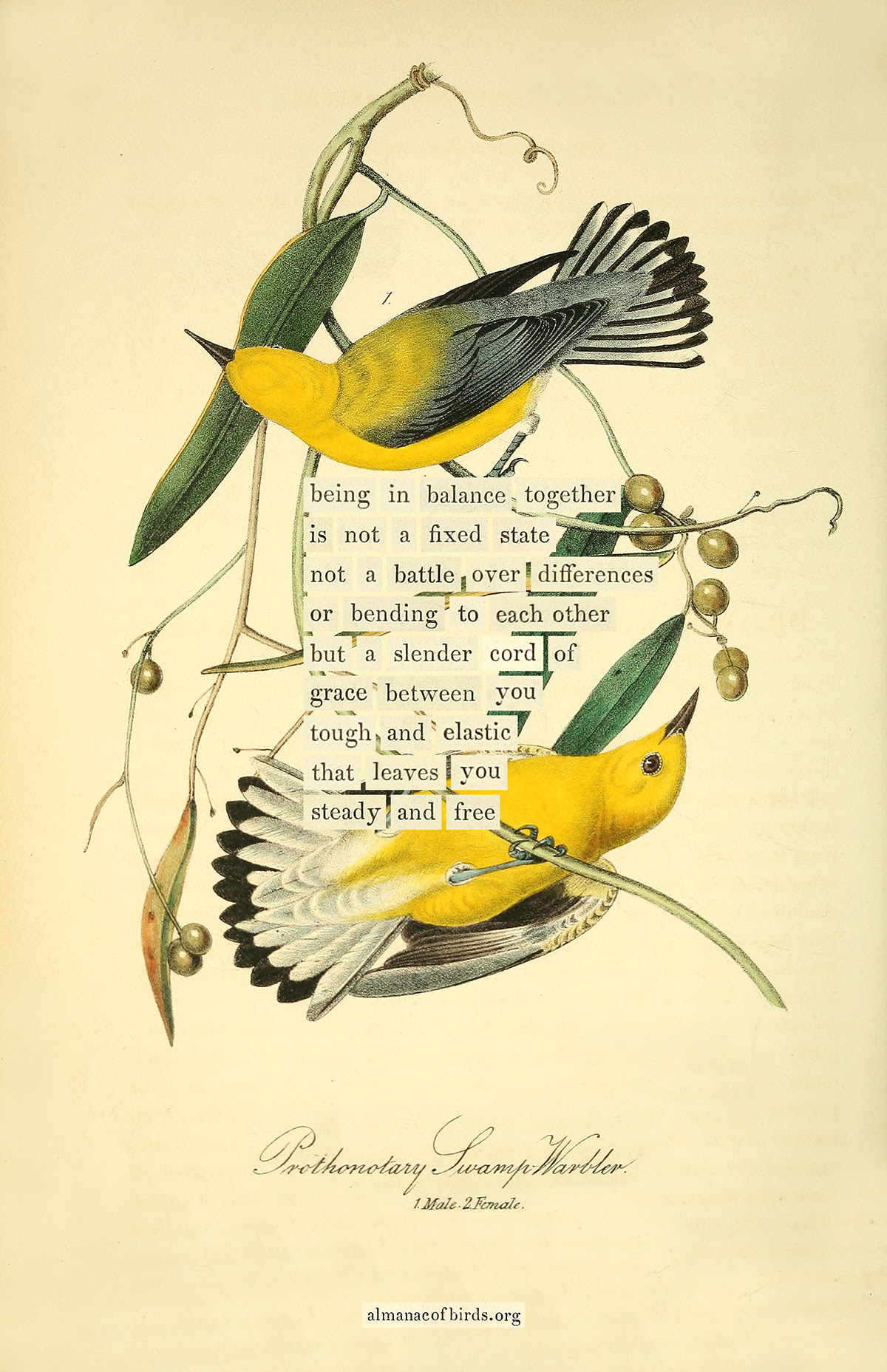
Art from An Almanac of Birds: Divinations for Uncertain Days.

And yet intimacy is haunted by a central paradox: "To become intimate is to become vulnerable not only to what I want and desire in my life, but to the fear I have of my desire being met."

This is the paradox of longing: Because longing can be an addiction, because no active addict ever wants to give up their addiction - or can without a great deal of suffering - it can be terrifying and almost unbearably vulnerable to surrender to an intimacy so amply fulfilling that it leaves nothing to long for. And yet in that vulnerability lies our power and our freedom to transform a relationship from a tether of dependency into a slender cord of grace.

David writes: "Intimacy cannot occur without a robust sense of vulnerability, and is tied to the sense of being pulled along in the gravitational field of any newly felt openness. In that new openness we feel as if we are pulled through the very doorway of our needs for something we desire deeply but cannot fully identify, partly because what we are about to identify is intimately connected with our own ability or inability to love."

Ultimately, he observes, intimacy is an instrument of discovery and self-discovery - a way of turning the walls between us and within us into sunlit windows through which to see and be seen:

"Intimacy always carries the sense of something hidden about to be felt and known in surprising ways; something brought out and made visible, that previously could not be seen or understood. In intimacy what is hidden will become a gift, discovered and rediscovered again and again in the eyes of both giver and receiver. To become human is to become visible, while carrying what is hidden as a gift to others."

Because what is visible is vulnerable, because what can be seen can be touched and what can be touched can be wounded, he adds: "Intimacy is intimately related to our sense of having been wounded, and the startling intuition that my way forward into life, or into another person’s life will be through the very doorway of the wound itself. Intimacy invites me to learn to trust the way being wounded has actually made me more available, more compassionate and possibly more intimate with the world, by being opened in ways I never realized it was possible to be open… Intimacy is always calibrated by the letting go of or the taking on of fear. Almost always our fear is experienced as an intimate invitation to understand and feel fully our particular form of wounded-ness.
[…]
Intimacy finds its ultimate expression in all the forms of surrender human beings find difficult to embrace."

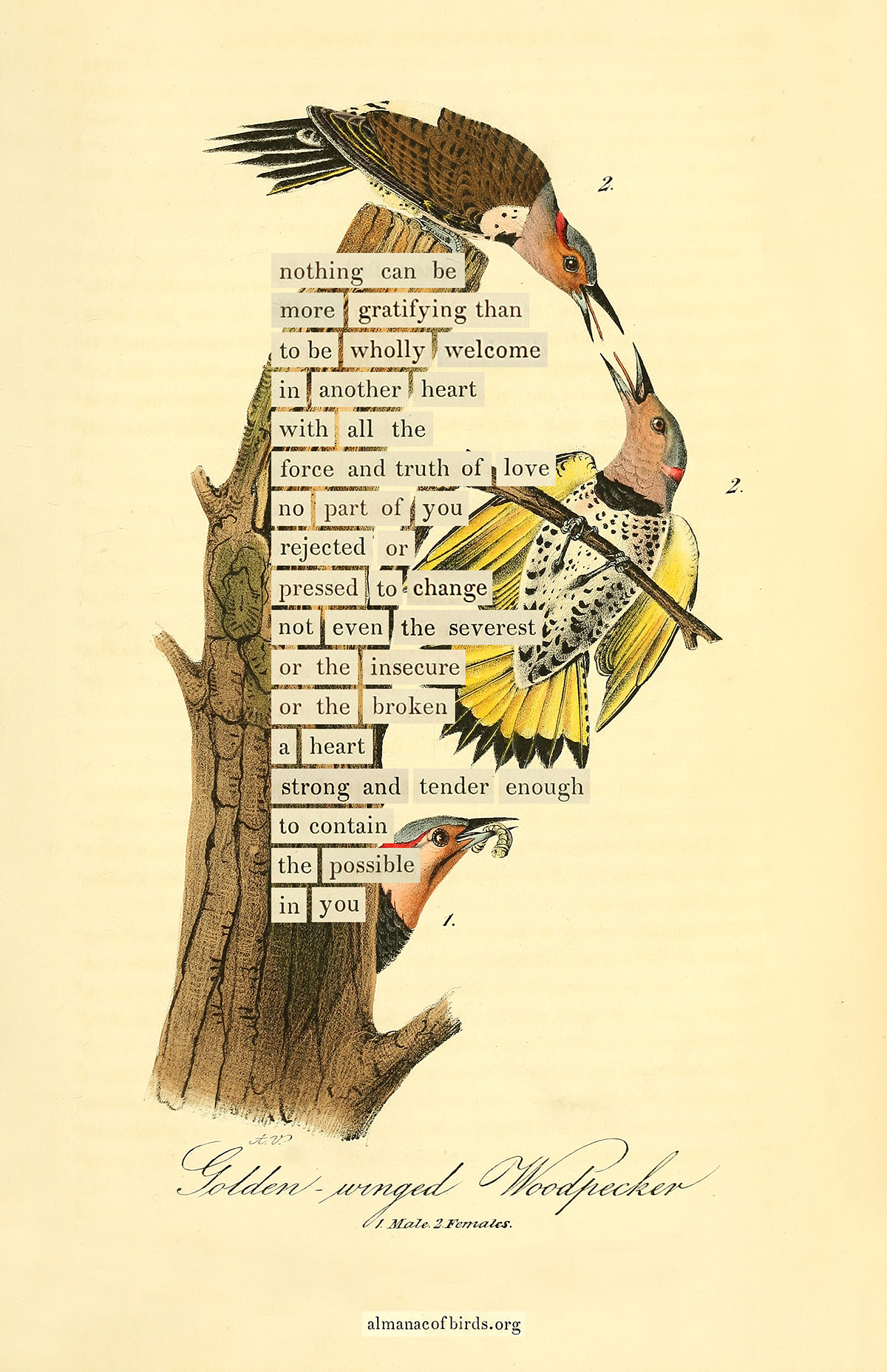
Art from An Almanac of Birds: Divinations for Uncertain Days.

By allowing true intimacy on the smallest scale of personal love - the bond between one and one - we open into the largest scale of belonging, into cohesion with what Margaret Fuller, inspired by Goethe, called the All. David writes:

"The need for intimacy in a human life and in a human social life is as foundational as our daily hunger and our never ending thirst, and needs to be met in just the same practical way, every day, just as necessarily and just as frequently: in touch, in conversation, in listening and in seeing, in the back and forth of ideas; intimate exchanges that say I am here and you are here and that by touching our bodies, our minds or our shared work in the world, we make a world together… Intimacy is our evolutionary inheritance, the internal force that has us returning to another and to the world from our insulated aloneness again and again, no matter our difficulties and no matter our wounds."

Couple these fragments of the thoroughly soul-slaking "Consolations II" — other essays in which explore such overused, underexamined words as shame, time, love, burnout, and end - with a wonderful read on lichens as a lens on intimacy, Kahlil Gibran on love’s difficult balance of intimacy and independence, and Eric Berne on the key to true intimacy, then savor this excellent interview with David by one of my oldest friends."

"I Remember..."

"I remember my youth and the feeling that will never come back any more, the feeling that I could last for ever, outlast the sea, the earth, and all men; the deceitful feeling that lures us on to joys, to perils, to love, to vain effort, to death; the triumphant conviction of strength, the heat of life in the handful of dust, the glow in the heart that with every year grows dim, grows cold, grows small, and expires,and expires, too soon, too soon, before life itself."
- Joseph Conrad, 1857-1924, English writer

Saturday, December 7, 2024

Canadian Prepper, "Alert! Historical Events Are About To Unfold! Total Collapse In Syria!"

Canadian Prepper, 12/7/24
"Alert! Historical Events Are About To Unfold!
 Total Collapse In Syria!"
Comments here:

Jeremiah Babe, "You May Not Get A Paycheck This Month"

Jeremiah Babe, 12/7/24
"You May Not Get A Paycheck This Month, 
Debt Is The Greatest Danger To Fear"
Comments here:

Musical Interlude: Paul Mauriat, "Love is Blue"

Full screen recommended.
Paul Mauriat, "Love is Blue"

"A Look to the Heavens"

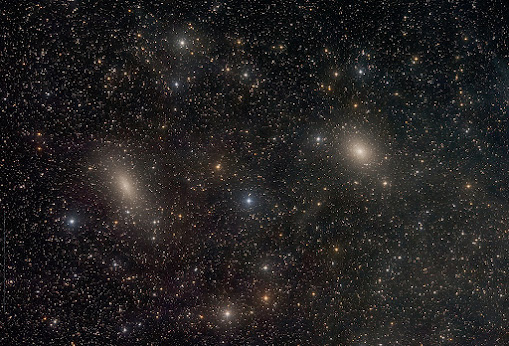
"Dwarf galaxies NGC 147 (left) and NGC 185 stand side by side in this sharp telescopic portrait. The two are not-often-imaged satellites of M31, the great spiral Andromeda Galaxy, some 2.5 million light-years away. Their separation on the sky, less than one degree across a pretty field of view, translates to only about 35 thousand light-years at Andromeda's distance, but Andromeda itself is found well outside this frame. 
Brighter and more famous satellite galaxies of Andromeda, M32 and M110, are seen closer to the great spiral. NGC 147 and NGC 185 have been identified as binary galaxies, forming a gravitationally stable binary system. But recently discovered faint dwarf galaxy Cassiopeia II also seems to be part of their system, forming a gravitationally bound group within Andromeda's intriguing population of small satellite galaxies."

Free Download, Kahlil Gibran, “The Garden of The Prophet”

“Oftentimes we call Life bitter names, but only when we ourselves are bitter and dark. And we deem her empty and unprofitable, but only when the soul goes wandering in desolate places, and the heart is drunken with over-mindfulness of self.

Life is deep and high and distant; and though only your vast vision can reach even her feet, yet she is near; and though only the breath of your breath reaches her heart, the shadow of your shadow crosses her face, and the echo of your faintest cry becomes a spring and an autumn in her breast.

And Life is veiled and hidden, even as your greater self is hidden and veiled. Yet when Life speaks, all the winds become words; and when she speaks again, the smiles upon your lips and the tears in your eyes turn also into words. When she sings, the deaf hear and are held; and when she comes walking, the sightless behold her and are amazed and follow her in wonder and astonishment.”
Freely download “The Garden of The Prophet” here:

"All The Money You Make..."

Full screen recommended.
Steve Cutts, "Happiness"
“All the money you make will never buy back your soul. ”
- Bob Dylan

“The Science of Stress and How Our Emotions Affect Our Susceptibility to Burnout and Disease”

“The Science of Stress and How Our Emotions
Affect Our Susceptibility to Burnout and Disease
by Maria Popova

"I had lived thirty good years before enduring my first food poisoning - odds quite fortunate in the grand scheme of things, but miserably unfortunate in the immediate experience of it. I found myself completely incapacitated to erect the pillars of my daily life - too cognitively foggy to read and write, too physically weak to work out or even meditate. The temporary disability soon elevated the assault on my mind and body to a new height of anguish: an intense experience of stress. Even as I consoled myself with Nabokov’s exceptionally florid account of food poisoning, I couldn’t shake the overwhelming malaise that had engulfed me - somehow, a physical illness had completely colored my psychoemotional reality.

This experience, of course, is far from uncommon. Long before scientists began shedding light on how our minds and bodies actually affect one another, an intuitive understanding of this dialogue between the body and the emotions, or feelings, emerged and permeated our very language: We use “feeling sick” as a grab-bag term for both the sensory symptoms - fever, fatigue, nausea - and the psychological malaise, woven of emotions like sadness and apathy.

Pre-modern medicine, in fact, has recognized this link between disease and emotion for millennia. Ancient Greek, Roman, and Indian Ayurvedic physicians all enlisted the theory of the four humors - blood, yellow bile, black bile, and phlegm - in their healing practices, believing that imbalances in these four visible secretions of the body caused disease and were themselves often caused by the emotions. These beliefs are fossilized in our present language - melancholy comes from the Latin words for “black” (melan) and “bitter bile” (choler), and we think of a melancholic person as gloomy or embittered; a phlegmatic person is languid and impassive, for phlegm makes one lethargic.

And then French philosopher and mathematician René Descartes came along in the seventeenth century, taking it upon himself to eradicate the superstitions that fueled the religious wars of the era by planting the seed of rationalism. But the very tenets that laid the foundation of modern science - the idea that truth comes only from what can be visibly ascertained and proven beyond doubt - severed this link between the physical body and the emotions; those mysterious and fleeting forces, the biological basis of which the tools of modern neuroscience are only just beginning to understand, seemed to exist entirely outside the realm of what could be examined with the tools of rationalism.

For nearly three centuries, the idea that our emotions could impact our physical health remained scientific taboo - setting out to fight one type of dogma, Descartes had inadvertently created another, which we’re only just beginning to shake off. It was only in the 1950s that Austrian-Canadian physician and physiologist Hans Selye pioneered the notion of stress as we now know it today, drawing the scientific community’s attention to the effects of stress on physical health and popularizing the concept around the world. (In addition to his scientific dedication, Selye also understood the branding component of any successful movement and worked tirelessly to include the word itself in dictionaries around the world; today, “stress” is perhaps the word pronounced most similarly in the greatest number of major languages.)

But no researcher has done more to illuminate the invisible threads that weave mind and body together than Dr. Esther Sternberg. Her groundbreaking work on the link between the central nervous system and the immune system, exploring how immune molecules made in the blood can trigger brain function that profoundly affects our emotions, has revolutionized our understanding of the integrated being we call a human self. In the immeasurably revelatory "The Balance Within: The Science Connecting Health and Emotions" (public library), Sternberg examines the interplay of our emotions and our physical health, mediated by that seemingly nebulous yet, it turns out, remarkably concrete experience called stress.

With an eye to modern medicine’s advances in cellular and molecular biology, which have made it possible to measure how our nervous system and our hormones affect our susceptibility to diseases as varied as depression, arthritis, AIDS, and chronic fatigue syndrome, Sternberg writes: "By parsing these chemical intermediaries, we can begin to understand the biological underpinnings of how emotions affect diseases… The same parts of the brain that control the stress response play an important role in susceptibility and resistance to inflammatory diseases such as arthritis. And since it is these parts of the brain that also play a role in depression, we can begin to understand why it is that many patients with inflammatory diseases may also experience depression at different times in their lives.

Rather than seeing the psyche as the source of such illnesses, we are discovering that while feelings don’t directly cause or cure disease, the biological mechanisms underlying them may cause or contribute to disease. Thus, many of the nerve pathways and molecules underlying both psychological responses and inflammatory disease are the same, making predisposition to one set of illnesses likely to go along with predisposition to the other. The questions need to be rephrased, therefore, to ask which of the many components that work together to create emotions also affect that other constellation of biological events, immune responses, which come together to fight or to cause disease. Rather than asking if depressing thoughts can cause an illness of the body, we need to ask what the molecules and nerve pathways are that cause depressing thoughts. And then we need to ask whether these affect the cells and molecules that cause disease.

We are even beginning to sort out how emotional memories reach the parts of the brain that control the hormonal stress response, and how such emotions can ultimately affect the workings of the immune system and thus affect illnesses as disparate as arthritis and cancer. We are also beginning to piece together how signals from the immune system can affect the brain and the emotional and physical responses it controls: the molecular basis of feeling sick. In all this, the boundaries between mind and body are beginning to blur."

Indeed, the relationship between memory, emotion, and stress is perhaps the most fascinating aspect of Sternberg’s work. She considers how we deal with the constant swirl of inputs and outputs as we move through the world, barraged by a stream of stimuli and sensations: "Every minute of the day and night we feel thousands of sensations that might trigger a positive emotion such as happiness, or a negative emotion such as sadness, or no emotion at all: a trace of perfume, a light touch, a fleeting shadow, a strain of music. And there are thousands of physiological responses, such as palpitations or sweating, that can equally accompany positive emotions such as love, or negative emotions such as fear, or can happen without any emotional tinge at all. What makes these sensory inputs and physiological outputs emotions is the charge that gets added to them somehow, somewhere in our brains. Emotions in their fullest sense comprise all of these components. Each can lead into the black box and produce an emotional experience, or something in the black box can lead out to an emotional response that seems to come from nowhere."

Memory, it turns out, is one of the major factors mediating the dialogue between sensation and emotional experience. Our memories of past experience become encoded into triggers that act as switchers on the rail of psychoemotional response, directing the incoming train of present experience in the direction of one emotional destination or another.

Sternberg writes: "Mood is not homogeneous like cream soup. It is more like Swiss cheese, filled with holes. The triggers are highly specific, tripped by sudden trails of memory: a faint fragrance, a few bars of a tune, a vague silhouette that tapped into a sad memory buried deep, but not completely erased. These sensory inputs from the moment float through layers of time in the parts of the brain that control memory, and they pull out with them not only reminders of sense but also trails of the emotions that were first connected to the memory. These memories become connected to emotions, which are processed in other parts of the brain: the amygdala for fear, the nucleus accumbens for pleasure - those same parts that the anatomists had named for their shapes. And these emotional brain centers are linked by nerve pathways to the sensory parts of the brain and to the frontal lobe and hippocampus - the coordinating centers of thought and memory."

The same sensory input can trigger a negative emotion or a positive one, depending on the memories associated with it. This is where stress comes in - much like memory mediates how we interpret and respond to various experiences, a complex set of biological and psychological factors determine how we respond to stress. Some types of stress can be stimulating and invigorating, mobilizing us into action and creative potency; others can be draining and incapacitating, leaving us frustrated and hopeless. This dichotomy of good vs. bad stress, Sternberg notes, is determined by the biology undergirding our feelings - by the dose and duration of the stress hormones secreted by the body in response to the stressful stimulus. She explains the neurobiological machinery behind this response:

"As soon as the stressful event occurs, it triggers the release of the cascade of hypothalamic, pituitary, and adrenal hormones - the brain’s stress response. It also triggers the adrenal glands to release epinephrine, or adrenaline, and the sympathetic nerves to squirt out the adrenaline-like chemical norepinephrine all over the body: nerves that wire the heart, and gut, and skin. So, the heart is driven to beat faster, the fine hairs of your skin stand up, you sweat, you may feel nausea or the urge to defecate. But your attention is focused, your vision becomes crystal clear, a surge of power helps you run - these same chemicals released from nerves make blood flow to your muscles, preparing you to sprint.

All this occurs quickly. If you were to measure the stress hormones in your blood or saliva, they would already be increased within three minutes of the event. In experimental psychology tests, playing a fast-paced video game will make salivary cortisol increase and norepinephrine spill over into venous blood almost as soon as the virtual battle begins. But if you prolong the stress, by being unable to control it or by making it too potent or long-lived, and these hormones and chemicals still continue to pump out from nerves and glands, then the same molecules that mobilized you for the short haul now debilitate you."

These effects of stress exist on a bell curve - that is, some is good, but too much becomes bad: As the nervous system secretes more and more stress hormones, performance increases, but up to a point; after that tipping point, performance begins to suffer as the hormones continue to flow. What makes stress “bad” - that is, what makes it render us more pervious to disease - is the disparity between the nervous system and immune system’s respective pace. 

Sternberg explains: "The nervous system and the hormonal stress response react to a stimulus in milliseconds, seconds, or minutes. The immune system takes parts of hours or days. It takes much longer than two minutes for immune cells to mobilize and respond to an invader, so it is unlikely that a single, even powerful, short-lived stress on the order of moments could have much of an effect on immune responses. However, when the stress turns chronic, immune defenses begin to be impaired. As the stressful stimulus hammers on, stress hormones and chemicals continue to pump out. Immune cells floating in this milieu in blood, or passing through the spleen, or growing up in thymic nurseries never have a chance to recover from the unabated rush of cortisol. Since cortisol shuts down immune cells’ responses, shifting them to a muted form, less able to react to foreign triggers, in the context of continued stress we are less able to defend and fight when faced with new invaders. And so, if you are exposed to, say, a flu or common cold virus when you are chronically stressed out, your immune system is less able to react and you become more susceptible to that infection."

Extended exposure to stress, especially to a variety of stressors at the same time - any combination from the vast existential menu of life-events like moving, divorce, a demanding job, the loss of a loved one, and even ongoing childcare - adds up a state of extreme exhaustion that leads to what we call burnout.

Sternberg writes: "Members of certain professions are more prone to burnout than others - nurses and teachers, for example, are among those at highest risk. These professionals are faced daily with caregiving situations in their work lives, often with inadequate pay, inadequate help in their jobs, and with too many patients or students in their charge. Some studies are beginning to show that burnt-out patients may have not only psychological burnout, but also physiological burnout: a flattened cortisol response and inability to respond to any stress with even a slight burst of cortisol. In other words, chronic unrelenting stress can change the stress response itself. And it can change other hormone systems in the body as well."

One of the most profound such changes affects the reproductive system - extended periods of stress can shut down the secretion of reproductive hormones in both men and women, resulting in lower fertility. But the effects are especially perilous for women - recurring and extended episodes of depression result in permanent changes in bone structure, increasing the risk of osteoporosis. In other words, we register stress literally in our bones.

But stress isn’t a direct causal function of the circumstances we’re in - what either amplifies or ameliorates our experience of stress is, once again, memory. Sternberg writes: Our perception of stress, and therefore our response to it, is an ever-changing thing that depends a great deal on the circumstances and settings in which we find ourselves. It depends on previous experience and knowledge, as well as on the actual event that has occurred. And it depends on memory, too.

The most acute manifestation of how memory modulates stress is post-traumatic stress disorder, or PTSD. For striking evidence of how memory encodes past experience into triggers, which then catalyze present experience, Sternberg points to research by psychologist Rachel Yehuda, who found both Holocaust survivors and their first-degree relatives - that is, children and siblings - exhibited a similar hormonal stress response.

This, Sternberg points out, could be a combination of nature and nurture - the survivors, as young parents for whom the trauma was still fresh, may well have subconsciously taught their children a common style of stress-responsiveness; but it’s also possible that these automatic hormonal stress responses permanently changed the parents’ biology and were transmitted via DNA to their children. Once again, memory encodes stress into our very bodies. Sternberg considers the broader implications: "Stress need not be on the order of war, rape, or the Holocaust to trigger at least some elements of PTSD. Common stresses that we all experience can trigger the emotional memory of a stressful circumstance - and all its accompanying physiological responses. Prolonged stress - such as divorce, a hostile workplace, the end of a relationship, or the death of a loved one - can all trigger elements of PTSD."

Among the major stressors - which include life-events expected to be on the list, such as divorce and the death of a loved one - is also one somewhat unexpected situation, at least to those who haven’t undergone it: moving. Sternberg considers the commonalities between something as devastating as death and something as mundane as moving: One is certainly loss - the loss of someone or something familiar. Another is novelty - finding oneself in a new and unfamiliar place because of the loss. Together these amount to change: moving away from something one knows and toward something one doesn’t. An unfamiliar environment is a universal stressor to nearly all species, no matter how developed or undeveloped.

In the remainder of the thoroughly illuminating "The Balance Within", Sternberg goes on to explore the role of interpersonal relationships in both contributing to stress and shielding us from it, how the immune system changes our moods, and what we can do to harness these neurobiological insights in alleviating our experience of the stressors with which every human life is strewn.”
Related:
"Neuroscience Says Listening to This Song 
Reduces Anxiety by Up to 65 Percent"
By Melanie Curtin
Full screen recommended.
"Everyone knows they need to manage their stress. When things get difficult at work, school, or in your personal life, you can use as many tips, tricks, and techniques as you can get to calm your nerves. So here's a science-backed one: make a playlist of the 10 songs found to be the most relaxing on earth. Sound therapies have long been popular as a way of relaxing and restoring one's health. For centuries, indigenous cultures have used music to enhance well-being and improve health conditions.

Now, neuroscientists out of the UK have specified which tunes give you the most bang for your musical buck. The study was conducted on participants who attempted to solve difficult puzzles as quickly as possible while connected to sensors. The puzzles induced a certain level of stress, and participants listened to different songs while researchers measured brain activity as well as physiological states that included heart rate, blood pressure, and rate of breathing.

According to Dr. David Lewis-Hodgson of Mindlab International, which conducted the research, the top song produced a greater state of relaxation than any other music tested to date. In fact, listening to that one song- "Weightless"- resulted in a striking 65 percent reduction in participants' overall anxiety, and a 35 percent reduction in their usual physiological resting rates. That is remarkable.

Equally remarkable is the fact the song was actually constructed to do so. The group that created "Weightless", Marconi Union, did so in collaboration with sound therapists. Its carefully arranged harmonies, rhythms, and bass lines help slow a listener's heart rate, reduce blood pressure and lower levels of the stress hormone cortisol.

When it comes to lowering anxiety, the stakes couldn't be higher. Stress either exacerbates or increases the risk of health issues like heart disease, obesity, depression, gastrointestinal problems, asthma, and more. More troubling still, a recent paper out of Harvard and Stanford found health issues from job stress alone cause more deaths than diabetes, Alzheimer's, or influenza.

In this age of constant bombardment, the science is clear: if you want your mind and body to last, you've got to prioritize giving them a rest. Music is an easy way to take some of the pressure off of all the pings, dings, apps, tags, texts, emails, appointments, meetings, and deadlines that can easily spike your stress level and leave you feeling drained and anxious.

Of the top track, Dr. David Lewis-Hodgson said, "'Weightless' was so effective, many women became drowsy and I would advise against driving while listening to the song because it could be dangerous." So don't drive while listening to these, but do take advantage of them:

10. "We Can Fly," by Rue du Soleil (Café Del Mar)
8. "Someone Like You," by Adele
7. "Pure Shores," by All Saints
6. "Please Don't Go," by Barcelona
5. "Strawberry Swing," by Coldplay
4. "Watermark," by Enya
2. "Electra," by Airstream
1. "Weightless," by Marconi Union

I made a public playlist of all of them on Spotify that runs about 50 minutes (it's also downloadable)."

The Daily "Near You?"

Lawton, Oklahoma, USA. Thanks for stopping by!

The Poet: Czeslaw Milosz, "A Song On The End Of The World"

"A Song On The End Of The World"

“On the day the world ends
A bee circles a clover,
A fisherman mends a glimmering net.
Happy porpoises jump in the sea,
By the rainspout young sparrows are playing
And the snake is gold-skinned as it should always be.

On the day the world ends
Women walk through the fields under their umbrellas,
A drunkard grows sleepy at the edge of a lawn,
Vegetable peddlers shout in the street
And a yellow-sailed boat comes nearer the island,
The voice of a violin lasts in the air
And leads into a starry night.

And those who expected lightning and thunder
Are disappointed.
And those who expected signs and archangels’ trumps
Do not believe it is happening now.
As long as the sun and the moon are above,
As long as the bumblebee visits a rose,
As long as rosy infants are born
No one believes it is happening now.

Only a white-haired old man, who would be a prophet
Yet is not a prophet, for he’s much too busy,
Repeats while he binds his tomatoes:
There will be no other end of the world,
There will be no other end of the world.”

~ Czeslaw Milosz

"I Have Hope..."


"At Last..."

“At last, the answer why. The lesson that had been so hard to find, so difficult to learn, came quick and clear and simple. The reason for problems is to overcome them. Why, that’s the very nature of man, I thought, to press past limits, to prove his freedom. It isn’t the challenge that faces us, that determines who we are and what we are becoming, but the way we meet the challenge, whether we toss a match at the wreck or work our way through it, step by step, to freedom.”
- Richard Bach, “Nothing by Chance”