StatCounter

Wednesday, August 30, 2023

"For I Know One Thing..."

"Happily men don't realize how stupid they are, or half the world would commit suicide. Knowledge is a will-of-the-wisp, fluttering ever out of the traveller's reach; and a weary journey must be endured before it is even seen. It is only when a man knows a good deal that he discovers how unfathomable is his ignorance. The man who knows nothing is satisfied that there is nothing to know, consequently that he knows everything; and you may more easily persuade him that the moon is made of green cheese than that he is not omniscient."
- W. Somerset Maugham

"Sometimes I Wonder..."

"Sometimes I wonder if the world is being run by smart people
who are putting us on or by imbeciles who really mean it."
- Laurence Peter

"Russia-Ukraine War Update 8/30/23"

Judge Napolitano - Judging Freedom, 8/30/23
"Ukraine War Weakening America 
Around the World w Tony Shaffer fmr DoD"
Comments here:
o
Stephen Gardner, 8/30/23
"Ex-CIA: US Pentagon Desperate
 To Cover Up Ukraine’s Defeat"
Ex CIA Larry Johnson shares with Stephen Gardner the real news update on the Ukraine Russia war. What really happened to Yevgeny Progozhin? Was Putin involved? Has news in Ukraine improved or worsened? Are the talking heads on CNN clouding judgment for clicks and money? Are Generals Lloyd Austin and Mark Milley bought and owned by the military-industrial complex?
Comments here:
o
Redacted, 8/30/23
"Ex-CIA: 'Zelensky is finished, 
prepare for the CIA to remove him."
Ex-CIA agent Larry Johnson joins Redacted to reveal how the intelligence community plans to remove Zelensky from power. The CIA has a long history of removing leaders that have used up their usefulness from Gaddafi to Hussein the playbook is rich with how this will unfold for Ukraine.
Comments here:

"How It Really Is"


"Back when I taught at UCLA, I was constantly amazed at how little so many students knew. Finally, I could no longer restrain myself from asking a student the question that had long puzzled me: ''What were you doing for the last 12 years before you got here?''
- Thomas Sowell
"The problem isn't that Johnny can't read. The problem isn't even that Johnny can't think. The problem is that Johnny doesn't know what thinking is; he confuses it with feeling."
- Thomas Sowell
"The trouble with most people is that they think with their hopes or fears or wishes rather than with their minds." - Will Durant
"It takes considerable knowledge just to  realize the extent of your own ignorance."
- Thomas Sowell

"Get Your Stuff Together..."

“We all got problems. But there’s a great book out called “Too Soon Old, Too Late Smart.” Did you see that? That book says the statute of limitations has expired on all childhood traumas. Get your stuff together and get on with your life, man. Stop whinin’ about what’s wrong, because everybody’s had a rough time, in one way or another.”
- Quincy Jones

Bill Bonner, "Trans Economy"

"Trans Economy"
The US is entering a period of confusion, doubt... and transition.
by Bill Bonner

Poitou, France - "A quick update…The US economy is in transition. It is leaving a period of rising stock and bond prices and entering a period in which, we believe, they are falling…in real terms. The transition is a mess, thanks to the confusion of a deflationary monetary policy mixed with an inflationary fiscal policy. The federal government continues to run large deficits, while the Fed is raising rates…and letting its portfolio of bonds expire (reducing the nation’s monetary footings.)

Reuters reports: "Powell signals no retreat, no surrender." "Crucially, Fed Chair Jerome Powell has once again reinforced the "higher for longer" mantra that has underpinned most of his, and his officials', communications this year, no matter how much market participants have bet otherwise. Stocks have held more or less steadfast near the top of their range.

Strapped for Cash: But in the early part of this transition, where we are now, the major risk to investors is still a stock market crash. The Fed is no longer supporting the market with EZ credit. Instead, it is withdrawing credit. So, there is danger of a credit crisis that will whack asset prices.

The crisis could enter the stock market from two different directions. It could stagger in the front door, for example, after trying to refinance its debt. Households are paying twice as much to refinance their mortgages. Business debt, too, is much more expensive to rollover. We’ve already seen the 2nd, 3rd, and 4th largest bank failures in US history. It wouldn’t be surprising to see more.

Or, like an old reprobate sneaking into church and taking a seat in the back row, it could go almost unnoticed, as consumers run out of money. They’ve gone through their stimmies. They’ve exhausted their savings. They’re facing over $1 trillion of credit card debt – at 20% interest! What’s left? Here’s DNYUZ: "U.S. Consumers Are Showing Signs of Stress, Retailers Say." "Now there are signs that some shoppers are becoming more cautious, as Americans’ savings erode, inflation continues to bite and other factors tighten their wallets - namely, the resumption of student loan payments in October. Financial reports from retailers - including Macy’s, Kohl’s, Foot Locker and Nordstrom - that landed this week suggest a shift is underway, from consumers buying with abandon to spending more on their needs.

Debt Stress Mounting: And here’s Business Insider: "America's consumer-debt stress is mounting - mortgage rates top 7%, credit-card liabilities hit $1 trillion, and now auto-loan defaults are on the rise. The early-stage past-due rate for auto loans – which measures outstanding payments from 30 to 89 days – has climbed above pre-pandemic levels, representing worse credit conditions for Americans, according to the Federal Deposit Insurance Scheme's 2023 risk review.

The rise in auto loan defaults is yet another worry for the American consumer – who must contend with mortgage rates hitting over 7% and an alarming increase in unsecured personal debt to $225 billion in 2023, per TransUnion. US consumer credit-card debt topped $1 trillion last quarter for the first time ever, according to Fed data.

The early stages of this kind of transition are usually deflationary. Prices tend to go down as people have trouble keeping up with current expenses and past debt. They look at the boat in the driveway and say: ‘What do I need that for?’

Inflate or Die: Over the longer term, prices can remain more or less constant…and still fall in real terms. That’s what happened in the 1970s. Taking inflation into account, stocks are down (using the Dow as a benchmark) about 10% from their 2021 top already. Even at a fairly modest rate of 4% per year…10 years of inflation would reduce the value of debt outstanding by more than a third.

The trouble is, US government debt is now increasing at about the same rate. What inflation taketh away, Congress and the Biden Administration giveth back, adding new debt at a rate of around $5 billion per day. The level of debt has to go down, or there remains a problem to be resolved. How? There are only two choices, neatly seated on the two ends of the teeter-totter, either ‘inflate or die.’ Either inflation reduces the debt…or the debts die, by defaults, bankruptcies, write-offs, etc. It’s a policy decision, typically made under the influence. Our inquiries into the nature of government – to which we will return anon – are just attempts to understand which way it will go. Stay tuned…"

Dan, I Allegedly, "Bank Risk is Getting Worse"

Full screen recommended.
Dan, I Allegedly 8/30/23
"Bank Risk is Getting Worse"
The FDIC just had a meeting, and they have insisted that banks increase their risk. There will be no such thing as too big to fail. Even midsize banks that have $100 billion in assets are going to have to change the way they do business.
Comments here:

"Maybe Viktor Orbán Was Right"

"Maybe Viktor Orbán Was Right"
A Dangerous Escalation In The Russia-Ukraine War
by Portfolio Armor

"In his recent interview with Tucker Carlson, Hungarian Prime Minister Viktor Orbán offered a stark warning: "This is a very dangerous moment now," he concludes, adding that it should be obvious to everyone that "The third world war is knocking on our door." Hot on the heels of Orbán's warning, a new kind of strike hit Russia.

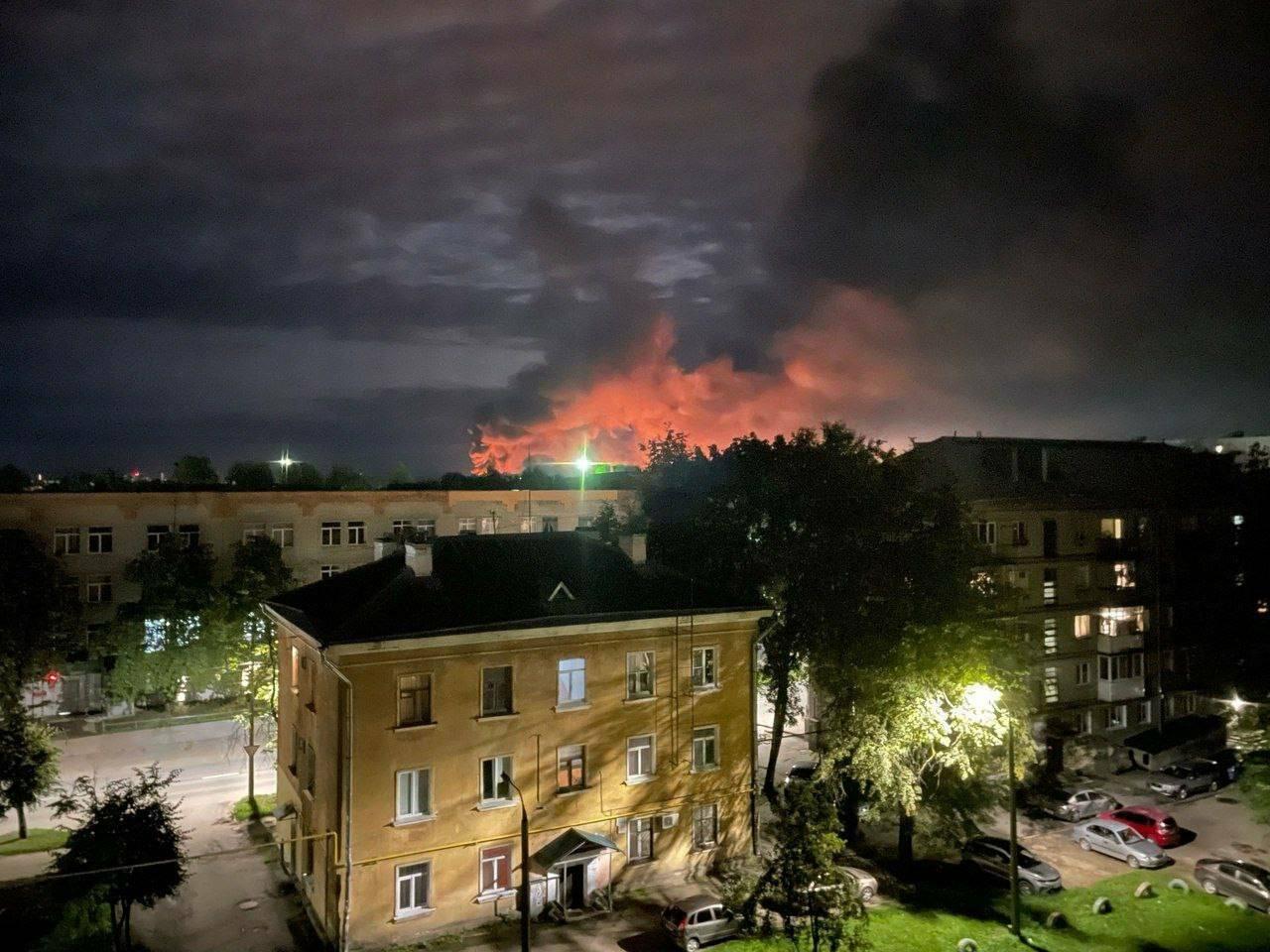
"Big fire at Pskov International Airport, looks like fuel. There are a lot of unconfirmed reports right now, two planes have supposedly been damaged, some sources are reporting that the drones came from the west, which would imply that they were launched from Latvia or Estonia."

What was new about this strike wasn't just the scale of it - Russian blogger Anatoly Karlin suggested it might have been the most significant air strike in Russia since World War II...
But the location of it. Note where Pskov is relative to the Ukraine.
Pskov is much closer to NATO members Estonia and Latvia (50 and 65 kilometers, respectively) than it is from the Ukraine (800 kilometers). What's more, Pskov is on the opposite side of Russian-allied Belarus from the Ukraine. Hence military analyst Sergei Witte's concerned post (tweet) below.
What Happened Here: In a long post (tweet) on X (Twitter), Armchair Warlord sketched out some possibilities. "Biggest development of the ongoing Ukrainian War today was a massive drone attack on Pskov Airfield that appears to have destroyed two Il-76 transport planes and started a fuel fire. Here's the issue - Pskov is on the other side of Belarus from Ukraine.

So our options are: 20+ Ukrainian strike drones flew over 660km of hostile territory (including the entire breadth of Belarus) without anyone noticing. This is unlikely;

Ukrainian DRGs launched 20+ strike drones from inside Russia. This is well beyond any capability they've ever demonstrated and would represent a major waste of assets against a peripheral target; or

The drones were launched from Latvia or Estonia, or ships in the Baltic Sea and overflew them enroute. This explains why Pskov was targeted and the lack of prior warning given the city is only about 60km from the border. I find this theory most likely.

Why now? Well, the great Ukrainian counteroffensive is culminating about 10km from its line of departure and with it hopes of Ukrainian victory. The Baltic States have distinguished themselves in their belligerence during this war and likely see the postwar writing clearly on the wall for their own long-term fates sandwiched between an ascendant Russia and the Baltic Sea. I can see a sufficiently irresponsible leader authorizing such an attack in the hopes of Russian retaliation triggering a general war with NATO to snatch victory from the jaws of defeat.

Here's the thing though - NATO isn't remotely ready for that war right now, and anyone claiming they are is deluded. NATO does not have the troops and gear in Eastern Europe to fight Russia right now. It's furthermore made quite clear to members that alliance membership does not guarantee NATO sponsorship if you just decide to attack someone. All loud talk aside, the NATO heavy hitters are about as interested in war with Russia as the Russians are in war with them right now. With that said, face must be saved.

The Russian authorities have yet to release an official statement placing blame for the attack at Pskov. This is quite significant because they've already released statements for the usual drizzle of sporadic Ukrainian drone attacks last night. If my assessment is correct and this attack came out of the Baltic States, I expect a tightly controlled Russian response - and I expect NATO proper to stay on the sidelines for it. Discussions about what exactly this will look like are probably ongoing between the parties as we speak.

It would seem pretty reckless for NATO members to have facilitated this strike, but then again destroying the Nord Stream pipelines seemed pretty reckless too. Perhaps Russia's lack of retaliation for Nord Stream emboldened whoever was involved with the attack on Pskov. Hopefully, cooler heads will prevail."

Gregory Mannarino, "The Economy Is DE@D!"

Gregory Mannarino, AM 8/30/23
"The Economy Is DE@D! Home Affordability Hits
 40 Year Low; It's Getting Much Worse"
Comments here:

"Massive Price Increases At Dollar General! This Is Ridiculous1"

Full screen recommended.
Adventures With Danno, 8/30/23
"Massive Price Increases At Dollar General!
 This Is Ridiculous1"
In today's vlog, we are at Dollar General and are noticing massive price increases! It's getting rough out here as some stores seem to be struggling with getting products and charging very high prices due to inflation and other factors!
Comments here:

Tuesday, August 29, 2023

“The Loss Of Dignity”

 
“The Loss Of Dignity”
by The Zman

“If you step back and think about it, the normal man can probably list a dozen things he cannot say in public that he grew up hearing on television, usually as jokes. Then the jokes were no longer welcome in polite company and soon they were deemed “not funny” by the sorts of people who worry about such things. The same was true of simple observations about the world. Somehow noticing the obvious became impolite, then it became taboo and finally prohibited.

The reverse is true as well. Middle-aged men can probably think of a dozen things that were unimaginable or unheard of, which are now fully normal. Of course, normal is one of those things that is now prohibited. It implies that something can be abnormal or weird and that itself is forbidden. The proliferation of novel identities and activities that demand to be treated with dignity and respect is a function of the old restraints having been eliminated. When everything is possible you get everything.

The strange thing about all of this is there is seemingly no point to it. The proliferation of new taboos was not in response to some harm being done. In most cases, the taboos are about observable reality. The people turning up in the public square with novel identities or activities demanding respect did not exist very long ago. If they did, not one was curious enough to look into it. The public was happy to ignore people into unusual activities, as long as they kept it to themselves.

Of course, none of what we generally call political correctness is intended to be uplifting or inspirational. The commissars of public morality like to pretend it is inspiring, but that’s just a way to entertain themselves. These new identity groups are not demanding the rest of us seek some higher plane of existence or challenge our limitations. In fact, it is always in the opposite directions. It’s a demand to lower standards and give up on our quaint notions of self-respect and human dignity.

In the "Demon In Democracy", Polish academic Ryszard Legutko observed that liberal democracy had abandoned the concept of dignity. This is the obligation to behave in a certain way, as determined by your position in society. Dignity was earned by acting in accordance with the high standards of the community. In turn, this behavior was rewarded with greater privilege and responsibility. Failure to live up to one’s duties would result in the loss of dignity, along with the status it conferred.

Instead, modern liberal democracy awards dignity by default. We are supposed to respect all choices and all behaviors as being equal. There are no standards against which to measure human behavior, other than the standard of absolute, unconditional acceptance. As a result, the most inventively degenerate and base activities spring from the culture, almost like a test of the community’s tolerance. Instead of looking up to the heavens for inspiration, liberal democracies look down in the gutter.

Dignity comes from maintaining one’s obligations to his position in the social order, but that requires a fidelity to a social order. It also requires a connection to the rest of the people in the society. In a world of deracinated individuals focused solely on getting as much as they can in order to maximize pleasure, a sense of commitment to the community is not possible. Democracy assumes we are all equal, therefore we have no duty to one another as duty requires a hierarchical relationship.

In the absence of a vertical set of reciprocal relationships, we get this weird lattice work of horizontal relationships, elevating the profane and vulgar, while pulling down the noble and honorable. The public culture is about minimizing and degrading those who participate in the public culture. In turn, the public culture attracts only those who cannot be shamed or embarrassed. The great joy of public culture is to see those who aspire to more get torn down as the crowd roars at their demise.

The puzzle is why this is a feature of liberal democracy. Ryszard Legutko places the blame on Protestantism. Their emphasis on original sin and man’s natural limitations minimized man’s role in the world. This focus on man’s wretchedness was useful in channeling our urge to labor and create into useful activities, thus generating great prosperity, but it left us with a minimalist view of human accomplishment. We are not worthy to aspire to anything more than the base and degraded.

It is certainly true that the restraints of Christianity limited the sorts of behavior that are common today, but he may be putting the cart before the horse. The emergence of Protestantism in northern Europe was as much a result of the people and their nature as anything else. Put more simply, the Protestant work ethic existed before there was such a thing as a Protestant. The desire to work and delay gratification evolved over many generations out of environmental necessity.

Still, culture is an important part of man’s environment and environmental factors shape our evolution. It is not unreasonable to say that the evolution of Protestant ethics magnified and structured naturally occurring instincts among the people. With the collapse of Christianity as a social force in the West, the natural defense to degeneracy and vulgarity has collapsed with it. As a result, great plenty is the fuel for a small cohort of deviants to overrun the culture of liberal democracies.

Even so, there does seem to be something else. Liberal democracy has not produced great art or great architecture. The Greeks and Romans left us great things that still inspire the imagination of the man who happens to gaze upon them. The castles and cathedrals of the medieval period still awe us. The great flourishing of liberal democracy in the 20th century gave us Brutalism and dribbles of pain on canvas. The new century promises us primitives exposing themselves on the internet.

There is something about the liberal democratic order that seeks to strip us of our dignity and self-respect. Look at what happened in the former Eastern Bloc countries after communism. Exposed to the narcotic of liberalism they immediately acquired the same cultural patterns. Fertility collapsed. Religion collapsed. Marriage and family formation collapsed. These suddenly free societies got the Western disease as soon as they were exposed to western liberal democracy.

The reaction we see today is not due to these societies being behind the times, but due to seeing the ugly face of liberal democracy. It is much like the reaction to the proliferation of recreational drugs in the 1970’s. At first, it seemed harmless, but then people realized the horror of unrestrained self-indulgence. That’s what we see in the former Eastern Bloc. Their leaders still retain some of the old sense of things and are trying to save their people from the dungeon of modernity.

That still leaves us with the unanswered question. What is it about liberal democracy that seems to lead to this loss of dignity? It is possible that such a fabulously efficient system for producing wealth is a tool mankind is not yet equipped to handle without killing ourselves. Maybe we are just not built for anything but scarcity. Want gives us purpose and without it, we lose our reason to exist. Either way, without dignity, we cannot defend ourselves and the results are inevitable.”

"Global Alert: Biggest Attack On Russia Yet, 'Nuclear Strike On Robotyne', All Airports Shut"

Full screen recommended.
Canadian Prepper, 8/29/23
"Global Alert: Biggest Attack On Russia Yet,
 'Nuclear Strike On Robotyne', All Airports Shut"
Comments here:

Gerald Celente, Trends Journal 8/29/23

Strong language alert!
Gerald Celente, Trends Journal 8/29/23
"Blimpitis Hits America:
 US Death Rate Outpaces Its Peers"
"The Trends Journal is a weekly magazine analyzing global current events forming future trends. Our mission is to present Facts and Truth over fear and propaganda to help subscribers prepare for What’s Next in these increasingly turbulent times."
Comments here:

"Gas Prices Will Hit Record Levels In September As Inventory Outages Hit Stations"

Full screen recommended.
"Gas Prices Will Hit Record Levels In 
September As Inventory Outages Hit Stations"
by Epic Economist

"There’s no way you haven’t noticed how fast gas prices have risen in August. From $3.55 to $3.75, and now $3.87, the cost of a gallon of gasoline jumped by more than 30 cents in less than 30 days! U.S. motorists will have to cope with even higher prices in September, according to official estimates. By the end of the week, the average cost of regular gasoline could surge by another 10 cents and hit the $4 mark on Labor Day. From that point on, prices are expected to continue to climb due to a huge policy mistake made by the U.S. government. Analysts say that despite of the recent rise in domestic oil production, refiners still won’t be able to refill inventories and put a lid on fuel prices this year. This will not only cause some serious sticker shock at the pump, but also hit your spending power right ahead of the holiday season, and force companies to keep raising their prices to offset higher transportation costs. The fuel crisis is going to affect every aspect of the economy and cause real hardship for American families.

Data shared by Yahoo Finance's Ines Ferre shows that this fall gasoline and diesel prices are expected to rise by $0.50 to $1.00, respectively, due to a policy mistake that is leaving America with a serious supply gap. Economists from the S&P Global Market Intelligence explained that there's about a 70% correlation between gas prices and the way that consumers think of the U.S. economy. And when you take into consideration that the cost of a gallon of gasoline is at the highest level in a year, of course, there are going to be higher implications down the supply chain. Higher fuel costs do not just impact consumers but are likely to keep driving inflation higher instead of lower as the Federal Reserve expects. For retailers, further pressure on transportation costs often results in price hikes on their products.

Even though U.S. oil production is one of the highest in the world and it is on track to set a new record this year, our domestic inventories aren’t rising significantly. The largest share of refined oil products is immediately sent by the market to meet demand, which is making it harder and harder to fill in the supply gap created in 2022. After the conflict between Russia and Ukraine began in February 2022, the Biden administration released large volumes of crude from the nation’s Strategic Petroleum Reserve to tame oil prices. In March of that year, officials announced the largest-ever sale from the reserve of 180 million barrels.

The use of the SPR as an oil market management tool infuriated some OPEC+ producers. In other others, the latest increase in domestic production of 100,000 barrels per day isn’t going to make a true difference in the cost of fuels. No wonder why the administration is on “alert” mode, said Robert McNally, the president of consultancy Rapidan Energy “The White House only has two kinds of modes when it comes to oil prices: oblivious or panicked.”

The White House is finally realizing that it has committed a huge mistake, and our dependence on the global market means that the government can no longer control the situation at home. For that reason, we should all prepare for some major volatility on the gasoline market in September and beyond. It looks like a reckoning day has just arrived, and our system is going to face some drastic shifts as we move closer to 2024."

"There Will Be No Recovery; Consumers Are Being Pushed To The Financial Brink; Credit Card Crisis"

Jeremiah Babe, 8/29/23
"There Will Be No Recovery; Consumers Are Being 
Pushed To The Financial Brink; Credit Card Crisis"
Comments here:

Musical Interlude: Deuter, "Endless Horizon"

Full screen recommended.
Deuter, "Endless Horizon"

Beautiful...

"A Look to the Heavens"

"A gorgeous spiral galaxy some 100 million light-years distant, NGC 1309 lies on the banks of the constellation of the River (Eridanus). NGC 1309 spans about 30,000 light-years, making it about one third the size of our larger Milky Way galaxy. Bluish clusters of young stars and dust lanes are seen to trace out NGC 1309's spiral arms as they wind around an older yellowish star population at its core.
Not just another pretty face-on spiral galaxy, observations of NGC 1309's recent supernova and Cepheid variable stars contribute to the calibration of the expansion of the Universe. Still, after you get over this beautiful galaxy's grand design, check out the array of more distant background galaxies also recorded in this sharp, reprocessed, Hubble Space Telescope view.”

"Maybe..."

"Maybe we're not supposed to be happy. Maybe gratitude has nothing to do with joy. Maybe being grateful means recognizing what you have for what it is. Appreciating small victories. Admiring the struggle it takes to simply be a human. Maybe, we're thankful for the familiar things we know. And maybe, we're thankful for the things we'll never know. At the end of the day, the fact that we have the courage to still be standing is reason enough to celebrate."
- "Grey's Anatomy"

Free Download: George Orwell, “Animal Farm"

"Animal Farm"
by George Orwell

Biographical note: "George Orwell, 1903-1950, was the pen name used by British author and journalist Eric Arthur Blair. During most of his professional life time Orwell was best known for his journalism, both in the British press and in books such as "Homage to Catalonia," describing his activities during the Spanish Civil War, and "Down and Out in Paris and London," describing a period of poverty in these cities. Orwell is best remembered today for two of his novels, "Animal Farm" and "Nineteen Eighty-Four."

Description: Power corrupts, but absolute power corrupts absolutely- and this is vividly and eloquently proved in Orwell's short novel. "Animal Farm" is a simple fable of great symbolic value, and as Orwell himself explained: "it is the history of a revolution that went wrong." The novel can be seen as the historical analysis of the causes of the failure of communism, or as a mere fairy-tale; in any case it tells a good story that aims to prove that human nature and diversity prevent people from being equal and happy, or at least equally happy.

"Animal Farm" tells the simple and tragic story of what happens when the oppressed farm animals rebel, drive out Mr. Jones, the farmer, and attempt to rule the farm themselves, on an equal basis. What the animals seem to have aimed at was a utopian sort of communism, where each would work according to his capacity, respecting the needs of others. The venture failed, and "Animal Farm" ended up being a dictatorship of pigs, who were the brightest, and most idle of the animals.

Orwell's mastery lies in his presentation of the horrors of totalitarian regimes, and his analysis of communism put to practice, through satire and simple story-telling. The structure of the novel is skillfully organized, and the careful reader may, for example, detect the causes of the unworkability of communism even from the first chapter. This is deduced from Orwell's description of the various animals as they enter the barn and take their seats to listen to the revolutionary preaching of Old Major, father of communism in Animal Farm. Each animal has different features and attitude; the pigs, for example, "settled down in the straw immediately in front of the platform", which is a hint on their future role, whereas Clover, the affectionate horse" made a sort of wall" with her foreleg to protect some ducklings.

So, it appears that the revolution was doomed from the beginning, even though it began in idealistic optimism as expressed by the motto "no animal must ever tyrannize over his own kind. Weak or strong, clever or simple, we are all brothers." "When the animals drive out Mr. Jones, they create their "Seven Commandments" which ensure equality and prosperity for all the animals. The pigs, however, being the natural leaders, managed to reverse the commandments, and through terror and propaganda establish the rule of an elite of pigs, under the leadership of Napoleon, the most revered and sinister pig.

"Animal Farm" successfully presents how the mechanism of propaganda and brainwashing works in totalitarian regimes, by showing how the pigs could make the other animals believe practically anything. Responsible for the propaganda was Squealer, a pig that "could turn black into white." Squealer managed to change the rule from "all animals are equal" to "all animals are equal but some animals are more equal than others." He managed to convince the other animals that it was for their sake that the pigs ate most of the apples and drank most of the milk, that leadership was "heavy responsibility" and therefore the animals should be thankful to Napoleon, that what they saw may have been something they "dreamed", and when everything else failed he would use the threat of "Jones returning" to silence the animals. In this simple but effective way, Orwell presents the tragedy and confusion of thought control to the extent that one seems better off simply believing that "Napoleon is always right".

Orwell's criticism of the role of the Church is also very effective. In Animal Farm, the Church is represented by Moses, a tame raven, who talks of "Sugarcandy Mountain", a happy country in the sky "where we poor animals shall rest forever from our labors". It is interesting to observe that when Old Major was first preaching revolutionary communism, Moses was sleeping in the barn, which satirizes the Church being caught asleep by communism. It is also important to note that the pig-dictators allowed and indirectly encouraged Moses; it seems that it suited the pigs to have the animals dreaming of a better life after death so that they wouldn't attempt to have a better life while still alive...

In "Animal Farm," Orwell describes how power turned the pigs from simple "comrades" to ruthless dictators who managed to walk on two legs, and carry whips. The story may be seen as an analysis of the Soviet regime, or as a warning against political power games of an absolute nature and totalitarianism in general. For this reason, the story ends with a hair-raising warning to all humankind: "The creatures outside looked from pig to man, and from man to pig, and from pig to man again: but already it was impossible to say which was which."
Free download George Orwell’s “Animal Farm" here:

"The Poet: William Butler Yeats, The Second Coming"

"The Second Coming"

"Turning and turning in the widening gyre
The falcon cannot hear the falconer;
Things fall apart; the center cannot hold;
Mere anarchy is loosed upon the world,
The blood-dimmed tide is loosed, and everywhere
The ceremony of innocence is drowned;
The best lack all conviction, while the worst
Are full of passionate intensity.
Surely some revelation is at hand;
Surely the Second Coming is at hand.
The Second Coming! Hardly are those words out
When a vast image out of Spiritus Mundi
Troubles my sight: somewhere in sands of the desert
A shape with lion body and the head of a man,
A gaze blank and pitiless as the sun,
Is moving its slow thighs, while all about it
Reel shadows of the indignant desert birds.
The darkness drops again; but now I know
That twenty centuries of stony sleep
Were vexed to nightmare by a rocking cradle,
And what rough beast, its hour come round at last,
Slouches towards Bethlehem to be born?"
- William Butler Yeats, January 1919

"Mere anarchy is loosed upon the world," indeed...

The Daily "Near You?"

Maintal, Hessen, Germany. Thanks for stopping by!

Dan, I Allegedly, "They Are Closing Your Bank Account"

Full screen recommended.
Dan, I Allegedly 8/29/23
"They Are Closing Your Bank Account"
Get ready to lose your bank account. It’s happening to so 
many people. Here’s what you do if this happens to you.
Comments here:

Bill Bonner, "Pan Am's Crash Landing"

"Pan Am's Crash Landing"
Why private companies fail while public disasters persist.
by Bill Bonner

Poitou, France - "Here’s a little item on Bloomberg this morning: "Train to Nowhere Shows How Not to Build Public Transit." "A light rail system in the capital shut down after less than two years in service. In July 2018, Muhammadu Buhari, the president of Nigeria at the time, boarded a gleaming new train linking the capital city, Abuja, with its airport. At the ribbon-cutting ceremony, Buhari hailed the system as “evidence that we are a government that delivers on its promises.”

Five years on, that promise looks empty. Train cars are locked away at a depot. Cavernous stations fully equipped with escalators, ticket offices, cameras and scanners stand empty, overseen by bored security guards. The faux leather couches in the VIP area are covered in bird and bat droppings. “It’s an abandoned project,” says Rowland Ataguba, an adviser to the government on rail strategy. “Quite clearly there was no plan on how to run the operations before they built it.”

Nigeria receives billions each year in foreign aid. The money is dispersed and dispensed, in the usual way – to cronies, crooks, and connivers who are tight with the politicians. Some of them, no doubt, made some money on the railroad to nowhere.

A Million Dead - Governments make ‘mistakes’ from time to time. But in the big scheme of things, Nigeria’s useless train hardly rates a footnote. The biggest mistake of the century, so far, was made by US president George W. Bush. His ‘war on terror’ was a $5 trillion/1 million corpse error, with much of the money ending up with the rich men north of Richmond.

Of course, mistakes are made in the private sector too. Lordstown Motors was said to be proof that start-up manufacturers could succeed in America’s heartland…Mike Pence said so when he visited the factory in 2020. Then, Hindenburg Research uncovered apparent fraud and fakery in the company’s reports. Lordstown Motors declared bankruptcy two months ago.

Nigeria, the US and Lordstown were all collective undertakings. All had receipts, expenses, managers, accountants, reports, and offices. All made mistakes. But only the latter is out of business. Nigeria is still a going concern. So is the US. Why the difference?

We’ve seen that even successful businesses are always prone to institutional sloth and bureaucracy. But they are subject to competition. When they get too gummed up by internal politics and self-focus, too off-track or out-of-step with customers, competitors move ahead of them. New trends and innovations leave them behind. And they are soon history.

Bear Stearns, Kodak, Radio Shack, Circuit City, Blockbuster – all went broke. And what about Pan Am? Pan American Airlines was begun in the 1920s. By the 1960s, it had a near monopoly on major international travel routes. Air travel was increasing rapidly. And Pan Am had the reputation, market share, capital, know-how to take advantage of it…in short, it was a clear winner.

Thrills and Spills - We can still remember what a thrill it was, when we bought our first airline ticket. We had been on airplanes before, courtesy of the US Navy. But it wasn’t until 1969 that we took a commercial flight.

At the time, Pan Am had a sparkling new building at JFK airport. It looked as though a flying saucer had landed on top of the terminal…a gleaming metal disk rested on tall columns. If we remember correctly, there was a large globe in the center. When you entered, you knew you were going somewhere.

Back in those days, even in New York, the ticket counters were manned by competent, polite people. There weren’t so many passengers…and no ‘security’ checks. We were not in so much of a rush to get in line or have our papers checked. Instead, we were calmly invited to choose ‘window or aisle’…. ‘smoking or non-smoking.’ (We don’t recall any mealtime options…but we were in the economy section!) It was a civilized experience, in other words.

And then, what a delight…to have in our hands that “airline ticket to romantic places”…that would entitle us to fly across the ocean to another world…to the Old World, thanks to Pan Am.

Pan Am dominated one of the fastest-growing industries in one of the world’s fastest-growing economies during its biggest growth spurt ever. Looking at it from the outside, the airline business looks simple enough. You know the cost of your equipment, fuel, and labor. The variable is ticket sales.

Crash Landing - Donald Trump entered the airline business in 1989. For a while he competed with Pan Am for the ‘shuttle’ business between Washington and New York. Pan Am had every advantage. It was a market leader, it scarcely needed to advertise. Still, it went out of business. How to explain it?

The simple explanation is the most obvious one. Over the years Pan Am had become accustomed to the first-class section. And after the US government deregulated the airline business in 1978, it wasn’t lean and hungry enough to compete.

Pan Am had a profit motive. Its investors wanted to make money. Its employees wanted their jobs. Its customers, presumably, appreciated its service. And yet, it went down for a final crash landing in 1991. Trump’s airline made its last flight a year later. Tomorrow, we’ll look at why Nigeria and the US are still in the air."

"How It Really Is"


”The 5 Stages of Economic Collapse”

”The 5 Stages of Economic Collapse” 
by Dmitry Orlov

“Elizabeth Kübler-Ross defined the five stages of coming to terms with grief and tragedy as denial, anger, bargaining, depression, and acceptance, and applied it quite successfully to various forms of catastrophic personal loss, such as death of a loved one, sudden end to one’s career, and so forth. Several thinkers, notably James Howard Kunstler and, more recently John Michael Greer, have pointed out that the Kübler-Ross model is also quite terrifyingly accurate in reflecting the process by which society as a whole (or at least the informed and thinking parts of it) is reconciling itself to the inevitability of a discontinuous future, with our institutions and life support systems undermined by a combination of resource depletion, catastrophic climate change, and political impotence.

But so far, little has been said specifically about the finer structure of these discontinuities. Instead, there is to be found continuum of subjective judgments, ranging from “a severe and prolonged recession” (the prediction we most often read in the financial press), to Kunstler’s evocative but unscientific-sounding “clusterf**k,” to the ever-popular “Collapse of Western Civilization,” painted with an ever-wider brush-stroke.

For those of us who have already gone through all of the emotional stages of reconciling ourselves to the prospect of social and economic upheaval, it might be helpful to have a more precise terminology that goes beyond such emotionally charged phrases. Defining a taxonomy of collapses might prove to be more than just an intellectual exercise: based on our abilities and circumstances, some of us may be able to specifically plan for a certain stage of collapse as a temporary, or even permanent, stopping point.

Even if society at the current stage of socioeconomic complexity will no longer be possible, and even if, as Tainter points in his “Collapse of Complex Societies,” there are circumstances in which collapse happens to be the correct adaptive response, it need not automatically cause a population crash, with the survivors disbanding into solitary, feral humans dispersed in the wilderness and subsisting miserably. Collapse can be conceived of as an orderly, organized retreat rather than a rout.

For instance, the collapse of the Soviet Union – our most recent and my personal favorite example of an imperial collapse – did not reach the point of political disintegration of the republics that made it up, although some of them (Georgia, Moldova) did lose some territory to separatist movements. And although most of the economy shut down for a time, many institutions, including the military, public utilities, and public transportation, continued to function throughout. And although there was much social dislocation and suffering, society as a whole did not collapse, because most of the population did not lose access to food, housing, medicine, or any of the other survival necessities. The command-and-control structure of the Soviet economy largely decoupled the necessities of daily life from any element of market psychology, associating them instead with physical flows of energy and physical access to resources. Thus situation, as I argue in my forthcoming book, Reinventing Collapse, allowed the Soviet population to inadvertently achieve a greater level of collapse-preparedness than is currently possible in the United States.

Having given a lot of thought to both the differences and the similarities between the two superpowers – the one that has collapsed already, and the one that is collapsing as I write this – I feel ready to attempt a bold conjecture, and define five stages of collapse, to serve as mental milestones as we gauge our own collapse-preparedness and see what can be done to improve it.

Rather than tying each phase to a particular emotion, as in the Kübler-Ross model, the proposed taxonomy ties each of the five collapse stages to the breaching of a specific level of trust, or faith, in the status quo. Although each stage causes physical, observable changes in the environment, these can be gradual, while the mental flip is generally quite swift. It is something of a cultural universal that nobody (but a real fool) wants to be the last fool to believe in a lie.

Stages of Collapse:

Stage 1: Financial collapse. Faith in “business as usual” is lost. The future is no longer assumed resemble the past in any way that allows risk to be assessed and financial assets to be guaranteed. Financial institutions become insolvent; savings are wiped out, and access to capital is lost.

Stage 2: Commercial collapse. Faith that “the market shall provide” is lost. Money is devalued and/or becomes scarce, commodities are hoarded, import and retail chains break down, and widespread shortages of survival necessities become the norm.

Stage 3: Political collapse. Faith that “the government will take care of you” is lost. As official attempts to mitigate widespread loss of access to commercial sources of survival necessities fail to make a difference, the political establishment loses legitimacy and relevance.

Stage 4: Social collapse. Faith that “your people will take care of you” is lost. As local social institutions, be they charities, community leaders, or other groups that rush in to fill the power vacuum, run out of resources or fail through internal conflict.

Stage 5: Cultural collapse. Faith in the goodness of humanity is lost. People lose their capacity for “kindness, generosity, consideration, affection, honesty, hospitality, compassion, charity” (Turnbull, "The Mountain People"). Families disband and compete as individuals for scarce resources. The new motto becomes “May you die today so that I die tomorrow” (Solzhenitsyn, "The Gulag Archipelago"). There may even be some cannibalism.

Although many people imagine collapse to be a sort of elevator that goes to the sub-basement (our Stage 5) no matter which button you push, no such automatic mechanism can be discerned. Rather, driving us all to Stage 5 will require that a concerted effort be made at each of the intervening stages. That all the players seem poised to make just such an effort may give this collapse the form a classical tragedy – a conscious but inexorable march to perdition – rather than a farce (“Oops! Ah, here we are, Stage 5.” – “So, whom do we eat first?” – “Me! I am delicious!”) Let us sketch out this process.

Financial collapse, as we are are currently observing it, consists of two parts. One is that a part of the general population is forced to move, no longer able to afford the house they bought based on inflated assessments, forged income numbers, and foolish expectations of endless asset inflation. Since, technically, they should never have been allowed to buy these houses, and were only able to do so because of financial and political malfeasance, this is actually a healthy development. The second part consists of men in expensive suits tossing bundles of suddenly worthless paper up in the air, ripping out their remaining hair, and (some of us might uncharitably hope) setting themselves on fire on the steps of the Federal Reserve. They, to express it in their own vernacular, “f**ked up,” and so this is also just as it should be.

The government response to this could be to offer some helpful homilies about “the wages of sin” and to open a few soup kitchens and flop houses in a variety of locations including Wall Street. The message would be: “You former debt addicts and gamblers, as you say, ‘f****d up,’ and so this will really hurt for a long time. We will never let you anywhere near big money again. Get yourselves over to the soup kitchen, and bring your own bowl, because we don’t do dishes.” This would result in a stable Stage 1 collapse – the Second Great Depression.

However, this is unlikely, because in the US the government happens to be debt addict and gambler number one. As individuals, we may have been as virtuous as we wished, but the government will have still run up exorbitant debts on our behalf. Every level of government, from local municipalities and authorities, which need the financial markets to finance their public works and public services, to the federal government, which relies on foreign investment to finance its endless wars, is addicted to public debt. They know they cannot stop borrowing, and so they will do anything they can to keep the game going for as long as possible.

About the only thing the government currently seems it fit to do is extend further credit to those in trouble, by setting interest rates at far below inflation, by accepting worthless bits of paper as collateral and by pumping money into insolvent financial institutions. This has the effect of diluting the dollar, further undermining its value, and will, in due course, lead to hyperinflation, which is bad enough in any economy, but is especially serious for one dominated by imports. As imports dry up and the associated parts of the economy shut down, we pass Stage 2: Commercial Collapse.

As businesses shut down, storefronts are boarded up and the population is left largely penniless and dependent on FEMA and charity for survival, the government may consider what to do next. It could, for example, repatriate all foreign troops and set them to work on public works projects designed to directly help the population. It could promote local economic self-sufficiency, by establishing community-supported agriculture programs, erecting renewable energy systems, and organizing and training local self-defense forces to maintain law and order. The Army Corps of Engineers could be ordered to bulldoze buildings erected on former farmland around city centers, return the land to cultivation, and to construct high-density solar-heated housing in urban centers to resettle those who are displaced. In the interim, it could reduce homelessness by imposing a steep tax on vacant residential properties and funneling the proceeds into rent subsidies for the indigent. With plenty of luck, such measures may be able to reverse the trend, eventually providing for a restoration of pre-Stage 2 conditions.

This may or may not be a good plan, but in any case it is rather unrealistic, because the United States, being so deeply in debt, will be forced to accede to the wishes of its foreign creditors, who own a lot of national assets (land, buildings, and businesses) and who would rather see a dependent American population slaving away working off their debt than a self-sufficient one, conveniently forgetting that they have mortgaged their children’s futures to pay for military fiascos, big houses, big cars, and flat-screen television sets. Thus, a much more likely scenario is that the federal government (knowing who butters their bread) will remain subservient to foreign financial interests. It will impose austerity conditions, maintain law and order through draconian means, and aid in the construction of foreign-owned factory towns and plantations. As people start to think that having a government may not be such a good idea, conditions become ripe for Stage 3.

If Stage 1 collapse can be observed by watching television, observing Stage 2 might require a hike or a bicycle ride to the nearest population center, while Stage 3 collapse is more than likely to be visible directly through one’s own living-room window, which may or may not still have glass in it. After a significant amount of bloodletting, much of the country becomes a no-go zone for the remaining authorities. Foreign creditors decide that their debts might not be repaid after all, cut their losses and depart in haste. The rest of the world decides to act as if there is no such place as The United States – because “nobody goes there any more.” So as not to lose out on the entertainment value, the foreign press still prints sporadic fables about Americans who eat their young, much as they did about Russia following the Soviet collapse. A few brave American expatriates who still come back to visit bring back amazing stories of a different kind, but everyone considers them eccentric and perhaps a little bit crazy.

Stage 3 collapse can sometimes be avoided by the timely introduction of international peacekeepers and through the efforts of international humanitarian NGOs. In the aftermath of a Stage 2 collapse, domestic authorities are highly unlikely to have either the resources or the legitimacy, or even the will, to arrest the collapse the dynamic and reconstitute themselves in a way that the population would accept.

As stage 3 collapse runs its course, the power vacuum left by the now defunct federal, state and local government is filled by a variety of new power structures. Remnants of former law enforcement and military, urban gangs, ethnic mafias, religious cults and wealthy property owners all attempt to build their little empires on the ruins of the big one, fighting each other over territory and access to resources. This is the age of Big Men: charismatic leaders, rabble-rousers, ruthless Macchiavelian princes and war lords. In the luckier places, they find it to their common advantage to pool their resources and amalgamate into some sort of legitimate local government, while in the rest their jostling for power leads to a spiral of conflict and open war.

Stage 4 collapse occurs when society becomes so disordered and impoverished that it can no longer support the Big Men, who become smaller and smaller, and eventually fade from view. Society fragments into extended families and small tribes of a dozen or so families, who find it advantageous to band together for mutual support and defense. This is the form of society that has existed over some 98.5% of humanity’s existence as a biological species, and can be said to be the bedrock of human existence. Humans can exist at this level of organization for thousands, perhaps millions of years. Most mammalian species go extinct after just a few million years, but, for all we know, Homo Sapiens still have a million or two left.

If pre-collapse society is too atomized, alienated and individualistic to form cohesive extended families and tribes, or if its physical environment becomes so disordered and impoverished that hunger and starvation become widespread, then Stage 5 collapse becomes likely. At this stage, a simpler biological imperative takes over, to preserve the life of the breeding couples. Families disband, the old are abandoned to their own devices, and children are only cared for up to age 3. All social unity is destroyed, and even the couples may disband for a time, preferring to forage on their own and refusing to share food. This is the state of society described by the anthropologist Colin Turnbull in his book “The Mountain People.” If society prior to Stage 5 collapse can be said to be the historical norm for humans, Stage 5 collapse brings humanity to the verge of physical extinction.

As we can easily imagine, the default is cascaded failure: each stage of collapse can easily lead to the next, perhaps even overlapping it. In Russia, the process was arrested just past Stage 3: there was considerable trouble with ethnic mafias and even some warlordism, but government authority won out in the end. In my other writings, I go into a lot of detail in describing the exact conditions that inadvertently made Russian society relatively collapse-proof. Here, I will simply say that these ingredients are not currently present in the United States.

While attempting to arrest collapse at Stage 1 and Stage 2 would probably be a dangerous waste of energy, it is probably worth everyone’s while to dig in their heels at Stage 3, definitely at Stage 4, and it is quite simply a matter of physical survival to avoid Stage 5. In certain localities – those with high population densities, as well as those that contain dangerous nuclear and industrial installations – avoiding Stage 3 collapse is rather important, to the point of inviting foreign troops and governments in to maintain order and avoid disasters. Other localities may be able to prosper indefinitely at Stage 3, and even the most impoverished environments may be able to support a sparse population subsisting indefinitely at Stage 4.

Although it is possible to prepare directly for surviving Stage 5, this seems like an altogether demoralizing thing to attempt. Preparing to survive Stages 3 and 4 may seem somewhat more reasonable, while explicitly aiming for Stage 3 may be reasonable if you plan to become one of the Big Men. Be that as it may, I must leave such preparations as an exercise for the reader. My hope is that these definitions of specific stages of collapse will enable a more specific and fruitful discussion than the one currently dominated by such vague and ultimately nonsensical terms as “the collapse of Western civilization.”
o
Download "The Collapse of Complex Societies", 
by Joseph A. Tainter, here:

""The Graveyard of Empires"

"The Graveyard of Empires: 
The Top Investments as the World Order Collapses"
by Nick Giambruno

Excerpt: "You have the watches, but we have the time." The Taliban often referred to this old Afghan saying when discussing their fight against the Americans. Ultimately, they were proven correct. After almost two decades of conflict, an insurgent army from one of the world’s poorest nations inflicted a decisive military defeat on the US, the global superpower that upholds the unipolar world order. The US government’s total failure in Afghanistan—the longest war in American history - signifies a crucial moment and turning point in world history. The Soviet Union collapsed about two years after the Red Army was defeated and withdrew from Afghanistan. As we approach the second anniversary of the American retreat, could a similar fate be in store for the US?

While nobody knows the future, there is an excellent chance that the colossal failure in Afghanistan could accelerate the unraveling of the geopolitical power of the US and the shift to a multipolar world order.

Afghanistan’s strategic position has always made it a coveted prize in the Eurasian landscape. As shown in the image below, Afghanistan is situated in the center of Eurasia, at the crossroads of China, Iran, and Russia—the three primary challengers to the US-led world order.
This central location is why Afghanistan has enormous geopolitical importance and why the US desired a strategic military presence there. The US military’s presence in Afghanistan was a strategic roadblock to Russia, China, and Iran’s goal of creating a powerful geopolitical group in Eurasia that could challenge the US-led world order. However, with the Taliban forcing the US military out of Afghanistan, the door to a more coherent geopolitical alliance in Eurasia is now wide open. In short, failure in Afghanistan is a geopolitical disaster for the US."
Full article here: