StatCounter

Sunday, March 26, 2023

"When One Cannot Be Sure..."

"When one cannot be sure that there are many days left, each single day becomes as important as a year, and one does not waste an hour in wishing that that hour were longer, but simply fills it, like a smaller cup, as high as it will go without spilling over."
- Natalie Kusz

The Daily "Near You"

Bailiwick Of Jersey, Jersey. Thanks for stopping by!

"We Must Marvel..."

“In our society, confidence leads to knowledge – which leads to power – which leads to pride – which leads to a fear of seeming ignorant – which constricts learning like an iron vise. We must understand that confidence is a blessing, for it is the embodiment of self-love, and through it we find the fuel for innovation and progress. We must realize that ignorance is merely the opportunity to learn more. And lastly, we must marvel rather than groan at the fact that there will always be more to learn… Only then will we be free of the intellectual prisons we have so readily caged ourselves within.”
- Zeb Reynolds

"Banks Call an Emergency Meeting"

Full screen recommended.
Dan, iAllegedly 3/26/23
"Banks Call an Emergency Meeting"
"The FSOC got together to decide what’s going to happen with some of the regional banks. This is the Financial Stability Oversight Council. They don’t want to admit that things are much worse than they are leading on."
Comments here:

"How Did We Get Here?"

"How Did We Get Here?"
by John Wilder

“Dividing and mutating at the same time?”
– "The Andromeda Strain"

"I think it’s fair to look around and ask a very simple question: How did we get here?

Certainly, the United States is in a heck of a mess in almost any way one can look at it. When it comes to cohesion, half of the country is like dad sitting on his easy chair after a hard day working at the PEZ® mines. The other half just wants to pester him because he doesn’t care enough about The Current Thing. They have been careful to not make dad put the paper down. Yet. Because that’s when the spanking hand comes out.

The ability of our economy to manufacture critical goods has been outsourced around the world, because, let’s face it, no one is better at sewing up a soccer ball than an 8-year-old Pakistani kid. And if we took the time to teach them and spent the money to build the factories, no one is better at making iPhones™ than Chinese women who are locked in those factories who have to put up nets to keep people from actually killing themselves when they try to jump off that same factory roof. I think the Chinese even charge the women an “amusement park ride fee” when they jump.

So, how did we get here? The United States has always had an ornery streak. I think Andrew Jackson would have happily had every single central banker in the United States executed – of course, the central bankers retaliated by putting his face on the $20 bill, but I assure you they waited until they were certain he was dead.

How, then, do you take a country that has divided in a massive War Between The States, been brought back (mostly) together, and divide the nation again? In many ways the three items I’ll bring up are intertwined and feed off of each other, but I’ll take each one in turn.

Propaganda. The first part is to skew the definition of America. America was a nation even up into the 1960s, where most (85%-90%) of people had a common ancestry in northwestern Europe, with Great Britain having the largest contribution. Scots may have had problems with the Irish, and the Irish with the English, they might have been neutral about the Swiss, and all of them might have been irritated by the French and Germans, but the common bounds of country and culture were there.

What changed? The idea that if you came to America, it would be expected that you would assimilate to America. Sure, your name might have been Giuseppe, but your grandkid’s name might be Colin, or Brandon, or Brayden. You left that old world behind and consciously gave it up for the new culture. The American culture.

The first lie is the lie that there is no American culture. I can understand that from the point of view of most of the world. How would a fish know about water when he’s swimming in it? American culture (with due credit to Great Britain for kickstarting it) became the most pervasive in the world, spinning off ideas and music and clothes and food at an amazing rate.

Now, of course, propaganda would tell us that we have no culture, and it is evil for us to expect people who come to our country to learn our language, and respect our culture first. No, that’s inverted. It does no good to a person who would divide a country for that to happen. Instead? It’s evil to ask people to learn English. If they kill chickens to sacrifice to Gorbo and marry off their eight-year-old kids to 32-year-old first cousins? We are expected to celebrate that.

No. That’s an inversion. They came here. If they can’t assimilate into American culture and American norms? Out. And take the chickens.

Other ways that propaganda has hurt America are numerous, probably enough for a book. One that’s still hurting us is the idea that nuclear power is evil. It isn’t. It’s funny that all the Green® power seems to be either more polluting or require those 8-year-old kids in Pakistan to learn how to mine lithium rather than sew up soccer balls to make batteries for cars fueled on pure Hopium. No, if you don’t like oil and gas, the only real solution is either condemning the country to an unending abject poverty or to build nuclear power plants.

The warfare culture post 9/11 has also been difficult. What, exactly, were we doing in Afghanistan after Osama Bin Laden assumed ocean temperature? Don’t know. Why did we go into Iraq? Don’t know. Why did we overthrow governments in Libya, Syria, and Ukraine?

Don’t know. But the propaganda that accompanied all of those divided the country, though it’s not nearly as bad as the race grievance industry that’s been in full tilt in the last two decades – but I’ll save that for a future post.

Pathological Altruism. If I have a puppy, and it piddles on the floor and everyone laughs and it’s cute, well, when it’s a big dog no one laughs. Then the dog wonders why I’m beating it for something I was laughing about. No one wants to be the bad guy and say, “No, you have to be punished for your actions so you won’t do it again.” Everyone wants to give people another chance.

A friend of mine had his house broken into. They were able to catch the criminals, and he attended the trial. Result of them stealing thousands and thousands of dollars of his property? A suspended sentence for one guy (who had multiple prior felony convictions) and two years for the other. What message, exactly, is that sending?

The Hart-Cellar Immigration Reform Act of 1965 (plus the amnesties that have followed and will follow) are horrifying in their pathological altruism and use of propaganda. The composition of the country has changed - it's no longer a nation. Where once there was a central culture, now every viewpoint is expected to be equally valid, and (I’m not making this up) the incoming medical school class pledged to honor “all indigenous ways of healing that have been historically marginalized by western medicine.”

Let’s go kill some chickens, because that will get rid of the gunshot wound. Oh, right, don’t forget the Ouija® board.

Corruption. The United States has always been corrupt, let’s get that out first. But the beauty of the corruption early on is that, mostly, it was limited because the scope of the Federal government was limited. Sure, Sheriff Smith over in Mount Pilot would take bribes, but he’d eventually be caught. And did several members of the state legislature take bribes to get the “right” senator into office?

Sure. That happened, too. Three events ushered in eras of nearly unfettered power for the Federal government: the Civil War, the 16th and 17th Amendments, and the New Deal. The Civil War ended the idea that the Several States were sovereign – they became mere political subdivisions of the United States. The 16th and This level of corruption concentrated power at the Federal level and made the farces we see today where people who are on the Right receive massive sentences at the Federal level for minor crimes, but people on the Left are not even indicted, and almost anyone who has power has a free pass for anything but killing someone on-screen at halftime during the Superbowl™, and that only counts as a delay of game penalty.

Amendments made it possible to tax and ended the appointment of Senators. Now, Senators became Representatives with six-year terms, rather than appointed representatives of the Several States – a huge difference.

I originally had more items here, but had to delete them because otherwise this could become a book. I’m certain, though, that the top three cover it well enough for now. I do think that America is getting ready to get out of the easy chair. And the spanking hand is getting ready. "

"How It Really Is"


Yeah, as a society we've clearly lost our minds...

"When Sorry? An Open Letter from We, The Peasants..."

"When Sorry?An Open Letter from We, The Peasants..."
By Joel Bowman

Buenos Aires, Argentina - 

"To whom remain unconcerned,

We – the collective, excess mass of humanity you so casually refer to, down your long, sneering noses, as “The People” – would like to know: When might we expect that apology? Eh? Eh? We appreciate you’re busy, what with protecting us from the uncertainty of the big, scary future and all. You have rates to fiddle, markets to diddle and thumbs to twiddle, even as the Empire burns. Your Climate Panjandrum, John Gulfstream Kerry, assures us you are a “select group of human beings,” on a mission to “save planet earth.” An “extraterrestrial” task, as he put it.

Gee whizz! The air must surely be thin, up there on the mountaintop! Though nothing compared to your Capital-C Causes, Great and Grand, we’ve been busy, too, down here on the flatlands of filth and ignorance... busy tending our own gardens, sweeping our own stoops, making our own beds and generally minding our own business. It’s not quite saving the planet, granted, but at least it’s honest. (You’ll just have to take our word for it.)

Even so, with all our stubborn own-business-minding, we couldn’t help but notice you seem to have... dare we venture... erred of late. We’re sure these peccadillos are mere oversights, products neither of malice or stupidity. (How else to explain the presence of evil in a world invigilated by beings omnipotent, omniscient and beneficent? Hmm...) Still, we reckon they’re worth bringing to your attention. Herewith, a few areas of concern...

No doubt you’ve noticed (how could you not have?) some fissures appearing in the financial system of late. The edifice, built on a foundation of trust in the “full faith and credit” of the American Government, over which many of you – elected and unelected alike – preside, appears to be giving way. Silvergate Bank... Silicon Valley Bank... Signature Bank... Credit Suisse... Deutsche Bank... First Republic Bank...

And yet, it was only a few short years ago (the blink of an eye for your immortal/undead ilk) when then Chairperson of the Federal Reserve, Ms. Janet Louise Yellen, stood in front of the nation and declared, with a straight face: “Would I say there will never, ever be another financial crisis? You know probably that would be going too far but I do think we’re much safer and I hope that it will not be in our lifetimes and I don’t believe it will be.” ~ Janet Yellen, June 20, 2017

But lo! Contrary to her highly paid prognostications... Ms. Yellen lives, even as major institutions under her bailiwick pass one by one into the shades. Even more astounding, Ms. Yellen is not earning her keep as one of Santa’s dopey elves at the local shopping mall, or spinning a pizza sign at an abandoned intersection, or even authoring weekend columns in some fringy Substack publication (Hermes forbid!)... but instead serves as both head of the United States Department of the Treasury and chief financial officer of the federal government of the United States of America.

Benevolent overlords, we are not without a sense of humor... but you’re going to have to unpack that punchline for us.

Then there’s Ms. Yellen’s comrade-in-arms, over at the Federal Reserve. Now, before you furrow your almighty brow, we understand that Chairman Powell inherited a mess of epic proportions. And we get that the Powell bone connects to the Yellen bone connects to the Bernanke bone, etc. And yes, we appreciate that The Covid wasn’t the Chairman’s leak (about which, more in a second).

But by pinning rates to the floor for 21 months straight, right as his mates over in the federal government were hosing the economy down with trillions of gallons of jet fuel, it was Mr. Powell who lit the match that set off the greatest conflagration in prices in over forty years. What’s more, to do so while telling Americans of the non-bazillionaire class – who were at the time gagged, locked down and lathered in Lysol, as per expert recommendations – that such a painful spike would be “transitory,” was more than a mere breach of decency. It was downright duplicitous.

Now, if it were just a money thing... confined to your meddling with the price of credit, the value of your devilish fiat, the stability of your stacked and corrupted financial system... we could maybe turn a half-blind eye. Unlike your kind, we lowlanders do not worship exclusively at the feet of mammon (although a little predictability, stability and durability in our money is not unappreciated... ergo, gold).

The problem, alas, is that your creepy McMission creep McCrept into other realms of our lives, too. In our language, you see, concepts like “liberty” and “self-determination” and “privacy” are not pejoratives, but values we hold dear. And so it is your overt and relentless intrusions into these realms with which we must take umbrage. (And please, kindly excuse our use of the “Royal You” hereafter – we mean no undue respect by it.)

Remember when you told us you were not conducting Gain of Fauci research at the Wuhan Institute of Virology...when you were?

Remember when you told us that so much as asking questions about a possible “lab leak” was tantamount to attacking “The Science”...when it wasn’t?

Remember when you locked down our communities, our businesses, our schools, our churches, our theaters, our airports, our state and national borders, our kids’ playgrounds, because it was necessary for “our own safety”...when it wasn’t?

Remember when you tackled people to the ground for yearning to breathe freely...when fresh air was what they needed most?

Remember when you built quarantine camps in the Australian outback...and then told us we should “be grateful” for them?

Remember when you assured us the vaccines were safe and effective...when they were neither?

Remember when you told us you had conducted clinical trials into their efficacy regarding transmission...when you hadn’t?

Remember when you sacked millions of nurses, firefighters, policemen, pilots, teachers, surgeons, factory workers and truck drivers, when they dared exercise their own bodily autonomy...exactly as was their right?

Remember when you told us to mask our dear children, because gagging their precious little faces was necessary to protect them...when it wasn’t?*

Remember when you told us Black Lives Matter was not a giant scam, designed to relieve well-intentioned non-racists of their hard-earned money...right before the founder purchased a $6 million private mansion?

Remember when you told us biological males had no advantage over females in sports...then failed to flatten Lia Thomas’s curve?
Remember when you said there were Weapons of Mass Destruction in Iraq...when there weren’t?

Remember when you promised, repeatedly, you would “bring an end” to the Nord Stream pipeline...and then claimed you didn’t?

Remember when you said the Hunter Biden laptop story was fake news...when it was as real as the Big Guy’s paychecks?

Remember when you told us that 2+2 could = 5...when, 4.

Remember when you said we had two, five, ten, twenty, pick-a-number years before the ice caps melted...and then they didn’t?

Remember when you said the Great Barrier Reef was going to die off...right before it grew at a record rate?

Remember when you said hurricanes and extreme weather events were increasing because of global warming...then refused to retract your “stories” after the National Oceanic and Atmospheric Administration (which you cited!), disputed your claims?

Remember when you said advanced, industrialized economies, like Germany, could run just fine on renewables...right before citizens there spent the winter felling virgin forests and burning trash to keep warm?

Remember when you said this constituted “peaceful protests”?
Remember when you said climate-related deaths were exploding...when they’re at historic lows?
Remember when you said we should “defund the police”...right before an epic crime wave?

Remember when you said you’d drain the swamp/close Gitmo/rein in government spending...then you didn’t?

Remember when you told us that you couldn’t define a woman...because you’re not a biologist?

Remember when you said “non-women” could get pregnant... when... really, do we have to even do this one?

We could go on. Indeed, our abiding readers are no doubt champing at the bit, another dozen examples of your ineptocracy at the very tip of their tongue... (do drop ‘em in the comments section, below...)

On these, and so many other fronts, you not only failed the smell test, you positively stunk the joint out. And yet, you continue to claim authority over our lives, our freedoms, our fates. Why should we listen to you, who could not have been more wrong… on more subjects… with more frequency?

We do not ask for much in this life, mere peasants that we are. To be left alone, to live and let live, to chart our own course, as best we can... We are but a simple people, having eschewed the miseducation of your woke, monoculture, Ivy League factories. Yes, we’ve read your books... your Keynes and Marx; we’ve suffered your opinion pages, your Krugman and Friedman; we’ve even endured your alleged “comedians,” your Colbert and Fallon. We’ve listened, politely, when you hurled your unlettered epithets – deplorables, conspiracy theorists, anti-vaxxers, racists, etc.

But all we really want to know, given the high crimes and misdemeanors perpetrated by your wretched lot, is...when sorry?

Oh, and may there be an especially noxious cauldron, bubbling away across the River Styx, waiting for those of you who enforced that gruesome diktat."

"Markets, A Look Ahead: The FED/Central Banks Must Now Hyper-inflate, Here's Why"

Full screen recommended.
Gregory Mannarino, AM 3/26/23:
"Markets, A Look Ahead: The FED/Central Banks 
Must Now Hyper-inflate, Here's Why"
Comments here:

"The Biggest Financial Crisis Of Our Lifetime Is Here! Gerald Celente Last Warning"

Full screen recommended.
The Atlantis Report, 3/26/23:
"The Biggest Financial Crisis Of Our Lifetime Is Here! 
Gerald Celente Last Warning"
Comments here:

"Massive Price Increases At Aldi! This Is Ridiculous!"

Full screen recommended.
Adventures With Danno, 3/26/23
"Massive Price Increases At Aldi!
 This Is Ridiculous!"
"In today's vlog we are at Aldi and are noticing massive price increases! We are here to check out skyrocketing prices, and a lot of empty shelves!"
Comments here:

Saturday, March 25, 2023

"Things Are About To Get Dangerous, Prepare To Deal with It Now. Retailers Closing."

Jeremiah Babe, 3/25/23:
"Things Are About To Get Dangerous,
 Prepare To Deal with It Now. Retailers Closing."
Comments here:

"Douglas Macgregor: "Russia Has Wiped Them Out, This Is It"

Red Pilled TV, 3/24/23:
"Douglas Macgregor: 
"Russia Has Wiped Them Out, This Is It"
"In exclusive interview Douglas Macgregor is back on the show to talk about the war in Ukraine. Macgregor gives his assessment of where things stand on the ground. They talk about the astounding casualty numbers and the horrifying nature of the battle over Bakhmut. Macgregor then gives some predictions for the next stages of the war. They talk about the rising tension with China. They agree there is no need to go to war with China but discuss what may explain the sudden attention shift towards Beijing. Lastly, they talk about the effects of cronyism in the weapons industry and the probability of a nuclear war."
Comments here:

"Banks Are On the Brink"

Full screen recommended.
Dan, iAllegedly 3/25/23
"Banks Are On the Brink"
"We’re supposed to believe that the banking problem is solved. We all know it’s not. Now we’re being told that Deutsche Bank could go down at any time."
Comments here:

Musical Interlude: Neil H, "Candlelight Dreams"

Neil H, "Candlelight Dreams"

"A Look to the Heavens"

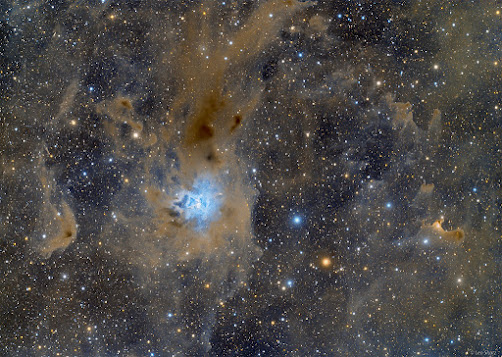
"Spooky shapes seem to haunt this dusty expanse, drifting through the night in the royal constellation Cepheus. Of course, the shapes are cosmic dust clouds visible in dimly reflected starlight. Far from your own neighborhood, they lurk above the plane of the Milky Way at the edge of the Cepheus Flare molecular cloud complex some 1,200 light-years away. 
Over 2 light-years across and brighter than most of the other ghostly apparitions, vdB 141 or Sh2-136 is also known as the Ghost Nebula, seen at the right of the starry field of view. Inside the nebula are the telltale signs of dense cores collapsing in the early stages of star formation. With the eerie hue of dust reflecting bluish light from hot young stars of NGC 7023, the Iris Nebula stands out against the dark just left of center. In the broad telescopic frame, these fertile interstellar dust fields stretch almost seven full moons across the sky."

"We May Know..."

“We may know that the work we continue to put off doing will be bad. Worse, however, is the work we never do. A work that’s finished is at least finished. It may be poor, but it exists, like the miserable plant in the lone flowerpot of my neighbor who’s crippled. That plant is her happiness, and sometimes it’s even mine. What I write, bad as it is, may provide some hurt or sad soul a few moments of distraction from something worse. That’s enough for me, or it isn’t enough, but it serves some purpose, and so it is with all of life.”
- Fernando Pessoa

"That One Chance..."

“You get that one chance; and damn it, you’ve got to take it! If there’s one lesson I know I will take with me for eternity, its that there are those things that might happen only once, those chances that come walking down the street, strolling out of a café; if you don’t let go and take them, they really could get away! We can get so washed out with a mindset of entitlement – the universe will do everything for us to ensure our happiness – that we forget why we came here! We came here to grab, to take, to give, to have! Not to wait! Nobody came here to wait! So, what makes anyone think that destiny will keep on knocking over and over again? It could, but what if it doesn’t? You go and you take the chance that you get; even if it makes you look stupid, insane, or whorish! Because it just might not come back again. You could wait a lifetime to see if it will… but I don’t think you should.”
- C. JoyBell C.

Chet Raymo, “Very, Very, Very, Very, Very...”

 “Very, Very, Very, Very, Very...”
by Chet Raymo

"In a short story that was published posthumously in the New Yorker, the inestimable Primo Levi meditated on the limits of language. The story was called “The Tranquil Star.” He writes "The star was very big and very hot, and its weight was enormous," and realizes immediately that the adjectives have failed him: “For a discussion of stars our language is inadequate and seems laughable, as if someone were trying to plow with a feather. It's a language that was born with us, suitable for describing objects more or less as large and long-lasting as we are; it has our dimensions, it's human. It doesn't go beyond what our senses tell us.

Until fairly recently in human history, there was nothing smaller than a scabies mite, writes Levi, and therefore no adjective to describe it. Nothing bigger than the sea or sky. Nothing hotter than fire. We can add modifiers: very big, very small, very hot. Or use adjectives of dubious superlativeness: enormous, colossal, extraordinary. But, really, these feeble stretchings of language don't take us very far in grasping the very, very, very extraordinarily diminutive or spectacularly colossal dimensions of atomic matter or cosmic space and time. We can overcome the limitations of language, Levi say, "only with a violent effort of the imagination."

I spent more than forty years trying to find ways to violently stretch the imaginations of my students (and myself) to accommodate the dimensions of the universe revealed by science. I would project onto a huge screen a photograph of a firestorm on the Sun, then superimpose a scale-sized Earth, which fit comfortably inside a loop of solar fire. I would take the class into the College Quad here near Boston, where I had set up a basketball to represent the Sun, then gathered 100 feet away with a pinhead Earth; we walked together with our pin in the great annual journey of the Earth, and looked through a telescope at the marble-sized Jupiter than I had previously installed at the other end of the long Quad (the next closest star system would have been a couple of basketballs in Hawaii). We walked geologic timelines that took us from one end of the campus to the other.

In one of my Globe essays I used this analogy: “Imagine the human DNA as a strand of sewing thread. On this scale, the DNA in the 23 pairs of chromosomes in a typical human cell would be about 150 miles long, with about 600 nucleotide pairs per inch. That is, the DNA in a single cell is equivalent to 1000 spools of sewing thread, representing two copies of the genetic code. Take all that thread - the 1000 spools worth - and crumple it into 46 wads (the chromosomes). Stuff the wads into a shoe box (the cell nucleus) along with - oh, say enough chicken soup to fill the box. Toss the shoe box into a steamer trunk (the cell), and fill the rest of the trunk with more soup. Take the steamer trunk with its contents and shrink it down to an invisibly small object, smaller than the point of a pin. Multiply that tiny object by a trillion and you have the trillion cells of the human body, each with its full complement of DNA.”

Or this description from 'Waking Zero': “The track of the Prime Meridian across England from Peace Haven in the south to the mouth of the River Humber in the north is nearly 200 miles. If that distance is taken to represent the 13.7 billion year history of the universe, as we understand it today, then all of recorded human history is less than a single step. The entire story I have told in this book, from the Alexandrian astronomers and geographers to the present-day astronomers who launch telescopes into space, would fit neatly into a single footprint. If the 200 miles of the meridian track is taken to represent the distance to the most distant objects we observe with our telescopes, then a couple of steps would take us across the Milky Way Galaxy. A mote of dust from my shoe is large enough to contain not only our own solar system but many neighboring stars.”
But as hard as one tries, the scale of these things escape us. If one could truly comprehend what we are seeing when we look, say, at the Hubble Ultra Deep Field Photo above, which I have done my best to convey to myself and others in a dozen ways, it would surely shake to the core some of our most cherished beliefs. Just as our language is contrived on a human scale, so too are our gods.”

The Daily "Near You?"

Port-of-Spain, Port-of-Spain, Trinidad and Tobago
Thanks for stopping by!

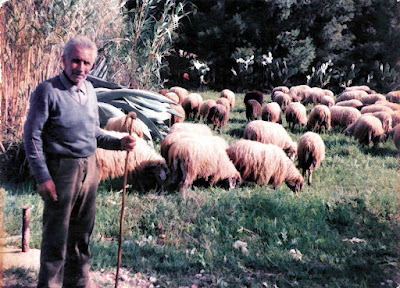
“24 Life Lessons By An Old Greek Shepherd”

“24 Life Lessons By An Old Greek Shepherd”
by George Giotis, Greece by Greeks

1. “The road to the destination is never straight. To reach out to the winter shelter someone must take a lot of turns, travel along rough roads, suffer losses. You have to make sure that you always take food supplies with you.

2. Leave the past behind. If a wolf eats your goat, you can’t do anything about it. Just make sure that next time you will be more careful.

3. Don’t live just for saving money and don’t be stingy. Don’t postpone the tasting of joy for future times. Do it now, while you are still young. Make your hard work worth even more.

4. Struggle, fight. You are the only one in charge of yourself. Don’t be truant, don’t expect your dogs to do all the work in herding the sheep.

5. Ask for the respect you deserve, don’t let others use you as a doormat. Set limits, put up fences, protect your animals.

6. Blessed are the ones who make mistakes. Make mistakes. These are life lessons, we call these experience. Don’t forget who you were until yesterday. Start today and define with your actions who you are going to be from now on.  Learn to forgive, starting with yourself. Don’t feel guilty, you have no time for that.

7. Blessed are those who doubt. Don’ t let your life be ruled by dogmas. Remember that if some people hadn’t doubted previous knowledge, mankind would have still lived in caves. Examine the information, be skeptical, think critically, think rationally, revise. You haven’t seen any fairies and ghosts in the forest, just wolves.

8. Be careful. Observe others. Look them in the eyes. Like a Greek saying, “If it is not shown in the goat, it is shown by the horn.”

9. Life is a journey, not a destination. And it is valuable. The previous word you read already belongs to the past.

10. Don’t advise the young constantly, it’s a waste of time. There is no right way to teach them pain or misery, solely experience will do that.

11. Go travel! Trips are experiences that stay with us forever. Get out, try, taste, savor images greedily. Let your senses free. Expose yourself, let it go, crumble, lose your self-control from time to time. Not just your self-control, but stop controlling others too.

12. You have been isolated enough in your winter shelter, get out. Go find your friends and companionship.

13. Do not try to control others. You condemn in anxiety and suffering not only yourself, but also those who you try to control. Let others live, and live for yourself. Leave the other flocks to their shepherds, take care of yours. 
14. Life is not fair. The universe does not owe you any solace, and it is certain that at the end of the road you die. Hurry up.

15. You can be a winner. Learn from those around you. Become a child with children, play with them, but also go to the cafe and talk to the elderly. You can learn from their accumulated experience.

16. Do not take everything into account. Do not take everything seriously. You are probably overreacting today. What bothers you or you are afraid of now, most likely tomorrow will seem lukewarm or insipid. Try to see yourself from a distance, take a look at the sight of your flock from the hill.

17. Have patience. The goats do not give birth every month. But when that happens you need to be there because they need you.

18. Quarrel with your partner if necessary, it is not terrible, let the feelings be defused. Make decompression in anger. The fire is sometimes beneficial. If an area of kermes oak get burnt, spring will give again vegetation, fine food for goats and their young. Careful though, the words you say you can’t take them back. Watch what your goats eat, they don’t know how to pick. If they eat the shoots of trees, the forest cannot be created again, the place will be left bare fallow.
  
19. Be balanced. Enjoy the food and your drink. Do not forget that the world’s poor walk miles for their daily food while the rich walk miles to digest it.

20. There is no perfect time, the circumstances and conditions will never be ideal. Start from where you are now! Do not postpone.

21. Be polite. A smiling face reflects similar behavior. Make gifts. Even the gift of a good word is important. Behave well to the elderly, you will soon be like them. Behave well to animals, they are not mean or envious, they have no obsessions or selfishness. They forgive without limit.

22. If you know how to read, read a lot! Those who read live extra lives. Not only their own but also all of those who you have read about.

23. Be bold. The fear keeps you tied but it is not real, it just comes from the unknown which is not in your head.

24. Do not get attached to things. Life is like the path of the pastures and the shepherd’s bag. The more you fill it, the harder you will walk. Take only the necessary things with you. The flock keeps walking, it will not wait for you if you can’t move because of too many heavy things. Let them go, release them, feel more flexible and free.”
Translated by Eleni Vafeiadou

"The Universe..."

"Life is not what you see, but what you've projected.
It's not what you've felt, but what you've decided.
It's not what you've experienced, but how you've remembered it. 
It's not what you've forged, but what you've allowed.
And it's not who's appeared, but who you've summoned.
And this should serve you well until you find what you already have."
- The Universe
“There are no accidents. If it's appeared on your life radar, this is why: to teach you that dreams come true; to reveal that you have the power to fix what's broken and heal what hurts; to catapult you beyond seeing with just your physical senses; and to lift the veils that have kept you from seeing that you're already the person you dreamed you'd become. There are no accidents. And believe me, that was one heck of a dream.”
“Tallyho,”
The Universe

“Thoughts become things... choose the good ones!”

"Feeling Fed Up with Humanity, In the World and in Ourselves"

"Feeling Fed Up with Humanity, 
In the World and in Ourselves"
by Madisyn Taylor, The DailyOM

"We are all capable of the best and the worst that humanity has to offer and knowing this allows us to find compassion. From time to time, we may all feel fed up with humanity, whether it’s from learning about what’s going on around the world, or what’s going on next door. There are always situations that leave us feeling as if people are simply not capable of behaving in a way that is coming from a place of awareness. Often it seems as if people are actually geared to handle things in the worst possible way, repeatedly. At the same time, none of us wants to linger in a judgmental mood about our own species. As a result, we might tend to repress the feelings coming up as we take in the news from the world and the neighborhood.

It is natural to feel let down and disappointed when we see our fellow humans behaving in ways that are greedy, selfish, violent, or uncaring, but there are also ways to process that disappointment without sinking into despondency. As with any emotional response, we honor our feelings by feeling them fully, without judging or acting on them. Once we’ve done that—and we may need to do it every day, as part of our daily self-care—we can begin to consider ways that we might help the situation in which humanity finds itself.

As always, we start with ourselves, utilizing our awareness of the failings of others to renew our own commitment to be more conscious human beings. We are all capable of the best and the worst that humanity has to offer, and remembering this keeps us in check, as well as allowing us to find compassion for others. We may find ourselves feeling compelled to serve people who are suffering injustices at the hands of other people, or we may begin to speak out when we see something that we don’t think is right. Whatever the case, the only thing we can do is pledge to serve the best, rather than the worst, of what humanity has to offer, both in the world, and in ourselves."
"What can we know? What are we all?
Poor silly half-brained things peering out at the infinite,
with the aspirations of angels and the instincts of beasts."
- Sir Arthur Conan Doyle

"If..."

If you were facing a firing squad, and we all are...
wouldn't you at least want to know why? 
And who stood you against the wall?

"How It Really Is"


"We Are Not The First Civilization To Collapse, But We Will Probably Be The Last"

"We Are Not The First Civilization To Collapse,
 But We Will Probably Be The Last"
by Chris Hedges

"I am standing atop a 100-foot-high temple mound, the largest known earthwork in the Americas built by prehistoric peoples. The temperatures, in the high 80s, along with the oppressive humidity, have emptied the park of all but a handful of visitors. My shirt is matted with sweat.

I look out from the structure - known as Monks Mound - at the flatlands below, with smaller mounds dotting the distance. These earthen mounds, built at a confluence of the Illinois, Mississippi and Missouri rivers, are all that remain of one of the largest pre-Columbian settlements north of Mexico, occupied from around 800 to 1,400 AD by perhaps as many as 20,000 people.

This great city, perhaps the greatest in North America, rose, flourished, fell into decline and was ultimately abandoned. Civilizations die in familiar patterns. They exhaust natural resources. They spawn parasitic elites who plunder and loot the institutions and systems that make a complex society possible. They engage in futile and self-defeating wars. And then the rot sets in. The great urban centers die first, falling into irreversible decay. Central authority unravels. Artistic expression and intellectual inquiry are replaced by a new dark age, the triumph of tawdry spectacle and the celebration of crowd-pleasing imbecility.

“Collapse occurs, and can only occur, in a power vacuum,” anthropologist Joseph Tainter writes in "The Collapse of Complex Societies." “Collapse is possible only where there is no competitor strong enough to fill the political vacuum of disintegration.”

Several centuries ago, the rulers of this vast city complex, which covered some 4,000 acres, including a 40-acre central plaza, stood where I stood. They no doubt saw below in the teeming settlements an unassailable power, with at least 120 temple mounds used as residences, sacred ceremonial sites, tombs, meeting centers and ball courts. Cahokia warriors dominated a vast territory from which they exacted tribute to enrich the ruling class of this highly stratified society. Reading the heavens, these mound builders constructed several circular astronomical observatories - wooden versions of Stonehenge.

The city’s hereditary rulers were venerated in life and death. A half mile from Monks Mound is the seven-foot-high Mound 72, in which archeologists found the remains of a man on a platform covered with 20,000 conch-shell disc beads from the Gulf of Mexico. The beads were arranged in the shape of a falcon, with the falcon’s head beneath and beside the man's head. Its wings and tail were placed underneath the man’s arms and legs. Below this layer of shells was the body of another man, buried face downward. Around these two men were six more human remains, possibly retainers, who may have been put to death to accompany the entombed man in the afterlife. Nearby were buried the remains of 53 girls and women ranging in age from 15 to 30, laid out in rows in two layers separated by matting. They appeared to have been strangled to death.

The poet Paul Valéry noted, “a civilization has the same fragility as a life.”

Across the Mississippi River from Monks Mound, the city skyline of St. Louis is visible. It is hard not to see our own collapse in that of Cahokia. In 1950, St. Louis was the eighth-largest city in the United States, with a population of 856,796. Today, that number has fallen to below 300,000, a drop of some 65 percent. Major employers - Anheuser-Busch, McDonnell-Douglas, TWA, Southwestern Bell and Ralston Purina - have dramatically reduced their presence or left altogether. St. Louis is consistently ranked one of the most dangerous cities in the country. One in five people live in poverty. The St. Louis Metropolitan Police Department has the highest rate of police killings per capita, of the 100 largest police departments in the nation, according to a 2021 report. Prisoners in the city’s squalid jails, where 47 people died in custody between 2009 and 2019, complain of water being shut off from their cells for hours and guards routinely pepper spraying inmates, including those on suicide watch. The city’s crumbling infrastructure, hundreds of gutted and abandoned buildings, empty factories, vacant warehouses and impoverished neighborhoods replicate the ruins of other post-industrial American cities, the classic signposts of a civilization in terminal decline.

“Just as in the past, countries that are environmentally stressed, overpopulated, or both, become at risk of getting politically stressed, and of their governments collapsing,” Jared Diamond argues in "Collapse: How Societies Choose to Fail or Succeed." “When people are desperate, undernourished and without hope, they blame their governments, which they see as responsible for or unable to solve their problems. They try to emigrate at any cost. They fight each other over land. They kill each other. They start civil wars. They figure that they have nothing to lose, so they become terrorists, or they support or tolerate terrorism.”

Pre-industrial civilizations were dependent on the limits of solar energy and constrained by roads and waterways, impediments that were obliterated when fossil fuel became an energy source. As industrial empires became global, their increase in size meant an increase in complexity. Ironically, this complexity makes us more vulnerable to catastrophic collapse, not less. Soaring temperatures (Iraq is enduring 120 degree heat that has fried the country’s electrical grid), the depletion of natural resources, flooding, droughts, (the worst drought in 500 years is devastating Western, Central and Southern Europe and is expected to see a decline in crop yields of 8 or 9 percent), power outages, wars, pandemics, a rise in zoonotic diseases and breakdowns in supply chains combine to shake the foundations of industrial society. The Arctic has been heating up four times faster than the global average, resulting in an accelerated melting of the Greenland ice sheet and freakish weather patterns. The Barents Sea north of Norway and Russia are warming up to seven times faster. Climate scientists did not expect this extreme weather until 2050.

“Each time history repeats itself, the price goes up,” the anthropologist Ronald Wright warns, calling industrial society “a suicide machine.” In "A Short History of Progress"he writes: "Civilization is an experiment, a very recent way of life in the human career, and it has a habit of walking into what I am calling progress traps. A small village on good land beside a river is a good idea; but when the village grows into a city and paves over the good land, it becomes a bad idea. While prevention might have been easy, a cure may be impossible: a city isn't easily moved. This human inability to foresee - or to watch out for - long-range consequences may be inherent to our kind, shaped by the millions of years when we lived from hand to mouth by hunting and gathering. It may also be little more than a mix of inertia, greed, and foolishness encouraged by the shape of the social pyramid. The concentration of power at the top of large-scale societies gives the elite a vested interest in the status quo; they continue to prosper in darkening times long after the environment and general populace begin to suffer."

Wright also reflects upon what will be left behind: "The archaeologists who dig us up will need to wear hazmat suits. Humankind will leave a telltale layer in the fossil record composed of everything we produce, from mounds of chicken bones, wet-wipes, tires, mattresses and other household waste to metals, concrete, plastics, industrial chemicals, and the nuclear residue of power plants and weaponry. We are cheating our children, handing them tawdry luxuries and addictive gadgets while we take away what’s left of the wealth, wonder and possibility of the pristine Earth."

Calculations of humanity’s footprint suggest we have been in ‘ecological deficit,’ taking more than Earth’s biological systems can withstand, for at least 30 years. Topsoil is being lost far faster than nature can replenish it; 30 percent of arable land has been exhausted since the mid-20th century. We have financed this monstrous debt by colonizing both past and future, drawing energy, chemical fertilizer and pesticides from the planet’s fossil carbon, and throwing the consequences onto coming generations of our species and all others. Some of those species have already been bankrupted: they are extinct. Others will follow.

As Cahokia declined, violence dramatically increased. Surrounding towns were burned to the ground. Groups, numbering in the hundreds, were slaughtered and buried in mass graves. At the end, “the enemy killed all people indiscriminately. The intent was not merely prestige, but an early form of ethnic cleansing” writes anthropologist Timothy R. Pauketat, in "Ancient Cahokia and the Mississippians." He notes that, in one fifteenth-century cemetery in central Illinois, one-third of all adults had been killed by blows to the head, arrow wounds or scalping. Many showed evidence of fractures on their arms from vain attempts to fight off their attackers.

Such descent into internecine violence is compounded by a weakened and discredited central authority. In the later stages of Cahokia, the ruling class surrounded themselves with fortified wooden stockades, including a two-mile long wall that enclosed Monks Mound. Similar fortifications dotted the vast territory the Cahokia controlled, segregating gated communities where the wealthy and powerful, protected by armed guards, sought safety from the increasing lawlessness and hoarded dwindling food supplies and resources.

Overcrowding inside these stockades saw the spread of tuberculosis and blastomycosis, caused by a soil-borne fungus, along with iron deficiency anemia. Infant mortality rates rose, and life spans declined, a result of social disintegration, poor diet and disease.

By the 1400s Cahokia had been abandoned. In 1541, when Hernando de Soto’s invading army descended on what is today Missouri, looking for gold, nothing but the great mounds remained, relics of a forgotten past.

This time the collapse will be global. It will not be possible, as in ancient societies, to migrate to new ecosystems rich in natural resources. The steady rise in heat will devastate crop yields and make much of the planet uninhabitable. Climate scientists warn that once temperatures rise by 4℃, the earth, at best, will be able to sustain a billion people. The more insurmountable the crisis becomes, the more we, like our prehistoric ancestors, will retreat into self-defeating responses, violence, magical thinking and denial.

The historian Arnold Toynbee, who singled out unchecked militarism as the fatal blow to past empires, argued that civilizations are not murdered, but commit suicide. They fail to adapt to a crisis, ensuring their own obliteration. Our civilization’s collapse will be unique in size, magnified by the destructive force of our fossil fuel-driven industrial society. But it will replicate the familiar patterns of collapse that toppled civilizations of the past. The difference will be in scale, and this time there will be no exit."