StatCounter

Friday, July 25, 2025

Gregory Mannarino, "A Great Reckoning Is Coming"

Gregory Mannarino, AM 7/25/25
"A Great Reckoning Is Coming"
Comments here:

Jim Kunstler, "Baseless?"

"Baseless?"
by Jim Kunstler

"If you can arrest a former president named Donald Trump, 
you can arrest a former president named Barack Obama." 
- Peachy Keenan on "X"

"Don’t you think it’s time for The New York Times to stop using the cliché “baseless” when referring to allegations - now, actually, official accusations - of the seditious conspiracy to run President Trump out of office after the 2016 election? Of all the fake “journalistic” blurts emanating from this bastion of degenerate sell-outs, “baseless” is the fakest, as if the word printed in a headline were so magically potent, the sheer assertion of it can make all your problems just - poof! - go away.

It’s the thought process of wicked children who fail to develop a sense of true or false, right or wrong, who grow into adults specially licensed, by some new perversion of the social contract, to get away with anything. And those wicked children have become America’s managerial class, the elite who are supposed to do your thinking for you op-ed style, the credentialed experts, such as Tony Fauci, “economist” Paul Krugman, DEI avatar and NPR honcho Katherine Maher, Harvard law prof Lawrence Tribe...the list is interminable, but you get the picture.

This class is also the owner/operator of America’s political Deep State, which by 2016 had grown into a colossal racketeering operation, money-laundering gazillions of taxpayer dollars into NGOs dedicated to the country’s cultural and political destruction while it processed campaign donations into fantastic fortunes for people officially earning less than $200-K a year. The racket also managed to pay for the support of multitudes allergic to working for living, as long as they were available for riots and ballot-harvesting drives.

It was working at such a high pitch by the end of Barack Obama’s two terms, with the most stupendously privileged creature in the Boomer bestiary ready to take her “turn” in the Oval Office - after amassing a $300-million-plus fortune serving as US senator (salary, $174-K / year) and Secretary of State (salary $199,700/year, then) - that you must imagine the mighty freak-out at the prospect of one Donald John Trump, outsider vulgarian extraordinaire, promising to step in and drain the whole massive, putrid, necrotic, parasitical nepo-infested quagmire of predatory grifters, leaving them gasping for their lives on the stinking Potomac mudbanks like so many grunions dying on the beach at Redondo.

Barack Obama, apparently, Darth Vadar-ized himself and was handed a light-saber (Hillary’s Steele dossier) by John Brennan, Grand Duke of Planet Intel...and the rest should have been history - but instead festered in the US body politic for more than ten years like an inflamed tuberculoma and is now bursting out of the Beltway’s peritoneal cavity in a spectacular spray of ordure, sticking to everyone and everything like a thousand tails pinned on the everlasting Democratic donkey. Alas, Babylon-on-the-Potomac...

Also: “baseless,” my ass...The basis for all this mischief is in the process of having proof supplied by the one figure, DNI Gabbard, in a position to retrieve the evidence, in writing, from the various heavily ring-fenced agencies over which she is the ultimate overseer, which has not been done before, especially back in the crucial weeks of late 2020 when John Ratcliffe was in that position. The reason Tulsi succeeded this time where Ratcliffe did not is probably due to newly available A-I systems which make collation of cross-searches much easier through the countless servers of the many intel agencies. And so, now it pours forth day by day.

That’s where things stand and the dust has not even begun to settle, with former President Obama seemingly hoisted on the petard of his own making back in December of 2016. Whether or not all the declassified info can be crafted into prosecutable cases is not yet determined, but you might imagine it will come together soon enough, if at all possible. It may not add up to treason per se, but there are plenty of other serious charges generally proceeding from deprivation of rights under color of law (18 U.S.C. § 242), to seditious conspiracy, i.e., overthrow of the president (18 U.S.C. § 2384) to stuff a number of former officials into orange jumpsuits behind bars.

I doubt, though that we have reckoned the worst damage done by the perpetrators of RussiaGate and the serial crimes it entailed, which is how it drove half the population of our country plumb batshit crazy. Once RussiaGate was put over, any absurdity was force-fed to the increasingly delusional opposition to Donald Trump largely aggregated under the “Democratic Party” banner. You were suffered to believe such patent nonsense as men can become women, that riots with arson were mostly peaceful protests, that the US/Mexico border could not be controlled without vast new legislation, and that a demonstrably corrupt and obviously senile Joe Biden was an able, functioning chief executive.

The Covid-19 op was the coup de grâce for the Left’s mental health - while it was also a silver bullet to get rid of Mr. Trump in the 2020 election. There is even reason to believe that the mRNA vaccines, with their spike protein payloads, delivered physical brain injury by way of induced vascular disorder. Millions who took them may never recover their senses - but so far that is just hypothesis.

If cases are brought against those who acted in the long-running coup, and are proven in court via an honest and upright process, we’ll find out whether half the country can recover enough rationality to accept the outcome. The signs for now are discouraging, as they seem to veer deeper into delusion, nominating outright jihadi communists for important offices and continuing their lawfare campaign to disable all and any actions by Mr. Trump’s executive branch.

The ultimate goal, for those interested in continuing the project of this American republic, will be to see if it’s possible to restore a workable consensus about a common culture and the common good on principles that are anything but baseless: equal protection under the law, fair play, the rights of property, and respect for verifiable truth."

Adventures With Danno, "Massive Changes At Walmart"

Full screen recommended.
Adventures With Danno, AM 7/25/25
"Massive Changes At Walmart"
Comments here:

Thursday, July 24, 2025

Musical Interlude: Soothing Relaxation, "Dance of Life"

Full screen recommended.
Soothing Relaxation, "Dance of Life"
Be kind to yourself, forget all the troubles for 
a little while and enjoy this beautiful video...

"A Look to the Heavens"

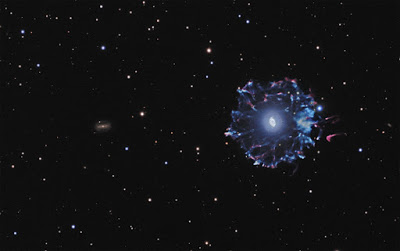
“The Cat's Eye Nebula (NGC 6543) is one of the best known planetary nebulae in the sky. Its more familiar outlines are seen in the brighter central region of the nebula in this impressive wide-angle view. But the composite image combines many short and long exposures to also reveal an extremely faint outer halo. At an estimated distance of 3,000 light-years, the faint outer halo is over 5 light-years across.
Planetary nebulae have long been appreciated as a final phase in the life of a sun-like star. More recently, some planetary nebulae are found to have halos like this one, likely formed of material shrugged off during earlier episodes in the star's evolution. While the planetary nebula phase is thought to last for around 10,000 years, astronomers estimate the age of the outer filamentary portions of this halo to be 50,000 to 90,000 years. Visible on the left, some 50 million light-years beyond the watchful planetary nebula, lies spiral galaxy NGC 6552.”
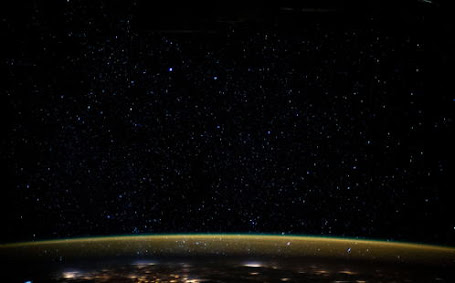
"Our planet is a tiny porthole, looking over a cosmic sea.
Can we learn what lies beyond our own horizons of perception?" 

"You Think..."

"You think you will never forget any of this, you will remember it always just the way it was. But you can't remember it the way it was. To know it, you have to be living in the presence of it right as it is happening. It can return only by surprise. Speaking of these things tells you that there are no words for them that are equal to them or that can restore them to your mind. And so you have a life that you are living only now, now and now and now, gone before you can speak of it, and you must be thankful for living day by day, moment by moment, in this presence. But you have a life too that you remember. It stays with you. You have lived a life in the breath and pulse and living light of the present, and your memories of it, remember now, are of a different life in a different world and time. When you remember the past, you are not remembering it as it was. You are remembering it as it is. It is a vision or a dream, present with you in the present, alive with you in the only time you are alive."
~ Wendell Berry

"Five Stupid Questions Women Ask Men: Vive la Différence, Indeed!"

"Five Stupid Questions Women Ask Men:
Vive la Différence, Indeed!"
"Why is it that men are better at getting their needs met than women? Maybe because they know how to keep it simple. Connie Podesta explains in this humorous yet poignant clip the five stupid questions women ask men and why. This is a very funny clip, enjoy!"
Comments here:
Hat tip to Kamosa from Second Life for this material!

Comments? He asks from a safe distance, of course lol...

"Regrets? Don’t Regret Anything, Unless You Want Me To Slap You When You Are Old"

"Regrets? Don’t Regret Anything,
Unless You Want Me To Slap You When You Are Old"
by John Wilder

"I’ve never written anything before that made me want to go to a hospice and slap a bunch of old dying people, but this particular post led me there. I’ll explain. It’s okay, it’ll all make sense in the end. I’m a trained professional.

I have made many mistakes in my life. Most of them I don’t remember – they were small and didn’t have any consequences, or at least any consequences I’ve seen yet.

Then there were some slightly larger mistakes – let’s call them medium size mistakes. There have been consequences to these. Again, medium-sized mistakes most often lead to medium-sized consequences. A scar here (carve away from your thumb, not towards it), a stock gone to zero there (thanks a lot, Enron®) and one really bad car trade when I was 24... medium-sized. Medium-sized mistakes are big enough for a big sting, but whatever permanent impacts there might be aren’t immediately fatal.

The biggest ones – I won’t give a laundry list of those. Most of those were where either passion, inexperience, a momentary lapse of character or judgement, or (worst of all) when all three contributed to a mistake. Some mistakes lasted longer, some were short. But all stung. The biggest include a marriage that led to divorce, underestimating a sociopathic boss, and wearing that white dress to my little sister’s wedding. I mean, I look fabulous in it, but some brides just have to be the center of attention. Also a bit weird because she wasn’t really my sister.

To put it bluntly, I am the author of almost every problem I have. If I didn’t cause the problem, I’m probably complicit in creating the problem or not dealing with the problem. But I don’t regret it. None of it. Not the victories, certainly, and not the failures. Why?

Life is a one-shot deal. And life is a ratchet. It only turns one way – we can’t take anything back. Regret isn’t a one-shot deal, though. If there’s anything that will burn a hole in your soul, it’s regret. Regret never comes alone – it brings guilt along for the ride.

If I were to dig more deeply into those feelings – regret and guilt are just ways that fear manifests itself. Fear of... what? Regret is a fear that the consequences of your choices or actions will impact you negatively, and cannot be changed. Here is a list of some of the common regrets from people on their deathbed (from a former palliative care nurse named Bronnie Ware, and, yes, I spelled that right – blame her parents, not me):

“I wish I’d had the courage to live a life true to myself, not the life others expected of me.”
“I wish I hadn’t worked so hard.”
“I wish I’d had the courage to express my feelings.”
“I wish I had stayed in touch with my friends.”
“I wish that I had let myself be happier.”

Even a quick look at this list tells me one simple thing: regret is for losers. I have never seen a whinier pack of self-serving weakness since I last watched a Democratic presidential debate. Everything, absolutely everything on this “top five” list is just, well, sad.

Would you like to go to your grave worrying about any of those things? I can’t imagine doing it. I refuse to let regret rule me. And I refuse to let any decision I made twenty years ago rule me. Hell, I refuse to let any decision I made last week rule me, except for choosing that convenience store egg/muffin sandwich – I don’t need to explain why. Deal with the consequences? Certainly. But regret? No.

Let’s go down the “top five” list:

Not living a life “true to yourself”? I’ve never heard such nonsense in my life. I was talking with a guy the other day who quit his job because his boss asked him to do something illegal. That’s being true to yourself – he walked away without a paycheck but with his values and beliefs intact. If you’re not being true to yourself, you’re either weak or flighty. The good news? Anyone who reads this blog is neither.

Wishing you hadn’t “worked so hard”? That’s also nonsense. A soul thrives on doing good work that matters. Doing good work excellently is hard. The Mrs. teaches, and works hard at it – I can see from her talking about her students, talking about the ones who learned and improved, the ones who keep coming back to her classroom to report on their lives that her work matters. Working hard at work that matters is what makes us the best humans we can be. If you think you worked too hard, you weren’t doing anything worth doing. The good news? Change now. You have an entire lifetime to fix that mistake.

Didn’t have the “courage to express my feelings”? Wow. This is the weakest on the list, so far. Number one: do you have feelings that matter? Most feelings are stupid – and I have stupid feelings, too. Thankfully, I’m not a five year old – I am at least twelve. I get to examine my feelings and reject those that don’t reflect my values, my virtue, my beliefs. I get to choose. If I feel slighted by something silly or petty? I get to choose to understand what a fool I’m being and ignore that feeling. Again, if you don’t express your feelings, that’s not always a bad thing. Your feelings are often stupid.

I’m sorry that “staying in touch with your friends” was so hard. But it’s really not. The people you care about, that care about you, are there. They always have been, they always will be. I don’t Facebook® much – why? I call my friends, on an actual phone. I text my friends. Am I often the one that calls first? Sure. Do we develop different lives, does life pull us away for a while? Do hundreds or thousands of miles separate us? Maybe. But I make quite a few phone calls. And mostly my friends pick up. Sure, it’s true that the biggest miracle Jesus exhibited in the Bible was having 12, 11 close friends (thanks, Judas) after the age of thirty – but you just need a few – a few that will have your back. A few you can share with.

Seriously – number five on the list is a wish for “letting themselves be happier.” Happy is easy ("All You Will Ever Need To Read About How To Be Happy* (*Most of the Time")), being significant is hard. It requires hard work while being true to yourself. It requires expressing those feelings that your virtue allows to exist. Friends? The good ones will be with you forever, and you can restart your conversations with the slightest hint of time passing, even if you haven’t talked regularly in a decade, if they’re true friends.

I’ve never thought about going to a hospice and slapping someone, but this list made me want to do it. I know, I know, it’s too late for them. And this is the list of people who had regrets. People like me? I don’t have a single regret at this moment of my life. Not one. In a hospice, I hope I’d be the, “Regrets? No. More clam chowder, please,” guy.

To be clear – it’s not that I don’t care. It’s not that I’m not blameless. It’s not that I was always right. Not one of those things is true. But I have done the most important thing I can think of: When I do something I regret, I’ve changed myself so that I won’t ("Clintoncide", "John Bolton’s Waifu", and "October Market Crashes: Knock on Wood") do that thing again. I cannot change the past. But if I have learned, if I can help others not make the same mistakes while not repeating my own mistake? Like an algebra teacher for the soul, I have taken something negative and turned it into something positive. The bonus is I get to end the dreams of high school freshmen in the process.

And I’m not planning on having any regrets tomorrow. If you have regrets? Fix them now or recognize them for the dead weight they are and cut them loose. The alternative? Trust me, you don’t want to have me chasing you down in a hospice and slapping you silly."

The Daily "Near You?"

Rock Port, Missouri, USA. Thanks for stopping by!

The Poet: Barbara Crooker, "In the Middle..."

"In the Middle..."

"In the middle
of a life that's as complicated as everyone else's,
struggling for balance, juggling time.
The mantle clock that was my grandfather's
has stopped at 9:20; we haven't had time
to get it repaired. The brass pendulum is still,
the chimes don't ring. One day you look out the window,
green summer, the next, and the leaves have already fallen,
and a grey sky lowers the horizon. Our children almost grown,
our parents gone, it happened so fast. Each day, we must learn
again how to love, between morning's quick coffee
and evening's slow return. Steam from a pot of soup rises,
mixing with the yeasty smell of baking bread. Our bodies
twine, and the big black dog pushes his great head between;
his tail is a metronome, 3/4 time. We'll never get there,
Time is always ahead of us, running down the beach, urging
us on faster, faster, but sometimes we take off our watches,
sometimes we lie in the hammock, caught between the mesh
of rope and the net of stars, suspended, tangled up
in love, running out of time."

~ Barbara Crooker

"The Times..."

"The times might be unpleasant, repulsive. The ghastly chaos, the abhorrent incivility might be intolerable, might force us into argument or leave us panic-stricken. On such occasions people build within themselves a conviction that the world outside is diabolical. The whimsical insults test our level of endurance, causing us to plead for mercy, wanting us to be pitied than exploited and victimized. Often this grief and shame form a delusion within us that there no longer exists good in this world, that good people are fictitious, and that goodness has lost its definition altogether. But such is not true because there are still people who are virtuous, unselfish, willing to help and possessing the ability of restoring our faith in humanity. To disregard them, their presence, would be as heinous as the deeds of the people who are unlike them. The times might be unpleasant, repulsive, but we'll come out it, unharmed and liberated." - Chirag Tulsiani
o
Sam: "It's like in the great stories Mr. Frodo, the ones that really mattered. Full of darkness and danger they were, and sometimes you didn't want to know the end because how could the end be happy? How could the world go back to the way it was when so much bad had happened? But in the end it's only a passing thing, this shadow, even darkness must pass. A new day will come, and when the sun shines it'll shine out the clearer. Those were the stories that stayed with you, that meant something even if you were too small to understand why. But I think Mr. Frodo, I do understand, I know now folk in those stories had lots of chances of turning back, only they didn't. They kept going because they were holding on to something.
Frodo: What are we holding onto, Sam?
Sam: That there's some good in the world, Mr. Frodo, and it's worth fighting for."
- Samwise Gamgee, "Lord of the Rings: The Two Towers"

"At The Approach Of Danger..."

“At the approach of danger there are always two voices that speak with equal force in the heart of man: one very reasonably tells the man to consider the nature of the danger and the means of avoiding it; the other, even more reasonable, says that it is too painful and harassing to think of the danger, since it is not a man’s power to provide for everything and escape from the general march of events; and that it is therefore better to turn aside from the painful subject till it has come, and to think of what is pleasant. In solitude a man generally yields to the first voice; in society to the second.”
- Leo Tolstoy, “War and Peace”

“All our mortal lives are set in danger and perplexity: one day to prosper,
and the next – who knows? When all is well, then look for rocks ahead.”
- Sophoclese, “Philoctetes”
Free Downloads:
A little light reading from Tolstoy…   
Freely download “War and Peace”, by Leo Tolstoy, here:

Freely download “Seven Tragedies of Sophocles- Philoctetes” here:

"A Simple Choice..."

"It comes down to a simple choice, really. 
Get busy living or get busy dying."
- "Andy Dufresne", "Shawshank Redemption"

"On the Other Hand..."

Michel de Montaigne’s cenotaph 
at the Musée d’Aquitaine in Bordeaux.
"On the Other Hand..."
by Joel Bowman
Bordeaux, France - “On the other hand...” The refrain was overheard, repeatedly, at Le Noailles brasserie yesterday, during an unhurried luncheon. Our agnostic interlocutor, who may be a friend or distant relative, is a cheerful septuagenarian, senior enough to eschew the vapid certainty that so contaminates youth.

Whether discussing philosophy or physics, politics or economics, or simply comparing the magret de canard versus the confit de canard, the gentleman was unfashionably thoughtful. “On the one hand,” he would begin with a wry smile, “cooking the animals in their own fat has a certain appeal. On the other, given the way they’ve handled the economy these past few years, I might as soon send them directly to the guillotine...”

At some point – between the oysters and the hypothetical severing of various heads of state – the conversation turned to The Enlightenment... “‘Sapere aude!’ as Kant challenged us. ‘Dare to know!’ Actually, the untraveled Königsberger borrowed the phrase from the great Roman poet, Horace. Nothing new under the sun, you see? Still, it’s generally accepted, even amongst thinking people, that ‘progress’ is something we can know and measure. ‘Standing on the shoulder of giants,’ as Newton phrased it, we need only employ our reason, our uniquely human capacity for rational thinking, to advance from A to B... then onto C... and so on and so forth.

Of course, this all rests on the idea that humans themselves are ‘improvable,’ an assertion that appears to fly in the face of all observable evidence to the contrary. Still, our ‘enlightened’ ancestors saw the history of man as a story of advancement, the triumph of knowledge over ignorance, wellbeing over misery, freedom over tyranny, etcetera... But is it really as simple as all that?”

An Acquired Distaste - At this point in the meal, the youngest of the gathered gourmandizers offered a Montaigne-worthy non sequitur, expertly weaving together a tale from the book series Spy Kids, a recent dream about Icelandic horses, and a raw assessment of what it’s like to try an oyster for the very first time: “It’s like eating snot. Really. Why on earth do adults like them so much?”

Following a brief discourse on gastronomy, in which the above-mentioned Montaigne was quoted – “A man may live well without riches, but he cannot live well without a stomach” – the subject veered back to man’s alleged path of progress.

“Take the unenviable task of governance, for example. On the one hand, we might say that it is preferable to have a government that serves the people, as opposed to the other way around. It was Messrs. Locke, with his "Two Treatises", and Montesquieu, with his "Spirit of the Laws," who did much of the heavy lifting there.

“And let’s not forget that other rapscallion, Rousseau, and his so-called ‘Social Contract.’ Have you ever seen a copy? I haven’t. What kind of contract is it, anyway, where the consent of the parties is merely implied? Ah, but that’s Rousseau for you. A Genevan, mind. And let us say nothing of the man’s advice on child-rearing, nothing Voltaire hasn’t already mentioned...

“But coming to the point... We are supposed to have a government ‘of the people, by the people and for the people.’ And democracy is held up as the process by which such an arrangement is delivered. At least, that’s the idea. Progress, remember?

“Now, I have little doubt that living under, say, Philip IV, the man they called “the Iron King,” was no picnic. Same for Charles VI, nicknamed “the Mad,” whose delusions brought this land under a brutal civil war... or Louis XI, who earned the moniker “the Universal Spider” after his penchant for spinning webs of psychological intrigue... and torturing his political opponents, sometimes to death. They were mad kings... lunatic dictators... and blood-thirsty sociopaths, all of them. On the other hand... at least the people knew what they were up against! Can we really say the same today, standing smugly atop our post-Enlightenment pedestal?"

Irrational Reverence: “Today, it is considered right and proper to revere our political class. We refer to them as ‘leaders’ and ‘statesmen’ and afford them all manner of special privilege and status. We bow to them not out of rational fear, but out of irrational reverence.

And when they rob us, harass us and send our children off to war, do we raise the sharpened blade, ready to deliver France’s closest shave? No. We praise the process by which they were elected... the sacred cow of democracy... and march off to the ballot box to give the next gang their turn at the helm.

Moreover, in addition to this political Stockholm Syndrome, we appear to suffer a kind of collective identity disorder, too, wherein we mistake our enslaved selves for our very own masters. What was it Hillary Clinton said? ‘Our government is all of us.’ And remember Obama, lately in the news, duly disgraced. What was it he used to say? ‘Government isn’t some distant force — it’s made up of us, the people.’

Well, he’s right about the first part; government is not ‘some distant force.’ Like an object in the rearview mirror, that force is closer than it may appear. It is a direct and immediate force, too, ready to rob, imprison, and even ‘cook in their own fat’ any one of us who doesn’t fall in line.

“As for the derriere-backwards notion of government being ‘all of us’... was it ‘all of us’ who ran our respective countries trillions and trillions of euros into debt? Was it ‘we, the people,’ who opened our borders to millions and millions of illegal immigrants? Was it ‘all of us’ who first created a virus, they used it to lock down the world? Who is this ‘we,’ they speak of so glibly? Like Rousseau’s phantom contract, written in invisible ink, I don’t remember signing off on any such matters...On the other hand... the Saint-Estèphe pairs perfectly with the duck, and the company of friends and family is not to be improved by talk of politics.” Stay tuned for more Notes From the End of the World...

"How It Really Is"


"Home Sales Fall as Prices Hit Record High - Real Estate Crisis 2025"

Full screen recommended.
Dan, I Allegedly, 7/24/25
"Home Sales Fall as Prices Hit Record High - 
Real Estate Crisis 2025"
"Home sales have hit a shocking 30-year low, and the real estate market is facing some serious challenges. In this video, I break down what’s REALLY happening with home prices, interest rates, and why so many homes aren’t selling. From skyrocketing average home prices to the struggles of realtors across the country, I’m sharing the latest insights and what it all means for buyers, sellers, and renters alike. If you’ve been wondering about #TheFed, #HomeBuilders, and #NAR predictions, this is the video to watch."
Comments here:

"The Coup And The Cover-Up"

"The Coup And The Cover-Up"
by Paul Rosenberg

"This is our second condensation of classified documents released by US Director of National Intelligence, Tulsi Gabbard. And again, this release shows that intelligence reports were manufactured to undermine Donald Trump.

The July 23rd release is a single, 46-page document, dated 18 September 2020, which seems to have existed in only five copies (the cover sheet is noted “Copy 1 of 5”) and was “stored in a limited-access vault at CIA headquarters.” It is a critique (apparently for the House Intelligence Committee) of the 5 January 2017 report, “Assessing Russian Activities and Intentions in Recent US Elections,” the one we mentioned in our previous post on this subject as the public beginning of the Russia-did-it narrative.

I’ll now give you some snips from this new report. But again, you can and should download the original to see it for yourself. This time I’ll set quotations in italics:

(The director of the CIA published three reports which were) substandard – containing information which was unclear, of uncertain origin, potentially biased or implausible – and those became foundational sources for ICA judgments that Putin preferred Trump over Clinton.

One scant, unclear, and unverifiable fragment of a sentence from one of the substandard reports constitutes the only classified information cited to suggest the Putin “aspired” to help Trump win.” Putin’s principle motivations… were to… weaken what the Russians considered to be an inevitable Clinton presidency. Putin held back leaking some compromising material for post-election use against the expected Clinton administration.

The ICA (“Assessing Russian Activities and Intentions in Recent US Elections”) ignored or selectively quoted reliable intelligence reports that challenged – or in some cases undermined – judgments that Putin sought to elect Trump.

The DCIA (Director of the CIA) picked five CIA analysts to write the ICA and rushed its production two weeks before President-Elect Trump was sworn-in. Hurried coordination and limited access to the draft reduced opportunities for the IC to discover misquoting of sources and other tradecraft errors. The drafters of the ICA did not accurately cite the most critical context statements.

The reports were published after the election on DCIA orders, despite veteran CIA officer judgments that they contained substandard information which was unclear, of uncertain origin, potentially biased, implausible, or in the words of senior operations officers, “odd.”

CIA officers also said that DCIA personally directed that two of the most important reports not be formally disseminated when he first learned of them, ostensibly because they were too sensitive to create printed copies. We were unable to obtain a convincing explanation, however, for why DCIA did this, since the CIA has a special reporting channel… whereby sensitive reports are restricted.

DCIA ordered the publication of a second substandard report, from an unknown subsource… to allege that Putin favored Trump. This information was both unverified and implausible and, like the unclear fragment, CIA professionals originally declined to publish it when it was first collected. It was only published on DCIA’s orders, after the election… to source the first bullet of evidence for the judgment that Putin “developed a clear preference” for candidate Trump.

There is much more in this report – including things like the State Department offering money to US religious organizations if they would support Hillary – and so you really should read it yourself.

Now, as to a cover-up: It’s important to understand that this has already been covered up. The report we’re talking about here was written five years ago, then delivered to the House Intelligence Committee, consisting of twenty-plus members, roughly half Democrats and half Republicans. For five years this group of elected representatives had this report and revealed nothing. A significant number of operators at CIA and other intel groups likewise knew of this and said nothing. Furthermore, the Special Prosecutor who previously examined this, John Durham, almost certainly saw these documents and likewise did nothing.

So, the cover-up has been running for a long time already. All of this is why it’s so crucial that Ms. Gabbard released actual evidence, not just talk about evidence. Official Washington has given us nothing, despite this being a type of coup. And it’s hard to characterize it any other way, once we consider that Mr. Trump was twice impeached, prosecuted endlessly, had his home invaded and more, largely based upon lies which were fabricated by the US intelligence apparatus, as ordered by Mr. Obama.

This is huge. If fact it may be so huge that most Americans will look for one excuse after another to close their eyes and stop their ears. And so we must spread this evidence as widely and repeatedly as possible."


This is treason... you do remember the traditional penalty 
for treason, don't you? A short drop and a very sudden stop...
Make it so.

Bill Bonner, "Bombastic Bullying Brutes"

The remains of the Roman Forum
"Bombastic Bullying Brutes"
By Bill Bonner

‘We are born into this time and must bravely follow
 the path to the destined end. There is no other way.’
- Oswald Spengler

Poitou, France - "As recently as 1999, the US had a budget surplus...debt of only $5.6 trillion...and stocks worth more (in gold and dollar terms) than ever in history. The US was still widely admired. Its federal debt was bought as a monetary reserve all over the world. It wasn’t at war and wasn’t sponsoring major wars or paying for mass murders overseas. It encouraged free trade and, generally, favored the rule of law. That was probably the apogee for the US...and for Western Civilization. It has been downhill ever since. At least, that’s how it looks to us.

This is not an original point of view. Oswald Spengler foresaw the peak of Western Civilization coming around the year 2000. And even Donald Trump noticed the decline and pledged to turn it around. And now that we are a quarter of a century into the down cycle, the real questions for us remain the same: how far down will it go...and how will it get there.

Spengler guessed that the top for Western Civilization would be followed by a difficult period of ‘Caesarism’ (which we’ve described as ‘Big Man Government’). Spengler saw Benito Mussolini as an early example of the post-democratic leader. “Democracy is beautiful in theory,” said Mussolini. “In practice it is a fallacy. You in America will see that some day.” Spengler died in 1936; he never met Donald Trump.

Yesterday, we looked at the way tariffs figure in the big scheme of things. In short, they seem to confirm the ‘declining empire hypothesis.’ Restrictions on trade slow an economy down and make people poorer. But they also nudge it away from civilization itself. Whether trade is a cause or an effect, we don’t know. But the two seem to go together. And restrictions on trade tend to move a society backwards - making it poorer...but also, like North Korea, less free and less civilized.

Restraining trade seems to be a part of the new world order. The first pitch of the Trump team was that other countries were ‘ripping us off’ (presumably with high tariffs compared to our lower ones). As a matter of fairness, as well as encouraging domestic production, tariffs would be made ‘reciprocal.’ But reciprocity fell by the wayside and the the negotiated deals are leading to higher tariffs, not lower ones. Even countries with which the US has a trade surplus - the UK and Brazil, for example - now face higher US tariffs.

Who pays? The Washington Post: "Tariffs hit U.S. companies hard, but businesses absorb them for now. The Trump administration’s tariffs are hitting companies that do business in the United States. But prices haven’t reflected them yet in many cases. In earnings reports, multiple companies on Monday and Tuesday blamed tariffs for hurting their bottom lines, including automakers General Motors and Stellantis. Companies will soon raise prices to protect their margins. Then, consumers will pay."

Meanwhile, the US president continues to threaten even higher tariffs. The Hill: "President Trump recently announced his intent to impose a 200 percent tariff on pharmaceuticals to lure drug manufacturing back to the U.S. This action, if implemented, will come at great cost to millions of Americans already struggling to cover their medical bills and force them deeper into health care debt."

What to make of it? What we make of it is that tariffs have become just another sleazy way to raise taxes and give the Big Man more power. They take us further into the political world…of bullying, bombast and brute force arms."

Adventures With Danno, "Unbelievable Prices at Kroger"

Full screen recommended.
Adventures With Danno, 7/24/25
"Unbelievable Prices at Kroger"
Comments here:

Wednesday, July 23, 2025

"My Family Is Leaving California For Idaho, Housing Crisis Deepens"

Jeremiah Babe, 7/23/25
"My Family Is Leaving California For Idaho,
 Housing Crisis Deepens"
Comments here:

Greg Hunter, "Prepare for Global War – Steve Quayle"

"Prepare for Global War – Steve Quayle"
by Greg Hunter’s USAWatchdog.com

"Renowned radio host, filmmaker, book author and archeological dig expert Steve Quayle says his sources are confirming exactly what Martin Armstrong is saying about the coming war with Russia that will, no doubt, go nuclear. Quayle says the US does not have any advantage over Russia in hypersonic missiles, subs or in the air. In short, Russia can see our B2 stealth bomber and everything else stealth. Yet, the US seems to be bumbling towards war with a superior adversary. Quayle explains, “Russia has warned over and over again that there is nothing the West has that can counter their hypersonic missiles. The American defense posture is this: It is simply going to be kiloton tactical nuclear weapons, and there is going to be no intercontinental ballistic missiles. That’s wrong, and that’s a lie. I believe the President is being lied to by the military industrial complex, and I do not believe Trump understands high technology.

This is not a put down, it is an awareness. The Russians could not have been more clear, and they have basically said we have all this advanced technology. Here’s a piece of information I just got, all of the Russian submarines are out to sea. The Russian subs are out to sea, and it appears the United States defense posture is out to lunch. The United States cannot sustain intercontinental ballistic missiles with 25-ton warheads. When this starts, Russia will hit all of the biggest bases. The United States is already defeated because they have not provided the civilian population with a viable civil defense.”

Quayle also points out the terrible money problems Europe and the US have. Quayle says, “In about 10 days, $7 trillion in US debt comes due. Again, $7 trillion. That’s seven thousand billion, and the United States cannot cover $7 trillion. People who are the debt holders don’t want any more T-bills or notes. They don’t want paper. Look, we don’t have the money. The US is not on a wartime economy. We do not have the industrial base or the raw material base.”

Quayle goes on to warn, “There is not time to dilly dally. Forget about being a spectator. First thing you should do is get out of online banking. There is no security, and the cyber hackers and attackers have access. Take your dominion over you own finances, and get canned food. Get rice. Now, in Japan, they like rice too, and they are rioting over the rice prices. Rice price not so nice. Take control of your funds. Those of you who have profits in Bitcoin or crypto currencies, take at least half of it and convert it to gold. There are no claims against gold you hold in your hand.”

Quayle also points out, “We are seeing on Earth the stress of nations, and we are seeing earthquakes in diverse places. That’s Jesus speaking in Matthew 24.” Add dozens of volcanos popping off all over the world, and you can see why Steve Quayle says, “Get ready, and get right with Christ Jesus.” There is more in the 64-minute interview.

Join Greg Hunter on Rumble as he goes one-on-one with Steve Quayle,
warning you to prepare for global war. 

Musical Interlude: Peder B. Helland, "High Above: "Beautiful Relaxing Music for Stress Relief"

Full screen recommended.
"High Above:
"Beautiful Relaxing Music for Stress Relief -
Relax, Sleep, Meditate, Study"
Beautiful relaxing music for stress relief, composed by Peder B. Helland. This track is called "High Above" and can be used to relax, sleep, meditate, study, work, do yoga, read and more.

"A Look to the Heavens"

"These cosmic clouds have blossomed 1,300 light-years away, in the fertile starfields of the constellation Cepheus. Called the Iris Nebula, NGC 7023 is not the only nebula to evoke the imagery of flowers. Still, this deep telescopic image shows off the Iris Nebula's range of colors and symmetries, embedded in surrounding fields of interstellar dust. 
Within the Iris itself, dusty nebular material surrounds a hot, young star. The dominant color of the brighter reflection nebula is blue, characteristic of dust grains reflecting starlight. Central filaments of the reflection nebula glow with a faint reddish photoluminesence as some dust grains effectively convert the star's invisible ultraviolet radiation to visible red light. Infrared observations indicate that this nebula contains complex carbon molecules known as PAHs. The dusty blue petals of the Iris Nebula span about six light-years."

Chet Raymo, “Very, Very, Very, Very, Very...”

“Very, Very, Very, Very, Very...”
by Chet Raymo

"In a short story that was published posthumously in the New Yorker, the inestimable Primo Levi meditated on the limits of language. The story was called “The Tranquil Star.” He writes "The star was very big and very hot, and its weight was enormous," and realizes immediately that the adjectives have failed him: “For a discussion of stars our language is inadequate and seems laughable, as if someone were trying to plow with a feather. It's a language that was born with us, suitable for describing objects more or less as large and long-lasting as we are; it has our dimensions, it's human. It doesn't go beyond what our senses tell us.

Until fairly recently in human history, there was nothing smaller than a scabies mite, writes Levi, and therefore no adjective to describe it. Nothing bigger than the sea or sky. Nothing hotter than fire. We can add modifiers: very big, very small, very hot. Or use adjectives of dubious superlativeness: enormous, colossal, extraordinary. But, really, these feeble stretchings of language don't take us very far in grasping the very, very, very extraordinarily diminutive or spectacularly colossal dimensions of atomic matter or cosmic space and time. We can overcome the limitations of language, Levi say, "only with a violent effort of the imagination."

I spent more than forty years trying to find ways to violently stretch the imaginations of my students (and myself) to accommodate the dimensions of the universe revealed by science. I would project onto a huge screen a photograph of a firestorm on the Sun, then superimpose a scale-sized Earth, which fit comfortably inside a loop of solar fire. I would take the class into the College Quad here near Boston, where I had set up a basketball to represent the Sun, then gathered 100 feet away with a pinhead Earth; we walked together with our pin in the great annual journey of the Earth, and looked through a telescope at the marble-sized Jupiter than I had previously installed at the other end of the long Quad (the next closest star system would have been a couple of basketballs in Hawaii). We walked geologic timelines that took us from one end of the campus to the other.

In one of my Globe essays I used this analogy: “Imagine the human DNA as a strand of sewing thread. On this scale, the DNA in the 23 pairs of chromosomes in a typical human cell would be about 150 miles long, with about 600 nucleotide pairs per inch. That is, the DNA in a single cell is equivalent to 1000 spools of sewing thread, representing two copies of the genetic code. Take all that thread - the 1000 spools worth - and crumple it into 46 wads (the chromosomes). Stuff the wads into a shoe box (the cell nucleus) along with - oh, say enough chicken soup to fill the box. Toss the shoe box into a steamer trunk (the cell), and fill the rest of the trunk with more soup. Take the steamer trunk with its contents and shrink it down to an invisibly small object, smaller than the point of a pin. Multiply that tiny object by a trillion and you have the trillion cells of the human body, each with its full complement of DNA.”

Or this description from 'Waking Zero': “The track of the Prime Meridian across England from Peace Haven in the south to the mouth of the River Humber in the north is nearly 200 miles. If that distance is taken to represent the 13.7 billion year history of the universe, as we understand it today, then all of recorded human history is less than a single step. The entire story I have told in this book, from the Alexandrian astronomers and geographers to the present-day astronomers who launch telescopes into space, would fit neatly into a single footprint. If the 200 miles of the meridian track is taken to represent the distance to the most distant objects we observe with our telescopes, then a couple of steps would take us across the Milky Way Galaxy. A mote of dust from my shoe is large enough to contain not only our own solar system but many neighboring stars.”
But as hard as one tries, the scale of these things escape us. If one could truly comprehend what we are seeing when we look, say, at the Hubble Ultra Deep Field Photo above, which I have done my best to convey to myself and others in a dozen ways, it would surely shake to the core some of our most cherished beliefs. Just as our language is contrived on a human scale, so too are our gods.”

"Maybe..."

“Maybe we’re not supposed to be happy. Maybe gratitude has nothing to do with joy. Maybe being grateful means recognizing what you have for what it is. Appreciating small victories. Admiring the struggle it takes to simply be a human. Maybe, we’re thankful for the familiar things we know. And maybe, we’re thankful for the things we’ll never know. At the end of the day, the fact that we have the courage to still be standing is reason enough to celebrate.”
- “Grey’s Anatomy”

“'Law' as a Jedi Mind Trick"

“'Law' as a Jedi Mind Trick"
by Paul Rosenberg

"About half the time it is used, possibly more, the word “law” is nothing more than a Jedi mind trick. There is nothing noble, righteous, or even ‘conservative’ about it. It’s a way for you to be abused via ignorance and inertia. We’ve all seen this trick in action, of course. It’s very common. And, sadly, more or less all of us have fallen (or rather, were pushed) into it at some point. It’s a way for you to be abused via confusion and inertia. And, sadly, more or less all of us have fallen (or rather, were pushed) into it at some point. That complicates things because people generally don’t like to admit their errors.

Nearly all of us have been taught, repetitively, to “respect the law,” and because of those teachings, nearly all of us have decided certain things must be right, simply because they were “the law.” We decided this, not because we understood the benefits that would follow certain actions, but because of repetitive prodding. It’s important to be clear on this: To uncritically, reflexively obey is not respect… it is to hold “the law” above reason… above reality. Saying, “Everyone else did it too,” makes this no better.

It is also common for obedience to follow intimidation: Obey, or else… armed men will hurt you; teacher will shame you; the other kids will laugh at you; important people will criticize you in public. Please note all of these are primitive, degrading reasons. But they were thrust upon us as small, coerced children, and they very often stuck. The really damaging part, however, comes after you obey reflexively or fearfully: when you leap to justify your past actions. Not many of us enjoy admitting our errors, but if we want to become honest, conscious adults, that is precisely what we need to do.

“But, but…” Yes, yes, I know the same automated slogans:
• Without the law, all would be chaos and death!
• Outside of law is tyranny!
• We are a nation of laws, not of men!
• Only law separates us from savages!

Please take a couple of deep breaths and continue.

There’s Law, and Then There’s Law: In the modern West, there are two different kinds of law. Unfortunately they are usually rolled up together and placed under a single tag. That’s a major part of this problem. If the early days of Western civilization, law was simply the process of determining what was just. Law was considered good if it were reasonable, fair, and had stood the test of time. And that’s all.

Historian Fritz Kern, in his "Kingship and Law in the Middle Ages", explains it this way: "For us law needs only one attribute in order to give it validity; it must, directly or indirectly, be sanctioned by the State. But in the Middle Ages, different attributes altogether were essential; medieval law must be “old” law and must be “good” law…. If law were not old and good law, it was not law at all, even though it were formally enacted by the State.

Law, in the old days, was developed locally, and judges were simply trusted men who reasoned well. The form we in the English-speaking world know best was the common law of England, and it was precisely this type of law. In fact, the historical record shows early English kings having to adopt customary law:The 1164 Clarendon Constitution cites a “record and recognition of a certain portion of the customs and liberties and rights of… ancestors.”

Article 39 of the Magna Carta (1215) reads, “No free man shall be taken or imprisoned or dispossessed, or outlawed… except by the legal judgment of his peers or by the law of the land.”

Now, before I explain how we got from law based on reason and experience to where we are now, there is one thing that is necessary to understand: Until recent times, law was not legislation.

I know this is contrary to what you’ve understood, but it’s true all the same. Legislation is primarily a modern invention. Law in the old days was not made by politicians or even by princes. Law was, as we said above, the process of determining what was just. The common law was created and updated by judges, not by legislators. To buttress this point, consider that when philosopher Jeremy Bentham died in 1832, he was revered as “the founder of modern legislation.” I won’t belabor this point, but consider these two statements, please:

• Legislation displaces law that is based upon reason and experience.
• Legislation is the edict of politicians, and nothing more.

Under legislation, reason and experience are not required. Politicians – whom nearly all of us hold in low regard – create this new law and can change it on a whim.

So… Let me ask some pointed questions:Is it sensible to worship the words of people we also condemn? And if we hold words above critical thought, are we not holding them above reality? Is that not a kind of worship or idolatry? Idolatry is precisely what we do when we hold politician-created “law” above reason. (Whatever you hold above reality is your god.)

Yes, I know, we did this because we were trained to do it and because we were intimidated into it. But we’re adults now; we should be ready to face our errors and correct them. The law of reason and experience always stands, of course, simply because it is reasonable and useful.

An uncritical respect for legislation, on the other hand, is a mind trick and differs little from that of a Star Wars Jedi. It requires us to bypass our minds and sacrifice our will to inertia and fear."