

So, we rise from the rubble...
StatCounter
Sunday, September 27, 2026

"Israel’s Iran Strategy Is Breaking Down - The Next Phase Looks Worse"
Col. Lawrence Wilkerson, 9/27/26
"Israel’s Iran Strategy Is Breaking Down -
The Next Phase Looks Worse"
Comments here:
"To All Americans: Trump Is About to Destroy Us!"
Douglas Macgregor, 9/27/26
"To All Americans:
Trump Is About to Destroy Us!"
Comments here:
"Is Putin Caught In An 'Escalation Trap'? The Long War In Eastern Europe"

"Is Putin Caught In An 'Escalation Trap'?
The Long War In Eastern Europe"
by Larry C. Johnson
"Yves Smith of Naked Capitalism has flagged a recent interview that Professor Robert Pape did with Mario Nawfal. During the interview, Pape argued that Vladimir Putin is caught in an "escalation trap." In his telling, Russia launched a preventive war in February 2022 to seize Kyiv and roughly 60 percent of Ukraine. That plan collapsed, and the fallback, betting that NATO would break, is now producing the European counterbalancing coalition Moscow most feared. It is a tidy theory. It also rests on a premise about Russian intentions that the record does not support, and once that premise goes, the trap goes with it.
What the force tells you about the objective
Start with arithmetic, the kind any planner of military operations does before anything else. Russia invaded with roughly 150,000 to 190,000 troops, including separatist forces. The standard rule of thumb for occupying a hostile population, from James Quinlivan’s RAND work, is about 20 troops per 1,000 inhabitants. For a country of more than 40 million, even occupying 60 percent of the territory would require several hundred thousand troops, several times what Russia sent. Moscow’s General Staff can do this arithmetic. A force that size is a coercive instrument, not an occupation army.
The pattern of the operation fits coercion. Russian forces approached Kyiv from the north but never attempted to assault or encircle a city of three million. The pressure was aimed at the government, not at taking the capital block by block. Talks began within days, in Belarus on February 28, and moved to Istanbul in March. Pape's supporters point to the airborne assault on Hostomel as proof of a plan to seize the capital. But a failed coup de main against an airfield is not evidence of an intent to occupy 60 percent of a country.
Istanbul: the objective was achieved
The strongest evidence against Pape is that the coercion worked. By the end of March 2022, meetings in Belarus and Turkey, together with video conferences, had produced the Istanbul Communiqué, a framework for a settlement. Ukraine accepted permanent neutrality in exchange for security guarantees from the United States and its allies, with Russia also as a guarantor. Russia, for its part, agreed to a process to settle the Crimea dispute diplomatically.via IISS
That was the core of what Moscow wanted, and the Ukrainian side confirmed it. David Arakhamia, who led Ukraine’s delegation, later said Russia was prepared to end the war if Ukraine accepted Finland-style neutrality and committed not to join NATO. Russian Foreign Minister Sergei Lavrov confirmed to me, Judge Napolitano and Mario Nawfal directly that the talks produced a tentative agreement, and that its terms were brought to the table by the Ukrainian delegation, not imposed by Moscow.
As a gesture of goodwill, Moscow withdrew its forces from north of Kyiv. Western commentary treats that as a retreat forced by battlefield failure. It is at least as consistent with the claim that the pressure had served its purpose.
How the deal died: Then the politics changed. Boris Johnson arrived unannounced in Kyiv on April 9, 2022, and according to Arakhamia told the Ukrainians not to sign anything with Russia and to “just fight.” Two days earlier, Lavrov had already complained publicly that Ukraine’s new draft departed sharply from the key provisions agreed at Istanbul on March 29. Washington and London had decided Russia was weaker than they had thought and that it could be bled. Ukraine walked away.
This is the point Pape’s framework cannot absorb. If Russia’s goal was a neutral Ukraine obtained through negotiation, the war did not go on because Moscow’s plan failed. It went on because Russia’s adversaries rejected the settlement.
No plan B, but a fast pivot and a new army: With hindsight, Russia clearly had not prepared a plan B for Ukraine walking away. That was a real planning failure. But the Russian military adjusted quickly. It concentrated on the Donbas and the land bridge to Crimea, and the fall of Mariupol in May gave it the first major result of that phase.
The bigger adjustment came in September 2022. After a large number of contract soldiers left the army in August and the Kharkiv counteroffensive exposed how thin Russian lines were, Putin ordered the mobilization of 300,000 reservists. That was the start, not the end, of Russia’s response. From that point Moscow set about building a much larger army, as the Russian officers I have interviewed have described in detail, including Gen. Apti Alaudinov, Gen. Evgeny Buzhinsky, Gen. Andrei Gurulev and Col. Eduard Basurin.
The mobilization was followed by a sustained recruitment campaign and an expanded annual draft. By Medvedev’s count, more than 452,000 men signed military contracts in 2023. Roughly 450,000 followed in 2024, and more than 422,000 in 2025. Year after year, Russia has added at least 350,000 new soldiers. Putin’s decrees tell the same story: authorized military strength rose from about 1.15 million in 2022 to 1.32 million in December 2023, then to 1.5 million effective December 2024. By 2026, according to my sources, Russia’s army had reached that 1.5 million active-duty figure.
That is not the behavior of a state that expected a quick war and is now improvising its way out of a trap. It is the behavior of a state that decided in the autumn of 2022 to fight a long war, and built the force to do it.
Why the timeline matters: The goals never changed. Putin announced them on February 24, 2022: the demilitarization and “denazification” of Ukraine. What changed after Istanbul was the method, from coercion toward a negotiated settlement to attrition. Moscow has never attached a timeline to that effort.
Pape’s trap depends on the assumption that Russia needed a quick victory and is now stuck with worse and worse options. An attrition strategy with no deadline, backed by an army that has grown every year since 2022, is not a trap. It is a choice. Moscow's theory of victory since late 2022 has been to exhaust Ukraine’s manpower and the West’s willingness to supply it, not to break NATO by a specific date. Four and a half years later, Russian forces are still advancing, and Ukraine’s reserve and mobilization problems are structural, not temporary.
Pape’s answer is European counterbalancing, backed by an EU economy he puts at about eight times Russia’s. That ratio only holds at market exchange rates, which badly understate what Russia’s economy can actually produce. On purchasing power parity, the measure that matters in a war of production, Russia is the fourth largest economy in the world: about $6.9 trillion in 2024 by the World Bank’s count, behind only China, the United States and India, and ahead of Japan and Germany. The EU as a bloc is still larger, but on that basis the gap is roughly half of Pape’s figure.
GDP understates Russia’s position in another way. Russia has a resource base that Europe cannot match, from oil, gas and coal to metals and fertilizer, and a defense-industrial base that Europe has let wither for thirty years.
Artillery shells, the basic currency of this war, show what that means in practice. Russia produced an estimated 400,000 122mm and 152mm artillery rounds in 2022. By 2025, estimates put its annual output at about 4.2 million. A 2026 Estonian intelligence report goes further, estimating that Russian factories produced about seven million artillery, mortar, tank and rocket rounds in 2025. On top of that, Russia has received millions of rounds from North Korea.
Europe started from almost nothing. At the beginning of 2024, according to Rheinmetall’s own internal estimate, all Western European manufacturers together could produce about 550,000 shells a year. NATO's own assessment was that Russia produced as much ammunition in the first three months of 2024 as the entire alliance did in a year. The EU pledged to reach a capacity of two million 155mm shells a year by the end of 2025, a target, not proven output. Even adding US production, which is aiming for about 100,000 rounds a month in 2026, allied programs might yield about three million shells this year, still less than Russia’s estimated output in 2025.
That is the real measure of the balance Pape is counting on. A bloc whose economy is several times Russia’s is still being outproduced in the one commodity that decides an attrition war. Balance-of-power theory may be right that Europe will eventually arm itself. It says nothing about whether that happens in time to change the outcome in Ukraine.
Russia sent a force too small to occupy most of Ukraine, negotiated within days, and reached a framework agreement within five weeks. When the West persuaded Kyiv to walk away, Russia shifted to an open-ended war of attrition and spent four years building an army to fight it. That is not a state trapped by the failure of a plan to conquer 60 percent of a country. It is a state that tried coercion first, adapted when it failed, and is fighting on its own timeline."
"The Siege Accelerates"

"The Siege Accelerates"
by Lamentor
Excerpt: "Last Saturday: The diesel pumps ran dry in Florida and Texas. The Joliet refinery remained offline. The Houthis struck Riyadh airport. The Kursk nuclear plant cooling tower burned. The PJM grid emergency covered thirteen states. The banks faced $326.7 billion in unrealized losses. The heating oil crack spread hit the highest level in history. The truckers pressed the decline button ten thousand times a day. The G7 met to discuss the Hormuz closure. Macron convened an emergency session. The Saudi exports to Europe sat at zero. The Colombian earthquake swarm passed 1,200 tremors. The Kilauea pattern broke. The war remained contained to the periphery. The narrative remained controlled. The agenda proceeded.
Today: I can feel it coming in the air tonight, oh Lord. The frogs in the pot are hot and unable to feel the heat. They sit in the pot as the temperature rises degree by degree, unaware that the comfort they feel is actually the threshold of death. They have been told the water is fine. They have been told to trust the chefs. They have been told that anyone who suggests the water is boiling is a conspiracy theorist, a doomer, a threat to the social order. So they sit. And they wait. And they do not jump.
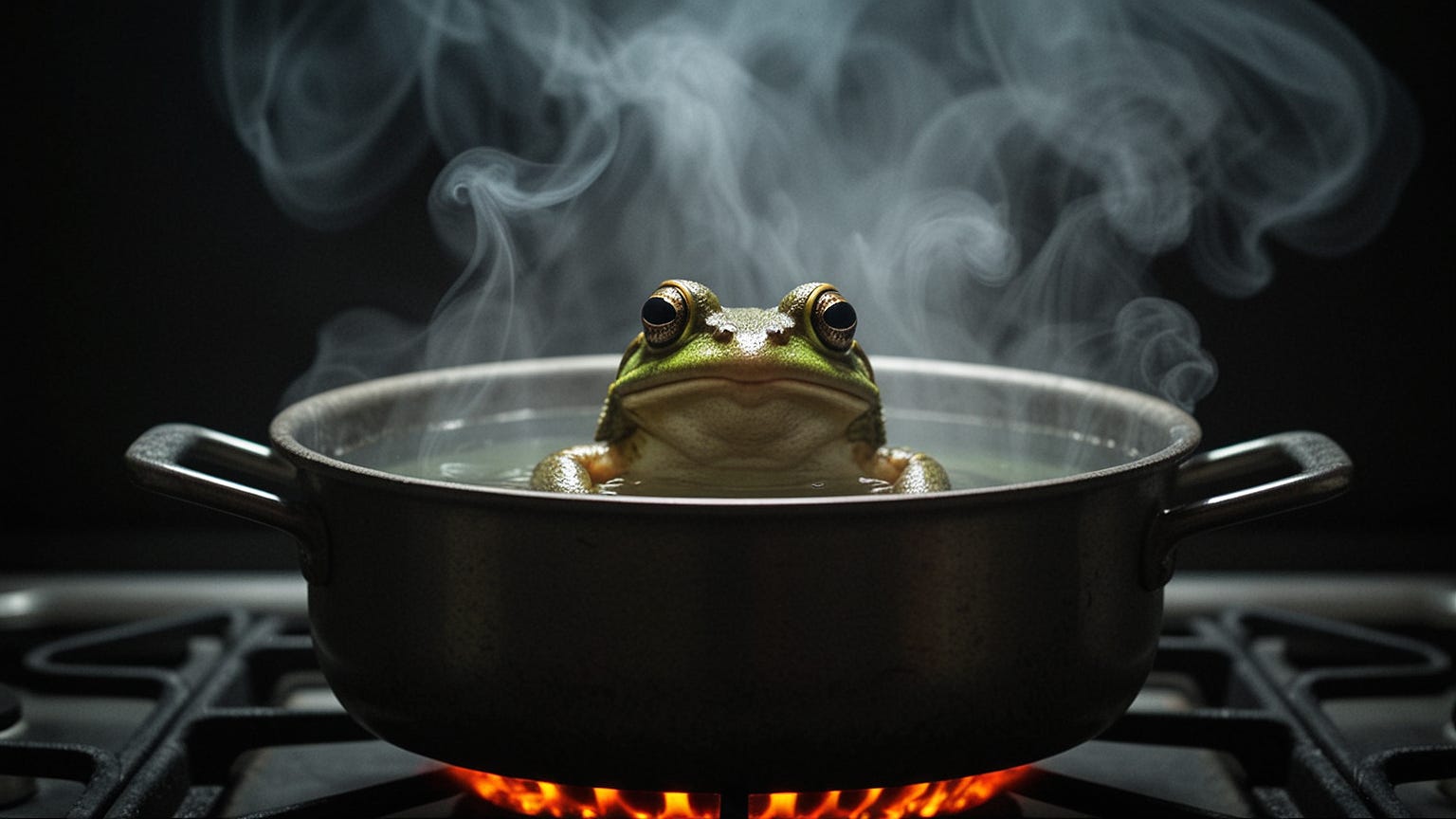
I have been watching for this moment for all my life, oh Lord. Not waiting. Not wanting. Not romanticizing. I have wished it would go away. I have prayed it would not arrive. I have warned in the hope that warning might prevent. But the moment has come regardless. The drum beat that signals the revelation is sounding now. The pack of lies is exposing itself. The grin cannot be wiped off because the grin is frozen in place, a rictus of denial, as the water approaches the boiling point.
The rain has come here and there and in one instant can be everywhere. It is accelerating. How fast can she go? When the night comes, no man knows. The hour is late.
The frogs are beginning to cook as the temperature rises slow. Some are beginning to notice the steam. Some are beginning to feel the pain that has been growing all along, the hurt that does not show but the pain still grows. It is no stranger to you and me. We have seen this before. We know where this leads. The first time was the warning. This time is the reality.
The final target is USA. The siege is not against some distant nation. It is against the heartland. It is against the infrastructure. It is against the currency. It is against the people. The chefs prepare the next course. The Clergy Response Team stands ready with scripture in hand to quote Romans 13 as the lid clamps down. The evacuation centers wait with beds made and barcodes ready. The bureaucratic blade is sharpened. The pneumatic guillotine is perfumed.
I can feel it coming in the air tonight, oh Lord. Not because I wanted it. Because I have been watching. Because the signs have been there all along. Because the water has been heating since August 28th, since the dollar reset began, since the first vent opened at Kilauea, since the first drone struck the refinery, since the first bank reported losses they could not hide. The moment is fast arriving. The drum beats are sounding in the distance. The revelation is now. The rain will become the flood. The night approaches. Maranatha."
Full, most highly recommended article is here:
Saturday, September 26, 2026
"America’s Diesel Surplus Is an Illusion"
"America’s Diesel Surplus Is an Illusion"by Larry C. Johnson

"Karl Miller has provided me with another excellent report on the diesel/aviation fuel crisis that is confronting the world. On paper, the United States should be the world’s safety valve in this fuel crisis. American refineries make far more diesel than Americans burn. But every one of those barrels is already spoken for. Between rising domestic demand, heavy export commitments and refineries running near their limit, the U.S. is drawing down its own stocks, not sitting on a surplus. As Miller argues in a new assessment, America has no spare diesel to offer a world that has lost 1.6 million barrels a day of diesel exports. Until finished-fuel supply recovers, the gap will be closed by higher prices, less economic activity, or both.
A physical shortage, not just a price spike
Miller’s central point is that this crisis is about missing barrels, not just expensive ones. He estimates that 2-3 million barrels a day of refined products disappeared from global supply by early September. If that persists, 60-90 million barrels have to be replaced, rationed or drawn from inventories every month.
Diesel is at the center of it. World consumption of diesel and gasoil runs about 29.4 million barrels a day, and diesel runs the trucks, harvesters, mines and backup generators of the global economy. Miller calculates that Gulf and Russian diesel exports in August were 1.6 million barrels a day below February levels. That isn’t a one-time loss that a few emergency cargoes can cover. Importers need a replacement cargo every day, in the right grade, delivered to the right terminal before their tanks run down.
The American numbers: That makes the U.S. the obvious supplier of last resort. Distillate production averaged about 5.2 million barrels a day in the four weeks through September 11, with refineries running at 96.8% of capacity. Domestic consumption, measured by EIA’s product-supplied figure, has typically run 3.4-3.7 million barrels a day.
That looks like a surplus of well over a million barrels a day. But it is already committed. The U.S. exported about 1.61 million barrels a day of distillate in the week ending September 11, after a record 1.935 million in early August. EIA says the export surge followed the loss of large amounts of distillate supply from the Middle East, Russia and China.
Miller’s calculation for the week ending September 18 shows where that leaves the country. Refiners produced 5.159 million barrels a day and the U.S. imported 85,000. Against that, domestic use was 3.975 million, rising with seasonal demand, and exports were 1.331 million. That left a shortfall of about 62,000 barrels a day, covered by drawing down stocks. The U.S. is not running a surplus. It is running a small deficit while exporting a quarter of its output.
The margin is already gone. Refinery utilization reached 98% in late August, the highest since 2018. Miller notes that every additional 100,000 barrels a day of exports must now come from new production, lower domestic consumption, or a bigger inventory draw.
Stocks are thin, and in the wrong place: Commercial distillate stocks were 107.9 million barrels on September 11, about 30 days of cover and 12% below the five-year average. EIA forecasts that they will fall below 100 million barrels in September and stay below the five-year low through the end of 2026 and most of 2027.
The national figure hides a regional problem. At the end of August, East Coast diesel stocks were 33% below a year earlier, and the Lower Atlantic, which supplies the Southeast, was down about 40%. The surplus sits on the Gulf Coast, and pipelines to the East Coast are close to full. The Jones Act waiver, in force since March and extended through November 15, has helped: Gulf-to-East Coast distillate shipments reached a record 220,000 barrels a day in April. But the waiver doesn’t change the incentive to export. With global crack spreads near record highs, Gulf refiners earn more shipping diesel abroad than to Florida or New York.
This is why Miller warns against restricting U.S. diesel exports. An export ban would keep fuel at home but deepen someone else’s shortage. It would not produce a single additional barrel of global diesel.
The tanker squeeze: it costs more fuel to move the fuel: Even replacement barrels arrive more slowly. Miller calculates that rerouting a 1.6 million barrel-a-day flow onto voyages ten days longer ties up 16 million extra barrels in transit. And if a tanker’s round trip lengthens from 30 to 45 days, the same fleet delivers only two-thirds as much fuel; keeping deliveries level would take 50% more ships. A cargo offshore, he writes, is not diesel at the truck rack.
The tanker market is where that arithmetic turns into cost. The wars have not shrunk the world’s fleet. They have lengthened its voyages. Oil shipping is measured in ton-miles, barrels multiplied by distance, and every detour this year has added miles: tankers swapping cargoes off Oman, ships sailing around Africa, Asian refiners reaching all the way to the Americas for replacement crude, and a large shadow fleet hauling sanctioned Russian and Iranian oil on slow, roundabout routes. Each longer voyage keeps a ship at sea and out of the pool available to everyone else. The fleet is the same size; the number of ships anyone can actually hire has collapsed.
Owners are charging accordingly. Supertankers carrying Gulf crude to China are now earning more than $1 million a day, nearly 30 times their ten-year average, according to shipbroker Gibson, whose research director calls the rates unsustainable and warns they will destroy demand if they persist. In mid-September, Clarksons put average earnings for the whole supertanker fleet at a record $451,000 a day, with Suezmax earnings also at a record $343,000. About 15% of the world’s supertankers were waiting off Oman, doing nothing useful. Trafigura’s chief economist said it has never been this expensive to move oil. In some regions, brokers report there are almost no ships left to charter.
Those premium rates make the shortage worse, not just more expensive, in four ways:
First, freight is added to every replacement barrel. Shipping, historically a small fraction of a cargo’s delivered cost, now takes a larger share than it ever has, according to Vortexa. In mid-September, the freight on a supertanker of U.S. Gulf crude to China hit a record $37.5 million, about $19 a barrel before the oil is refined. An importer replacing lost Gulf or Russian diesel pays the Gulf Coast price plus freight on that scale, which is why Miller warns that destination costs add another burden on top of his wholesale price ranges. Poorer importing countries hit the limit of what they can finance first.
Second, barrels that exist stop moving. When freight eats the margin, long-distance trades become uneconomic and don’t happen. That matters most for crude. With the Gulf’s medium and heavy sour grades cut off, refiners in Asia and Europe have turned to light, sweet substitutes from the Americas, the North Sea and West Africa, which sit far from where they’re needed. When the freight makes a distant cargo unprofitable, the refinery doesn’t buy it, runs less crude, and makes less diesel and jet fuel. Meanwhile refiners bid up whatever sweet crude is close at hand, raising the feedstock cost of the diesel that does get made.
Third, the workarounds use up even more ships, and the crude market is pulling ships away from diesel. Asian refiners are chartering smaller Aframax tankers instead of supertankers to bring in U.S. crude, and Atlantic cargoes are being split between two Suezmax ships where one supertanker used to do the job. More vessels per barrel tightens the market further. Worse, the tankers that carry diesel are defecting to crude. The LR2, the largest clean-product tanker, is an Aframax with coated tanks: it can carry either diesel or crude, but an ordinary Aframax can’t carry diesel. On September 11, the Baltic Exchange assessed an 80,000-ton crude cargo in the Mediterranean at about $115,000 a day, three times the $38,000 for an equivalent clean-product cargo. Owners have followed the money: by late April, more than half of the coated LR2 fleet was hauling crude. TORM, a major product-tanker owner, says usable clean capacity is down about 5% even though the fleet has grown. The world is losing diesel-carrying capacity in the middle of a diesel shortage.
Fourth, the fuel that runs the ships is itself going short. Squeezed refiners are converting more heavy fuel oil into higher-value diesel and jet, which leaves less bunker fuel for the tanker fleet and pushes shipping rates up again. It costs more fuel to move the fuel.
Freight also decides where America’s export barrels go. U.S. Gulf Coast diesel goes to whichever buyer pays the most after shipping, which is one more reason cargoes sail for Europe and Latin America while the U.S. East Coast stays short. The tanker shortage didn’t cause the fuel crisis. But it takes a tight market and turns it into a broken one.
Jet fuel faces a similar problem. Europe produces about 1.1 million barrels a day of jet fuel but uses 1.6 million, importing the rest. Losing 200,000 barrels a day of those imports leaves 6 million barrels to cover each month. Airports can be forced to cut flights long before global jet fuel stocks run low.
Diesel prices will not follow crude down: On September 22, Gulf Coast diesel traded at $209.66 a barrel, or $4.99 a gallon, against WTI crude at $96.41. That’s a gap of about $113 a barrel, which tells you the shortage is in refining and delivery, not crude. Miller’s forecast for the next 90 days, assuming the strain continues, is $190-240 a barrel for Gulf Coast diesel and $165-215 for jet fuel. Another major supply shock would push diesel to $230-300. Only a real recovery in supply brings it down to $125-165. He also warns against reading too much into falling prices. Prices can drop because supply recovers, or because truckers, farmers and airlines cut back. The second is demand destruction, not recovery.
Reopening Hormuz won’t end it: The longer-term risk is that people assume the crisis ends when the Strait of Hormuz reopens. Miller argues that an open strait won’t repair a well, restart a compressor, or pay a contractor. In his central engineering stress case, even after safe access begins, about 11.8 million barrels a day of Gulf export capacity is still unavailable after a year, and restoration costs $380-870 billion over five years. The pace is set by damaged wells, shared processing plants, specialist crews and cash, not by shipping announcements.
Even when supply and demand balance again, inventories still have to be rebuilt. At a sustained surplus of half a million barrels a day, refilling 30 million barrels of stocks takes another two months.
Bottom line: America makes far more diesel than it uses, and it is already using all of it. Between domestic demand, export commitments and refineries running near their limit, the U.S. has no spare barrels to offer a world that has lost 1.6 million barrels a day of diesel exports. Until finished fuel supply recovers, the adjustment will come through higher prices, reduced economic activity, or both."
"Alert! Trump Knows What's Coming. No Deals. No Diesel. WW3 Or Bust!"
Full screen recommended.
Canadian Prepper, 9/26/26
"Alert! Trump Knows What's Coming.
No Deals. No Diesel. WW3 Or Bust!"
Comments here:
"A Look to the Heavens"
"Some spiral galaxies are seen nearly sideways. Most bright stars in spiral galaxies swirl around the center in a disk, and seen from the side, this disk can appear quite thin. Some spiral galaxies appear even thinner than NGC 3717, which is actually seen tilted just a bit. Spiral galaxies form disks because the original gas collided with itself and cooled as it fell inward. Planets may orbit in disks for similar reasons.

The featured image by the Hubble Space Telescope shows a light-colored central bulge composed of older stars beyond filaments of orbiting dark brown dust. NGC 3717 spans about 100,000 light years and lies about 60 million light years away toward the constellation of the Water Snake (Hydra)."
"He Gave a Kitten a Home, and It Remembered Forever"
Full screen recommended.
The Quiet Town,
"He Gave a Kitten a Home,
and It Remembered Forever"
"He Gave a Kitten a Home, and It Remembered Forever" is a gentle story from The Quiet Town about kindness, companionship, and the quiet meaning of home. On a stormy night, a tiny black kitten appears outside an old stone cottage. Elias brings him inside, warms him beside the fire, and wraps him in a faded blue-grey blanket. What begins as one small act of kindness slowly becomes a lifetime shared together. Through spring gardens, quiet summer afternoons, falling autumn leaves, and snowy winter evenings, the kitten grows into a loyal old cat while Elias grows older beside him. The same chair, the same window, the same blanket, and the same peaceful routines remain as the years pass. And when one day the chair becomes empty, Milo still returns to the place where he first learned what home meant. Accompanied by gentle European folk instrumental music and nostalgic countryside visuals, this relaxing story is created for quiet evenings, reading, studying, sleeping, stress relief, or simply slowing down for a few peaceful moments. Welcome to The Quiet Town - a place where simple lives, old memories, and small acts of kindness are never forgotten."
"Why Showing Up Matters More Than Knowing What to Say"
Full screen recommended.
Native American Elder,
"Why Showing Up Matters
More Than Knowing What to Say"
"It Was Never Built To Last"
Full screen recommended.
Nathaniel MoonFall, "It Was Never Built To Last"
"It Was Never Built To Last" is a raw, melancholic journey through the ruins of a fragile past. Built on a foundation of heavy, weathered acoustic guitar rhythms and deeply soulful vocals, this track captures the bittersweet peace that comes with finally admitting that some things are fragile from the start."

The Poet: Rolf Jacobsen, "When They Sleep"

"When They Sleep"
"All people are children when they sleep.
There's no war in them then.
They open their hands and breathe
in that quiet rhythm heaven has given them.
They pucker their lips like small children
and open their hands halfway,
soldiers and statesmen, servants and masters.
The stars stand guard
and a haze veils the sky,
a few hours when no one will do anybody harm.
If only we could speak to one another then
when our hearts are half-open flowers.
Words like golden bees
would drift in.
God, teach me the language of sleep."
- Rolf Jacobsen,
"The Roads Have Come to an End Now"
"Edward Gibbon: On The Seven Key Indicators Of Civilizational Decline"

"Edward Gibbon: On The Seven Key
Indicators Of Civilizational Decline"
By Kaisar
"Most modern historians are weak. But there is one who stands out above the rest. I can think of no post-Enlightenment historian who better captured why civilizations wither and die than Edward Gibbon. His 1788 work "The Decline and Fall of the Roman Empire" describes the process of collapse well, using Rome as the example. I highly recommend this read, even if using the abridged versions.
Here is a brief summary: "The Decline and Fall of the Roman Empire" is a monumental work by Edward Gibbon, published in six volumes between 1776 and 1788. Gibbon’s magnum opus provides a comprehensive historical account of the decline and collapse of the Roman Empire, spanning from the height of its power to its eventual fragmentation and fall. The work is considered a masterpiece of historical literature and a key text in the study of the Roman Empire.
Gibbon begins with the reign of Marcus Aurelius in the second century AD and traces the history of the Roman Empire through its various phases, ultimately concluding with the fall of Constantinople in 1453. You can take his causes of decline from the fall of Rome and apply it to every major national collapse since then. We can summarize these causes into seven key categories:
Internal Decay: Gibbon argues that internal decay played a crucial role in Rome’s decline. This included moral decadence, corruption, and a loss of civic virtue among the ruling class.
Military Challenges: The Roman military, once a formidable force, faced challenges such as overextension, external invasions, and reliance on mercenaries, contributing to its decline.
Economic Issues: Economic factors, including heavy taxation, inflation, and a reliance on slave labor, are highlighted by Gibbon as contributing to the empire’s decline.
Religious Factors: Gibbon explores the role of religion in the decline, emphasizing the rise of Christianity and its impact on the traditional Roman values and institutions. This created a breakdown from the original tradition, and a splintering within the foundational values of the state.
Barbarian Invasions: External pressures from barbarian invasions, particularly by Germanic and Hunnic tribes, are obviously identified as significant contributors to the fall of the Western Roman Empire.
Administrative Inefficiency: Gibbon critiques the Roman administrative system, pointing to bureaucratic inefficiency, corruption, and a lack of responsiveness to emerging challenges.
Division of the Empire: The division of the Roman Empire into East and West is seen as a weakening factor, with the Western Roman Empire eventually succumbing to various pressures while the Eastern Roman Empire (Byzantine Empire) persisted for several more centuries.
Any of those sound familiar? I have written on each one of these regarding the current American system:
Internal Decay: America Is Babylon
Military Challenges: The Condition Of The U.S. Military: Lying Dog-Faced Pony Soldiers
Economic Issues: Recognizing The Foundational Crack
Religious Factors: The Fall Of Christendom And The Great Lie Of The Enlightenment
Barbarian Invasions: The Ominous Purpose Of Illegal Immigration
Administrative Inefficiency: Bureaucracy Will Destroy Us
Division of the Empire: The [Much Needed] Great American Partition
If you didn’t know I was talking about Rome when you read the first list, you’d probably think this article was about the United States. Even the division piece – we don’t have an outright division yet, but the foundation is there, just as it was for Rome.
Remember: this work was written around 1788. When you read the above seven points, you would think it’s a critique of the current American state. But nope, this was Rome circa pre-collapse. It’s a great work, if you can stomach the sheer amount of content included. Those seven key indicators of decline are helpful to recognize; to properly discern the signs of the times. The lessons the book provides are phenomenal for extrapolating to future collapses. And pensively, to our own current condition."
Freely download "The Decline and Fall
of the Roman Empire" here:

"The 'Titanic' Analogy You Haven't Heard"

"The 'Titanic' Analogy You Haven't Heard:
Passively Accepting Oblivion"
by Charles Hugh Smith
"You've undoubtedly heard rearranging the deck chairs on the Titanic as an analogy for the futility of approving policy tweaks to address systemic crises. I've used the Titanic as an analogy to explain the fragility of our financial system and the "glancing blow" of the pandemic:
"Why Our Financial System Is Like the Titanic" (March 15, 2015)
But there's a powerful analogy you haven't heard before. To understand the analogy, we first need to recap the tragedy's basic set-up.
On April 14, 1912, the liner Titanic, considered unsinkable due to its watertight compartments, struck a glancing blow against a massive iceberg on that moonless, weirdly calm night. In the early hours of April 15, the great ship broke in half and sank, ending the lives of the majority of its passengers and crew. Of the 2,208 passengers and crew onboard, 1,503 perished and 705 survived. The lifeboats had a maximum capacity of 1,178, so some 475 people died unnecessarily. Passengers of the Titanic (Wikipedia)
The initial complacency of the passengers and crew after the collision is another source of analogies relating to humanity's near-infinite capacity for denial. The class structure of the era was enforced by the authorities - the ship's officers. As the situation grew visibly threatening, the First Class passengers were herded into the remaining lifeboats while the steerage/Third Class passengers - many of them immigrants - were mostly kept below decks. Officers were instructed to enforce this class hierarchy with their revolvers.
Two-thirds of all passengers died, but the losses were not evenly distributed: 39% of First Class passengers perished, 58% of Second Class passengers lost their lives and 76% of Third Class passengers did not survive.
Rudimentary calculations by the ship's designer, who was on board to oversee the maiden voyage, revealed the truth to the officers: the ship would sink and there was no way to stop it. The ship was designed to survive four watertight compartments being compromised, and could likely stay afloat if five were opened to the sea, but not if six compartments were flooded. Water would inevitably spill over into adjacent compartments in a domino-like fashion until the ship sank.
What did the authorities do with this knowledge? Stripped of niceties, they passively accepted oblivion as the outcome and devoted their resources to enforcing the class hierarchy and the era's gender chivalry: 80% of male passengers perished, 25% of female passengers lost their lives. The loading of passengers into lifeboats was so poorly managed that only 60% of the lifeboat capacity was filled.
What if the officers had boldly accepted the inevitability of the ship sinking early on and devised a plan to minimize the loss of life? It would not have takes any extraordinary leap of creativity to organize the crew and passenger volunteers to strip the ship of everything that floated - wooden deck chairs, etc. - and lash them together into rafts. Given the calm seas that night and the freezing water, just keeping people above water would have been enough.
Rather than promote the absurd charade that the ship was fine, just fine, when time was of the essence, the authorities could have rounded up the women and children and filled every seat on lifeboats. Of the 1,030 people who could not be placed in a lifeboat, 890 were crew members, including about 25 women. The crew members were almost all in the prime of life. If anyone could survive several hours on a partially-submerged raft, it would have been the crew. (The first rescue ship arrived about two hours after the Titanic sank.)
Would this hurried effort to save everyone on board have succeeded? At a minimum, it would have saved an additional 475 souls via a careful loading of the lifeboats to capacity, and if the makeshift rafts had offered any meaningful flotation at all, many more lives would have been saved. Rather than devote resources to maintaining the pretense of safety and order, what if the ship's leaders had focused their response around answering a simple question: what was needed for people to survive a freezing night once the lifeboats were filled and the ship sank?
I think you see the analogy to the present. Our leadership, such as it is, is devoting resources to maintaining the absurd pretense that everything will magically re-set to September 2019 if we just print enough money and bail out the financial Aristocracy.
Whether we realize it or not, we're responding with passive acceptance of oblivion. The economy and social order were precariously fragile before the pandemic, and now the fragilities are unraveling. We need to start thinking beyond pretense and PR."
○
Full screen recommended.
"Do Not Let Your Fire Go Out..."

“Do not let your fire go out, spark by irreplaceable spark in the
hopeless swamps of the not-quite, the not-yet, and the not-at-all.”
- Ayn Rand, "Atlas Shrugged"
"Al Swearengen's Take On Life"
Strong language alert!
"In life you have to do a lot of things you don't ****ing want to do.
Many times, that's what the **** life is... one vile ****ing task after another.
"
○
Strong language alert!
"Pain or damage don't end the world, or despair or f***ing beatings.
The world ends when you’re dead. Until then you got more punishment
in store. Stand it like a man, and give some back.”
- “Al Swearengen”, Ian McShane’s character on “Deadwood”

“Screw The Way Things Are, I Want Out!”

“Screw The Way Things Are, I Want Out!”
by Paul Rosenberg
“This is a beautiful planet, filled, in the main, with decent, cooperative humans. And yet, I want out. Give me any kind of functional spaceship and any reasonable chance, and I’ll take it. This place is anti-human. It chokes the best that’s in us, aggressively and self-righteously. I was struck not long ago by a comment of Ludwig Wittgenstein’s, in which he expressed the same kind of feeling: “I ought to have become a star in the sky. Instead of which I have remained stuck on earth…”
All of us who’ve had a moment of transcendence - who made some type of contact with what is truly the best inside ourselves - have also sensed that life in the current world is incompatible with it. I think we should stop burying that understanding beneath piles of “that’s the way things are,” “we should be realistic,” and “you can’t fight City Hall.” Screw the way things are, screw “realistic,” and screw City Hall too. I was made for better things than this, and you were too.
Everywhere I turn, some kind of ruler, sub-ruler, enforcer, regulator, or “right-thinking” quasi-enforcer demands not only my money but also for me to make myself easy to punish, thus showing myself to be a good subservient. That’s not just wrong; it’s a disease. I don’t care whether such people are “following orders,” “just doing their job,” or whatever else they tell themselves to soothe their rightly troubled souls. That mode of living is perverse, and these people are enforcing a disease.
Let me make this part very clear: The desire to control others is disease; it is corruption. Willing controllers are a morally inferior class. And the truly deranged thing is that these people rule the world! Forget about why this is so - we can debate that later - focus rather on the utter insanity of this: A minority of moral defectives, who think extortion is a virtue, rule people who are happy to live and let live, by force.
That’s outright lunacy. And to support the lunacy, we have lies, intimidation, and slogans: “In a democracy, you’re really ruling yourself,” “Only crazy people disagree,” “It’s always been this way,” and so on. To all of which I reply, How stupid do you think we are? You drilled that crap into us when we were children, but we’re not children anymore. And if “our way” isn’t as bad as North Korea, that makes it right? Only to a fool.
And the results of “the way it’s always been”… my God, the results… A study from the 1980s found that since 3600 BC, the world has known only 292 years of peace. During this period there have been 14,531 wars, large and small, in which 3.6 billion people have been killed.
This is what I’m supposed to serve with all my heart and soul? A Bronze Age system that can’t keep itself from slaughter? We’re talking about a 5,600-year track record of mass death, and yet fundamental change is considered unthinkable? Well, screw that too, because I think deep, fundamental change is called for, and was called for a long time ago.
Again, this is a wonderful planet and most of the people on it are decent, but it is ruled by insanity, and I want out. Yes, I know, there’s really nowhere to go. Every place I might go is dominated by the same diseased model, and dissent is punished the same, and in some places worse. That’s one of the reasons space appeals to me; it gives me a chance to escape this madness.
I’ll draw this to a close with a passage from C. Delisle Burns’s wonderful "The First Europe," describing why the Roman Empire collapsed: “Great numbers of men and women were unwilling to make the effort required for the maintenance of the old order, not because they were not good enough to fulfill their civic duties, but because they were too good to be satisfied with a system from which so few derived benefit.”
I, for one, am unwilling to expend any effort to maintain the present order. It is by its nature incompatible with the best that is in us, and always will be. Those of us who want to be more and better cannot support the current order without opposing what’s best in ourselves. Screw that.”
"AI for Dummies: AI Turns Us Into Dummies"

"AI for Dummies: AI Turns Us Into Dummies"
by Charles Hugh Smith
"I just got called out by a programmer who uses AI who was furious and wrote "students cheat, always have, tell us something we don't already know". I responded: "did you read the MIT paper or the other link?" Of course he didn't: TL/DR, which proves my point. Even the programmer admitted he has to check AI's work.
The point here is *those who received real educations can use AI because they know enough to double-check it, but the kids using AI as a substitute for real learning will never develop this capacity.* Those who actually have mastery can use AI and not realize the point I'm making isn't that AI is useless, the point is it fatally undermines real learning and thinking. The MIT paper is 206 pages long, the last section being the stats of the research, but the points it makes are truly important. So is the other article linked below."
"That AI is turning those who use it into dummies is not only self-evident, it's irrefutable. ChatGPT May Be Eroding Critical Thinking Skills, According to a New MIT Study "Of the three groups, ChatGPT users had the lowest brain engagement and 'consistently underperformed at neural, linguistic, and behavioral levels.' Over the course of several months, ChatGPT users got lazier with each subsequent essay, often resorting to copy-and-paste by the end of the study. The task was executed, and you could say that it was efficient and convenient," Kosmyna says. "But as we show in the paper, you basically didn't integrate any of it into your memory networks."
AI breaks the connection between learning and completing an academic task. With AI, students can check the box - task completed, paper written and submitted - without learning anything. And by learning we don't mean remember a factoid, we mean learning how to learn and learning how to think. As Substack writer Maalvika explains in her viral essay "Compression culture is making you stupid and uninteresting, digital technologies have compressed our attention spans via what I would term "rewarding distraction" so we can no longer read anything longer than a few sentences without wanting a summary, highlights video or sound-bite.
In other words, very few people will actually read the MIT paper: TL/DR. Here's the precis: "Your Brain on ChatGPT" (mit.edu). Here's the full paper. "Your Brain on ChatGPT: Accumulation of Cognitive Debt when Using an AI Assistant for Essay Writing Task."
To understand the context - and indeed, the ultimate point of the research - we must start by understanding the structure of learning and thinking which is a complex set of processes. Cognitive Load Theory (CLT) is a framework that parses out some of these processes.
Cognitive Load Theory (CLT), developed by John Sweller, provides a framework for understanding the mental effort required during learning and problem-solving. It identifies three categories of cognitive load: intrinsic cognitive load (ICL), which is tied to the complexity of the material being learned and the learner's prior knowledge; extraneous cognitive load (ECL), which refers to the mental effort imposed by presentation of information; and germane cognitive load (GCL), which is the mental effort dedicated to constructing and automating schemas that support learning.
Checking the box "task completed" teaches us nothing. Actual learning and thinking require doing all the cognitive work that AI claims to do for us: reading the source materials, following the links between these sources, finding wormholes between various universes of knowledge, and thinking through claims and assumptions as an independent critical thinker.
When AI slaps together a bunch of claims and assumptions as authoritative, we don't gain a superficial knowledge - we learn nothing. AI summarizes but without any ability to weed out questionable claims and assumptions because it has no tacit knowledge of contexts. So AI spews out material without any actual cognitive value and the student slaps this into a paper without learning any actual cognitive skills. This cognitive debt can never be "paid back," for the cognitive deficit lasts a lifetime.
Even AI's vaunted ability to summarize robs us of the need to develop core cognitive abilities. As this researcher explains, "drudgery" is how we learn and learn to think deeply as opposed to a superficial grasp of material to pass an exam.
"In Defense of Drudgery: AI is making good on its promise to liberate people from drudgery. But sometimes, exorcising drudgery can stifle innovation." "Unfortunately, this innovation stifles innovation. When humans do the drudgery of literature search, citation validation, and due research diligence - the things OpenAI claims for Deep Research - they serendipitously see things they weren't looking for. They build on the ideas of others that they hadn't considered before and are inspired to form altogether new ideas. They also learn cognitive skills including the ability to filter information efficiently and recognize discrepancies in meaning.
I have seen in my field of systems analysis where decades of researchers have cited information that was incorrect - and expanded it into its own self-perpetuating world view. Critical thinking leads the researcher to not accept the work that others took as foundational and to spot the error. Tools such as Deep Research are incapable of spotting the core truth and so will perpetuate misdirection in research. That's the opposite of good innovation."
In summary: given that AI is fundamentally incapable of performing the tasks required for authentic innovation, we're de-learning how to innovate. What we're "learning" is to substitute a superficially clever simulation of innovation for authentic innovation, and in doing so, we're losing the core cognitive skills needed to innovate. In following the easy, convenient path of AI's simulations of innovation, we are indeed "carefully falling into the cliff." But since this is all TL/DR, and there's no summary, highlights video or sound-bite, we don't even see it. So here's the TL/DR "dummies" summary of AI: AI is turning us into dummies."
Dan, I Allegedly, "Something Always Breaks - It's About to Get Bad"
Full screen recommended.
Dan, I Allegedly, 9/26/26
"Something Always Breaks -
It's About to Get Bad"
"Rising mortgage rates and higher interest rates are putting another major strain on the economy. When borrowing becomes more expensive, buyers pull back, builders delay projects, businesses feel the pressure, and consumers have less money to spend. The housing market is already showing the effects, and these problems don’t happen in isolation. You have to look at everything as a whole. Higher borrowing costs affect housing, construction, businesses, spending, investment and the financial markets. When all of these pressures start building at the same time, something eventually breaks. This is a warning sign that deserves our attention. Like and subscribe for Business News You Can Use."
Comments here:
"AI the Real Danger?"

"AI the Real Danger?"
by Martin Armstrong
"A lot of emails have come in about the AI will destroy humanity. The difference between Socrates and Neural Nets is that Socrates has only a economic related database and we have more than anything out there on the internet. That’s why back in 1999, the government freaked out and shut down the IPO we were going to do for $3 billion back then. Socrates is what people call classic AI. That was discussed even in open court.
Neural networks are not “rule-free.” They are trained on data with defined objectives, architectures, and constraints set by their developers. That’s the problem. Giving it free access to the internet, they cannot possibly understand all the ways this can function so they cannot create an iron-clad rule to government what they create. The AI models don’t have moral reasoning, but they also don’t operate in a vacuum - they’re tools built and deployed by humans. They have failed to properly control some agents.
They are intending to introduce in a few months the recursive ability to allow AI to rewrite its own code and in essence to design the next generation. This is the danger for there are no rules and they are creating a synthetic electronic lifeform that they have no idea of what will be the result. Giving this access to the internet would be a huge risk that nobody would be able to speculate on what comes next. It would still not be self-aware with morals. A robot just follows orders, it does not make judgements based on morality.

That may be what Zelensky is praying for with their claims to have humanoid soldiers. I guess when he runs out a human soldiers this is his backup. He would love it if they engaged in a Russian genocide – Ukrainian history of ethnic cleansing. This hatred between Ukraine and Russia is ethnically interesting for they are like twin brothers who were separated at birth and grew up in to different houses. This is the same as the Arabs and the Jews claiming to be both the children of Abraham. I guess family feuds are the worst."
Adventures With Danno, "Unbelievable Prices at Aldi"
Full screen recommended.
Adventures With Danno, 9/26/26
"Unbelievable Prices at Aldi"
Comments here:
"Is Donald Trump the New Commodus?"

"Is Donald Trump the New Commodus?"
by Larry Johnson
"During my long trek returning home to Florida from Russia, I watched a three hour documentary on the rise and fall of the Roman Empire and I gained an appreciation of why Trump is often labeled as a reincarnation of various leaders of the Rome. Caligula is the favorite of those who see caprice and cruelty, the emperor who reportedly planned to make his horse a consul, invoked whenever loyalty seems to outrank competence. Nero is summoned for the performer-ruler, the emperor-artist blamed for fiddling while Rome burned. Julius Caesar is the go-to for warnings about a strongman crossing the Rubicon and hollowing out a republic’s norms.
Each comparison captures something, and I think each overreaches. Caligula and Nero are remembered mainly for murder and madness. Caesar destroyed a republic with his legions. The comparisons say more about their authors’ fears than about the man.
After watching the documentary, I think the most apt comparison is Commodus, the son of Marcus Aurelius, who ruled from 180 to 192 AD. Ridley Scott’s movie, "The Gladiator", brought Commodus to life via the actor Joaquin Phoenix. Commodus is less famous than the others, but the parallel rests on something more concrete than temperament. Unlike Trump, Commodus inherited a stable order from a revered predecessor. However, Commodus governed as a showman, and above all compulsively stamped his own name on the institutions of the state while he held power.
He renamed the twelve months after his own titles. He refounded Rome as Colonia Commodiana and renamed the Senate, the legions and the African grain fleet after himself. He had the colossal statue near the Colosseum recut in his own likeness as Hercules. All of it stood until he was strangled in his bath on the last day of 192. Only then did the Senate declare damnatio memoriae and strip his names from the city, the calendar and the army. Rome had no way to check an emperor’s self-glorification except to kill him.
Donald Trump has revived the Commodus habit of renaming things and putting his name on a variety of public symbols. What is different, and what matters, is that the American system is not waiting for him to die to undo it.
The renaming campaign: In his second term, Trump has put his name on public institutions in the Commodus manner: first take control of the institution, then rename it. In March 2025, DOGE entered the U.S. Institute of Peace, replaced its leadership, fired its staff and took over the building. In December, the State Department put “Donald J. Trump” in silver lettering above the institute’s engraved name.
The Kennedy Center followed the same pattern. Trump purged the board and named himself chairman. In December 2025, a board made up entirely of his appointees voted unanimously to rename it the “Trump Kennedy Center.” His appointed president then renamed the Kennedy Center Honors after him too.
The list goes further: “Trump-class” battleships, “Trump accounts” for newborns, and his portrait on national park passes next to Washington’s. Allies in Congress have introduced bills to rename Dulles Airport after him, put his face on the $100 bill, and add him to Mount Rushmore.
The impulse to rename by decree reaches beyond his own name. On his first day back in office in January 2025, Trump signed an executive order renaming the Gulf of Mexico the “Gulf of America.” On August 27, 2026, in the middle of a trade war with Canada, he signed another renaming Lake Ontario “Lake America,” effective immediately, and suggested the Atlantic or the Pacific could be next. Neither body of water carries his name, but both show the same instinct Commodus had: the ruler redraws the map by personal fiat. Commodus renamed Rome; Trump renames the waters around America.
Then there is the coinage. Roman emperors put their faces on the money, and Commodus had himself shown on his coins as Hercules. Days before his second inauguration, Trump went further in one respect: he launched the $TRUMP meme coin, a cryptocurrency that turned his name into a tradable asset. It is a private venture, not state currency, but it is the most literal version of the Commodus habit on this list. This is where the comparison with Rome ends.
The courts moved first. Democratic Rep. Joyce Beatty sued over the Kennedy Center renaming within days, calling the board vote a “thinly-veiled sham.” On May 29, 2026, US District Judge Christopher Cooper ruled the renaming unlawful: Congress named the Kennedy Center, so only Congress can rename it. He ordered the signage removed, and it came down in June. Trump’s response looks more like Commodus than like a modern president. The Kennedy Center is now temporarily closed, and he has suggested it could be demolished unless the courts let his name go up.
The Institute of Peace fight is live this week. On September 17 and 18, the ousted board asked a federal appeals court for emergency relief to stop the administration from carving Trump’s name into the stone facade of its Constitution Avenue headquarters. For now his name is only bolted on. Their motion argues that the administration would suffer no harm at all if the carving were blocked.
Elected officials are acting too. Fifteen House Democrats, led by Reps. Jared Huffman and Pramila Jayapal, filed a brief supporting a lawsuit against Trump’s image on park passes. They argue the law requires a yearly contest to choose the image. Meanwhile, the Dulles renaming, the “Trump Train,” the $100 bill and Mount Rushmore bills have all stalled in a Republican-controlled Congress. Federal law also still bars putting a living person on US currency.
The battles in the judiciary rage on. The Institute of Peace name is still up, and the underlying case over the institute’s seizure has been stayed on appeal since 2025. The geographic renamings also stand inside the federal government. The Gulf of America name has never been tested in Congress, which has stayed in Republican hands, although Canada has rejected “Lake America” and no other country is bound by either name. But the direction is clear. In Rome, the names came down after a funeral. In Washington, they’re coming down through court orders, lawsuits and a Congress that simply declines to act.
The Commodus comparison is usually offered as a warning that America is sliding toward imperial decadence. The naming record suggests the opposite lesson. A sitting president has tried to do what a Roman emperor did, and the institutions he tried to capture have pushed back while he is still in office. The judiciary told him that a name Congress gave belongs to Congress. Members of Congress went to court. Ordinary legislative inertia, which is usually a flaw, has served as a defense. Rome needed a conspiracy of the palace guard to erase Commodus’s name. The United States needed a district judge.
Trump’s defenders argue that the renamings were approved by boards acting within their authority, that honoring a president who brokered peace deals is legitimate, and that the lawsuits are partisan. They also point out that appellate courts and the Supreme Court may yet see the board and removal questions differently. I note that the Institute of Peace case, in particular, is still unresolved.
But even if Trump ultimately wins some of these cases, the contrast holds. He will have won them in a courtroom, under law, and not because nobody was able to challenge him. And, given Trump’s disdain for exercise, he is unlikely to meet the fate of Commodus, who was strangled by his personal trainer on New Year’s Eve in 192 CE."
Subscribe to:
Posts (Atom)