
"God Help Us All"
by NO1
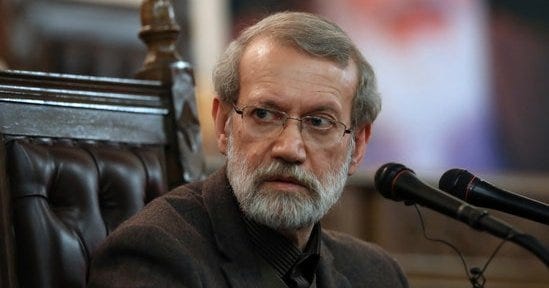
"Ali Larijani was killed in his daughter’s home on a Tuesday morning. His son alongside him. A residential area in the outskirts of eastern Tehran levelled in the strike. Iranian state TV confirmed it before sunrise. He was, by most accounts, the last senior Iranian official who could pick up a phone to a European foreign minister and be taken seriously. Parliament Speaker for twelve years. Chief nuclear negotiator. PhD in Western philosophy. Wrote books on Kant. No one's left anymore to negotiate…
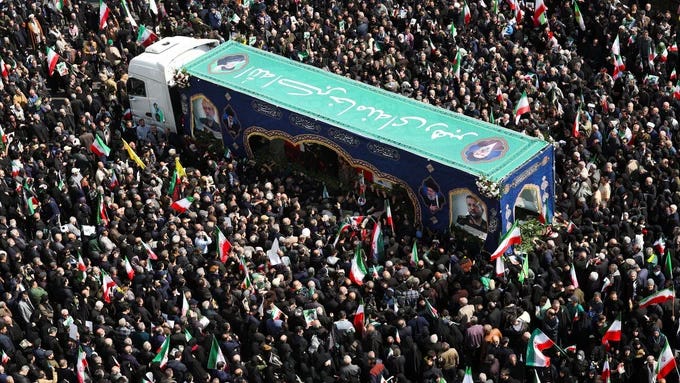
Thousands filled Revolution Square for Larijani’s funeral the same night.
This war was completely preventable on several occasions. But Israel, in its infinite wisdom, chose otherwise:
July 31, 2024. Hamas’s chief ceasefire negotiator Ismail Haniyeh was killed in an IRGC guesthouse in Tehran. He was there attending a presidential inauguration. Tracked on Iranian sovereign soil, during a diplomatic event, and killed. Ceasefire talks collapsed immediately.
June 13, 2025. Israel launched what became known as the Twelve-Day War while the sixth round of US-Iran nuclear talks was scheduled for that Sunday in Oman. Ali Shamkhani, the official running those talks, was among the targets. He’d told NBC the month before: “If the Americans act as they say, for sure we can have better relations”. The talks didn’t happen on Sunday. They didn’t happen at all.
September 9, 2025. The Hamas negotiating team was mid-meeting in Doha, discussing Trump’s own ceasefire proposal, when Israeli jets struck the office of their lead negotiator Khalil al-Hayya. Six killed, including al-Hayya’s son. Qatar – a US ally, host of the largest American air base in the region – called it “state terrorism”. Hamas called it “the assassination of the entire negotiation process”. Trump said he was “not thrilled”. The Times of Israel reported he’d given the green light in advance.
February 27, 2026. Oman’s Foreign Minister stood up and announced Iran had agreed to full IAEA verification. Agreed to never stockpile enriched uranium. Agreed to downgrade its current stockpiles to the lowest possible level. “Peace is within reach”, he said. Talks scheduled to resume March 2. The bombs fell February 28. And then Larijani, a few days ago, in his daughter’s home.
The Oman FM published an op-ed this week. He said that the United States has “lost control of its foreign policy” to Israel. He was in the room for the February breakthrough. He confirmed the deal was real. Britain’s national security adviser Jonathan Powell confirmed the Geneva sessions were producing genuine progress. “We regarded Witkoff and Kushner as Israeli assets that dragged a president into a war he wants to get out of”, a UK diplomat told the Guardian.
The people who could have stopped this have all been eliminated, one by one, on a nine-month schedule. Haniyeh. Shamkhani. The Doha negotiation team. The Oman breakthrough. Larijani now. What you’re watching is not a war that diplomacy failed to prevent. It is a war that was repeatedly kept alive by killing the diplomats.
There’s no one left. The IRGC commanders who fill the vacuum don’t take calls from Geneva. They have standing orders and they follow them. Araghchi said it as plainly as it can be said: “The presence or absence of one person doesn’t affect this structure”. He’s right. And that’s the problem. The structure continues. On autopilot. Without moderates. Without off-ramps.
Things Go Haywire as Israeli Escalation Throws Iran Conflict into Dangerous New Phase: Things really hit the fan earlier today after Iran’s largest natural gas field, the South Pars, was struck by Israel. This field reportedly accounts for 75% of Iran’s natural gas production and 80-85% of its electric grid… Simplicius put it concisely enough that I’ll just quote the frame: Israel’s strategy is running on two tracks simultaneously. Kill the moderates to guarantee that only hardliners remain. Strike Iran’s most sensitive sites to guarantee that Iran retaliates against Gulf infrastructure, dragging the whole region into a fire large enough to force the world to “finish Iran off”. The South Pars strike this week – on the facility that powers 75-80% of Iran’s electricity grid – and the immediate Iranian retaliation against Qatar’s Ras Laffan LNG hub, were not accidents. They were that strategy, executing.
South Pars. Ras Laffan. These names occupy the headlines, but what do they actually mean? And what’s at stake here?
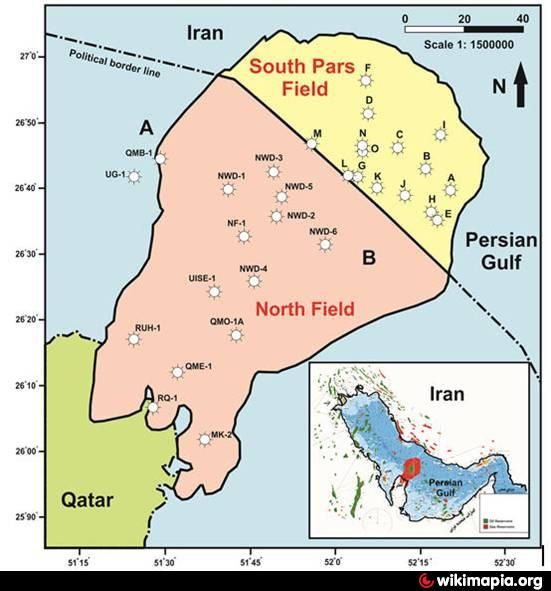
South Pars and Qatar’s North Field are essentially the same geological reservoir. One reservoir, with a border running right through the middle. Iran calls its half South Pars. Qatar its North Field. They share the same rock. The same methane. When Israel struck South Pars phases, it struck the geological twin of the installation that supplies 20% of global LNG exports and keeps European households from freezing. Qatar called it “dangerous and irresponsible”. Qatar – which, according to Reuters, has privately been pressing Washington to “finish the job” on Iran – is now watching its own gas facility burn as a direct consequence of the escalation it was encouraging.
Simplicius’s description of Ras Laffan: “Worlds most sophisticated gas processing plant, took 14 years to build.” Some engineers are saying the damage may be irreparable. I don’t know if that’s true yet. But even partial damage to Ras Laffan on top of the production suspension since March 2 is not a problem you fix with a maintenance crew and three weeks. You fix it – if you even can – in years…
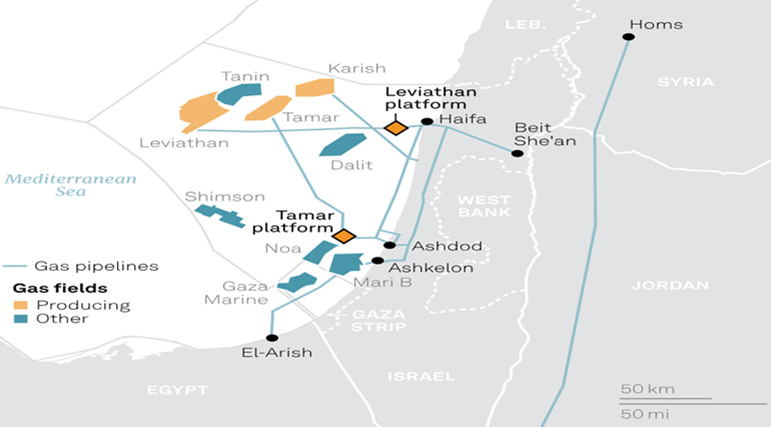
Iran published its retaliation list: Leviathan, Tamar, Karish, Tanin, Dalit, Heletz, Haifa port. Those are Israel’s gas fields and its main industrial port. They haven’t been struck yet, though by the time you’re reading this, that may have changed.
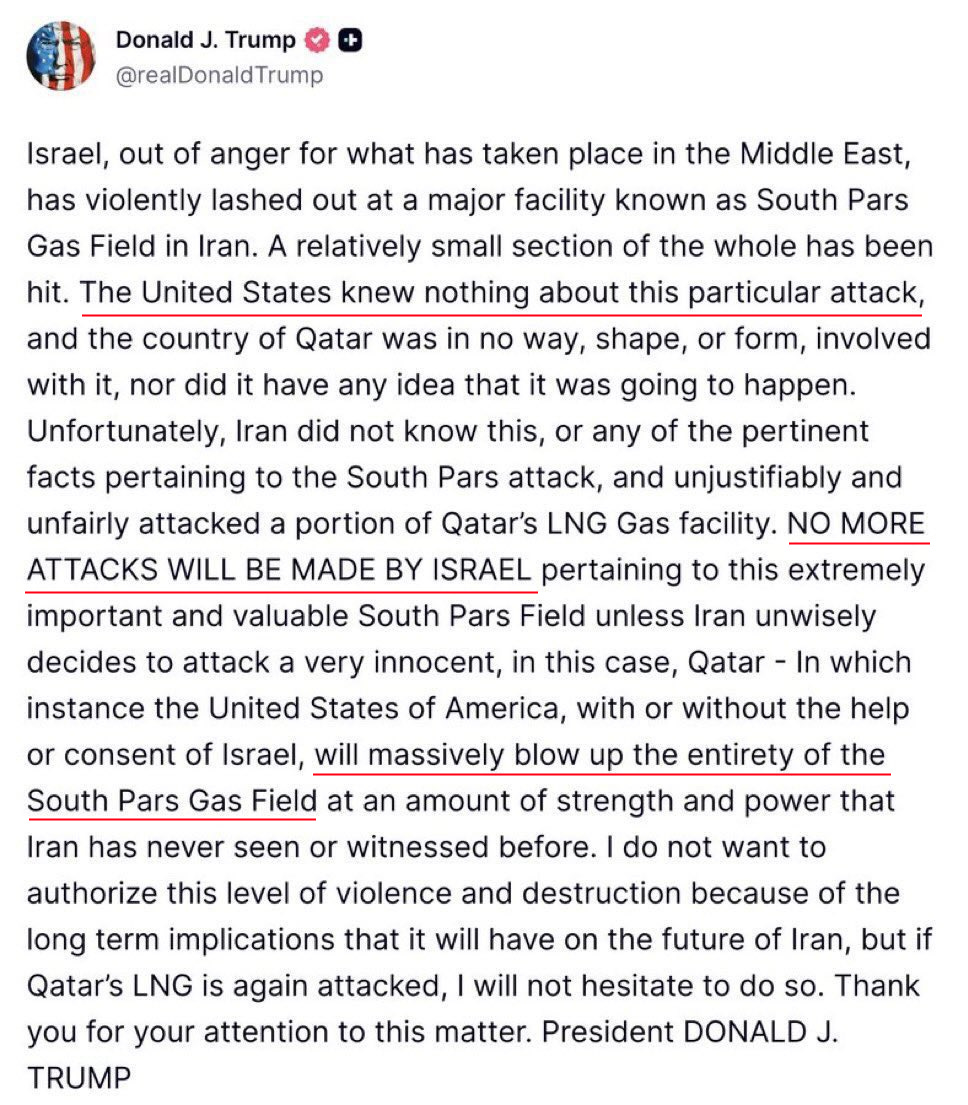
Trump’s response on Truth Social was to simultaneously claim the US knew nothing about the South Pars strike, blame Israel for striking it, and then threaten to “blow up the entire South Pars” if Iran retaliates against Qatar again.
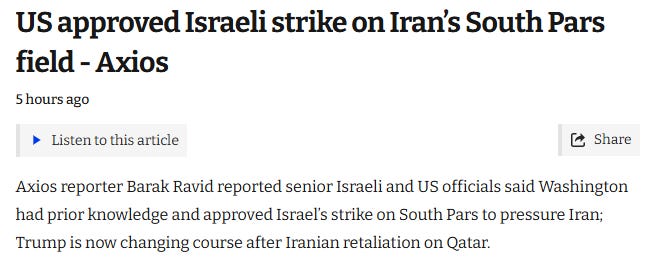
Axios’s Barak Ravid reported within hours that the US had given Israel the green light. Both things can’t be true, and neither is reassuring. Either the US has zero control over its ally, or it’s lying about having zero control. The distinction doesn’t help anyone.
The immediate structural damage is already historic. Oman crude hit $154 a barrel. Dubai crude $130. Brent $102. WTI $93. That $61 gap between Oman and US prices – 65% – is not a rounding error. It’s two oil markets. One for countries that can get physical delivery from the Gulf under Iranian transit permission. And another one for everyone else buying paper at discounted prices that don’t reflect physical scarcity. (silver enters the chat) The London Metal Exchange halted all contracts on March 16. First time ever. The insurance market for marine war risk has been functionally closed since the first week. That’s the short term. High but legible. A spike.
The medium term is where it gets structural. A third of global seaborne fertilizer trade transits the Strait of Hormuz. China halted NPK fertilizer exports and extended its phosphate suspension through August. India requested emergency urea from China – denied. The nitrogen and phosphate that was supposed to go into the soil across the northern hemisphere’s planting season is not going in. Not this spring. The biological window for spring application in most of Europe and North America runs through May. It’s March 19. The war has no end in sight.
Case in point: Sri Lanka… One season of synthetic fertilizer ban in 2021. Rice production dropped 40%. Prices surged. The government fell. That was one country, one policy decision, reversed within months. What’s happening now is that that same constraint is applied simultaneously to the global seaborne supply, with no reversal in sight, across the single most important planting window of the year.
Another underreported supply chain that is running off the same cliff is the pharmaceutical one. Paracetamol. Ibuprofen. Metformin – the world’s most prescribed diabetes drug. All are 80~100% petrochemical-derived. The naphtha feedstock that Asian pharmaceutical plants need is stuck behind the blockade. Nobody has a strategic reserve for pharmaceutical feedstocks. Nobody ever thought to build one.
The long term? Oh boy… People think 1970s… Let me tell you where this will break down in both directions. In October 1973, OPEC cut production and the world entered a period of stagflation that redefined the decade. It was devastating. But the crucial difference is that in 1973, you could turn the tap back on. The infrastructure existed. The question was just political will, not physical capability.
What’s happening now is completely different. No switch was flipped. The switch was bombed! The Shah gas field in the UAE – the world’s largest ultra-sour gas operation – is offline. South Pars phases are burning. Habshan and the Bab field in the UAE shut down. Kuwait is at half oil production. UAE at just over half. Saudi Aramco has suspended all 54 of its jackup drilling rigs. When the politics eventually resolve, you don’t flick that switch. You have to rebuild it. Counted in years.
Debt/GDP in the 1970s was at around 35%. We could absorb it. You could run deficits through the stagflation and come out the other side. But now? The US national debt crossed $39 trillion just a few days ago. Debt-to-GDP? North of 120%. And everything is going so smoothly that the Pentagon just has to ask Congress for a neat supplement of a mere $200 billion. The FPRI calculated that the first 4 days costed $10-16 billion in munitions alone… Yep. Everything’s fine. Repeat after me: everything’s fine. Exhale. Keep repeating it until you believe it.
The Federal Reserve held rates this week – second consecutive hold – and Powell described the energy shock as “generally transitory”. “Transitory”. I think I heard this somewhere before. Very reassuring. But you’ll forgive me if I don’t pull out the party balloons just yet. When Powell said “transitory” about the pandemic inflation in 2021, he was describing a demand shock in a system with intact supply chains. And we all know how that turned out. “Transitory.”
This oil and gas shock is a supply shock, in a system with physically destroyed infrastructure, financed by a country with trillions in debt that cannot even afford the rates required to fight inflation. Let alone a war. The Fed is trapped. Raise rates into a war-driven recession, or hold rates and watch inflation embed. There are no good options left.
As I already mentioned: in the first 96 hours of the war, the coalition expended 5,197 .. 8 .. 9 .. 5,200 .. munitions across ~35 types. Replacement bill: $10-16 billion. For just the first 4 days. We’re 3 weeks in now. And they’re asking for $200B. This is definitely going to end next week.
Warning times in Israel have collapsed from fifteen minutes on day one to three minutes now, with some strikes arriving with none. The interceptor inventory is effectively gone – I wrote about that over two weeks ago and it’s now confirmed not by my napkin but by the lived reality of cluster munitions landing at Savidor Central Station and private jets burning at Ben Gurion.
Iran deployed its Haj Qassem ballistic missile this week for the first time in this conflict. A missile specifically designed to defeat the defenses Israel no longer has. It wasn’t held back for weeks because Iran was saving its best. It was held back because you don’t use a key-defeating missile until the lock is broken. The lock has been bombed, hammered, irrevocably and completely crushed into dust. It IS broken. Iran’s launch rate hasn’t declined. It’s stable, and in the past week, increasing.
The coalition has lost 10% of its entire MQ-9 Reaper drone fleet. The US has zero combat vessels actively present in the Persian Gulf – the Littoral Combat Ships based in Bahrain, whose entire purpose is to engage IRGC speedboats and sweep mines, were spotted in Malaysia three days ago. I have been told the beaches are lovely this time of year.
Iran has thirty-plus speedboats patrolling the strait, boarding vessels, forcing unauthorised transits to turn back. “The Persian Gulf is now an Iranian lake”, as one analyst put it. That’s no exaggeration. It’s the geography, stupid.
Iran’s declared terms are: reparations, closure of all US bases in the GCC, guarantees against future aggression. The US’s declared goal is: regime change, denuclearisation, dismantlement of the “Iranian terror regime”. Neither side has moved an inch. The only people who might have found a middle lane are either dead or sidelined.
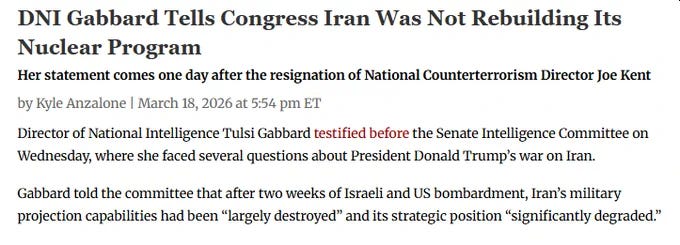
Tulsi Gabbard testified to Congress that the nuclear program “was obliterated and Iran was NOT rebuilding it”. No12 days. Internal cracks… Initial step building towards impeachment?
Joe Kent, who ran the National Counterterrorism Center until his resignation Monday, said there was no imminent threat and that Israel drove the decision. The casus belli is dissolving in public, on the record, while the war continues anyway.
The Gulf states who privately demanded escalation are now burning. Qatar expelled Iranian diplomats after Ras Laffan was struck. Qatar – which mediated between Iran and the West for years, which Iran supplied during the 2017 GCC isolation, which shares a gas field with Iran – is now in direct military confrontation with the country next door. The belt of states from Kuwait to Oman spent two weeks cheering the war on from behind their firewalls. Iran’s retaliation list was always going to include their infrastructure. They knew that. They did it anyway.
The Belgian Prime Minister – who runs the country hosting NATO headquarters – told the Financial Times this week that Europe must normalize relations with Russia. “In private”, he said, “European leaders agree with me. But nobody dares say it out loud”. The coalition that refused to send ships to Hormuz is now starting to say the quiet parts in public.
There’s only one scenario I see where this ends in weeks. A massive Iranian domestic collapse that produces a negotiated transition. Hasn’t happened. Doubtful it will now. Every other scenario involves months if not years.
The energy infrastructure damage is already partly irreversible. The fertilizer window is basically over. The yuan transit system is being institutionalized wave by wave, port call by port call. The petrodollar is fracturing in the way I described in my Bretton Whoops piece (link).
The US seems to be settling its trade deficit already in gold for three of the last four months. The Fed is trapped. And $200B in new debt will be added on top of the $39T current debt on top of a global energy shock. And the last moderate is dead in his daughter’s living room. God help us all.
No comments:
Post a Comment